Story Category: Legacy

A right royal entrance: The North Gate of the Royal Pavilion

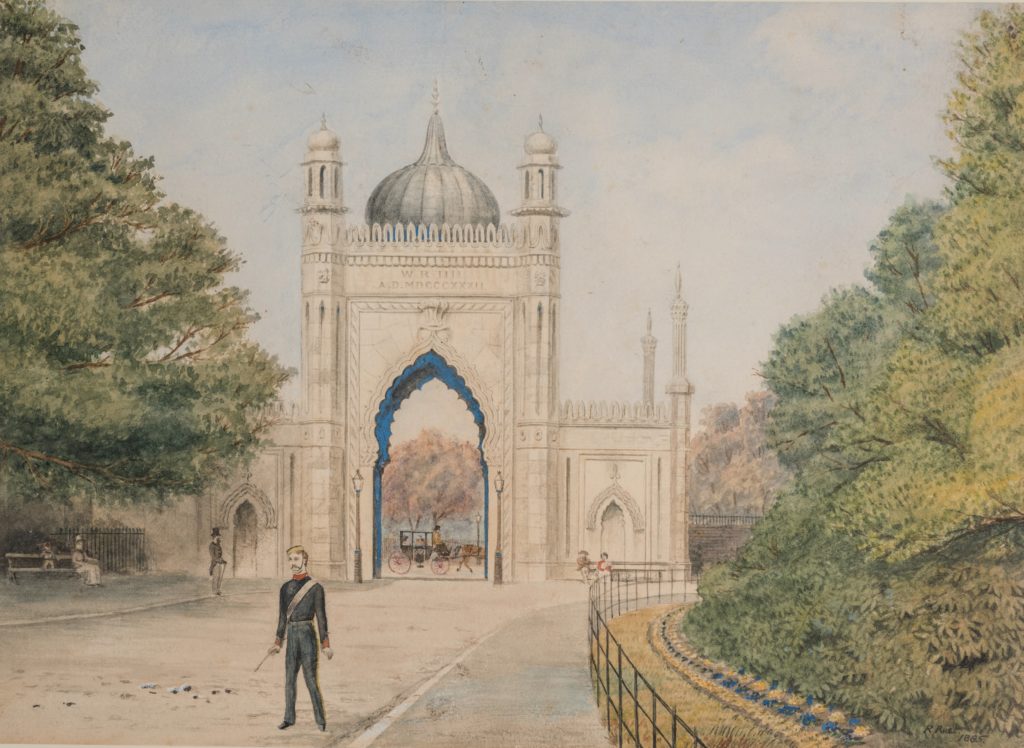
Colour drawing showing northern entrance to Royal Pavilion Estate

This is a legacy story from an earlier version of our website. It may contain some formatting issues and broken links.

The magnificent gateway at the northern entrance to the Royal Pavilion dates from 1832 and is an often overlooked and underappreciated Brighton building.

The North Gate in 2017

As with the south gate, we don’t know exactly how it looked in the late 18th and early 19th century, during the early years of the Royal Pavilion. In architect John Nash’s ground plan from 1826 both gates are called ‘lodges’ and are marked as small square brick structures, perhaps in the style of sentry boxes.

Nash ground plan, 1826, detail

As the North Gate is so much in keeping with the oriental style of the Royal Pavilion itself, you may think it is also by Nash and was commissioned by George IV, but the inscription tells a different story. This is the work of the architect and surveyor Joseph Henry Good, built in the early years of the short reign of George’s successor, his brother William IV. We have a fine portrait in oil by an unknown artist of Good (currently not on display), painted in c.1830, around the time he started working here.

Joseph Henry Good, English School, c1830

William IV had great plans for the Royal Pavilion and engaged Good to not only survey the entire estate but also add numerous buildings, including splendid gates at the north and south entrance.  It was reported that John Nash met with William IV on his first visit to Brighton as King in 1830, and was seen marking illustrations in the gravel with his stick, so he may have had some influence on the designs. Good’s South Gate, complete with servants’ rooms and link corridors to the main building and the servants’ dormitories, does not survive.

Good produced no fewer than 46 drawings and proposals for the North Gate alone, the earliest dated September 1830. His architectural plans survive and show how he played with a number of ideas, including cladding part of the gate in blue and white tiles (as seen in plan no. 82, although it is also possible that the blue and white colouring was used to indicate different types of stone), or perspective views with alternative inscriptions to the ones that were eventually included (for example no. 87, where the text reads ‘The Pavilion became a Royal Palace AD MDCCCXXX’). Here are just some examples of these plans, all dating from 1830 to 1832:

The version that was eventually built (as seen here in an 1885 watercolour by R Rust) is a well-proportioned, grand symmetrical gate with a central arch, minarets and a copper dome which has turned a shimmering green.

The North Gate of the Royal Pavilion, 1885, R Rust (fl 1885)

It is a proud building that for many Brighton visitors approaching the town from the north would have been one of the first glimpses of the Pavilion estate. On the occasion of Queen Victoria’s first visit to Brighton in October 1837, an amphitheatre with a triumphal arch was erected to the north of the North Gate, through which Victoria entered the estate, as illustrated in this print from the same year:

Amphitheatre and triumphal arch erected north of the North Gate on Queen Victoria’s first visit to Brighton as queen.

The gate is still the first structure you see when you come to Brighton by bus from the Lewes area or by car from the London Road, and looks attractive at any time of the day and year. Quite appropriately, the building now houses the offices of the estate’s Head Gardener and his numerous volunteers.

Alexandra Loske, Curator (Royal Pavilion Archives), with thanks to Jo Essex, researcher and volunteer at the Royal Pavilion.

Angel Delight – A Celestial Presence at Brighton Museum & Art Gallery

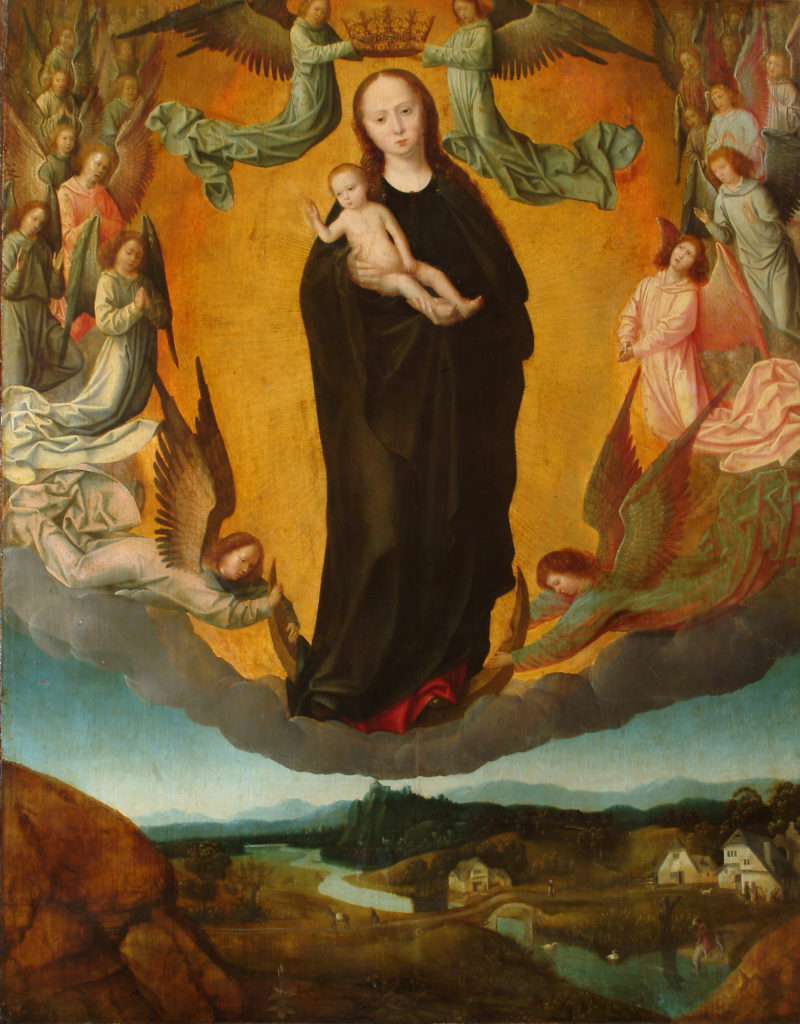
The Glorification of the Virgin, c1515, by Albert Cornelis. Royal Pavilion & Museums, Brighton & Hove

This is a legacy story from an earlier version of our website. It may contain some formatting issues and broken links.

Do you fancy an other-worldly experience? Join us for Angel Day on Saturday 10th February 2018 at Brighton Museum & Art Gallery.

There will be singing workshops, the Interfaith Choir, live music, poetry, angel-related objects from the collection, art and craft activities, talks and storytelling. Drop-in for free.                  

The Glorification of the Virgin, c1515, by Albert Cornelis

The Glorification of the Virgin, c1515, by Albert Cornelis. Royal Pavilion & Museums, Brighton & Hove

But why angels?

It was the idea of the Interfaith Contact Group of Brighton & Hove (IFCG) who work to bring people of faith and non-faith together in harmony. The group are planning events throughout 2018 to emphasise similarities between faiths by using the common link of angels. There is a long history of angelic messengers or saviours appearing in different mythologies and cultures, such as ancient Egyptian, Greek and Roman, or in faiths such as Christianity, Baha’i, Islam and Judaism.

Angels are even name-checked in the natural world. My Natural Science colleague, Grace, introduced me to the adorable angel sea-slug.

angel sea-slugs

To misquote Robbie Williams, I’m loving angel sea-slugs instead


The IFCG will be launching their Angels in Our City competition and an Angel Trail at the museum on February 10th.

Early 20th century postcard that belonged

Early 20th century postcard that belonged
to the Stanford family of Preston Manor, Brighton. Royal Pavilion & Museums, Brighton & Hove

The trail will offer sightings of the celestial beings in Brighton and Hove in the form of stained-glass windows in churches, such as St Michael & All Angels, murals, statues and art works. But can any be found in Brighton Museum & Art Gallery?

The Guardian Angel, print, c1805, by James Gillray

The Guardian Angel, print, c1805, by James Gillray. Royal Pavilion & Museums, Brighton & Hove

There must be an angel…
As a Collection Assistant I often source objects from our collections for events and talks but I doubted that there would be many suitable examples for Angel Day. Paintings and prints were the most obvious areas but surprisingly I found over 100 references to the winged-ones in our collections – and it was a very mixed assortment indeed!

  • Commemorative ceramics, figurines, medallions and a Sylvia Pankhurst tea set, with an angel emblem, in Decorative Art
  • Angel wings and vest in Costume
  • Religious paintings and icons, caricatures, prints by Albrecht Durer, an oil by Glyn Philpot and a self-portrait by Alison Lapper in Fine Art
  • Military badges and medals, postcards and Victorian mourning cards in Local History & Archaeology
  • Angel-wing shells, an angel shark and a sun angel-bird in Natural Science
  • Christmas decorations, children’s books, Victorian Christmas cards and even a Heartstring-Angel Barbie in Toys, Media and Film
  • A silk cloth with religious scenes from China and a Lithograph Print from Arctic Canada in World Art.

Some of these objects will be putting in a celestial appearance on Angel Day, upstairs in Museum Lab.                                              

An angel watches over Queen Victoria’s royal children while they sleep. Earthenware figure group from the Willett collection, 1845

An angel watches over Queen Victoria’s royal children while they sleep. Earthenware figure group from the Willett collection, 1845.Royal Pavilion & Museums, Brighton & Hove

I also discovered that we have seven angel-themed objects on long-term display in Brighton Museum. These will be highlighted for a children’s trail on the day. There are three 19th century Staffordshire figurines in the Willett Gallery, a Minton flask, 1876, in the 20th Century gallery (well, it is decorated with Cupid, who almost counts as an angel) the Arctic print in the World Art gallery, Angel in Town, 2008, by Suvinai Ashoona, and two paintings, The Glorification of the Virgin, c1515, Albert Cornelis, on the staircase; and Angel of the Annunciation, 1925, in the Glyn Philpot display in the Fine Art gallery. Jenny Lund, Curator of Fine Art, will be giving a bite-size talk about this work on the day, between 12.30 and 1pm.

Angel of the Annunciation,1925, by Glyn Philpot

Angel of the Annunciation,1925, by Glyn Philpot. Royal Pavilion & Museums, Brighton & Hove

See if you can find any more angels at Brighton Museum and beyond!

Lucy Faithful, Collection Assistant. With thanks to Rev Anthea Ballam, Interfaith Minister, for information.

Celebrating 100 years since the Representation of the People Act, 1918-2018

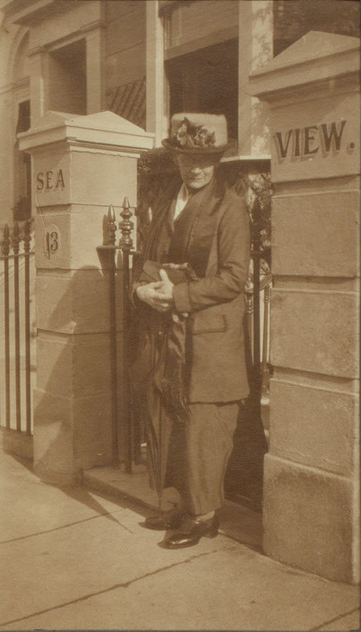
Minnie Turner outside Sea View boarding house

This is a legacy story from an earlier version of our website. It may contain some formatting issues and broken links.

(c) Alex Lake www.twoshortdays.com

Do You Vote? Their Fight Our Future

On the 6 February 1918, eight million women, out of an electorate of twenty one, were given the opportunity to vote. Only women over the age of 30 with educational & property qualifications were allowed to do so.

100 years later, on Tuesday 6 and Wednesday 7 2018, pop into Brighton Museum for Their Fight Our Future from 2pm to find out more about local Suffragette and Social Reformer, Minnie Turner, who was arrested three times for her suffrage activities!

Also explore how changing women’s fashions throughout the 20th Century reflected social change, from a bodice skirt and bloomers from the 1890s to a Mary Quant mini-skirt. Even try on a replica corset! Share your views about voting today with our Learning Assistant, Karen Antoni, in character as Minnie Turner or through our secret ballot box…

Minnie Turner 1867-1948

In the early years of the last century number 13 & 14 Victoria Road, Brighton, known as “Sea View” were first leased and then purchased by Minnie Sara Turner, a local resident well known for her involvement in the Women’s Suffrage movement. She ran her home as a guest house which attracted mainly professional women visitors. For twelve years she was the honourable secretary of the Hove ward of the Brighton & Hove Women’s Liberal association, but left the Liberal Party because of its lack of support for women’s suffrage. In 1908 she joined The Women’s Social & Political Union (W.S.P.U) and turned to militarism.

By 1913, 13 Victoria Road had quite a reputation locally as a militant suffragette boarding house. Her guests included, Mrs Pankhurst and several of her family, Lady Constance Lytton, Lady Emmeline Pethick-Lawrence , Emily Wilding Davison, Annie Kenney, Mrs Drummond and many others. The guest house was often full, and extra accommodation was arranged in the form of a wooden hut in the garden of No 13 and even a potting shed-type annexe to the back of No 12, next door. Minnie kept a small library of books on the social position of women for her guests to enjoy.

Minnie believed passionately in suffrage and social justice. She was hard working and had a strong sense of responsibility to the community.

Minnie Turner outside Sea View boarding house

Minnie Turner outside Sea View boarding house

She was a member of the Clifton Road Congregational Church and was elected to the Brighton Board of Guardians soon after the First World War. For seven years she committed to improving the conditions in the Brighton workhouse on Elm Grove. She valued education, peace and fellowship. When she died in 1948 many of the organisations sent representatives to her funeral at the Downs Crematorium. There were representatives from the Suffragette Fellowship, the Women’s Freedom League, and the Women’s International League. Many of her possessions are in the Museum of London.

On the centenary of the Representation of the People Act, 1918 we will be displaying The Holloway Brooch worn with the sash awarded to Minnie and other ex-prisoners to honour their sacrifice. In 2015 a relative of Minnie Turner donated them to the Royal Pavilion and Museums.

The Suffrage Movement and the First World War

Some historians say that the highly skilled and dangerous work done by women during the war is why they were awarded the vote, as a token of gratitude for their war work. Others have argued that the emphasis placed on women’s economic contribution to the war does not take into account the groundwork done by the pre-war suffrage campaign. Some have even said that the war actually postponed the vote for women. It has been suggested that the vote was about to be granted just before the war broke out. The hard work of both the Suffragists & Suffragettes during the war ended the militant methods that had been used. It conferred respectability on the suffrage cause. It was thought that the women involved in the suffrage movement had shown themselves to be responsible and mature beings who were more than capable of taking part in a democracy which they defended.

WSPU (Women Social & Political Union) Suffragettes

The WSPU lead the way in patriotism. When war was declared in 1914 the WSPU suspended suffrage activities. Both Mrs E Pankhurst and her daughter Christabel Pankhurst adopted an extremely nationalistic position. The outbreak of the war enabled the WSPU and its members to abandon their violent methods, and demonstrate their patriotic loyalty and ultimately their deservedness of the vote. Within a few days of the war being declared, the party threw itself into a vigorous campaign, in which the defeat of Germany took priority over women’s suffrage. The WSPU placed its organisation and its funds at the disposal of the Government, who by 1915 needed labour.

2 million men had joined the armed forces at a time of increased demand for munition production. To encourage women to join the workforce, Lloyd George, now Minister of Munitions liaised with the WSPU. The Suffragettes’ renamed their paper, “Britannia” to express their commitment to the British Empire, and in 1917 the name of the WSPU was changed to the Women’s Party. Emmaline & Christabel Pankhurst were great assets in promoting the war effort world-wide. They launched a campaign to urge Russian women to encourage their men to keep fighting. They toured America & Canada to speak to women about war service. At home they called for military conscription for men, industrial conscription for women, and the abolition of Trade Unions. Any young man in civilian clothes, who was unfortunate to encounter Mrs Pankhurst and her supporters would have been handed a white feather as a symbol of cowardice. The WSPU demanded that conscientious objectors, alongside those of the enemy race living in Britain, to be interned. Not all members agreed with Emmaline Pankhurst and her use of the party’s funds to promote the war effort.

The National Union of Women’s Suffrage Societies (NUWWSS) Suffragists

The NUWSS were bitterly divided over the war. Some members wholly supported the war effort; there were some who were ambivalent and still others who were unwilling to support it at all. Millicent Fawcett was against the white feathers! She had signed an appeal for peace at the beginning of the war, she changed her mind a few days later and said “women your country needs you”. She believed war was the gravest crisis facing Britain, for if Germany won, it would destroy the democratic institution of Parliament. Whatever their attitude was towards the war, almost all suffragists were active in wartime relief work. They established a registry of voluntary workers who would in turn find the unemployed work. Lots of industries such as dressmaking, which employed lots of women, collapsed as richer women cut back on luxury goods. In response to high female unemployment, members of the NUWSS set to work organising the unemployed and soon became the main focus of relief work. Workrooms opened where garments were made for war relief dining rooms, for pregnant and nursing mothers as well as establishing women’s patrol to “protect the honour of young girls” and guard against prostitution. One of the most important things that the NUWSS did was to set up and finance Scottish Women’s Hospital Units. These units employed all-female teams of doctors, nurses and ambulance drivers to work on the front lines of the war in some of the worst fighting zones.

Unlike the WSPU the NUWSS remained committed to Women’s Suffrage and left its organisational structure in place, enabling it to recommence suffrage activities when the time was right.

Karen Antoni, Learning Assistant

‘Behind the Scenes’, MuseumLab, 2-5pm, Tuesday 6 and Wednesday 7 February 2018.

Part of our 1918-2018: 100 years Remembrance Season


Preparing for nuclear war at Preston Manor

This is a legacy story from an earlier version of our website. It may contain some formatting issues and broken links.

Paula Wrightson’s latest blog post on the surprising history of Preston Manor looks at its role during the Cold War. How would this elegant Edwardian house have been used in the event of a nuclear attack?

Brighton in 1966 was a town ready to embrace the new youthful age of the Swinging Sixties. Memories of the Second World War, now 20 years past, might remain vivid in the heads of the older population who had lived through the conflict but for those born post-war, the first generation ‘Baby Boomers,’ war was ancient history. However, at Preston Manor the spectre of nuclear war loomed vivid.

Brighton postcard, mid-1960s

In the mid-1960s peace was on most people’s minds and with near full employment in Britain, especially for the young, residents of sunny Brighton had much cause for optimism. The seaside town retained all the pleasures of a traditional bucket-and-spade seaside holiday resort and yet exciting new cultural directions were being taken. The first Brighton Festival was held in 1967 launching an event now famed as one of Europe’s leading arts festivals. Half a century on it is easy to picture the optimism of the age. Harder maybe to feel the concerns, thankfully unrealised, that nuclear war or similar catastrophe might strike at any minute.

On 25 July 1966 Miss Margery Roberts, Preston Manor’s Honorary Curator, received a letter from Mr. James B. Adnams, the County Borough of Brighton’s Civil Defence Officer.

Based at the Civil Defence Headquarters in Edward Street Mr Adnams informs Miss Roberts of the suitability of basement rooms at Preston Manor for becoming a Sector Post of Brighton’s Civil Defence Control Organisation. A week prior to writing he’d made a visit to the house and approved the location for his needs.

‘I anticipate that access would only be needed some 8 to 10 times per year for a very limited number of people’ he writes ‘we should, of course, confirm to any of your security requirements.’

25 July 1966 letter from Mr. James B. Adnams

The tone of the surviving letters between three correspondents (Mr Adnams; W. O. Dodd, Town Clerk & Clerk of the Peace; and Miss Margery Roberts) is both sombre and brisk – the language not dissimilar to that used by Margery’s late father, Mr Henry Roberts, during the Second World War when Preston Manor was closed as a museum and used for civil defence purposes. Reading the 1966 letters, war seems to draw close again.

Why civil defence?

In Britain the Civil Defence Corps was established in 1948, three years after the end of the Second World War, and administered by local councils under the authority of the Home Office. The County Borough of Brighton (now Brighton & Hove City Council) had a Civil Defence Division staffed by officers under Mr Adnams. There is no Council department of this name today. The purpose of Civil Defence in peacetime was to be prepared for war – and during the height of the Cold War this meant nuclear attack. No adult in 1966 would forget the Cuban Missile Crisis of four years previous, when the United States and the Soviet Union came close to launching nuclear missile strikes.

A letter dated 7 September 1966 from Mr Dodd, the Town Clerk, to Mr Councillor P. E. W Best, Chairman of the Preston Manor Sub-Committee gives us more detail on how the house was to be used in anticipation of crisis.

‘Mr Adnams, the Civil Defence Officer, has been in touch with Miss Roberts about then possibility of using a very small area in the basement of the Manor, some 200 sq.ft., for a Sector Post as part of the civil defence control organisation in the town…Civil Defence would install at their expense an independent telephone and provide some simple furniture..’

Given the potentail devastation of a nucler war, one wonders quite how effective these basic facilities might be.

Prepared for the worst

Every county in the UK was a Corps Authority within which subdivisions or sections existed to oversee a wide range of actions in the event of hostile attack: the Headquarters Section, Warden Section, Rescue Section and Ambulance & First Aid Section and Welfare Section. The Welfare Section was responsible for the welfare of people made homeless including evacuation of the town’s population, provision of new accommodation for displaced persons, food, clothing, sanitation and medical care. When one considers the attack was presumed to be nuclear, and Brighton was a heavily populated area, the scale of the task would be huge.

During a parliamentary debate regarding staff levels at Bevendean Hospital on 22 April 1966 the Minister for Health, Mr Kenneth Robinson, quoted the population of Brighton and surrounding district as 290,000 with hospital bed provision for 1,600.

The Ambulance & First Aid Section of the Corps Authority were detailed to take injured persons to emergency field hospitals or Forward Medical Aid Units (FMAU) since hospitals would be swamped. The total number arriving at hospitals in a single civil defence area was estimated in 1959 as between 7,000 and 14,000.

To ensure efficiency, large-scale nuclear attack exercise scenarios were carried out in major cities in the UK in the 1950s and 1960s with hundreds of volunteers acting as casualties. Striking names for these manoeuvres included ‘Exercise Bull-Ring’ (1956), ‘Exercise Battledore’ (1959) and, chillingly, ‘Exercise Gory’ (1960) which attracted 700 cadets on bicycles attending an FMAU to assist the medics.

Underground bunkers

In a letter to the Town Clerk dated 6 September 1966 and headed ‘Plan 6’, Mr Adnams makes clear his preference for Preston Manor as a suitable Sector Post (along with Moulescoomb Place, then housing Brighton Corporation’s Parks and Recreation Department and now part of the University of Brighton).

‘Preston Manor fulfils all the requirements most adequately as it was used for the County Borough Control during the war.’

Steps to cellars used for civil defence on the Second World War

Indeed, remnants of the former civil defence control room can be seen in one of the cellars. The space was reinforced with iron girders to withstand bomb damage and air vents added. Fascinatingly a piece of graffiti drawn in chalk can be seen on one of the upright girders. The drawing, of no known date, shows an image popular in the 1940s and known as ‘Chad’ or ‘Mr Chad’ or ‘Kilroy was here’. The exact origins of Chad are unknown but he is associated with American servicemen, or GIs.  The character is a bald-headed man with a prominent nose peeping over a wall. He would often appear with the slogan ‘Wot, no bananas’ or similar grumbles associated with wartime shortages. In the British army Chad went by the name Private Snoops.

Wartime graffiti in Preston Manor cellar (unknown date)

There are three large cellars at Preston Manor: one for coal, and two storage cellars for provisions such as wine. They would have made excellent bomb shelters in the Second World War. Thankfully they were never tested as nuclear bunkers

Preston Manor under attack

A heavy bomb raid on 9 March 1941 narrowly missed Preston Manor. Resident curator, Henry Roberts described the night in a letter dated 18 April 1941:

‘The blast came down the chimney, set the soot on fire, and threw it all over the floor. The noise was appalling, the lights went out…we had nearly fifty windows broken, some of the sashes were blown out, but no damage was done to the contents of the house, although the roofs and some walls suffered.’

In her 1998 memoir, A Time Remembered, Henry’s daughter Margery writes of the night:

‘The entrance hall of the Manor was turned into a Casualty Clearing Station… I can still see Dr John Thwaites who had bravely been helping in the rescue work, coming through the hall doorway carrying in his arms the dead body of the five-year old son of the Preston butcher.’

This image, clear in her head nearly 60 years later, explains Margery’s keenness to assist Brighton’s Civil Defence Division in 1966.

Damage to Preston Road viaduct, 1943

In his July letter Mr Adnams writes:

‘Dear Miss Roberts, I am very grateful for all the time and trouble you took when I called at Preston Manor last week. I only wish that everyone was as co-operative as yourself.’

Locating the Sector Post at Preston Manor

The room deemed suitable by Mr Adnams is unknown today so we must look for clues in his letters to Miss Roberts. The room is described as in the basement: ‘the one with the logs in would appear the most suitable’.

In the 1960s open fires were still in use in Preston Manor, although not in the part of the house open as a museum. The West Wing housed Margery’s apartment on the second floor and the custodian’s family rooms in the basement. There was also a staff room used by the museum warders and the night watchmen. All these quarters relied on open fires for heating. Coal and logs were delivered to Preston Manor. We know the coal was emptied into the coal cellar via a coalhole, the metal cover of which can still be seen today. But where were the logs stored?

Until the 1980s, none of the basement rooms were open to the public. The restored Victorian servants’ quarters so popular with visitors today were boarded up and used as storerooms. A plan of the house drawn up in 1959 shows the present day Victorian kitchen and the Servants’ Hall both marked as stores. At that time the toilets put in during the wartime were still in use: the two cubicle ladies’ toilet. taking up half of the Servants’ Hall, and the one gents’ in the lobby outside the present day Butler’s Pantry, which was also listed as a store in 1959. The present day Boot Hall is shown as a coke store (coke is a solid fuel made from coal and similar in appearance). In the 1950s and 1960s coke was used to fire hot-water and other domestic boilers and, indeed, there is a nearby boiler room shown on the 1959 house plan.

1943 fuel licence for three tons of coke

Huge quantities of solid fuel were required to keep Preston Manor warm. A Licence to Acquire Fuel permit for the summer months of 1943 shows that three tons of coke alone was delivered by Rickett Smith & Co. of 30 Ship Street, Brighton. It is extraordinary to think that in the cellars beneath this precious historic house many tons of highly combustible fuel was stored, but this was usual practice in all houses before gas fired central heating.

Most basement rooms could be the 1966 log store in question. However, logs being heavy, they were likely not carried far into the house. A possible location therefore would be the Victorian kitchen as it lies just off the tradesman’s entrance, the door of which is underneath the main house steps. I am discounting the many west wing basement rooms as a site for the Sector Post as these were the custodian’s living quarters.

To support the hypothesis that the chosen room was the present Victorian kitchen, Mr Adnams states his department will ‘arrange partitioning so that you still had access to the other parts of the basement’, which indicates that the room in question was on a thoroughfare, and not tucked away.

Aftermath

I have found no evidence that the Sector Post was created at Preston Manor. Indeed the Civil Defence Corps was disbanded in Britain in 1968. Huge numbers of Civil Defence volunteers were stood down. In 1964 they had numbered 122,000 in the Civil Defence Corps and 14,000 in the Auxiliary Fire Service.

From 1968 the British government focused on the creation of public information films, pamphlets and pre-scripted radio broadcasts that would be made public should Britain suffer nuclear attack. The now infamous ‘Protect and Survive’ pamphlet was produced in the mid-1970s but came to prominence in 1980 when it was released due to public interest. Government advice in the event of nuclear attack was to stay at home in a specially prepared room stocked with enough food and water for 14 days. Families were told not to re-locate as only their local home town authority would help them. The optimism of this statement suggests the personnel of Civil Defence sector posts, such as that planned for Preston Manor, would step in and provide rapid assistance and restoration of civic order. Criticism of the ‘Protect and Survive’ advice came from the Campaign for Nuclear Disarmament (CND) who took issue with the suggestion that nuclear war could be survived, thereby advancing nuclear armament.

Do you want to know more?

Items relating to Civil Defence in Brighton in the 1950s and 1960s can be accessed at The Keep, Falmer. Now classified as open documents these once-restricted papers include 15 volumes dated 1961-1966 of The Buckler, the journal of the Brighton Civil Defence Division, a 1954 Welfare Section basic training manual and a set of correspondence from September 1966 to August 1967 concerning the appointment of various emergency officers, reports on civil defence exercises and staff redundancy on the cessation of funding for Civil Defence.

This last set of documents appears to answer the question of whether or not the Sector Post was installed at Preston Manor. Until the autumn of 1966 plans were agreed and in place, the proposal having gone through various municipal channels.

In a letter dated 14 September 1966, Town Clerk Mr. Dodd informs Civil Defence Officer, Mr. Adnams, that Mr. Councillor Best, Chairman of the Preston Manor Sub-Committee ’has agreed to your proposal to use the small area in the basement for the ‘provision of Sector Posts.’

All appears set for use of the basement room – and money no object, as Mr. Adnams confidently informs Margery Roberts in his July 1966 letter:

‘We would like to install at our expense an independent telephone…if necessary we would pay a suitable rent.’

Indeed, on 17 October 1966 the Borough Valuer suggested a rent of ‘£10.0.0 per annum inclusive of rates and water rates.’

October 1966 letter from the Borough Valuer and Estates Manager

This is the last letter on file at Preston Manor regarding Civil Defence plans. 1967 was drawing near and it appears from records held at The Keep that funding for civil defence in Brighton was ended sometime during the Summer of Love.

I don’t know what happened to Mr James B. Adnams, Civil Defence Officer for the County Borough of Brighton. With the cessation of funding and staff redundancy I hope he found alternative employment suited to his expertise.

Paula Wrightson, Venue Officer, Preston Manor


Textiles in Exile: Textiles made in refugee camps on the Thailand/Myanmar border

Crocheted torch-cover/carrier made of pre-dyed wool-synthetic mix yarn. Made in Camp 5, Mae Hong Son Province, Thailand and collected by Sandra Dudley in 1997. [Museum number: WA508116]

This is a legacy story from an earlier version of our website. It may contain some formatting issues and broken links.

The World Art collection at Brighton Museum & Art Gallery includes a small group of textiles made by women living in refugee camps near the Thailand/Myanmar border, in the Mae Hong Son area.

Most of these women identified with the Karenni ethnic identity, having been displaced by conflict from Karenni (Kayah) State in Myanmar. The textiles were collected in 1997 by a British anthropologist, Sandra Dudley. Tragically, no-one could have imagined then that, two decades later, 99,946 individuals (as at December 2017, figure published by The Border Consortium) would still be living in these camps, unable to return to Myanmar but prevented from integrating into Thai society.

Karenni-style skirt-cloth made on a non-automated frame loom in a weaving centre in Camp 3, Mae Hong Son Province, Thailand and collected by Sandra Dudley in 1997. [Museum number: WA508065]

Karenni State (known by the Myanmar government as Kayah State) is the smallest state in Myanmar, a country in Southeast Asia which borders India to the west, China to the northeast and Thailand to the southeast. It is also one of the least developed states, with extremely limited infrastructure to meet the needs of its resident population, in terms of health, education and employment.

Since its independence from British rule in 1948, Myanmar has experienced near-constant political turbulence and conflict. Much of this has been fuelled by disagreements between political representatives of the majority ethnic group – Burmans – who have held long periods of influence, and the country’s many ethnic minorities. Many minorities are based in the border areas and consider themselves to have distinctive cultural traditions including language. While most Burmans are Buddhist, many of the ethnic minorities are Christian, having had contact with European missionaries. Many minorities believe that the Myanmar government is engaged in a long-term campaign to ‘Burmanize’ the country, and report widespread discrimination.

The Karenni – a term which covers a wide and shifting number of sub-groups – form part of the wider Karen ethno-linguistic family. This family is divided into three main Karen groups: Pwo, Sgaw and Karen. Karenni political interests have been served by the Karenni National Progressive Party which has been involved in long periods of conflict with the Myanmar government and its armed forces. From the late 1980s this conflict has been a ‘push’ factor, driving refugees across the border into refugee camps in Thailand. Thailand is not a party to the 1951 United Nations Convention Relating to the Status of Refugees nor its 1967 Protocol. As such asylum-seekers are considered illegal migrants and are not able to access government health care or education or to work legally within Thailand.

The camps are run by the Karenni community, with the support of international non-governmental organisations. There is some health and educational provision but it is limited. Camps are overcrowded and the Thai government restricts camp residents’ movement. With the installation of a nominally civilian Myanmar government in 2011 and the promise of reform has come a decrease in humanitarian aid and conditions in the camps are growing increasingly precarious.

Crocheted torch-cover/carrier made of pre-dyed wool-synthetic mix yarn. Made in Camp 5, Mae Hong Son Province, Thailand and collected by Sandra Dudley in 1997. [Museum number: WA508116]

The group of 25 textiles include skirt-cloths, tunics and bags. Most were handwoven, some on a backstrap loom (the collection includes an example of a back-strap loom, which uses a strip of rice sack for the back-strap in place of the usual strip of hide) and some on a non-automated frame loom. The textiles were collected in Karenni-majority camps but also reflect garments usually associated with other Karen groups including the Sgaw Karen and Paku Karen. In reflecting the development of new forms of material culture, the collection also includes a crocheted torch cover, a necessary piece of equipment for those living in camps without access to mains electricity.

Helen Mears, Keeper of World Art

Creating a Taxidermy Mount from a 40 Year Old Liquid Preserved Cheetah Skin

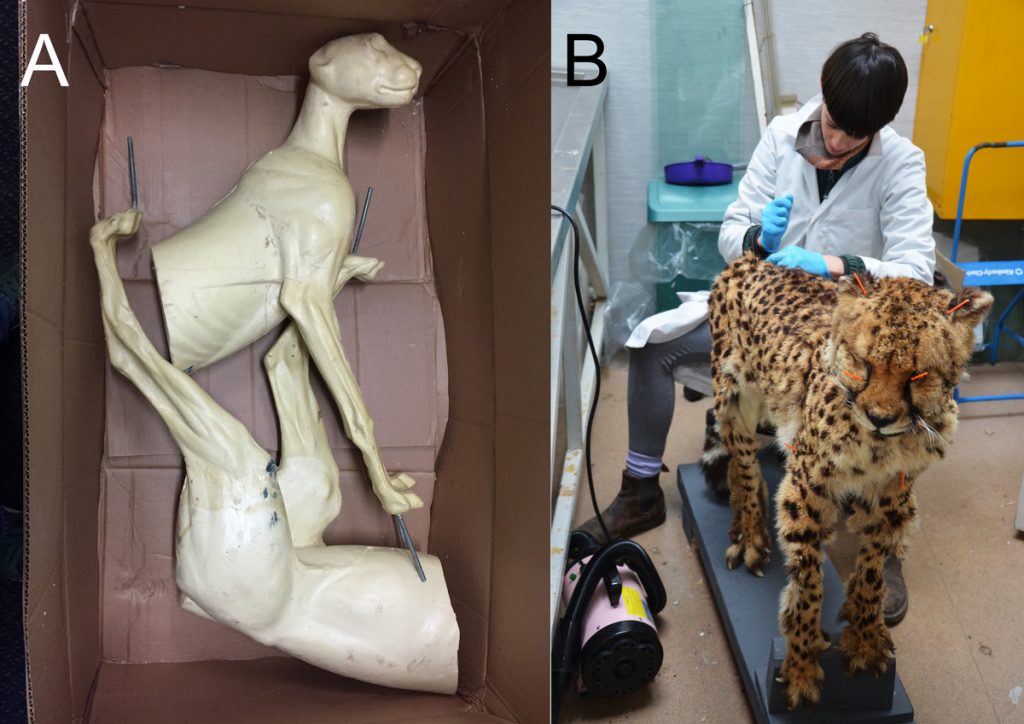
The preformed mannequin (A) and Jazmine working on the cheetah mount (B)

This is a legacy story from an earlier version of our website. It may contain some formatting issues and broken links.

Introduction.

The Royal Pavilion and Museums holds a diverse, designated collection of natural history specimens in a dedicated building – the Booth Museum. In the 1960s, a dedicated team, including a taxidermist, were based at the Booth. The museum acquired specimens from a range of sources, including from zoos, who donated rarer animals which had died under their care. these specimens were processed rapidly and entered the collections, usually as flat skins and osteology.

Barrels containing skins

The financial cuts of the 1980s began to see staffing levels fall, with the loss of admin staff and a curator. This reduced the capacity to work on taxidermy. To free up freezer space, large specimens were skinned, and the skins placed into barrels of liquid preservative. This was envisaged as a temporary measure which would enable them to be completed at a later date.

More recently, further cuts forced many museums to transfer their natural history collections to Brighton, as the Booth was one of the few regional museums with dedicated natural science curators. This again reduced the capacity to work on new specimens whilst staff cared for existing collections. The preserved skins were left until time or money could be found to process them.

STAGE 1: BIRTH OF AN IDEA

Image of the Big Draw life drawing event in partnership with the Drawing Circus © Brekespere 2015

In the autumn of 2015 the Booth Museum held a life drawing event with ‘The Drawing Circus’ as part of that year’s The Big Draw. This was aimed at diversifying the audience at the Booth, as well as host a drawing event for an adult audience. The event was a great success, and was recognised at the Big Draw awards, where it won first prize of £750 for Museums and Galleries. The money was awarded in the understanding it would go towards a future public event involving arts, craft and public engagement.

Additionally, the Booth was involved in the publicity for a Kate Mosse book, and at the launch event we reconnected with Jazmine Miles Long, a consultant to the author on taxidermy. Jazmine had originally volunteered at the Booth Museum and this reconnection lead to a number of collaborative events and workshops with her.

As the barrels had some specimens of considerable rarity, It was decided that the museum should move forward on a project with Jazmine to complete the skinning process and to create a mounted specimen for eventual display.

STAGE 2: SETTLING AND FUNDING THE PROJECT

The cheetah was chosen as the subject to focus on as it was felt it would be the most engaging to the public, and would support the work of other departments, such as the learning team.

The project would also have an element of community engagement, both in order to make the local audience feel more ownership for the specimen, as well as to generate income to fund the project.

Because of the age of the skin, the experimental nature, and the community engagement element of the project, it was also felt that this might be a suitable project to seek external funding for. Unfortunately, as the skin had spent so long in liquid preservative and the work was not guaranteed to be a success, the application was rejected as too much of a risk.

Thankfully, with the existing prize awarded from the Big Draw, along with projected sell-out income of £1250-1500 from a proposed ‘Late’ event to be held at the museum, we determined we could cover the cost. If successful, it would give the foundation for processing the other skins at a future date.

STAGE 3: BEGINNING THE PROCESS:

To begin this process, a survey of the skin was carried out. The cheetah was removed from the preservative and the fur, skin and features such as nose and claws were tested to see if they appeared firmly attached. As the skin appeared viable at this stage, the next step was to determine the chemical composition of the preservative. Studying a variety of publications on preserving specimens in liquid from the museum’s archives gave a variety of possible solutions, and these were presented to the now retired curator who had originally preserved the skins. He narrowed it down to a 40% Formalin solution.

Jazmine then garnered expert opinions on processing a large mammalian skin from a preservative. The advice received proved quite disheartening and suggested a very difficult if not impossible process. All consensus appeared to be that the skin would either shed its fur, be very faded in colour or be too stiff to work after removal from the preservative.

The preformed mannequin (A) and Jazmine working on the cheetah mount (B)

Undaunted by this information, Jazmine researched how to remove the formalin from the skin. No advice was found in the case of animal skins so she followed the procedure of removing formalin from human tissue. She proceeded to rinse the skin with water then soak it in 99% denatured alcohol. This was followed by multiple baths of water until the water was clean. After this, it was pared down in the same way a freshly prepared and pickled taxidermy skin would be. The skin was then washed with specialist detergent, and tanned. The skin came through the process successfully, though the fur was slightly coarser and duller than would be expected for a cheetah. This, however, may be due to the old age and illness of the cheetah in life rather than from the formalin solution.

Usually Jazmine would build the taxidermy form using the traditional bind-up method studying and copying the anatomy of the animal. However, in this case the body of the cheetah had been disposed of in the 1980s and measurements had not been recorded. Instead, a pre-formed body was purchased. This involved measuring the skin instead of the muscular anatomical structure of the animal and buying a pre made generic cheetah form that fits the skin. This is then carved to fit the skin. We also identified the cheetah’s skeleton in the collection, so glass eyes were purchased to fit using measurements from the skull.

STAGE 4: PUBLIC PARTICIPATION

A Late Stitch Up at the Booth Museum

One of our main aims was to make this project more of a community effort. We had previously held late events which had proved popular, and as we were keen for a more adult audience to attend, we thought this would be the most suitable event for promoting the project.

The main event – the cheetah taxidermy – would host 30 people at a time over 5 sessions throughout the evening, allowing all visitors to see the cheetah and hear about its creation, as well as get a chance to be involved. The idea was to allow those attending the event to put a few stitches into the mount in order for them to have hands on involvement in the production of the piece. All of those who attended the late would also have their names displayed alongside the finished piece to demonstrate it was only made possible by our visitors. However, this also relied on the gamble that not everyone would want to try stitching up the cheetah. Thankfully this was borne out with only a few people in each session opting to have a go, with most of the audience happy to ask questions and listen instead.

The main event was supported by smaller activities, including a series of small talks, a ‘Mr Booth puppet show’, mini writing workshops, and a magic lantern show of old glass plate slides. These were mostly delivered by staff or friends of the museum on a lieu time or voluntary basis. We also provided a bar (covered by a TEN notice) and behind the scenes tours at additional cost, in order to increase our income. In all, the evening proved to be a great success – All 150 tickets sold, mostly to non-members, bringing us close to the £1500 predicted income. Bar sales and tours also brought in a further income after all costs of almost £400. This income, along with the Big Draw money covered both Jazmine’s costs and the costs involved in putting on the late event.

Members of the public get a chance to sew up some of the cheetah mount during the museum late event © MilesLong 2017

FINAL STAGE: COMPLETION AND DISPLAY

Due to the nature of the event and the numbers involved, the cheetah only ended up having one leg stitched up, so Jazmine continued the creation of the mount in the weeks following the event. The skin was mounted and fitted to the form using hide glue and the seams were matched and sewn together. The face was sculpted with clay and the ears and feet were formed using two part epoxy resin. One problem was that the skin was more rigid than a fresh taxidermy skin would usually be, but with the use of pins it was held close to the form whilst it dried. Areas of the skin that were missing due to infection were patched using excess fur. Once the skin dried the nose, around the eyes and pads of the feet were built up using two part epoxy clay and then painted.

Following the completion of the mount, there are a few more aspects to complete prior to the specimen going on public display. The first part is to mount the cheetah onto a more attractive and relevant base. This base is perceived to resemble a patch of rocky savannah with the cheetah’s front legs perched upon a rock as if surveying the plains for prey. This pose is an unfortunate side effect of taking a shortcut of buying a preformed body, as the pose was predetermined.

Marwell Zoo, who originally donated the cheetah to us were contacted and provided us with the information they have on file for the animal. Though there is no recorded name, she was their F1 female (the first female cheetah they kept). She had been born in Poole Children’s Zoo in 1969, and had been given to Marwell Zoo in May 1970. She died on the 4th November 1980. The day prior to her euthanasia, she had been seen by the veterinary surgery and was determined to have the following age-related problems – ‘loss of condition and weight, an abscess in her mouth, several dental issues and some hair loss/patches of baldness’. There was also a large, fly-blown wound over the base of her spine, with some muscle and tissue damage. They have no record as to how this wound occurred. Her official reason for euthanasia is listed as ‘increasing signs of senility and wound on spine’.

This information, as well as how long she has taken to be processed and become part of the collections has been used in the interpretation of the specimen, alongside a panel listing all those involved in the creation of the specimen. The cheetah was revealed at a launch event in September.

Lee Ismail, Curator of Natural Sciences and Jazmine Miles-Long

Creating Art Creating Magic

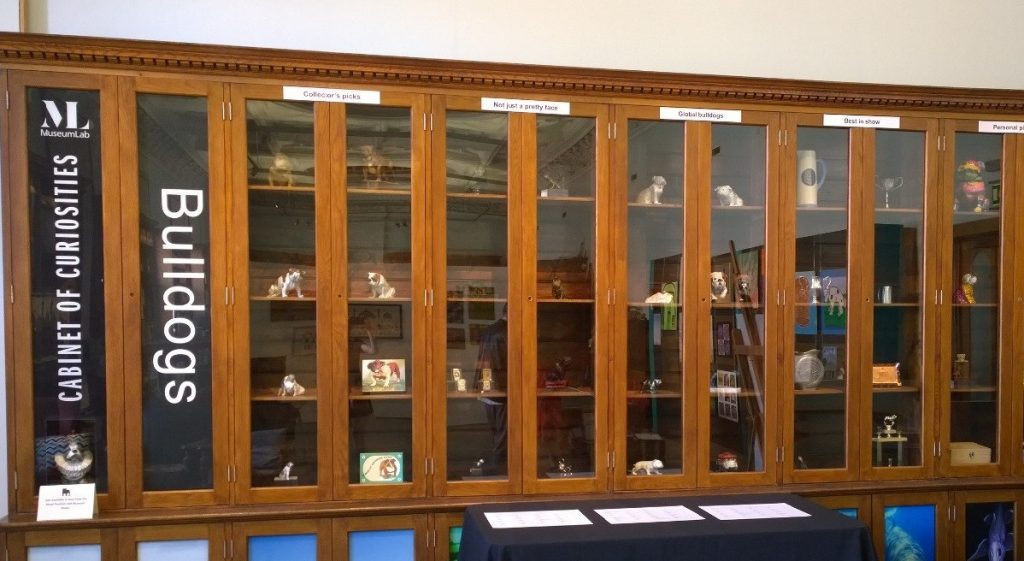
Bulldog display in Museum Lab, 2017

This is a legacy story from an earlier version of our website. It may contain some formatting issues and broken links.

In this guest post Eiffion Ashdown looks back at his work in Brighton Museum with his fellow Museum Mentors, including a display of his personal collection of bulldog pieces.

Creating Art Creating Magic

Hi there readers of this blog. I hope you’re all good and safe.  I’m guessing many of you know the museum with its beautiful buildings, its amazing pieces and of course the wonderful staff that keep the museum wheels churning. I wonder how many out there have visited what is a beautiful building full of history wonder and solace in a peaceful setting.

I’m writing this as someone whom experienced the Museum Mentors summer project and of course a client of the art group the museum offers to those with either or both mental / physical struggles. I say of course as I have my own website and following and I’m open about my issues to help fight stigma.

Creating Magic

Let’s start with the latter and I’ll explain the title meaning. There was not a magic act at the exhibition and I mean no offence to anyone when I say it wasn’t till the 11th hour that anyone knew for definite when and where the exhibition was going to take place. When you see the work my fellow clients had created in the time given you’ll be fooled into thinking some sort of magic was used.

The Thursday and Friday groups did theoretically pull a rabbit from the hat with the help of the museum mentors staff and we were so lucky we were to get two curators taking time out of very busy schedules to help set up, putting up the pieces finding out facts, and doing computer and paperwork are just a few things we were privileged with.

Creating Art

Now, I’ve said on my site  profile, wherever I can admit it ‘I’m not very good at art’. I see what is in front of me as childish so I try to stay away from conventional art whilst attending group and my needs are graciously met as I explore other skill sets. Don’t get me wrong I have done lots of art in the past but in the last year or so I’ve been trying to sort out my own blog and website.

I will not embarrass my fellow clients and use any names and I’m hoping once I pass this on to be used it will be published with art from what are truly talented gentle souls and when I walk into group now I’m not surprised if I have to pick my jaw of the floor whilst getting to a table where the talent is top notch.

Art by Museum Mentors

Wow look what we created

The open day for our exhibition / display project was a time to share our work with each other and the staff and see what the whole installation looked like finished. The Pavilion was a favourite theme but other great works were created too. I displayed my bulldogs from my collection and I up-cycled a few pieces in art group so that it all tied in.

Bulldog display in Museum Lab, 2017

Each and every member that took part should take away immense pride. The pieces that were up on display were made with time commitment and for some I think thrive as they enjoy the creations that are first a thought and when finished marvels, and wonder at a real sense of accomplishment, and hopefully for all to muse and reflect on.

Quick Thank You

3D printed bulldog replicas by University of Brighton

Before I continue I’d like to say my own thank you to those at Brighton Museum. At one of my lowest points a member of the Museum Mentors intervened and I’m now still here thanks to the skill set possessed in noticing my trauma and setting the right cogs in motion. I’d like to say thank you for my portion of the project (my bulldogs from the collection as part of the installation) and continued help regarding my venture. And lastly thank you for giving my website a link to yours I really felt I’d made it somewhere when that was agreed. THANK YOU ALL……

Lastly

I think it’s only right and proper that as I’m articulate enough to brief blog about the event I can say without hesitation on behalf of the group I work alongside a ‘massive thank’ you to Brighton Museum, the Museum Mentors staff, and the staff behind the scenes that sit in the offices doing all the bits and bobs that allow projects like this to be created, so from admin to the museum security that keep us all safe, the group is united in showing gratitude and saying a genuine thank you.

The museum ethos on mental health is a working module with all involved learning as we g,o from clients bothering to turn up because they want to, through to the staff having a dignified understanding of clients’ needs and issues. Brighton Museum is showing there’s always room to improve with any issues should they arise and should be praised for the projects they do, and we the art group are just one small part of so many projects events and special occasions that the museum and Pavilion are involved with, so keep popping back to the museum website to see what’s new and if you’re ever in town it’s a great place to visit — I mean beautiful history in object form and warm smiles who wouldn’t.

Eiffion Ashdown, Blogger

Brummel the Cat goes 3D

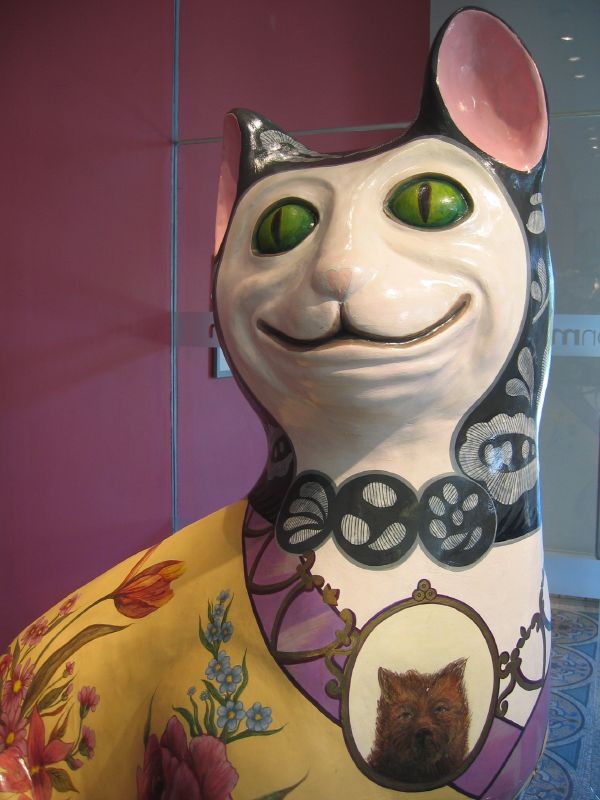
Photo of Brummell the Cat in Brighton Museum & Art Gallery lobby

This is a legacy story from an earlier version of our website. It may contain some formatting issues and broken links.

Photo of model cat in Brighton Museum foyer

Photo by nickzeff, CC BY-NC-ND, Flickr

How a 19th century Art Nouveau cat has given birth to a surprising digital litter.

We allow visitors to take photographs in most of our museums. Sometimes we can’t permit photography: in the Royal Pavilion and some of our temporary exhibitions we have to respect the wishes of lenders who do not want their works to be photographed, and sometimes we also need to protect the copyright of artists whose work is on display. But where possible we allow photography and often actively encourage it — visitors capturing their experiences of our museums and sharing them on social media is a really effective form of word of mouth promotion.

But what if a 2D photograph is no longer enough? What if a visitor wishes to capture a favourite item on display as a 3D model?

This issue briefly became a news story back in early 2016 when two artists released a 3D model of a famous bust of the Ancient Egyptian queen Nefertiti, which they claimed to have scanned from the original in Berlin’s Neues Museum in defiance of their no photography policy. It later transpired that they had almost certainly re-used an existing model but it opened up a debate. If 3D scanning technology becomes sufficiently lightweight and easy for a casual visitor to use, will museums find their displayed collections being reproduced and even 3D printed in places beyond their control?

To bring this subject closer to home, here’s a 3D model of Brummel the cat that sits in the entrance foyer of Brighton Museum.

This model was made by animator Dave Packer of Sheep Films. We know Dave well from his work on Remix the Museum, and we were happy for him to make and release the model. The model was created with photogrammetry, a technique in which a 3D model is created from multiple still photographs.It can be tricky to get good results with photogrammetry, but it is one way in which a visitor to a museum could digitise an object in one of our museums with relative ease. Indeed, Dave did not require any additional supervision when capturing Brummel.

Perhaps the real question is not whether museums should allow visitors to turn their exhibits into 3D models, but where does this process of capture and recreation end? Brummel is a donation box made in the 1990s which was based on an original animal figure made by the French artist Émile Gallé in the 1880s (a pair of these can be found on display in our 20th Century Art & Design gallery). So Dave’s 3D model is already a third generation replication of Gallé’s design; where might that cat go next?

The German philosopher and cultural critic Walter Benjamin wrote extensively about the anxieties of this process in his famous essay The Work of Art in the Age of Mechanical Reproduction. But Dave addresses the possibility rather more succinctly in this animated GIF.


http://remixthemuseum.com/post/168264511513

Kevin Bacon, Digital Manager

Jane Austen’s brother and the Royal Oxfordshire Militia mutiny of 1795

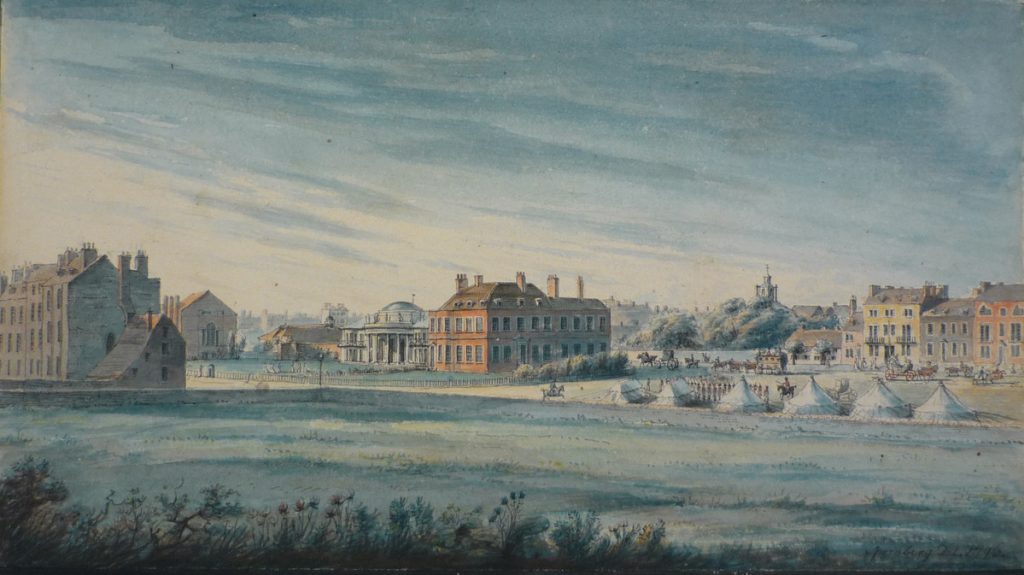
Old Steine, Brighton, from the North, 1796

This is a legacy story from an earlier version of our website. It may contain some formatting issues and broken links.

Our current Jane Austen by the Sea exhibition explores the author’s relationship with the seaside. While there is no evidence that she ever visited Brighton, her brother, Henry Thomas Austen, spent some time in the town while serving with the Royal Oxfordshire Militia.

Henry’s experiences almost certainly informed the descriptions of Brighton that appear in Pride & Prejudice, Jane Austen’s most famous novel. While these passages are presented through the naive imagination of Lydia Bennet, one of the characters in the novel, it is easy to imagine the militia in Brighton to have been handsome, if perhaps caddish, men in smart uniforms. Yet military life in Georgian England was harsh, and Henry Austen would have been well aware of this. For in 1795, hundreds of his fellow soldiers of the Royal Oxfordshire Militia mutinied in Seaford as a result of poor pay and conditions, an action that eventually lead to the brutal public execution of two men in Hove.

Henry Austen and the Milita

Henry Austen was born in 1771, one of eight children. After completing a Master’s degree at Oxford University, he joined the Royal Oxfordshire Militia in 1793.

Militia were reserve military forces, a little like the present day Territorial Army. Every English county was expected to raise its own militia, with officers appointed from the property owning classes, and the lower ranks recruited from local working class men. The men who served in these milita were part-time soldiers, and not required to serve overseas. During his service with the Royal Oxfordshire Milita, Henry Austen was also able to build a career as a banker.

The primary purpose of these milita was to provide protection against French invasion. Henry Austen joined during the French Revolutionary Wars, and Britain would be at war with France for most of the next two decades.

These militia were also intended to crush any civilian uprisings that might occur. At this time the government was deeply concerned that the French Revolution could inspire a popular revolt in England.

Along with Kent, Sussex was the most likely landing place for any French invasion. As a result, milita units were frequently stationed in Sussex, and large numbers of soldiers would pass through Brighton in the 1790s and early 1800s. Indeed, one early view of Prince George’s Marine Pavilion (an early form of today’s Royal Pavilion) shows a miltary encampment to the north of the building.

Old Steine, Brighton, from the North, 1796

Sussex also carried the advantage that soldiers from other counties would be unlikely to know many local people. As such, if the men were deployed to quell any civilian uprising, they would be unlikely to be required to shoot at friends, family or neighbours.

Background to the Mutiny

The men of the Royal Oxfordshire Milita arrived in Sussex in January 1795. They were accommodated in poor quality barracks near Seaford, and had to endure a hard training regime. Each day they were required to march to and from their training grounds in Brighton, a distance of twelve miles each way.

But the main complaint of the men was a lack of food. As a result of a bad harvest the previous year and the war with France, grain prices were inflating rapidly. The situation was exacerbated locally as shop keepers were accused of raising prices even higher to exploit the large number of men relying on the limited supply of a small town.

Tensions were further inlamed by the presence of the large tide mill near Bishopstone, a few miles north west of Seaford. The men were able to see large quantities of flour being transported away, and it was even rumoured that some of this flour was being sold to the French.

To push the situation to breaking point, some of what little flour the men could afford had to be used for their hair. British Army regulations at the time required soldiers to dress their pig tails in flour.

The Mutiny erupts

Peter Longstaff-Tyrrell’s The Seaford Mutiny of 1795 (2001) provides one of the best accounts of the uprising. The mutiny took place over three days, from Thursday 16 April to Saturday 18 April 1795. It began late on the Thursday when a group of men from the Royal Oxfordshire Milita broke into a local butcher’s shop and stole numerous goods. Officers were able to persuade the men back to the barracks on this occasion, but it had awakened an appetite for looting.

The next day, 500 soldiers fixed bayonets to their guns and marched on Seaford, seizing all the food and provisions they could find. Another group of soldiers raided the nearby mill, and seized 300 bags of flour. They took over a ship that was due to sail to Falmouth and transported the flour to a warehouse in Newhaven. By nightfall, various food stuffs were being sold and traded by the men, and a group of 60 soldiers were left guarding the warehouse.

As the milita officers and local leaders were unable to restore discipline, Captain Thomas Harben of the Seaford Volunteers sought help. By Saturday morning he had brought in troops from the Lancashire Fencibles at Shoreham and the Horse Artillery in Lewes. Accompanied by heavy artillery in the form of cannons, these soldiers marched on the Royal Oxfordshire Milita. Outnumbered and outgunned, the mutineers quickly surrendered. By Saturday lunchtime, the uprising had been crushed.

Discipline and Politics

Although the mutiny had been conducted and quashed with minimal violence, the authorities were determined that it should not go unpunished. A small number of men were identified as ring leaders and were due to received the harshest punishment. Some of these men were tried through the civilian court system in Horsham, while others were court martialled in Brighton. Of those who were court martialled, six men were sentenced to flogging, and one was transported to Australia. The most severe punishment was reserved for two men, Edward Cooke and Henry Parish. Although both seem to have been little more than accidental spokespersons, they were sentenced to death.

An elaborate public punishment was devised for those soldiers who were to be flogged or executed. According to Longstaff-Tyrrell, the architect of this was Prince Frederick, Duke of York, a younger brother of George, Prince of Wales. The Duke had been made a Field Marshal earlier that year, and just a few days prior to the mutiny had effectively been made commander in chief of the nation’s army by his father, King George III.

Frederick was naturally keen to impose discipline on his army and discourage further mutinies, but he would also have been aware of growing political unrest in the country. The American and French Revolutions had inspired a new wave of English radicalism in the 1790s which the government was determined to suppress. The radical writer and former Lewes resident Thomas Paine had been forced to flee the country in 1792, after he was put on trial for publishing his Rights of Man. In 1794, the London Corresponding Society, widely regarded as the first working class political organisation, had been broken up and its leading members tried for treason. The government was even prepared to encourage, or at least turn a blind eye towards, extra-legal violence against potential revolutionaries. According to EP Thompson’s Making of the English Working Class (1963), the wife of one of the leaders of the London Corresponding Society died in childbirth after her house was besieged by a ‘Church & King’ mob.

The Royal Oxfordshire Milita mutiny may have been sparked by hungry men desperate for food, but in the 1790s it was a politically charged action.

Execution at Goldstone Bottom

Goldstone Bottom in Hove was chosen as the location for a grotesque spectacle of punishment. Situated just south of where Hove Park lies today, at the time this was a shallow meadow that formed a natural ampitheatre.

The event took place on 13 June. By 5am soldiers from the 13 regiments stationed in Brighton were assembled around the meadow. The convicted men were punished in turn. First, the six men who had been sentenced to flogging were tied to a whipping post and received multiple lashings. Three received 300 lashings each, and this was only reduced on the advice of surgeons who feared they might die.

Finally, Cooke and Parish were led out to be shot. They were made to kneel on coffins and faced a firing squad made up of twelve of their fellow mutineers. The men were shot dead by their comrades, after which the Royal Oxfordshire Militia led the assembled soldiers in a march past their lifeless bodies.

Print showing two men kneeling on coffins, facing a firing squad

Execution of Cooke and Parish at Goldstone Bottom, watercolour, 1850

The whole spectacle took some three and a half hours. With many local civilians also looking on, it is estimated that the execution was witnessed by some 8000 people.

Aftermath

It is said that a local shepherd cut two coffin shapes into the ground to mark the site of the execution, and these shapes could still be seen some fifty years later.

The distressing manner of execution and the severity of the punishment angered many. Numerous people, including army officers, had pleaded for clemency for the men during their trial and imprisonment. After their death, pamphlets were circulated containing the last testimony of Edward Cooke, including his appeal that:

‘I am going to Die for what the Redgment done; I am not afraid to meet Death, for I have done no harm to no person, and that is a great comfort to me.’

A handwritten letter by Henry Parish to his mother contained similar sentiments.

Handwritten letter from Henry Parish to his mother, 1795

The execution was also used by political radicals with wider concerns, who referenced it in seditious poems attacking the cruelty of King George III and Prime Minister WIlliam Pitt the Younger. Longstaff-Tyrell quotes one poem that was posted around Sussex following the executions in Hove, including the following lines:

‘Soldiers to arms and revenge your Cause

On those bloody numbskulls, Pitt and George.

For since they no longer can send you to France

To be murdered like Swine, or pierc’d by the Lance

You are sent for by Express to make a speedy Return

To be shot like a Crow, or hang’d in your Turn’

There was, of course, no revolution in England, and both the king and Prime Minister would survive in power for several more years.

Prince Frederick continued to lead the army for almost twenty five years. Although he was forced to resign as Commander in Chief following a scandal with his mistress in 1809, he was reappointed to the role in 1811 by his older brother George, then Prince Regent. He remained in that role until his death in 1820, although he is now largely remembered as the likely inspiration for the Grand Old Duke of York in the popular nusery rhyme.

Although he was almost certainly a witness to the execution, Henry Thomas Austen also continued his miltary career. The Oxford Milita were stripped of their royal title as a result of the mutiny, but Austen served with them until 1801, by which time he had risen to the rank of captain. He continued in banking until a bank he co-founded collapsed in 1816. Thereafter he took up a career in the church until his death in 1850.

But Henry Austen’s most lasting work was his contribution to securing his sister’s literary legacy. After Jane Austen’s death in 1817 he arranged for the posthumous publication of Northanger Abbey and Persuasion. He also contributed biographies of Jane to some of the subsequent editions of her works.

Kevin Bacon, Digital Manager

More information


Bolsheviks & Bloodlines: Preston Manor and Russia’s October Revolution

This is a legacy story from an earlier version of our website. It may contain some formatting issues and broken links.

One hundred years ago this month Russia’s October Revolution was launched in Petrograd (now known as St Petersburg) and changed the course of world history.

1300 hunded miles away at Preston Manor in Brighton, Ellen Thomas-Stanford found herself uniquely close to the uprising as her morning post bought first hand reports written in cinematic detail. More shocking still, within a year a dear friend’s niece would die in a hail of bullets alongside Tsar Nicolas II, the last reigning Romanov.

The home front: Brighton 1917

Photo of leather cover of scrapbook

Ellen Thomas-Stanford & ‘1917-18’ scrapbook

Ellen Thomas-Stanford’s five large scrapbooks compiled between 1914 and 1919 are an extraordinary archive. The rarely opened pages positively sing with history made fresh.

Life in Brighton in 1917 was tougher than we can imagine, even without violent revolution on the streets. The First World War, so boldly entered, had been raging three long years. In April 550,000 tons of shipping was sunk by enemy submarines — disastrous for a country reliant on imported food. Even the wealthy were affected by shortages.

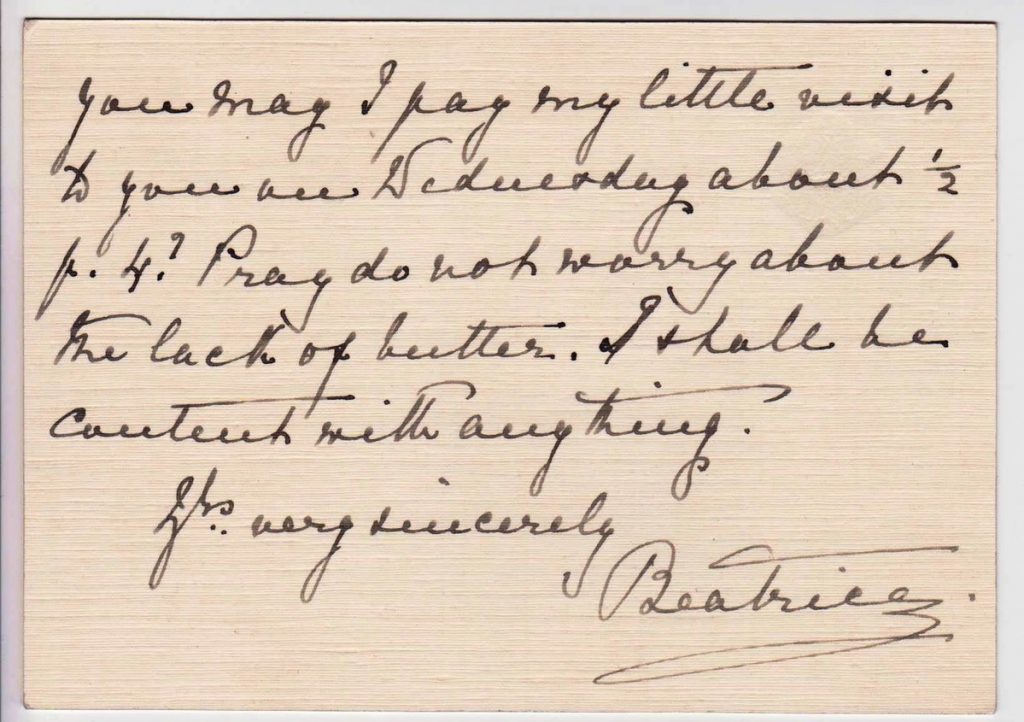
‘Please do not worry about the lack of butter,’ writes Princess Beatrice to Ellen before visiting to take tea. ‘I shall be cautious with everything.’


Princess Beatrice note to Ellen Thomas-Stanford regarding butter shortage


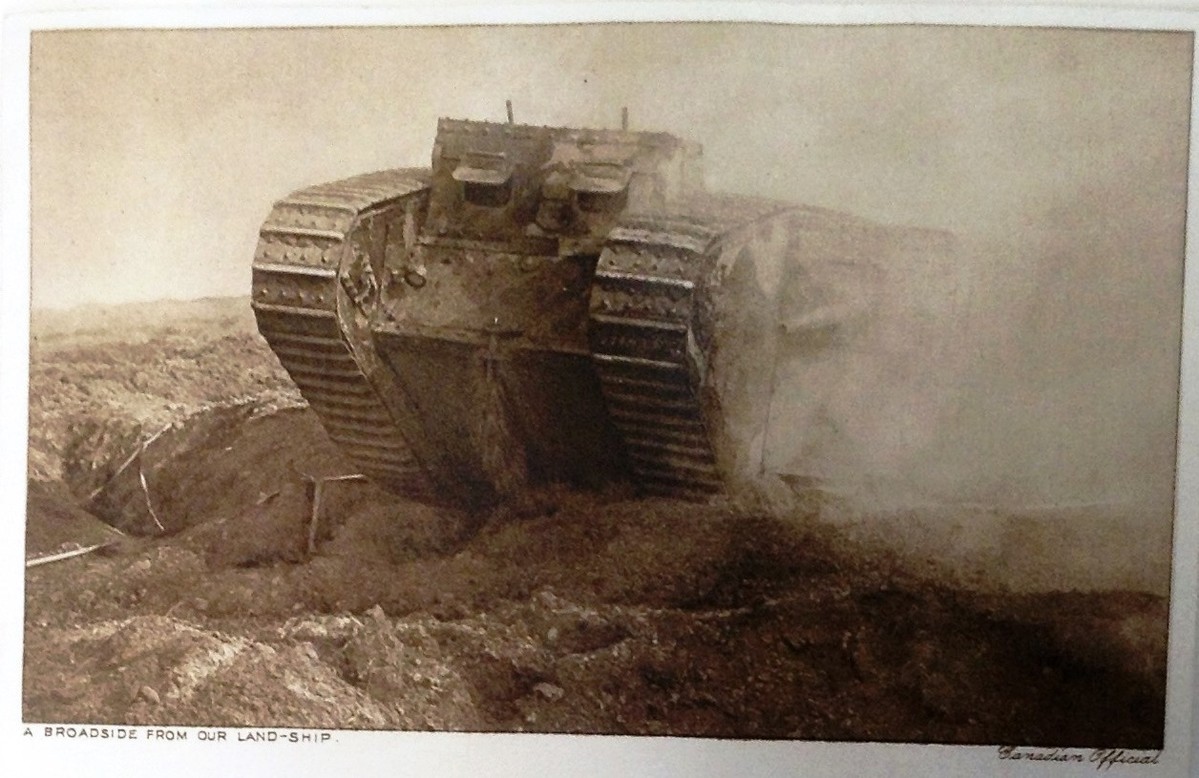
Photo of large tank surrounded by dust

Postcard: ‘A Broadside from our land-ship’

Ellen’s comfortable life did not spare her from heartache. Sadness seeps into her 1917 scrapbook as page after page of black-edged mourning notepaper reports deaths of friends’ sons, nephews and husbands. In a snapshot of the age there are newspaper cuttings: mostly obituaries, letters from the Red Cross expressing thanks for fundraising, a postcard of a tank — an invention so new the machine barely had a name beyond, ‘our landship’. A colourful notice bearing the flags of the allies declares ‘A Solemn Oath’ that the signatories will swear not to ‘knowingly purchase anything made in Germany’ or ‘transact business with or through a German for 10 years after peace is declared’. Carefully pasted as a keepsake, the notice is unsigned.

The October Revolution: Petrograd 1917

In the autumn of 1917, peace must have felt like an unimaginable dream. As today, the leaves on the great trees in Preston Park were beginning to fall heralding yet another bleak winter of war on the home front. In Petrograd meanwhile, Ellen’s correspondents, Colonel ‘Croppy’ Henry Vere Bennet and Mr. Oswald Rayner of British Intelligence were living a hair-raising existence and preparing for the bite of the fierce Russian winter described in February 1918 by Croppy:

‘Cold here is normal but we had a fearful 3 days blizzard and furious snow storms which has upset even the Russians. We had 43° of frost i.e. 13° below zero for three days and the wind is what makes this place the limit…the streets are baulked up high with mounds of snow, high as a man’s head, which no amount of work could remove.’

Photographic portrait of Harry Vere-Benett


Lieutenant Colonel Benett in the uniform of Aide de Camp to Major R Gillespie, Bombay late 1880s

Revolution in October bought disorder and hardship.

‘There is no electricity, candles cost a fortune and are of very inferior quality. Oil is equally scarce and dear. Bread is very scarce & bad & contains much straw and “foreign matter” which causes much illness especially amongst children & old people & now an outbreak of typhus, which after all is not surprising as the intake of water supply is well below the stream of output of the sewage of the city.’

Croppy reports a severe shortage of meat, vegetables, potatoes and eggs: ‘I’ve not seen an egg since October.’

The October Revolution began in Petrograd on the old Russian calendar date of 25 October (7 November in the UK). Led by Vladimir Lenin, Bolshevik Red Guards captured the Winter Palace–  ‘our Buckingham Palace’, as Croppy clarifies for Ellen.

‘The Winter Palace is pitted all over with bullet holes, like the plums in a pudding, & nearly every one of its hundred windows is patched up with paper.’

On the spot while revolution raged, Croppy and Rayner kept Ellen informed of events.

‘On Tuesday 6th November, the uprising of the Bolsheviks which had been threatening for a week or more came to a head. The whole situation resembled a cauldron full of seething ingredients which still refuse to combine or amalgamate.’

Rayner, about who hangs much mystery regarding his role in the death of Rasputin in December 1916, was briefly back in London but writing on 22nd September 1917 he informs Ellen: ‘I am now busily engaged in active preparations for my return journey to Petrograd.’

Ever the Secret Intelligence Service officer he writes sparingly. However he can’t resist letting Ellen know he has been asked to ‘make a study of the work carried on in quite a new department (for me) at the War Office.’

At 28 years of age Oswald Rayner comes across in letters held at Preston Manor as a man of immense self-confidence and poise. He was a brilliant Oxford scholar, fluent in Russian, French and German, belying his humble origins as the son of a Staffordshire draper. In 1917 Rayner was in the prime of life and diligently acting upon whatever daredevilry his country asked of him.

On 26 September he tells Ellen:

‘I am making the necessary preparations to be able to leave on October 1st – these were my instructions. Further details will depend on the next date of sailing of H.M.S ‘Hush-Hush’! As she is called.’

Rayner’s exploits and evident cool head under pressure gives the impression that he was something of a James Bond of the First World War. If the final assassin’s shot that finally ended the life of Rasputin was fired from Rayner’s Webley revolver, as some historians believe, then the picture is complete.

Oswald Rayner died in 1961 leaving instructions that his private papers be destroyed. However a paper trail remains in the outpourings of his heart and reportage of Russian matters to Ellen Thomas-Stanford.

Russia’s revolutionary women

On arrival in Petrograd in the heat of revolution, Rayner reported:

‘There is virtually no government and public business is consequentially at a standstill. We seem to be drifting headlong into utter chaos with never a straw to cling to. Any hope that is left is centred on the proverbial miracle that is always supposed to come to Russia’s aid in her severest extremities.’


Coming to Russia’s aid at this time of crisis were an extraordinary band of soldiers, the Women’s Battalion of Death. Croppy met these all-female combat units out on manoeuvres. Fascinated, he was eager to share his thoughts with Ellen in Brighton.

The Women’s Batallion of Death, 1917

To illustrate he sent two postcards. One he marks with symbols so Ellen might see the Colonel and her Adjutant with whom he spoke.

‘The former is the widow of a soldier and was herself five times wounded…she is of peasant origin and is now in hospital suffering from shock. The adjutant, a girl of 18 only, I found in temporary command. Quite pretty, the daughter of an Admiral, well educated, speaking English fluently and in Petrograd society.’

Russian military women


A military man himself Croppy writes admiringly of these female fighters.


‘They were occupying a sector of the front line and do everything for themselves. I found them quite smart, discipline better than some regiments of men, sentries and snipers alert and all seemed in deadly earnest.’

Safe in the quiet surrounds of her ancient family home, Ellen must have shuddered at Croppy’s description of life in Petrograd sent 9 November.

‘For some time past life here has been unsatisfactory and most unsettled. The police disappeared in our first revolution and the militia which replaced them has gradually melted away. Neither life nor property has been safe and there is no one to turn to for protection. People are robbed not only in the slums but also in the streets of the best quarters of the city. Women are stripped of their boots, their furs or a good cloak in broad daylight…houses are entered and everything removed which takes the fancy of the visitors…last week four-hundred robberies were reported in one night.’

Ellen Thomas-Stanford’s friends in Brighton

Black edged letter

Reading Ellen’s collection of black-edged letters from October and November 1917 is a sobering task. One hundred years on the bitterness and animosity felt towards the German people has the power to shock.

J.N Langley writes from Hedgerley Lodge, Cambridge on 25 November.

‘I do not understand the frame of mind of those who are ready to renew relations with Germans after the war. The pests should be treated as such.’

A friend writing from Barrowfield Lodge, Brighton on 11 October places blame at the top:

‘It is too terribly sad these many bright young lives one after another be sacrificed, and to think that all this misery is caused by one wicked man, the German Emperor.’

A matter perhaps not considered by this friend was Ellen Thomas-Stanford’s astonishing closeness to the ‘wicked man’ for she regularly admitted into her home Kaiser Wilhelm’s aunt,  Princess Beatrice.

Haemophilia: Queen Victoria’s genetic legacy

Beatrice’s mother, Queen Victoria, famously gave birth to a bloodline of descendants destined to be reigning monarchs of Britain, Germany, Russia and Spain at the start of the new century.

Victoria’s lineage bought with it the infamous gene for haemophilia, the devastating blood disorder that would shape the European world map almost as much as war.

Ellen’s friend Beatrice was Victoria and Albert’s fifth daughter and youngest child. Along with her sister Alice she was a carrier for haemophilia, so when she married the German Prince Henry of Battenberg in 1885 the health of any children yet to be born was already imperilled.

Sisters Helena and Louise, who also visited Preston Manor, were not carriers.

Both Beatrice’s sons, Lord Leopold Mountbatten and Prince Maurice of Battenberg, were haemophiliacs and both would die young. Maurice was killed on active service at the Battle of Ypres in 1914, fighting for the Allies irrespective of his German pedigree. Leopold, always the frailer brother, died aged 32 in 1922 the result of an attempted hip operation – certain death for a haemophiliac whose blood fails to clot.

Ellen must have felt Leopold’s death keenly, for he died one month before her beloved grandson, Vere. In many respects Leopold was much like a second grandson to Ellen. The pair corresponded by letter, Leopold writing from his quarters at Clock Court, Kensington Palace.

Of his brother‘s death he writes,

‘There is little comfort in knowing he died a soldier’s death, which I am sure he would have wished but it has been an awful blow to me all the same.’

We can’t know if Ellen and Beatrice talked about world politics. The tone of their letters suggests they kept to uncontentious subjects. Perhaps some subjects were too painful to commit to paper even at this time of revolution, war and family deaths.

Rayner, Rasputin and Russia’s royals executed

The most prominent death linked to Ellen’s circle of friends was one unmentioned in any letter I have yet found between Beatrice and Ellen.

Not written about but surely talked of at Preston Manor were the events of 17 July 1918. On that date Beatrice’s niece, Alexandra (known as Alix), who had married Tsar Nicholas II in 1894 and become Empress of Russia, was executed by Bolshevik troops alongside her husband and their five children. A 200 year old Romanov dynasty was wiped out in one hail of gunfire.

Tsarina Alix’s concern for her young haemophiliac son, the Tsarevitch Alexis, had led directly to the entry of faith healer Grigory Rasputin into the royal household.

One year before the massacre of the Russian royal family, Croppy makes reference to one of the many unorthodox medical practitioners enlisted by the Romanov family in the vain hope of a cure.

In a letter to Charles Thomas-Stanford dated 18 June 1917 he writes: ‘I won’t give his name but I have known something about it in the course of my work.’

Croppy refers to the mysterious man as ‘a strange personage, a Thibetan (sic) doctor,’ who historians identify as Siberian born Pyotr Badmaev, friend of Rasputin.

‘Whether Rasputin was his agent or he Rasputin’s no one can say definitely,’ Croppy writes adding with distain, ‘he is strongly pro-German.’

Rayner’s old Oxford University friend, Prince Felix Yusupov, in whose palace Rasputin was murdered, gave a newspaper interview in March 1917 claiming Rasputin and Badmaev fed drugs to Tsar Nicholas, rendering him useless. Croppy mentions the story in his letter to Charles, ‘with the increasing rumours of the drugging on the Emperor for some time past.’

War’s end and aftermath

Croppy and Rayner continued to keep the Thomas-Stanfords informed of world news after the war ended in 1918. A letter from Croppy written from his residence at 8 Challoner Mansions, West Kensington on 2nd October 1919 is especially intriguing.

‘I am very busy at the W.O. (War Office) finishing up writing reports and appreciations of my years’ work in North Russia. When we meet I have much to tell you which it was quite impossible to write or hint at on paper.’

As for Oswald Rayner, his whereabouts become international: Japan, the United States, and Sweden – and in March 1919 he was writing from the Headquarters of the British Military Mission to Siberia.

Turning 30 he writes, ‘my future movements are shrouded in mystery,’ and it seems he had moments of homesickness confessing to Ellen:

‘I am accustomed to being abroad, as you know, and never before have I experienced such an overpowering “nostalgie”. I want to be with my friends, my real friends. How good it would be to be at Preston for a weekend. When oh! When will it be?’

Promotion and honours

Like his friend Rayner, Croppy was fascinated by Russia and its peoples.

‘There are very many strange things in this country and it has taught me a great deal about human nature and its weaknesses.’

Croppy was honoured internationally for his contribution to the war effort.

He sent Ellen postcard pictures of his Russian medals, the Order of St Stanislas 1916 and the Order of St Anne 1918 awarded for his efforts in improving the Allied-Russian communications system.

The French awarded him the Légion d’Honneur, Croix d’Officier in October 1918.


Naval & Military Club letter

In 1918 Croppy was made one of the first Commanders of the Order of the British Empire (CBE) in recognition for his services in Russia, an honour he accepted with modesty. Writing on a Naval & Military Club card dated 20 June 1918 he thanks Ellen for her ‘pleasing’ congratulations. However he prefers to speak of Rayner’s promotion to the rank of Captain, applauding the capability of the younger man rather than basking in personal honours.

Henry ‘Croppy’ Vere Fane Benet died in March 1931 the year before Ellen Thomas-Stanford, his fondly addressed, ‘Mrs Squire’ and recipient of his vivid letters from revolutionary Russia.

Paula Wrightson, Venue Officer, Preston Manor

More information