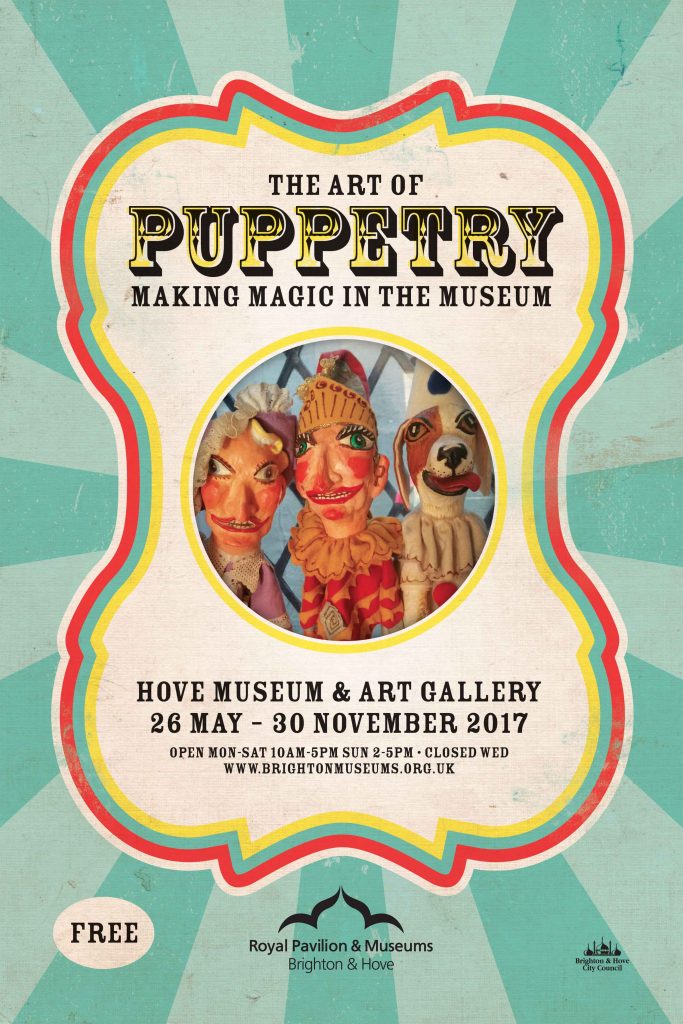
Story Category: Legacy

Puppet Magic at Hove Museum

The Art of Puppetry. Making Magic in the Museum

This is a legacy story from an earlier version of our website. It may contain some formatting issues and broken links.

A new exhibition opens at Hove Museum tomorrow showcasing the work of local puppet artists. In this post, Martina Bellotto talks about her work behind the scenes and the artists involved.

The Art of Puppetry. Making Magic in the Museum is a vibrant and colourful display that brings together local puppet artists with their stories, puppets, props and stage designs.

“They seem to come alive with music, light and dance. This is the art of puppetry.” Philip Sugg

It has been very exciting for me to work on this new exhibition at Hove Museum in the last four months as part of my Workforce Development. It has been great to work with puppet artists and get closer to a form of art with which I was not familiar.

All is finally coming together in these last weeks. We have worked hard on the installation and the galleries are now ready to welcome visitors and to bring them into new worlds, where imagination meets reality. The puppets come alive thanks to the talent of the puppet artist, whether they are operated by string, glove or rod.

Puppetry is a very ancient form of theatre and can take many forms, but all share the same process of animating inanimate figures and objects to tell a story. The puppet artists taking part in this exhibition tell their different tales, from the traditional Italian figures of Punch and Judy to the enigmatic Slavic folktale of Baba Yaga. They show us different ways of storytelling with puppets whether it is through simple paper pop-up theatres, the ancient form of the shadow theatre, giant animal masks or mysterious marionettes.

These puppet artists have a very strong passion for theatre and storytelling which they express through their works. Their creativity and imagination bring twists to old stories as well as the creation of new ones.

The exhibition has two areas. The first overwhelms the visitor with the vibrant enchantment of colours, masks, portable theatres, shadow puppets, marionettes, jig dolls, fantoccini, props and figures. The second projects the visitor into a mystical world of folklore and mythology. This division of the galleries came naturally due to the different sensibilities, ways of working and using materials, and the different stories the artists tell.

The Puppet Artists

The puppet artists whose work can be seen in the exhibition are:

Amanda Rosenstein Davidson
Artist, art teacher, children’s book author, illustrator and craft designer. Amanda paints and exhibits works on themes that reflect her love of theatre, ballet and performance

Philip Sugg
Art historian and retired museum educator that now collaborates with a circle of puppeteers and artists on projects that turn his childhood dreams and passion for the stage into reality.

TouchedTheatre
A collaboration between award-winning puppetry director Darren East and writer/producer Beccy Smith. The duo are specialists in using puppetry, storytelling and film in participatory projects with people experiencing mental health difficulties.

Rust & Stardust
A puppet theatre company run by Eleanor Conlon and Katie Sommers. In their work they combine new writing, puppetry, costume making, music and education. They often use recycled materials and unexpected items in their creations.

Imogen Di Sapia
Brighton based artist/maker whose work ranges over the fields of textile crafts including weaving, costume and puppetry, whilst also creating unique therapeutic storytelling.

Liza Stevens
Liza is children’s author, illustrator and puppet maker. Her puppets are most often made from textiles, frequently using recycled materials.

The artists have created a close group that often works and exhibits together. Each brings their specialisation and experience to the magic to be discovered in this exhibition.

The exhibition will be accompanied by shows, workshops and opportunities to meet the artists. The first of these opportunities is coming very soon, an event open to all that will celebrate the Art of Puppetry exhibition and the other fantastic things to be found at the museum. This takes place on Bank Holiday Monday 29 May: Love Your Museum at Hove Museum.

The event will run from 10am to 4pm with a series of activities during the day for children and grown ups, such as puppet making and craft workshops, fun activities, trails and gallery resources, storytelling for children and talks for adults. There will be artists at work and the opportunity to talk with them, plus close contact with objects from the Royal Pavilion & Museums’ collection.

Come and join us for a fabulous day at Hove Museum!

Martina Bellotto, Gallery Explainer

Exhibition
The Art of Puppetry. Making Magic in the Museum
26 May-30 November 2017
Free admission

Event
Love Your Museum
Monday 29th may 2017
10am-4pm Free, Drop-in

Hove Museum & Art Gallery
19 New Church Road, Hove BN3 4AB

Opening times
Mon, Tue, Thu, Fri, Sat 10 am-5pm
Sun 2-5pm
Closed Wed

We need your help! Choose objects for our Cabinet of Curiosities

Cabinet of Curiosities in Brighton Museum Lab

This is a legacy story from an earlier version of our website. It may contain some formatting issues and broken links.

In Brighton Museum next week we will be choosing objects for our Cabinet of Curiosities display. This will have animals from our Natural Sciences collection and will be on display in Museum Lab. We would like visitors to vote for five key objects to display and help us to decide the stories we will tell. Would you like to see local animals? Or would you prefer to learn about more exotic creatures?

Cabinet of Curiosities in Brighton Museum Lab

Hoopoe (Upupa epops)

Get hands on with our mystery object from a migrating animal and investigate what and where it might have come from. Tell us your ideas and help us to create a label for the display.

If you can help with this, please join us on Weds 24 May between 2-5pm outside the Museum Lab in Brighton Museum. It will be a chance to input your ideas for a display in the museum, and an opportunity to meet museum curators and other staff.

Grace Brindle, Collections Assistant

At home with the Homemaker plate

Homemaker plate, c1955

This is a legacy story from an earlier version of our website. It may contain some formatting issues and broken links.

In this guest post, author and freelance museum education consultant Rebecca Reynolds discusses a piece of popular crockery in our collections that has now become a much sought after item.

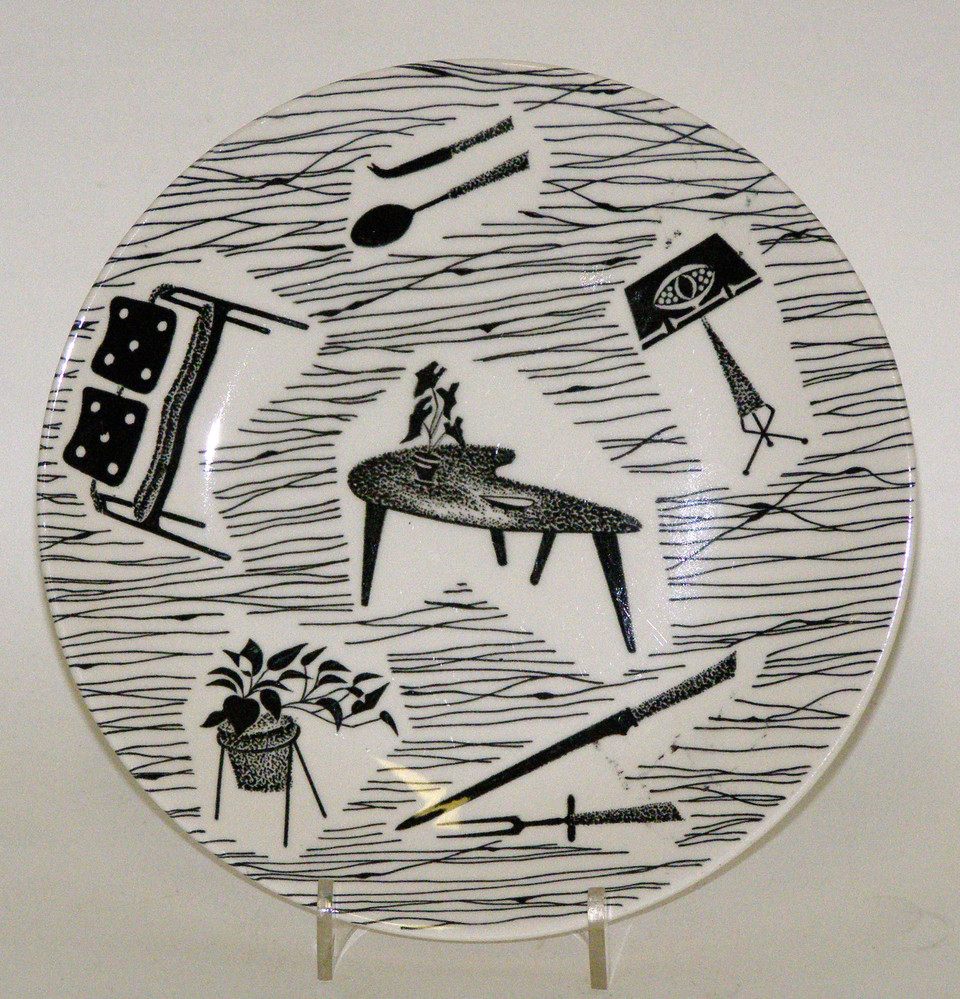
This month sees the 60th anniversary of the first Woolworth’s order for ‘Homemaker’ tea sets, the crockery of choice on so many dining room tables from the late 1950s onwards. You might recognise the Homemaker’s geometric design of sofas, pot plants, carving knives and armchairs.

Homemaker plate, c1955

A plate from the range made its way into a book published in February this year, Curiosities from the Cabinet: Objects and Voices from Britain’s Museums, in which I asked curators, conservators, visitors, users and artists to talk about museum objects from around the UK. Dr Louise Purbrick, senior lecturer in Art and Design at Brighton University, chose to talk about a Homemaker plate in a cabinet on the ground floor of Brighton Museum.

Woolworth’s piled Homemaker kitchenware high and sold it cheap. Teapots went for 10 to 15 shillings (50-75p) and teacups for 2/6 (12 ½p); a full set of plates, bowls and cups cost 31 shillings (£1.55). Many of the families who bought the range could not have afforded the more upmarket furniture shown on it, such as the chic kidney-shaped table. Indeed, the design helped to give the shop’s image a boost: ‘Smart, stylish and modern,’ said an advert of the time. ‘Can it be Woolworth?’. The range, designed by Enid Seeney at Ridgway, was a huge success.

The line has since become highly collectable; a 40-piece set went for just over £400 at Bonhams in 2010. ‘I just love the black and white vintage furniture icons, the simple rounded shape of the items and their overall durability,’ says collector and gardening blogger Gillian Carson.  ‘I have scoured the charity shops for even one plate from this sacred range, but have had to resort to eBay to get my hands on one for my kitchen wall,’ says Claire  Smyth, who blogs about ‘retro wonders’. ‘A red sandwich plate has been found in Australia,’ writes Simon Moss in Homemaker: A 1950s Design Classic, which tells the history of the design and tracks different versions.

Dr Purbrick set a place for the plate in her personal and professional life:

‘The reason I know this plate is because I had one. I was a punk – a little bit of a young punk, and in the 1980s I was setting up home – or at least, I was moving into a flat – and I bought a few of these in second-hand shops in Worthing.

Mine was a tea plate. They would have been ever so cheap – 20p each, perhaps less. I really liked them, but you change your mind about things or you feel you can’t carry them, you don’t know where you’re going and you might be moving from an unfurnished to a furnished place so I got rid of them. And then I came across it in the 20th-century gallery in the V&A and thought ‘why did I not keep those?’ But when I bought it I had no idea I was going to be an Art and Design historian; I was working as a home help; thinking about doing social history; I was retaking A-levels and didn’t go to university (that is, to a polytechnic) until I was 23.

The plate has also got quite a humorous and kitsch punk look, like people who liked the B-52s, which I didn’t exactly, but I can see how punk in the 1980s would have some of that humour. Kitsch can be thought of as over-decorated and standing for what Pierre Bourdieu would call vulgar, popular taste because it’s easy to read; you can see the images on the surface of the kitsch object, whereas fine art would be abstract and you would contemplate its significance and deep meanings. So kitsch would stand for ideas of poor taste or working class taste but also a style that’s understandable, translatable, and assimilated into life. But I think kitsch now has become redeemed in the way which a vintage buyer in Brighton, for example, is able to identify something that is at the margins of good taste and which can be recuperated as a sign of knowledge of what’s in and out of fashion.

I wish I still had that plate.’

Front cover of Curiosities from the Cabinet

In the book the plate appears alongside two other domestic objects – a child’s toy farm set from Reading’s Museum of English Rural Life, and Jane Austen’s writing table in the Jane Austen’s House Museum in Chawton, Hampshire.

You can learn more about Curiosities from the Cabinet: Objects and Voices from Britain’s Museums at my website.

Rebecca Reynolds, author and freelance museum consultant

Please note that the Homemaker plate is not currently on display in Brighton Museum, but you can view and download an image from our Digital Media Bank.

BrightonMuseums on Sketchfab

Piltdown Man Skull by Brighton Museums on Sketchfab

This is a legacy story from an earlier version of our website. It may contain some formatting issues and broken links.

As part of our ongoing work experimenting with 3D digital technology, we have just launched a Royal Pavilion & Museums account on Sketchfab: sketchfab.com/BrightonMuseums.

3D model of Venus of WillendorfIf you’re not familiar with Sketchfab, it’s a platform for publishing and sharing 3D and VR content online. Numerous museums are using Sketchfab now, and there is even a dedicated channel for 3D content from museums and other cultural organisations.

Sketchfab seems to be fast doing for 3D content what YouTube did for videos several years ago. Like YouTube, Sketchfab is bringing together collections of rich media so that users can easily search and browse through content from a variety of providers. It’s also curing some technical headaches; like video, 3D models are complex media that come in a range of evolving formats and file sizes. One of YouTube’s biggest achievements was to enable people to rapidly publish video without having to worry about codecs and other issues, and enabling the publisher to feel confident that their video would work in most browsers and devices. Indeed, YouTube arguably did this so well that many of us have forgotten how difficult it used to be to publish video on the web.

Publishing Piltdown Man


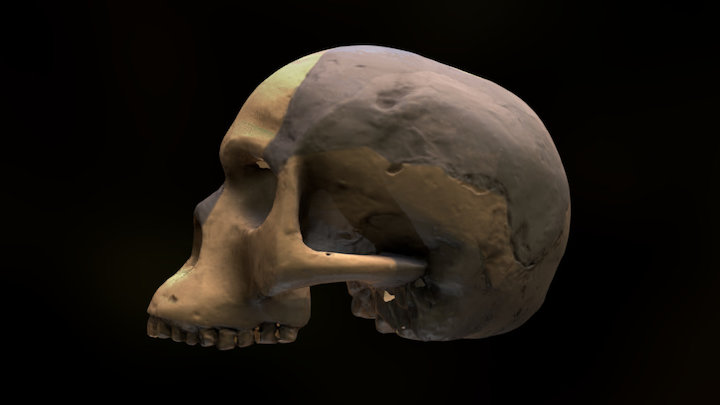
Up until now, we have relied on software such as 3D Hop to publish our models online. 3D Hop is open source and has many great features, but the way we published these models was a laborious process. First, each model had to be compressed down to a manageable size, often with some reduction in quality. Then each model had to be manually uploaded to a server along with a hand coded HTML file to display it. That HTML file then had to be pulled into our website through an iframe, such as this example of the Piltdown Man skull which was kindly digitised for us by the University of Brighton’s Cultural Informatics Group.

By contrast, getting the model online through Sketchfab has simply been a case of uploading the original file to our account, and then copying the embed code into our website. The example above has taken a fraction of the time it took before, and the overall quality is much higher.

Royal Pavilion in detail

Another good example is this 2015 model of the Royal Pavilion by volunteer Colin Jones.This is a complex and detailed model, and compressing it to work with 3D Hop created too much distortion.

Colin was able to get a version of the model live with X3D, but this was still a complicated process. Thanks to Sketchfab we are now able to publish the model again, this time using a detailed 49mb file rather than a heavily compressed version. We have also used Sketchfab to add a metallic surface to the model. While the Pavilion has never had such a surface historically, it helps make the detail of the model more visible.


We only have a small number of models available on Sketchfab at present, but we will be uploading more soon.

Kevin Bacon, Digital Manager


Grand entrance for a grand piano: George IV’s Tomkison piano returns home

George IV’s Tomkison piano returns home

This is a legacy story from an earlier version of our website. It may contain some formatting issues and broken links.

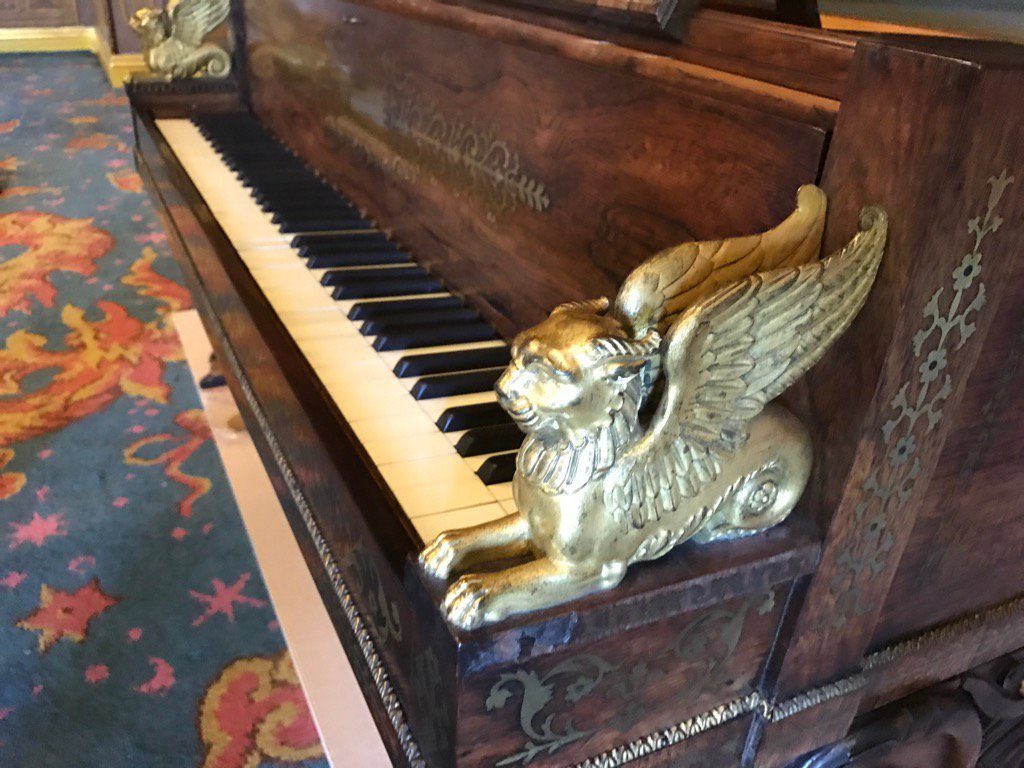
A team of Royal Pavilion & Museums staff have worked tirelessly over the last couple of weeks to secure the funding that made it possible to acquire this extraordinary piano made for King George IV for the Royal Pavilion in c1821. Today it returned home and here are impressions of its arrival.

The piano was bought by the Royal Pavilion & Museums at auction on 6 April 2017. We would like to acknowledge the help of Martin Levy of Blairman’s in the acquisition, who kindly bid on our behalf at the auction. We are also grateful to Norman McSween and Luke Bradley for the help with the research in the history of this piano. The historic piece was secured after a successful bid of £62k was made using money from the Art Fund, Arts Council England/Victoria and Albert Museum Purchase Grant Fund, The Leche Trust and the Royal Pavilion Foundation. On the same day Martin Levy organised its removal to temporary storage near London and we quickly made arrangements to bring this important and exciting object back to its original home. We are immensely pleased that the piano has now arrived safely in Brighton, just a few days after the auction. It will be temporarily displayed in the Music Room pending a decision as to its permanent location. We are hoping to display it in the Entrance Hall where it was shown in George IV’s day.


More information on the piano:

The piano was made by Thomas Tomkison and is the most celebrated of his surviving works. The maker’s flamboyant approach to case decoration clearly appealed to George’s Francophile and adventurous taste and was perfectly in keeping with the Royal Pavilion style. In a bill in the Royal Archives the piano is described as ‘An elegant rosewood grand piano inlaid with brass, the case highly polished, gilt mouldings, gilt turnbuckles and elegantly carved legs’. At a cost of £236 5/- the piano was well over twice the cost of a standard top quality English grand piano at the time. Accounts reveal that Tomkison supplied other ‘extra elegant’ pianos to the Prince Regent, but no others are known to have survived.

When the Pavilion was sold to Brighton in 1850, Queen Victoria stripped it of its contents which were taken to other royal palaces. When it became clear that the Pavilion was not going to be demolished, Queen Victoria started returning fixtures and fittings. This process has continued under successive monarchs.  Occasionally items are acquired which have by various means left the Royal Collection. These are acquired whenever resources allow by gift or purchase. It is not known when the Tomkison piano left the Royal Collection. It is possible it was sold or disposed of by Queen Victoria because there is some evidence it may have been at Windsor Castle in the 1840s.

We carried out considerable research into the piano in preparation for the funding application and, now that it is back at the Pavilion, will look further into its history. The piano can be seen in a number of images of the 1820s, including this hand-coloured aquatint from John Nash’s Views of the Royal Pavilion at Brighton, published in 1826 (you can see the whole book here).

Entrance Hall of the Royal Pavilion in an aquatint from 1826. The Tomkison piano can be seen on the right.

We also have in our collection a preparatory drawing by Augustus Charles Pugin, who provided the detailed watercolours for the aquatints in Nash’s publication, that shows our piano. Only a couple of areas in this drawing are coloured in, including, coincidentally, the Tomkison piano (see detail of the drawing below).

A detail of A C Pugin’s drawing of the Entrance Hall, c1821

Alexandra Loske, Curator, Royal Pavilion Archives

Experimental Motion: from early cameras to GTA V

This is a legacy story from an earlier version of our website. It may contain some formatting issues and broken links.

DV8 student Harry Symes has recently been working with our programming team. In this guest post, he shares his thoughts on our experimental film exhibition at Brighton Museum.

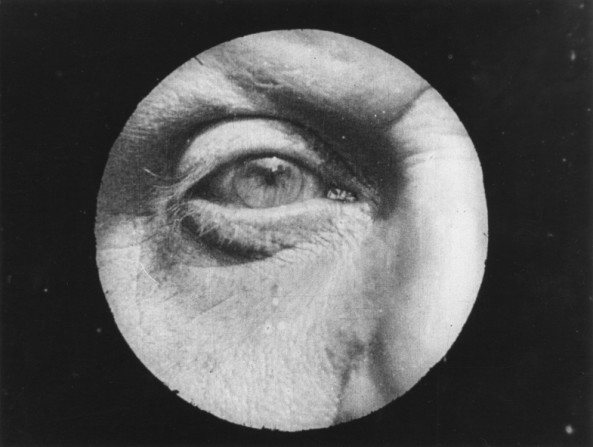
Image taken from film still showing eye peering through a circle

Still from Grandma’s Reading Glass, 1900, by George Albert Smith. Courtesy of British Film Institute

As part of my Media course at DV8, Brighton, I spent two days working at Brighton Museum and spent time in the Experimental Motion exhibition.

Experimental Motion is a great exhibition. It ranges from information about early film to showing short self-produced films. It is very interesting to see the cameras from the late 1800s to early 1900s and what types of films they were used in. The information boards are full of interesting facts that I didn’t know, such as film editing was first used in Brighton & Hove.

The gallery has a few small screens on the walls showing short films, with a pair of headphones for each screen, which really helps immerse you in the films, I was so immersed that I didn’t realise I had spent the best part of an hour watching them all! All the films are very different from each other, but all are intriguing and draw you in. One of the films that I particularly enjoyed was made using the game Grand Theft Auto 5; I never thought that someone could create something so powerful using a game. It is self-aware of the fact that it is a film in a virtual environment, making a couple of comments about how it is not reality but the experience is real.

There is one big screen playing a number of short films at the end of the room. There is a bench facing the screen which has a cinema feel, and it is also a place to rest if you’re feeling weary after walking around the museum. I would definitely recommend this exhibit to anyone who has an interest in film or anyone passing through the museum to take a look at this gallery.

Harry Symes, DV8 student

Familiar yet Strange: Humphry Repton’s Royal Pavilion Estate in 3D

This is a legacy story from an earlier version of our website. It may contain some formatting issues and broken links.

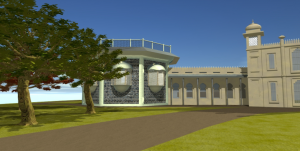
Earlier this year I posted about our work with 3D digital technology, and how you would be able to see more examples this year. To accompany our Visions of the Royal Pavilion Estate exhibition which opened in Brighton Museum last week, volunteer Colin Jones has produced a new model based on 1806 designs for the estate.

While Colin’s previous models have shown the Royal Pavilion estate as it is today, or how it once looked, this model shows the estate as it might have been. This is the Royal Pavilion in a form that was never built, a design that only existed in the pages of a book and the imagination of its designer, Humphry Repton.

For anyone who knows central Brighton, this model will appear both familiar and strange. Brighton Dome, the former stable complex which was completed in 1808, appears as it does today. But the Royal Pavilion looks very different, and the west garden, which now features a conservatory, is much more secluded. A hotspot on the northern edge of the building shifts the viewing point to the other side of the building, revealing a proposed observatory.

The model can be sampled below, but is best viewed in full screen.

This model does not feature any additional information or audio commentary, but it is intended to help tell the story of Repton’s book. Original illustrations from Repton’s designs can be seen in the Visions of the Royal Pavilion Estate exhibition, but you can also download a copy of the book and listen to Royal Pavilion curator Alexandra Loske discussing Repton’s book on our Tales from the Pavilion Archive web pages.

What excites me about Colin’s model is how it makes the book more accessible. I find maps and plans fascinating, but I lack the spatial imagination to visualise how they would translate into a 3D space. Colin’s model does precisely that, and this is probably the closest we will ever get to seeing how the Royal Pavilion might have looked if history (or rather Prince George) — had taken a different course.

As ever, my sincere thanks go to Colin for his work on this model, and for my curatorial colleagues who have supported this work.

Kevin Bacon, Digital Manager

International Women’s Day celebrations at Brighton Museum

Votes for Women badges

This is a legacy story from an earlier version of our website. It may contain some formatting issues and broken links.

On Wednesday 8 March, people of the world threw their fists in the air for International Women’s Day – a day that has been celebrated since 1909 to commemorate the movement for women’s rights.

We couldn’t not have a celebration of our own, so on Saturday 4 March, Brighton Museum & Art Gallery joined forces with Brighton Dome and Brighton Women’s Centre to throw a good old-fashioned shin-dig. With entry to the museum free all day and a specially curated programme of inspiring speakers, activists and innovators, workshops, arts and crafts, causes and campaigns for everyone, it was looking set to be a big one – and it didn’t disappoint!

The day began at 10am, and the hordes of revellers were impressive and steady from the get-go. The Dome café boasted a vibrant marketplace of ideas, from a pop-up sari shop to SmallHillArts’ stall dedicated to Communal Quilting; the creation of a communal, unconventional patchwork quilt by members of the public. Upstairs in the Dome’s mezzanine bar was the Cultural Sharing Area, a space for an eclectic mix of artists and public speakers to come together to celebrate and provide historical context to International Women’s Day.

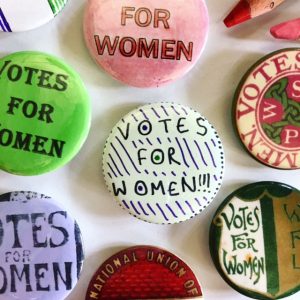
Photo of coloured Votes for Women badgesThe museum was rammed to the rafters with things to listen to, look at and get stuck into, and on arrival it was virtually impossible to choose where to check out first! The Museum Lab seemed a good bet, with the option to craft one’s own ‘Votes For Women’ pin badge and have a chin-wag with some important women from history. Brighton suffragette Minnie Turner and fossil hunter Mary Anning were present to greet visitors, offer their insights and talk us through some of Brighton Museums’ collections. Satisfied with my new badge and pumped by my chats with Minnie and Mary, I decided to venture along to the exhibition gallery, where word around the campfire had it that something interesting was going on.

21 Years / 21 Works is the live and online collection of choreographer Charlotte Vincent’s work – and the power behind the pop-up Virgin Territory workspace in the exhibition gallery last Saturday. The thought-provoking space encouraged visitors to reflect and respond to how our digitised, porn-infused culture is affecting young people’s identities, personal choices and relationships. Through various media of art, we were invited to share our thoughts on areas such as the hyper-sexualisation of children in fashion, music videos that make us feel uncomfortable, sexual consent and the way in which women in magazines are punished and judged no matter how their bodies are presented. Not only was I blown away by the striking and slightly haunting aesthetic of the space, which had been an empty husk of a room just days beforehand, but left hugely disconcerted by the ideas presented and thoughts evoked – the workspace did its job.

Photo of t-shirt bearing slogan 'Girls have the Right to Speak'

In the Fashion & Style Gallery a mannequin had appeared, inviting passers-by to decorate her figure with Post-It notes suggesting how and why she might want to alter her body. Continuing to provoke discussion on cosmetic alterations and body image were boards sharing hair-raising facts about the complete inaccuracy of a Barbie doll’s proportions – did you know that Barbie’s neck is twice as long as and six inches thinner than the average woman’s, meaning she’d be incapable of lifting her own head? Or that with feet and ankles so miniature and such top-heavy weight distribution, she’d have to walk about on all fours? It’s no wonder our ideas about physical ‘perfection’ have become so unattainable and warped.

Also filling the Fashion & Style gallery was a newly created soundscape exploring the creative responses of thirteen young women who used the gallery itself to explore themes of identity and self-image.

Photo of people watching talk in art galleryThroughout the day, other activities and special features included pop-up talks from curator Dr Alexandra Loske on paintings by female artists; walking tours of the Royal Pavilion Estate from tour guide Louise Peskitt to explore the important women of Brighton’s history; an open discussion on what it means to be a feminist in the 21st century, hosted by Brighton Women’s Centre; and a presentation in the Old Courtroom from renowned photographers Marilyn Stafford and Nina Emett of their work based on the theme of women.

In the Education Pavilion, a series of short talks were held throughout the day. The first I popped my head into was at 12.30pm and from Laura Barton, writer and journalist (mostly for The Guardian), about travelling alone as a woman. Laura has spent many a year globe-trotting solitary and has found it peppered with equal measures of pleasures and challenges. In Laura’s talk she discussed not only the new perspectives that travelling alone as a woman can bring, but the general assumptions and reactions of others when they learn that a lone female traveller is what you are. (The words ‘slut’, ‘suspicious’ and ‘failure’ were each mentioned more than once). One particular quote from Laura really resonated with me: ‘We are not encouraged as girls or women to go anywhere alone – it is not deemed becoming to explore those edges of ourselves.’

Next was Fat Bodies with Mathilda Gregory, another Education Pavilion-based talk – this one centred on society’s reactions to and fears about fat bodies. Mathilda is the world’s most famous werewolf erotica author in the world – but is also a writer and performer who makes work about bodies and popular culture. With a light-hearted air, Mathilda chatted to us about her experiences in life and in talking so publically about her own body – and explained how one of the reactions she receives most frequently at the end of her shows is “But you’re not fat!” This displeases Mathilda; instead of feeling that fat bodies are so upsetting and abhorrent that they must be denied, we should consider starting to openly accept that we are what we are – and that’s not the end of the world.

At 2.45pm, the Fashion & Style Gallery became hushed and filled from wall to wall with audience members, all present to hear musician and writer Helen Reddington (aka Helen McCookerybook) lift the lid on women in the punk scene. Unfortunately I wasn’t able to sit in on the entire talk, but stuck around just long enough to listen to Helen share some anecdotes about her youth as a Brighton punk – think running away from the police and being inspired by X-Ray Spex’s Poly Styrene.

To round off the day, I took part in a workshop called Blog to Express, Not Impress from Brighton Girl editors Pippa and Sofaya. Brighton Girl is an online and printed magazine for young women living and working in Brighton, also hosting events and meet-ups to bring the community together. As a group, we discussed where we currently are on our respective blogging journeys, challenges we face and what frightens us most about the big, scary blogging world. An eclectic mix, the group ranged from seasoned bloggers with impressive readerships to complete novices. One particular member runs a blog campaigning for an end to the production and use of nuclear weapons, whilst another has plans to start a blog dedicated to speaking frankly about her illness. When asked what their top blogging tip would be for us, Pippa and Sofaya kept it simple – really, there are no rules. Writing without too much thought, in a way in which you feel comfortable, is the key to success. Each and every one of us has a different voice, and blogging is all about celebrating that.

And with that, the fun and games had drawn to a close, the museum’s walls heaving a heavy sigh as the excitable revellers filed out into the evening. I had a brilliant day and came away feeling both reflective and inspired. The only disappointment was my not seeing and doing everything I possibly could have – there simply weren’t enough hours in the day! What I was left with, though, was the complete satisfaction that this world is full of strong, creative and inspirational women – young and old – all passionate about making the world a better place. To everybody who spoke, oversaw, performed, organised, helped out and everything in between: thank you.

Ruby McGonigle
Bookings Office and Retail Assistant, Royal Pavilion & Museums


International Women’s Day, The Things Women Do To Feel Beautiful

Two Chinese ‘lotus’ shoes (not a pair)

This is a legacy story from an earlier version of our website. It may contain some formatting issues and broken links.

International Women’s Day is a worldwide event which celebrates the achievements of women, while also calling out for gender equality.

On Monday the 13th of February a group of young women collaborated with Brighton Museum to explore issues such as ‘the things women do to feel beautiful’ ahead of International Women’s Day and to look at the way women are represented in today’s society.

The group was a combination of different cultures, languages and backgrounds. Everyone had strong opinions on what they felt was right, or not, when it came to changing yourself to be beautiful. For the majority of the girls it was their first time meeting each other. We spent the morning learning each other’s names and finding out things we had in common. A couple of girls were thrilled when they found out they were both from the same part of the world, other girls were shocked about how similar their taste in music was despite having completely different lives.

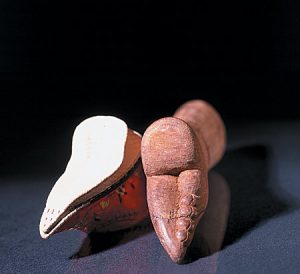
We had the chance to look at some objects which the Museum brought out of storage. These included tiny shoes and a corset. When the young women were asked who they thought the shoes were designed for, they said children, or possible china dolls. It was a sensible assumption because of the size, but the shoes were actually designed for Chinese women who had bound their feet.

Two Chinese ‘lotus’ shoes (not a pair)

After learning what ‘foot binding’ involved, the girls look mortified. Everyone was shocked by the amount of pain and suffering those women went through just to be considered beautiful. It was a difficult subject to talk about, everyone was in agreement that it was wrong but it was also mentioned that, if the women wanted to bind their feet, then who were we to say that they couldn’t.

We discussed the reasons the women might have wanted to look that way; to seem more attractive to men, to show they were wealthy and didn’t need to work, or to be the same as the other girls who had ‘lotus feet’. Despite these reasons the group was in agreement that it wasn’t right.

In the same way some Chinese women bound their feet, Victorian women in England wore corsets to make their waists smaller. Despite the risks and the discomfort they caused, it was almost mandatory to wear one. It was believed to make women seem more sexually appealing to men, made them appear thinner and their busts larger.

In groups we made lists of all the things modern day women do to change their appearance. We only had several minutes but the lists seemed to be endless. Ranging from makeup to surgery, it seemed insane how many different things women would put themselves through just to feel what is considered, to many girls nowadays, as… normal. Looking at the lists we realised not much has changed since the times of corsets and foot binding, women haven’t stopped altering their appearance, the methods haven’t become painless or risk free, they have just become more widely available and are viewed as nothing out of the ordinary.

Just some of things women do to change their appearance

The girl’s discussions and thoughts were recorded throughout the day. As they wandered around the Fashion and Style gallery at Brighton museum they discussed which outfits were most beautiful or most comfortable, they talked about what was the most conformist and the most outgoing. All the discussions, thoughts and opinions from the activities were saved so they could be made into a ‘sound loop’ to be played on International Women Day.

We ended the day making music out of sounds. It was very strange, someone sticking a microphone in your face saying “make noise”. If we had started the day with this activity I don’t even think I would have be able to join in but after a whole day of getting to know each other and laughing and sharing thoughts, we all felt completely comfortable. It was the best part of the day in my eyes. Everyone went straight for it, everyone had fun and the piece of ‘music’ we made at the end was absolutely brilliant.

You can hear the soundscape in Fashion & Style Gallery at Brighton Museum as part of the International Women’s Day Celebrations on Saturday 4th March. Find out more about what is going on here.

Don’t worry if you miss it you can also visit it on the 5th, 11th and 12th of March.

Ellen Hall, Learning Museum Trainee

A Day in the Life of a Booth Volunteer

Tortoise shell and skull

This is a legacy story from an earlier version of our website. It may contain some formatting issues and broken links.

I have been volunteering at the Booth Museum since October 2016.

So far I have been cataloguing bird skins, which means cataloguing on to the database many of the birds that have been preserved and archived in the Museum. It has been a very helpful way of increasing my knowledge on birds and enabled me to see what some birds actually look like close up – birds being notoriously hard to get close to! It has also been interesting to see when the birds were collected and where. Many specimens have been preserved in pretty good condition since the end of the 1890s. Some birds were given as a gift to the museum from other parts of the world, namely Japan, Holland and Norway. You can see photos and find further information on these birds on the Museum website.

I have also tried my hand at photographing the birds and the training on object handling that we had really helped with manoeuvring the birds in to position.

But it’s not just the tasks you are given which is so interesting about working at the Booth it is the things that happen around you. On my first day volunteering just by chance someone returned a piece of meteor which they had borrowed from the museum. The meteor was found in Argentina sometime in the early 1500s – around the time of Henry VIII reign! What’s more it was really heavy. I don’t think I have ever thought about how much a meteor would weigh! But the fact that I was holding a piece of meteor found in the early 1500s to me was slightly mind blowing!

Last week I came to do my weekly volunteering session at the Booth museum and the writer in residence Mick Jackson (who had worked here the year before researching the Booth) showed us several books he had found which were handmade, written and illustrated by a Collectors wife in 1930. The books were works of art not only in their description of a bike ride through the Sussex Downs in 1930s rural Britain but also in their illustration, through hand painted drawings, of the wildlife she saw on her journey. A particular highlight being an inventory of the birds she saw every morning on waking and her absolute delight in encountering a moorhen that was nesting on the ground nearby. I was also fascinated by the menu she had included of what they ate and drank throughout their tour. Ryvita being a particular favourite snack (I didn’t realise Ryvita existed then!) It was an incredible example of someone’s personal and beautiful account of the natural world around them which has since become part of our natural history.

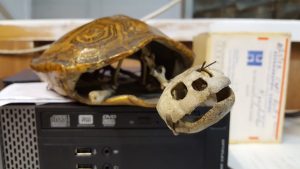
As I sit writing this I am sitting opposite a tortoise shell and skull of the tortoise head which is still all intact. Never having seen this before I look at the tortoise skull and observe the back bone goes from the base of the skull down to the shell where the vertebrae fuse to the shell almost immediately underneath the topside of the shell. As a child I had often wondered whether tortoises could separate from their shell I now know for certain they cannot! Something I may tell my son later on today.

My tasks next week are to work with the paper butterflies. I will be learning how to photograph, catalogue, preserve and display them. Every week I look forward to coming and when I arrive my supervisor, Grace, who is very knowledgeable and friendly, fills me in on the tasks for the day. Now I’m just going to take a look at the tarantula sitting behind me…!

Catherine, Booth Museum Volunteer