Story Category: Legacy

Madeira Terrace in Battledress

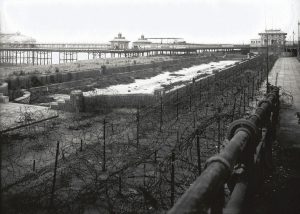
Brighton seafront defences, c1940

This is a legacy story from an earlier version of our website. It may contain some formatting issues and broken links.

Did you know that Madeira Terrace played a role in Brighton’s seafront defences during the Second World War? As the Save Madeira Terrace crowdfunding campaign continues, it is worth remembering there was a time when this famous section of Brighton’s seafront architecture faced a very different threat.

Photo of Brighton seafront defences, c1940. View east towards West Pier.

Brighton seafront defences, c1940

After the defeat of France in June 1940, Britain was faced with the danger of a German invasion from across the Channel. The South East of England suddenly became a potential front line. Brighton’s beaches were closed off, and the central sections of the town’s two piers were dismantled so they could not be used as landing stages by enemy troops. Barbed wire and barricades were constructed along the whole seafront.

The German invasion was postponed by the Battle of Britain in the summer of 1940, and ultimately halted by Hitler’s decision to attack the Soviet Union in June 1941. But the threat was very real, as this German reconnaissance photo of Brighton shows.

Luftwaffe reconnaissance photo of Brighton, 1940


Taken by the German air force, the Luftwaffe, in 1940, the photo has marked the dismantled sections of the West Pier and Palace Pier. It’s clear evidence that the Germans were using aircraft to survey Britain’s coastal defences, and it shows why the covered walkway of Madeira Terrace was useful in hiding some of these defence measures from enemy eyes.

The best record we have of Brighton’s seafront defences is a series of photographs taken by the local authority in August 1944. Following the successful D-Day landings in June that year, the beaches were considered safe to reopen. The town’s Borough Surveyor’s department recorded some of these defences as they were cleared away, and these photographs are available to view and download from our Digital Media Bank. One shows a large covered oil tank  situated beneath Madeira Terrace. A section of the structure’s distinctive latticework can also be seen on the right of the photograph, presumably as it was waiting to be reattached following the tank’s removal.

Photo of Fuel tank beneath Madeira Terrace, August 1944

Fuel tank beneath Madeira Terrace, August 1944

It’s possible that this may have been an emergency fuel store for vehicles, and was covered to discourage theft. But it’s more likely to have been set up for use as a potential weapon. In the event of an invasion, oil could have been sprayed onto the beach and the sea and set alight, creating a wall of fire against enemy soldiers.

Although the threat of a military invasion has long passed, Madeira Terrace is in urgent need of funds to save it from irreversible disrepair. To find out how you can help, visit the Save Madeira Terrace crowdfunding page. (Update 28/12/18: the funding target was achieved, and work will begin on the restoration in Spring 2019.)

Kevin Bacon, Digital Manager


The Beauty of Small Things

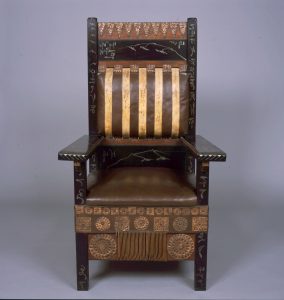
da300157, Chair, c1890-1900, by Carlo Bugatti, Italy

This is a legacy story from an earlier version of our website. It may contain some formatting issues and broken links.

In May, 33 prop-making students from Brighton Metropolitan College (part of the Northbrook College Campus) spent a day in Brighton Museum drawing inspiration from the eclectic collection of furniture in the 20th Century gallery.

Students and their workbooks outside Brighton Museum

The students’ task was to choose an object that resonated with them. The outcome was to construct a small scale 1:6 replica model, informed by independent research.

Three different scale 1.6 interpretations of the Bugatti chair, shown below. Model-makers: Charles Watkinson Stack, Victoria Lowe and Ben May.

da300157, Chair, c1890-1900, by Carlo Bugatti, Italy

Many students explored the historical context of their chosen piece, looking at its particular narrative or its maker etc. Investigations into the making methods of the original furniture influenced construction of the models. A broad range of materials was used – including everyday household items.

The green tacks, included for comparison in some of the images, show just how small the models are.

Marta Rodrigues, Nicola Gunne and Ed Leader made versions of A Trapped Star/ Irawo Ta De Mole chair, 2015, by Yinka Ilori (photograph by Veerle Evens), UK; the Garden Egg chair, c1968, by Peter Ghyczy, Germany; and the Max Le Verrier lamp, 1925, France.

This was an opportunity for students to develop their model-making skills and learn new making techniques through experimentation. Each piece was made with different methods informed by technical drawing and keen attention to detail.

Students working on their models. 

Staff at Brighton Museum were truly impressed with the students’ results. The pieces are perfect small replicas of familiar furniture in the Decorative Art collection, imaginatively constructed and minutely observed.

Elizabeth Johnson, Raj Dutta and Luke Hemming made versions of the Mae West’s Lips sofa, c1938, by Salvador Dali and Edward James, UK; the Mercier Freres chair, 1920-25, France; and the Clair de Lune screen, c1928, by Jean Dunand, France.

This project was the last of a busy learning year, in which students engaged in projects that focused on sculpting, moulding and casting, fabrication, metal and wood work.

Aaron Kealy, Ed Sole, Katie Merrit and Rebecca Cran made versions of the Fontane cabinet, c1925, by Emile-Jacques Ruhlmann, France; a chair and desk, c1905, by E A Taylor, UK, and a Louis Majorelle writing desk, c1900, France.

Lecturers on the course, Rowena Boshier and Caroline Testa, said this:

The fantastically varied collection of 20th century furniture at Brighton Museum acted as a wonderful stimulus for students to hone their skills and demonstrate their abilities in these well-crafted models. RB

When “learners are given responsibility…and opportunities” they begin “thinking for themselves”. (p137 Bowkett 2007). As lecturers, we believe trips like this strengthen responsibility, engagement and self-confidence. CT

Sophie Simpson, Oli Vaughn, Jacob Huxford and Will Foreman made models of the Contour chair, 1968, by David Colwel, UK; the Long Chair, 1935-6, by Marcel Breuer, UK; and the Prince of Wales chair, 1969, by Snowdon and Toms, UK.

The students’ course is a Foundation Degree in Prop Making and Special Effects.

More information and other examples of the students’ work can be found by clicking these links:

https://propsuk.com/

https://www.instagram.com/met.propsuk/ 

All photographs of the models are by Stephanie Farmer.

Crank up the digital!

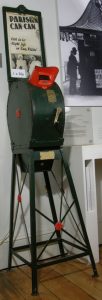
Mutoscope in Brighton Museum

This is a legacy story from an earlier version of our website. It may contain some formatting issues and broken links.

This Wednesday the University of Lancaster will be bringing a hand-cranked digital device to Brighton Museum. While the phrase ‘hand-cranked’ seldom features in descriptions of cutting-edge technology, there are very good reasons why this belongs in this year’s Brighton Digital Festival programme.

What the Butler Saw

Mutoscope in Brighton Museum

The ‘crank machine’ we will be showcasing on Wednesday is inspired by the mutoscope. Originally developed in the 1890s, a mutoscope is a device that produces simple animations. The user turns a handle to rapdily flick through a series of paper images, producing an effect similar to watching a short silent movie.

Mutoscopes rely on the user peering through a small viewer, so they can only be used by one person at a time. Many mutoscopes produced in their Edwardian heyday took advantage of this feature to present risque content. We have an original mutoscope on display in Brighton Museum’s Images of Brighton gallery which features the then notorious ‘Parisian Can Can’ dance. Even today mutoscopes are more commonly known as ‘what the butler saw’ machines, named after one popular example.

Edwardian technology

The crank machine we’ll be showcasing on Wednesday is perfectly safe for families. The content on this device will be focused on another great Edwardian invention: the double backed postcard.

Launched in Britain in 1902, the double backed postcard revolutionised popular communication. By providing a cheap medium in which simple messages could be sent alongside an accompanying image, postcards became enormously popular. At a time when a postcard could be posted in the morning and arrive by lunchtime, the Edwardian postcard anticipated the rapid sharing of text and images through socal media by almost a century.

The digitised postcards used in the crank machine come from the University of Lancaster’s Edwardian Postcard Project collection and our own postcard collections. With the help of a metadata switch, the crank machine will allow the viewer to look through themed arrangements of the two collections, bringing the texts and images together in a new form.

Interfacing the future

The crank machine was built by Adrian Gradinar of the University of Lancaster’s Physical Social Network project team. Although I have yet to try the finished version, I am intrigued by the new interaction on offer here.

Adding a mechanical handle to a computer may seem unnecessary and counter-intuitive, but it may make a lot of sense in a museum environment. Visitors navigate museums in complex and distinct patterns, and different users respond to different means of presenting information. For example, a few of our galleries feature touchscreen interactives that allow visitors to learn more about the subject of the display. But my estimate is that only about 5% of visitors ever use these — and this is hardly surprising. Only a minority of visitors are ever likely to want to know more about any given subject; many are more likely to be focused on the social aspects of their visit (such as keeping a relative or child entertained), others will be looking to relax rather than becoming highly engaged with the displays, and others will quickly suffer museum fatigue — there is already a huge amount of information to absorb.

But what if a digital interactive can become part of a spectacle? A touchscreen interactive might have seemed moderately unusual in the 1990s, but with around 80% of us owning a smart phone or a tablet these are now too common to notice. Can a mechanical handle disrupt that, by enhancing curiosity and inviting visitors to engage with the interactive?

There is also a question of intimacy. Like most medium to large museums, the main mechanism by which we present our digitised collections is through searchable databases. But these are buit around managing and presenting large quantities of data. A user has to do a fair bit of searching before they are likely to focus on a single digitised object. By contrast, the crank machine is built around intimacy, presenting a single postcard at a time, and in a format where the object becomes the user’s sole focus. Can this invite a new relationship with these historic postcards?

Test the crank machine and tell us what you think

If you can join us this Wednesday, come and have a play with the crank machine in Brighton Museum’s MuseumLab from 2-5pm. In addition to trying the machine, you can also chat to Adrian Gradinar and Julia Gillen of the University of Lancaster about their work. I will also be on hand to chat about our digitised collections, and our involvement in the project.

I’m looking forward to welcoming Adrian and Julia and their marvellous machine to Brighton this week. Although Brighton and Lancaster are opposite ends of the country, Brighton seems the perfect place to bring a device that celebrates two technologies — mutoscopes and postcards — which are often associated with the pleasurable escapism of the seaside resort.

Kevin Bacon, Digital Manager

Brighton Digital Festival 2017 logo


Working with Wikipedia and Testing Tours

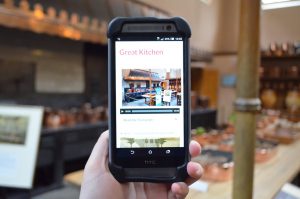
Royal Pavilion mobile audio tour

This is a legacy story from an earlier version of our website. It may contain some formatting issues and broken links.

This Saturday we’ll be running a Wikipedia Edit-a-thon in Brighton Museum. Part of this year’s Brighton Digital Festival, it will be an opportunity for you to learn more about editing Wikipedia from a member of Wikimedia UK, a chance to meet some of our curators, and help improve the online presence of our African fashion collections.

I will also be on hand to ask for your help with a different digital project. I’m looking for volunteers who would be willing to test a new audio tour of Brighton Museum that we’re developing. The tour is still in its early stages, with only a small amount of sample content, but there are several features I’m keen on testing.

Before I explain why we need to test this so early, I’ll talk a little about my experience in developing audio tours.

Linearity and Serendipity

Last weekend I talked to the Fresh Start group in Portslade’s Easthill Park about developing mobile tours. They are working on a community created tour of Portslade Old Village, and I was invited to share a few tips from my experience of working with on these sorts of projects.

While preparing for the talk, I reallised how much time I’ve spent over the last few years working on audio tours of one form or another. These projects have included the revised audio tour for hired handsets in the Royal Pavilion; developing content for the dedicated WW1 military hospital tour of the Royal Pavilion; the Story Drop app the smartphone version of the Royal Pavilion tour; and, most recently, some prototyping with Blast Theory.

Over the years, I’ve learned a few dos and don’ts which I was able to share with the group, but it reminded me that while audio tours all seem to do a similar job, they can be very different in practice. Seemingly small variances in user behaviour, narrative style, and the subject matter can all have a huge bearing on how the tour needs to be developed, and how well it wil work for the audience. In many ways, the technology is the simplest element.

Royal Pavilion mobile audio tour

As an example, the Pavilion tour is a relatively straightforward experience: the user listens to a story in a room, walks to the next room, and then listens to the next story. It’s a simple linear progression that was very easy to convert into a website for mobile phones last year.

A tour for Brighton Museum simply can’t work the same way. Once a visitor steps over the threshold, there is no single route they have to follow. We could insist that they follow one for the purposes of the tour, but while that may be helpful for some visitors, for many it will feel like an artifical imposition that’s at odds with the layout of the building.

As a result the tour we’re developing for Brighton Museum can’t be structured around linearity. Instead, it needs to embrace serendipity — how can it aid and provide pleasurable discovery? That is a tougher challenge.

Storytelling

Screeng rab from protoype Brighton Museum mobile tourDesigning the tour so that it can facilitate a more open form of navigation is one answer to this challenge. Another is to find ways of telling stories about the exhibits that will grab and hold attention.

Brighton Museum contains a variety of galleries that reflect our eclectic collections. There is no single theme or narrative that brings them together, other than the circumstances of those who donated the founding collections to the museum in the 19th century. As such, the stories have to fragment and splinter, usually becoming tales about individual items on display rather than a grand narrative about the museum.

Our tour is built around two potential solutions to these problems of navigation and narrative. But do they work? Only you can tell us.

Join us

If you are able to pop in and test the tour, I will be available from 10.30am until 4pm in Brighton Museum’s MuseumLab. Please bring your own phone for the test. The tour runs from a mobile website, so there is no need to download and install an app. Free wifi is available in the museum.

See our Brighton Museum pages for details on admission charges.

If you’re interested in coming along, but would like to learn more, do please drop me a line at kevin.bacon@brighton-hove.gov.uk.

If you’d like to know more about our Wikipedia Edit-a-thon, please contact my colleague Stephen Kisko at stephen.kisko@brighton-hove.gov.uk.

Kevin Bacon, Digital Manager


More information

Lily MacDonald: a ghost-seeing enigma at Preston Manor

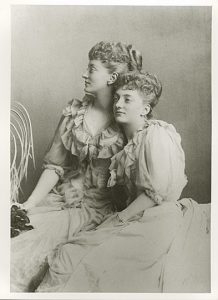
Diana and Christiana (Lily) Macdonald 1887

This is a legacy story from an earlier version of our website. It may contain some formatting issues and broken links.

This month marks the 70th anniversary of the death of Christiana ‘Lily’ Blanche Ashworth Macdonald. One of Preston Manor’s more enigmatic residents, Lily’s outwardly quiet life touched upon the supernatural, the mysterious death of a fiancé, and the Aesthetic movement popularised by Oscar Wilde.

B&W photo of two young twin sisters

Diana and Christiana (Lily) Macdonald 1887

Lily was born at Preston Manor in 1866, alongisde her twin sister Diana.The twins were younger half-sisters to Ellen Thomas-Stanford, who would become the last private owner of Preston Manor.

We know rather more about Diana, who outlived Lily by nine years. This is possibly because she married and led a conventional life, but also because she corresponded with Henry Roberts, Preston Manor’s first curator, and letters exist in her decorative, looping handwriting which reveal some of her character. Lily, however, remains an enigma: the puzzling silent twin.

A ghostly ‘White Lady’

Lily and Diana are best remembered for their brush with the paranormal, as they both saw the famous ghost of the White Lady whilst growing up in the house.

Lily related a vivid encounter to her nephew, John Benett-Stanford, who passed the report to Henry Roberts in the hope he might include the sighting in a guidebook to the new Preston Manor museum.

‘Miss Lily Macdonald tells me that in October or November 1896 as she was trying a new lampshade in the Drawing Room at Preston Manor, the ghost walked in at the door and came straight to her as if to speak. Miss M recognised it as the ghost, seeing her white dress and hair hanging down. She followed the ghost through the Billiard Room to the foot of the stairs, then put her arm around her saying ‘No – you don’t go now’. Miss M’s arms went through the figure and it disappeared at once.’

The Cleves Room c.1896 with vase of white lilies

Later that year Lily and her mother invited two renowned paranormalists to Preston Manor: Ada Goodrich Freer, a spiritualistic medium and Assistant Editor of Borderland, the leading spiritualist magazine of the day; and Thomas Douglas Murray, a member of the illustrious Ghost Club. Together in the Cleves Room the group held a séance with the aim of contacting the ghost to find out why she wandered the house. The dramatic results of the séance remain inconclusive.

The ghost of the White Lady at Preston Manor was described in detail by Lily and Diana. They say she was dressed in flowing white robes and wore her golden hair loose. Although spoken to, clearly she did not reply. Interpretation to date has relied on Ada Goodrich Freer’s suggestion that the ghost was a nun called Sister Agnes. However, descriptions of the White Lady do not mention a nun’s habit, and what nun has long blonde hair?

Further doubt must be cast on Freer’s identification because in 1897 she was denounced as a fraudulent medium and thereafter fled in disgrace to America. Perhaps the White Lady should have been addressed in Latin, as Diana’s description fits that of a high-born Roman woman of the classical period. Preston Manor sits in a part of Brighton known to be Romano-British archaeologically, so perhaps the sisters saw a Roman ghost?

From Goddesses to Mephistopheles

Christiana Macdonald styled herself ‘Lily’, rejecting her birth name for reasons unknown. A carte-de-visité photograph taken in about 1886 shows a fragile young woman photographed from the back, her head turned to make the most of her slender neck and heart-shaped face in three-quarter profile. With her abundant curled hair piled high she wears a ruffle-backed white dress, corseted at the waist with huge gauzy puffed sleeves.

Photograph of Lily by society photographer Alfred D Kissack, 130 High Street Eton, Windsor

Whiteness and purity surround Lily Macdonald. Even from birth she is associated with white. Her middle name Blanche translates as ‘white’ in French, derived from the Latin blancus. Her chosen name of Lily also refers to a white flower.

Had Lily married she may have chosen lilies for her bridal bouquet. According to the Victorian Language of Flowers the lily spoke of virginity and even divinity, for in Christianity the lily is the emblem of the Virgin Mary. For the ancient Greeks the lily was associated with the powerful goddess Hera, Queen of Heaven and wife of Zeus.

Lily sitting on the lawn outside Preston Manor with dachshunds, Bushey and Faust, c1890

Lily would have spent her girlhood at Preston Manor becoming skilled in ladylike accomplishments considered essential to attracting a prestigious suitor, yet she did not marry. This was unusual for a woman of her era and social standing. Instead Lily poured her heart into her pets. Keeping little dogs was a popular pastime in Lily’s day, equal to the modern trend for miniature lap-dogs.

Victorian and Edwardian dachshunds were often given German names but Lily’s choice of Faust and Bushey may hint at a darker side to her character. Faust is a character from German legend, a scholar who makes a pact with a demon, Mephistopheles, gaining a short life of knowledge and pleasure in exchange for eternal damnation.

One remaining sign of Lily’s affection for her pets is the pet cemetery at Preston Manor, which she created with Diana.

A mystery worthy of Agatha Christie

The darkest known episode in Lily’s life was the untimely death of her first fiancé, William Frederick Forsyth Grant.

William of Clan Grant was a member of the landed gentry in Scotland, passing his time as Captain and Acting Adjutant of the Forfar and Kincardineshire Militia Artillery. He was a man accustomed to handling weapons, a fact that puts a question mark over the events leading up to his death.

Grant died at his family home, Ecclesgreig Castle, on 27 January 1902. According to local newspaper reports William died as a result of tripping over a rug with a knife in his hand. This seems to me a spectacularly clumsy accident for a soldier and country sportsman. Was his death suicide, or even murder? Curiously William was buried after a mere three days. Why the haste?

William’s death certificate has been recently acquired from The Highland Archive, Inverness. This shows the cause of death as a ‘wound in chest – haemorrhage’. William died of asphyxiation in the arms of his brother, Maurice, after three agonising hours. He was 33 years old.

William’s last will and testament dated 1 May 1901 speaks of his devotion and intentions towards Lily.

‘I hereby leave to Miss Christiana Blanche Ashworth Macdonald (Lil) absolutely all and every fully paid share I may be possessed of at the time of my decease and any and all policies on my life i.e. any money accruing on my death and all cash etc. in any bank etc.’

William left just over £12,000 in stock, bonds and life insurance (worth in the region of £1.5 million today). Decorum of the age suggests Lily never availed herself of this blood-soaked inheritance, not least because she had disengaged herself from William days before his death in favour of Captain Jackson, fiancé number two. Little is now known of this man except that he painted four interior views of Preston Manor in watercolour.

The Dining Room at Preston Manor, c1896


Secrets to the grave

Following her mother’s death at Preston Manor in 1903, Lily spent her adult life in London. The 1911 census shows 45 year old Lily living at 28 Chapel Street in London’s exclusive Belgravia. She lived alone looked after by Alice Good, a parlour maid aged 21. When Diana was widowed in the early 1930s the twins set up home together at Cumberland Mansions, a grand apartment block near Hyde Park.

We don’t know why Lily never married although she didn’t need a husband for financial support. In 1947 Lily’s worth at probate was £6,738, 6s 2d at a time when two thousand pounds would buy a good sized family house.

I recently applied for access to Lily Macdonald’s will and the document reveals some interesting facts. Lily bequeathed most of her possessions to her twin, Diana, and nieces Phyllis Porteous and Lilas Campion (née Porteous), daughters of the twins’ older sister, Flora. A charming collection of miniature family portraits were left to Preston Manor and can be seen on display today.

It seems common practice for families associated with Preston Manor to make provision for favoured servants in their wills. Lily was no exception. She bequeathed £500 to her maid, Kate Good (perhaps a relation of her parlour maid Alice), ‘in recognition of many years faithful service’. In 1947 this amount was a substantial sum equalling two years wages for Kate.

Whatever secrets Lily held, she took them to her grave. I believe Lily had many secrets, not least, perhaps, the full story behind William Grant’s death. Frustratingly Lily left the following clause in her will:

‘I also give free of duty to the said Lilas Campion all my dispatch boxes and their contents and all my other private papers with the request that she will burn unread all my private letters at once.’

St Peter’s Church, Preston

Lily died aged 81 on 15 August 1947. She was cremated so she might be laid to rest at the church of St. Peter’s next to her childhood home — burials had ceased in the churchyard from 1870. Curator Henry Roberts closed Preston Manor for the afternoon of 20 August 1947 so he might play a key role in the ceremony and host the wake in the house.

He wrote a poignant letter to the family solicitor, F Bentham Stevens of Marlborough Place, describing Lily’s funeral and internment of ashes.

‘We left the Manor by the old private way into the churchyard just before 3.30. I carried the casket, followed by Mrs Magniac and Lady Galway, Mrs Campion and Miss Philcox, the nurse and maid. In the churchyard we were met by the verger and Mr. Tomkinson. The latter took the service.’

Through Henry Roberts’s description of Lily’s funeral we know that Diana placed a sheaf of white carnations on her sister’s grave. The Roberts family cut white and mauve asters from the Manor gardens and these were placed in two vases on the altar.

Henry ends his letter by clarifying ‘what sort of tip’ one pays the verger ‘for verging’ and for ‘digging a small grave…on a very hot day.’ He thought twenty shillings (one pound) would be adequate and asked for Mr Bentham Stevens to send a cheque to A. J. Latta of 6 Bates Road.


Henry’s sharp-eyed daughter, Margery, then aged 39, added further detail in her memoir, A Time Remembered, published in 1998. She describes providing sandwiches for tea in the drawing room but was irked by Diana’s request for luxury eatables at a time of post-war shortages: ‘we had Fuller’s iced cake, chocolate madeira cake, it meant going to many places to buy the food because of rationing.’ Margery goes on to observe:

‘I don’t think Mrs Magniac, Miss Macdonald’s twin sister, really understood. They were beautiful women, but always rather aloof from everyday life and reminded me of Marie Antoinette’s famous saying about the peasants. If they can’t get bread, let them eat cake!’

An enchanting portrait: Lily the Aesthete

In the spring of 2017 a large oil painting of Lily Macdonald came up for auction in London.

Unseen outside private ownership the portrait is a rare discovery and is reproduced here by kind permission of its new owners who visited Preston Manor in June to see Lily’s childhood home and last resting place.

Portrait of Lily Macdonald by John William Schofield (1865-1944) Private collection with permission

Painted by the British artist John William Schofield, Lily is depicted seated at a small circular highly polished mahogany table in soulful profile. Her characteristic heavy head of dressed chestnut coloured hair accentuates the delicacy of her slim neck and pale arms.

Lily’s choice of costume and setting for her portrait shows she may have been influenced by Aestheticism, an approach to life opposed to the brash consumerism and ugly industrialism of the late Victorian age in favour of ‘art for art’s sake’ and the pleasure to be found in beautiful things. The poet and writer Oscar Wilde, at the height of his fame in Lily’s youth, was a leading personality of the Aesthetic Movement and acted as something of a style guru. Wilde was a supporter of dress reform and encouraged the rejection of mainstream fashion in favour of ‘artistic dress’. Embracing Wilde’s advice to discard constricting whalebone corsets and brightly dyed over-ornamented costumes, female followers wore loose flowing garments in subtle muted colours. In accordance Lily wears a diaphanous silvery-grey shawl decorated with dun-gold tassels over an unstructured black velvet gown with a low-cut white satin underdress. A soft poesy of mauve flowers pinned to her breast drops faded decorous petals onto her lap. In lieu of showy jewellery Lily wears a simple gold band on the little finger of her left hand.

Aesthetes delighted in Japanese art and indeed a Cult of Japan hit the Aesthetic home, which became filled with trays, fans, screens and teapots – and was promptly satirised by Punch magazine in cartoons depicting wilting Aesthetes swooning with delight over oriental ceramics. European trade with Japan and the influx of picturesque goods inspired librettist Gilbert and composer Sullivan to create The Mikado, their hugely successful 1885 Japanese fantasy operetta. Theatre-going crowds were enthralled and inspired by the dazzling sets and costumes made from Japanese silks purchased at the Aesthete’s emporium, Liberty & Co.

Voguishly in trend Lily is portrayed gazing upon a glass dome containing a Japanese doll figurine with shimada hairstyle wearing an embroidered silk kimono with paper parasol.

There is no indication of where or when Lily’s portrait was painted, but it may have been Preston Manor, her home in the 1890s. Could the ‘five-fold leather screen’ mentioned in her mother’s will dated 1899 be the backdrop to this picture?

Cleves Room at Preston Manor

If you visit the Cleves Room at Preston Manor you too can revel in the taste for all things oriental. Here you will find a small collection of ceramics dating to the late 19th century and originating from Japan and China, including examples of the blue and white china so beloved of Wilde and his followers. The ceramics are displayed in the approved Aesthetic manner on the mantelpiece and on plain wooden shelves.

I like to think Lily would approve.

Paula Wrightson, Venue Officer, Preston Manor
 

Museum Tales 4

This is a legacy story from an earlier version of our website. It may contain some formatting issues and broken links.

Another year and another publication for the ‘Writing at the Museum’ course run by Creative Future.

This is the forth pamphlet in the series, showing how Brighton Museum & Art Gallery continues to inspire our writers, and how every object (or painting) has its story. This publication contains a selection of work from the two courses held during 2016-2017. Writers featured in earlier Museum Tales publications are seen here again, along with new writers such as Luc(e) Raesmith, Kathleen Weigelt, Maxine Toff, Niall Drennan, James Kerr and Paul Tschinder. Participants were inspired by paintings, furniture, African fashion, punk outfits, and the many eclectic pieces in the Brighton Museum & Art Gallery collections.

Luc(e), inspired by the flower paintings in the permanent collection, writes on modern-day consumerism in his ‘Haikus for a High Street.’

Niall, in his poem ‘War, Claudia’, makes a strong emotional point about war.

Kathleen’s piece ‘Beep, Beep’ tackles female genital mutilation through a poem about a glamorous African woman.

This is a strong, and at times political, emotional and entertaining collection of writing, reflecting the divisive and diverse times we live in. As always, we greatly enjoyed reading this publication’s submissions, just as much as the participants loved writing them. We hope you will enjoy reading them and will see museum artefacts in a new life as a result – and, who knows, they may even inspire you to write.

Read them all online here,

Celia Goth – Dress Code

James Kerr – Bouquet

Jasmine Sharif – Portrait of Mrs  Betsey Chatfield

Kathleen Weigelt – Beep, Beep

Luc Raesmith – Haikus for a High Street

Maxine Toff – The Angel

Miriam Beza – Punk

Moray Sanders – The Nymph

Niall Drennan – War Claudia

Paul Tschinder – African Mannequin

Tony Spiers – Pot Oiseau

Vicky Darling – The Rebellious Octogenarian


Dominique De-Light, Director, Creative Future

Creative Future is a charity that provides training, mentoring and national showcasing opportunities, including the Creative Future Literary Awards and the Tight Modern to talented people who lack opportunities due to mental health issues, disability, health, identity or social circumstance. For more information see www.creativefuture.org.uk

Museum Tales 4: War, Claudia

This is a legacy story from an earlier version of our website. It may contain some formatting issues and broken links.

War, Claudia

War,

Claudia,

What is it good for?


Well, absolutely everything really:

the economy, science, social progress

and poetry, and then there’s engineering and

unemployment, and did I

mention, poetry?


So, chlorine or whisky?

A toast to the host,

nowhere to be seen

an officer, a gentleman,

what say you, old bean?


And down in the trenches

there’s little to do

So ve all take a Mustard

gas break, at precisely

–             10.22

Ya?


Niall Drennan

Museum Tales 4: Beep, Beep

This is a legacy story from an earlier version of our website. It may contain some formatting issues and broken links.

Beep, Beep


She glides down the catwalk

Confident in her African beauty.

Her dress an African sunset,

Swirls of purple, pink, orange and blue

Catch the light, shimmer in the photographer’s glare.

She wears her chains with ease

They don’t shackle her,

She’s reclaimed them in silk.

These feet, encased in jewel encrusted shoes,

Used to walk barefooted on her way to school.

Dust staining her toes saffron.

On Saturday she’d go market with her mother

Buy green plantain, glossy yellow peppers,

Brown dried fish. The fragrance of cinnamon,

Sage, clove and cardamom intoxicated her.

Women wore their weekend best,

Colours as dazzling as the

Vegetables and spices they were buying.

She never forgets where she came from

She’s more than a clothes horse for a nation.

She’ll keep on telling of the day when

Her mother took her to the woman’s house.

Of the lightless interior and the stench of

Disinfectant and blood.  How her mother

And grandmother held her down on the green mat

While the woman cut.  She will keep on telling

How, on her seventh birthday, she became a woman.


Kathleen Weigelt


Museum Tales 4: Bouquet

This is a legacy story from an earlier version of our website. It may contain some formatting issues and broken links.

Bouquet

My dictionary curtly defines the word ‘bouquet’ as a ‘bunch of flowers!’

Yet, over the years I’ve seen people channel their artistic tendencies into the creation of colourful, balanced and delightful floral displays. Those dedicated souls who arrange the flowers in churches, for example, surely must consider their efforts as considerably more than the mere tending of bunches of flowers. Their displays are comprised of the gatherings of numerous individual blooms which, tenderly and strategically placed in vases, reveal the wonder of nature and the botanical ingenuity of mankind.

As a member of the Creative Writing group at Brighton Museum I was spoiled for choice of inspirational objects, and privileged to work in a treasure trove of artefacts, each with the power to ignite a writer’s imagination. For today’s exercise, I went to ‘The Flower Painting Room’ to select from its array of framed paintings one with personally appealed, and then to write about it. I wandered around and gazed intently at what appeared to be a collection of still life portraits of many-hued flowers, in water-filled containers, centrally placed on the tops of wooden tables.

These images of hacked down flowering plants connected me to the memory of a most sensitive, nature loving soul I once knew. So closely attuned to the feelings of all living things in her environment that she said she felt their pain when heedlessly abused by humans. She even claimed that she could hear flowers screaming when cut and gathered for people’s frivolous, ornamental and inessential purposes. With that in mind, I turned away from the walls hung with almost copycat variations on a definite theme; the isolated, carefully bunched flowers in crystal vases.

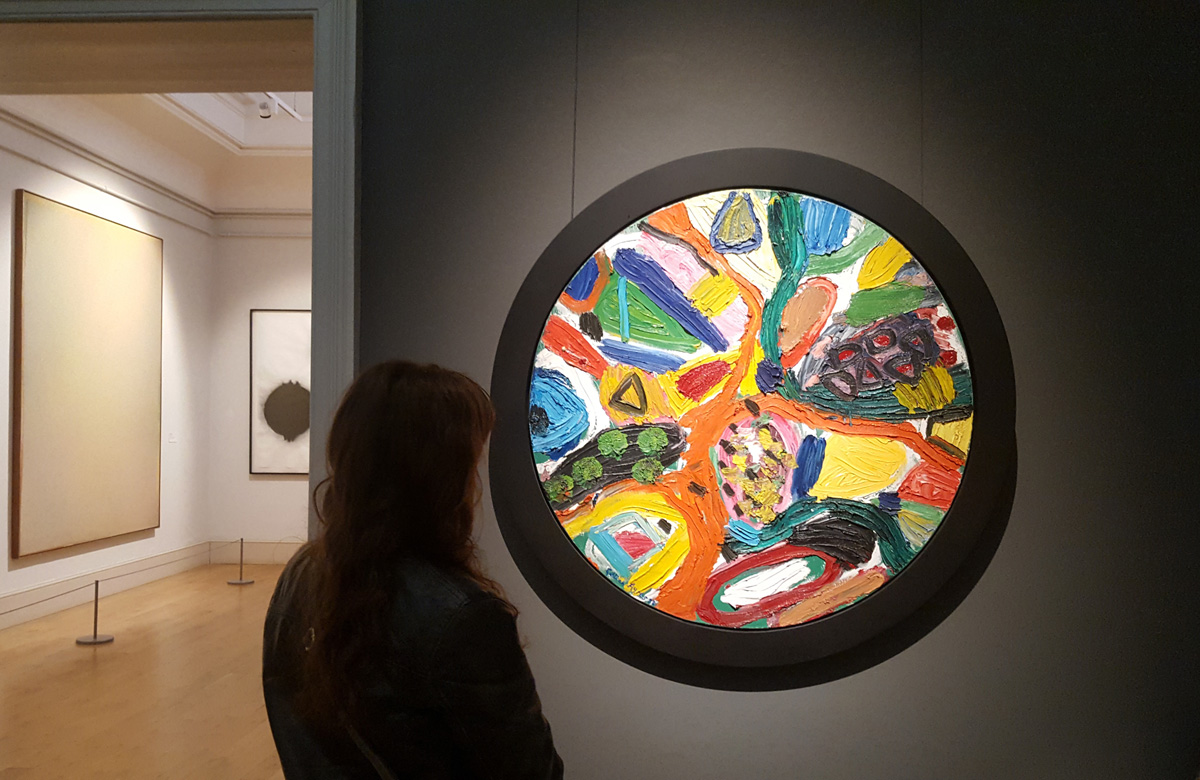
Of their own volition, my eyes focused on the brightness of a piece of abstract art that hung in a corner close to the exit. It appeared to be illuminated by sunlight or spotlights or, perhaps, by the fiercely burning spirit of its artistic creator. The painting gave me the impression, not so much of a floral bouquet, but more, much more, that of a garden full of growing flowers and plants. It was as if I was looking out through a circular window onto a distant complex of paths, shrubs and flowerbeds. It conveyed the sense that I could even smell the bouquet; actually inhale the bounty of life-giving earth. This arresting abstraction, ‘Sappho,’ was challengingly brought to life by the English artist, Gillian Ayres, CBE, RA, born 1930.

If I take away one lasting memory from this Creative Writing at the Museum experience, it will be the internal glow of her outstandingly defiant and awe inspiring piece of an original painter’s art!


James Kerr


Inspiration: Gillian Ayres’ ‘Sappho’


Museum Tales 4: The Angel

The Angel

This is a legacy story from an earlier version of our website. It may contain some formatting issues and broken links.

The Angel

Sent out to browse in the museum, I wandered into the Arctic Room. Not one I was familiar with. The print by Shuvinai Ashoona called ‘Angel in Town’ fascinated me. It shows an angel in a typical white robe, bare feet, I can’t remember if her wings were showing, I think they were.

She is hovering above a modern town, not all the houses have orange tiled roofs. It could be Portslade. The information next to the print says that this is a contemporary Inuit settlement. The buildings stand on blocks to keep them out of the snow and to prevent them sinking into the soil when the snow thaws. I look carefully but there is no igloo in sight.

What would the angel say if she landed in my town? Would she knock on doors to introduce herself or would she wait and see if anyone noticed her hovering. I hope she wasn’t cold, there wasn’t any snow in the picture but it gave no indication what the weather was like and she wasn’t very warmly dressed, not even wearing sandals.

I don’t know why I was assuming she was a female angel, not being very familiar with angels I just took a guess. Then I wondered how she would address us. Supposing it was me she found, would she say “Hallo Darling? Hallo Madam? Hallo Maxine?”

The only angels I could remember didn’t address the people they were visiting; they usually came straight out with their message “I come to bring you tidings of great joy”, that sort of thing.

Perhaps she would ask if there was anything she could do for me? I’m not sure what I would say. Would she be like a fairy and offer me a wish? Two wishes? Three wishes?

Would I be altruistic and ask for world peace or something more important that is preying on my mind? Could she arrange an accident to kill off Trump but in such a way his supporters would not keep a good memory of him and realise what a perfect idiot he was? That might tax her skills; but I think there would be general cheering all round.

I have just started a collection of cartoons about Trump which I display on a cork board in the lavatory. I have labelled it ROGUES GALLERY. There is only one cartoon there at the moment but I feel confident there will be many more. It gives me a tiny bit of satisfaction to have him in my own lavatory. It is the privileged power of the observer, a phrase used by another member of our group which seems apt.

Maxine Toff


Inspiration: Shuvinai Ashoona’s ‘Angel in Town’