Story Category: Legacy

What’s in the Box? Handmade Beatrix Potter figures

This is a legacy story from an earlier version of our website. It may contain some formatting issues and broken links.

Here’s the latest story from our What’s in the Box display.

Beatrix Potter (1866-1943) started writing and illustrating with her first book ‘The Tale of Peter Rabbit’ published in 1901.

Her scientific interests as a naturalist and knowledge of animal behaviour are at the heart of her animal characters. Although they often wear human clothing, live in houses and follow human occupations, they remain true to the characteristics of their species, as Beatrix Potter perceived it.

Beatrix Potter figures

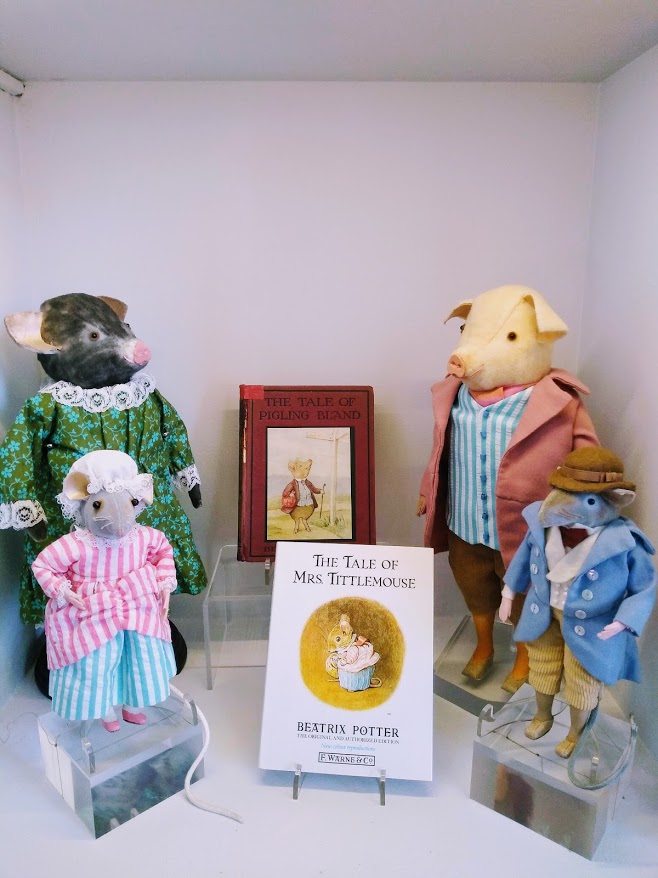
Beatrix Potter figures on display at Hove Museum

The figures on display were handmade and donated to the Museum by a Brighton resident, Mrs Fraser, who based them on the designs in the ballet film ‘The Tales of Beatrix Potter’ (1971). The film was choreographed by Sir Frederick Ashton (who danced Mrs Tiggywinkle) and included many dancers from the Royal Ballet. There are no words, only movement and music, but the film was a huge success with audiences internationally. Mrs Fraser’s figures are beautifully made with great attention to detail.

The books on display are:

The Tale of Mrs Tittlemouse (1910) – modern copy

The Tale of Pigling Bland (1913) – pre 1917 edition

Find out More

Follow the What’s in the Box category on our blog to see what new items have come out from our stores.

If you visit Hove Museum in Church Road, Hove, look out for our What’s in the Box? display. 

Joy Whittam, Collections Assistant

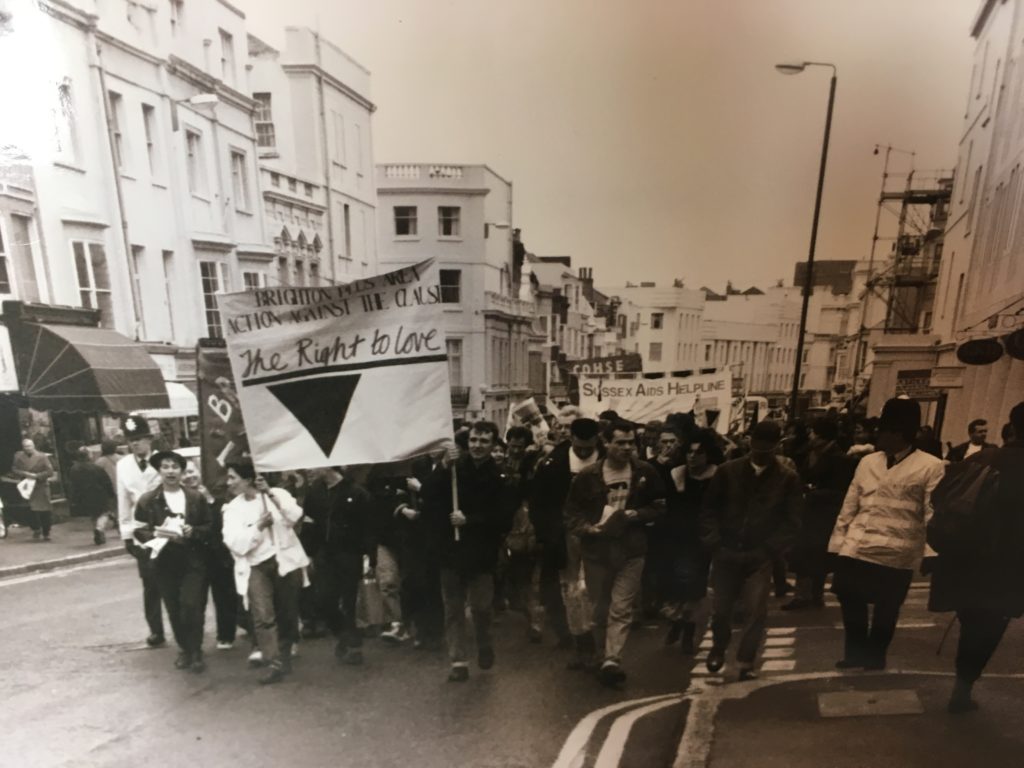
We’re here, we’re queer, we’re not going shopping! Clause 28 and the birth of the LGBTIQ+ community

Photograph of 1988 march. Lent by Paul Clift.

This is a legacy story from an earlier version of our website. It may contain some formatting issues and broken links.

The first I knew about Clause 28 was a flyer I was handed outside Birmingham Cathedral in 1987.

On one side was the famous poem which begins ‘First they came for the socialists….’ about how in 1930s Germany the Nazis were picking off opponents and groups they deemed undesirable one by one. On the other side, a brief description of a hate-filled law the Tory government of the day was hell-bent on introducing.

The core element of Clause 28 of the 1988 Local Government Act was to stop local authorities from ‘promoting’ homosexuality. So vague was the wording that this might have included anything from libraries stocking books by gay authors to teachers being unable to protect children from homophobic bullying in their schools. We were already dealing with AIDS, and now this! Sick to my stomach I ran into the nearby Cathedral and wept openly for the first time in years.

Brighton Area Action Against the Clause. A4 poster. 1988 Lent by Alf Le Flohic

Brighton Area Action Against the Clause. A4 poster. 1988 Lent by Alf Le Flohic

Working as a Community Curator on Queer the Pier I have once again been brought face-to-face with those dark days. And though at times this has been quite harrowing, I have been utterly captivated by the archives stored at The Keep that document the response in the south-east to this pernicious legislation.

Likewise I have been thrilled to meet so many people who were part of that struggle in our area – people who have memories of marching through Brighton’s streets in protest against the act. Especially those who have lent objects from their own private collections to the exhibition.

Photograph of 1988 march. Lent by Paul Clift.

Photograph of 1988 march. Lent by Paul Clift.

In fact, in a cabinet devoted to the extraordinary lives of ordinary people in Sussex, not only do we have photos of a famous march between the two town halls of Brighton and Hove lent by Paul Clift, but thanks to Alf Le Flohic we have one of the actual banners carried on the protest itself.

Fabric banner. 1988. Lent by Alf Le Flohic

Fabric banner. 1988. Lent by Alf Le Flohic

Sadly we lost the fight and Clause 28 became Section 28 in 1988, triggering years of institutionalised homophobia and who knows how much unnecessary pain and heart ache.

Though perhaps the most poignant thing about this dark episode in our history is that rather than sounding the death knell for our small but growing gay community, Clause 28 galvanised queers like nothing had done before – creating support networks that became the foundation for the proud and confident LGBTIQ+ community we know today.

Defy Clause 28 badge. 1988. Lent by Alf Le Flohic

Defy Clause 28 badge. 1988. Lent by Alf Le Flohic

Thankfully Section 28 was repealed in Scotland in 2000 and the rest of the UK in 2003.

Even so, for me the fact that such a law could have been introduced in my own lifetime is a chilling reminder to just how fragile our hard won rights are and how vigilant we must be of those who wish to take them away.

This story is just one of many Sussex LGBTIQ+ histories we are bringing to life through Queer The Pier. To discover more from over 200 years of our queer past come along to the exhibition in 2020. In the meantime look out for more blogs inspired by objects and ephemera collected for the exhibition.

Launching 2020

Queer the pier will launch in 2020, but in the meantime:

Daren Kay, Queer the Pier working group member

What’s in the Box? Journey Into Adventure

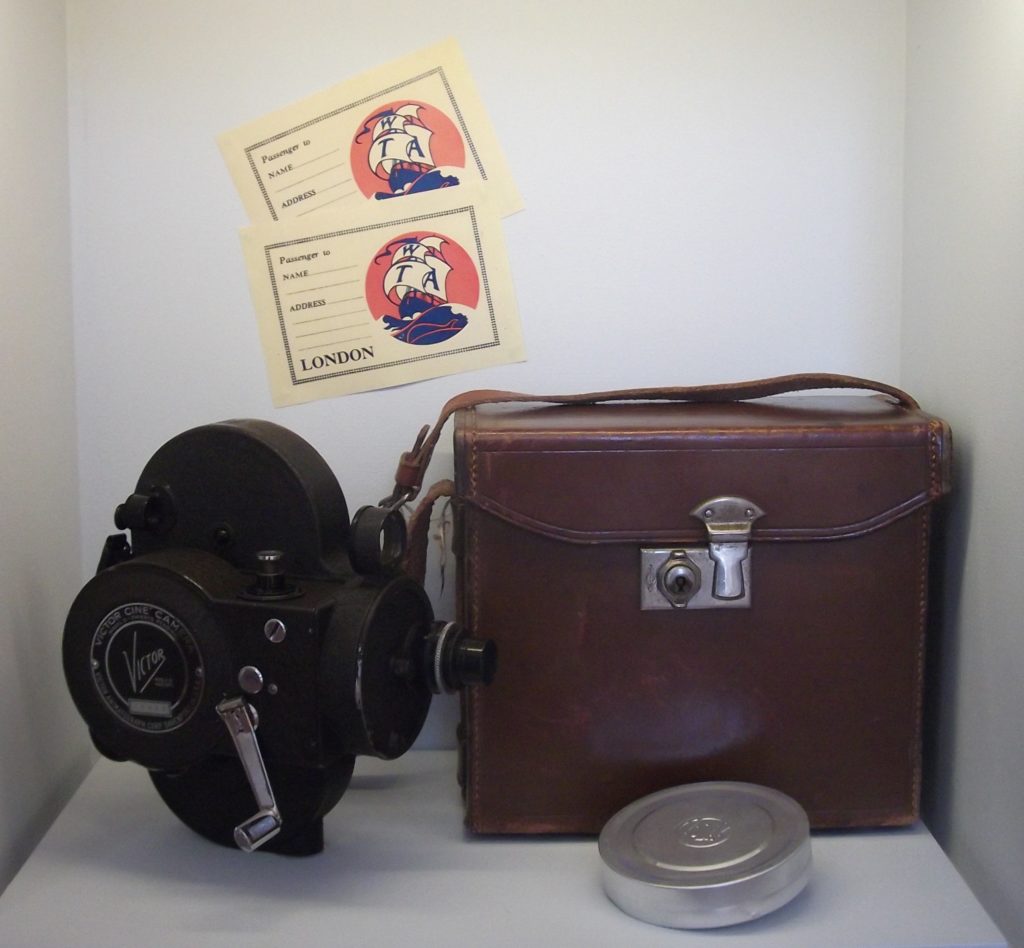
Model 3 Victor Cine Camera (Acc. No. DB478)

This is a legacy story from an earlier version of our website. It may contain some formatting issues and broken links.

Here’s the latest story from our What’s in the Box display.

I have borrowed the title Journey Into Adventure as I feel it is suitable not only for the subject matter of this blog but also for museum work in general.

Researching the story behind one object has led me to such exotic locations as Kent County Archive in Maidstone and Croydon Museum, as well as taking me around the world in my imagination!

Model 3 Victor Cine Camera (Acc. No. DB478)

My starting point is the Model 3 Victor Cine Camera (Acc. No. DB478) donated by Ernest Wimble’s daughter who resided in Hove in 2001. It was accompanied by one short paragraph explaining that it had belonged to her father who used it in his work for the Workers’ Travel Association (WTA) and sometimes family holidays. Sadly most of the WTA films were destroyed by bombing of the head office in London during the Second World War. Ernest was awarded a CBE and made a Chevalier de l’Ordre Léopold II of Belgium, for his work on international travel. Intrigued by this, I decided to try and find out more…

Firstly, a little background on the object. The cine camera was made by the Victor Animatograph Corporation, founded in 1910 in Davenport, Iowa, USA by Swedish-born American inventor Alexander F. Victor. Victor started his career as a magician but was soon entranced by the new ‘moving pictures’, and began to incorporate them into his shows. He tried out various inventions relating to film making and projection but with limited success. In July 1923 Eastman Kodak brought out their hand-cranked camera, the Cine-Kodak, which established 16mm film as a standard for amateur use. By August Victor was already following with the Victor Cine, although his publicity often claimed that he was the pioneer of this format.

Victor later developed the Model 3 Cine camera in 1927, based on a design by Bell & Howell. This could be operated by a clockwork spring mechanism, or hand-cranked. He produced these cameras, with minor variations, in relatively small quantities until the Second World War. By then 16mm was popular with amateur film makers and for educational use in schools and churches.

So who was the owner of this particular camera?

Ernest Walter Wimble was born 23 September 1887 in Bromley and grew up in various parts of South London. He lived for many years in Croydon and eventually moved to Hove in 1976. He died only a while later, in 1979.

After a secondary school scholarship he started working life as a clerk in the Civil Service, then the London office of the New York Times, and a City firm of export merchants. He tried to organise a union for the clerks, and lost his job for supporting the Dock Strikers in 1912.

Ernest was then employed by the Workers’ Educational Association (WEA). An Association for the Higher Education of Working Men was founded in 1903 and re-named as WEA in 1905. It was started by Albert and Frances Mansbridge to support adult education for working-class people, and still continues today, with local branches across the UK.

Ernest became Editor of The Highway (journal of the WEA), and later the organisation’s Financial Secretary. He began working for the WEA until the outbreak of the First World War, when he volunteered for the army. He served four years in France, initially as a French-speaking shorthand typist, rising to the position of lieutenant. After the war he returned to the WEA, organizing students’ bookshops. He was very involved with the Labour movement, standing for election to Croydon Corporation as Labour candidate in 1920, 1922, and finally successful in 1923.

Ernest Wimble’s 1922 election poster Credit: Image courtesy of Museum of Croydon archives

Ernest Wimble’s 1922 election poster. Credit: Image courtesy of Museum of Croydon archives

The Museum of Croydon archives hold a scrapbook donated by Ernest’s daughter after his death. This vast book has tissue paper pages and although only a small portion of them are used, Ernest proudly kept many pamphlets, posters and correspondence relating to his election campaigns. Indeed, one foresighted letter is from the Chief Librarian of Croydon Library who requests a copy of any printed matter in connection with the election as ‘Such a record will have great historical value in the future.’ Reading this and the scrapbook contents almost a hundred years later, I had to smile and concur. The scrapbook only covers a few years during the early 1920s, but someone (Ernest’s daughter perhaps?) had loosely inserted a tiny newspaper clipping from the Croydon Advertiser, dated 1979. ‘Sir, A letter last week about the death of Mr Wimble prompts me to ask: am I wrong in thinking that the deceased was one of the famous quartet of my youth, who were candidates for the same local election – Wimble, Trimble, Trumble and Tripe?’

Before continuing with Ernest’s story, let’s take a step back and look at how the Workers’ Travel Association came into being. The organisation’s archive is held at Kent County Archive and one visit was barely time to scratch the surface. However, I was able to browse through brochures and peruse posters enough to get a flavour of the WTA and how exciting it must have been to take a holiday with them.

The book to which I am indebted for both the title and the contents is Journey Into Adventure by Francis Williams. This lively account of the WTA was published in 1960 when the organisation was still a successful travel agency. The following is just a glimpse at the WTA’s activities during Ernest’s tenure.

In 1921 a trip to Geneva was arranged by the League of Nations Union (LNU) in order to visit the International Labour Office. One evening, a conversation took place around an idea suggested by Cecil Rogerson (who worked for the LNU) to enable working people from different nations to meet and learn about each other’s lives and countries, with the purpose of developing ‘the greatly needed comradeship among nations’.

The idea was to form a non-political cooperative working class travel agency along the lines of the WEA. As the first President of the WTA Harry Gosling recalls, ‘We felt it would be a great thing if we could do something, however small, to begin to break down the prejudice against ‘foreigners’ so readily encouraged by the press of all countries. If only the ordinary people of one country could meet the ordinary people of other countries and get to know their ways and movements, what a powerful factor it would be in securing real and lasting peace.’

Rogerson enlisted the help of JJ Mallon, warden of Toynbee Hall in London (headquarters of the WEA) and others sympathetic to the cause. They held an initial meeting in November 1921 hoping to attract many supporters but only a few people turned up. Even so, those present agreed that an organisation should be formed and the WTA was born.

Despite the growing power of trade unions, the possibility of paid holidays for manual working classes was still a dream, and the first UK law Holidays with Pay Act was not passed until 1938. In the meantime, the WTA hoped to not only give holiday enjoyment but to make people wiser and more understanding. Those travelling with the WTA were to be considered ‘working class ambassadors’. Their ideals were perhaps over ambitious and they were somewhat disappointed to realise that ‘even members of the Labour Movement seem to want to enjoy themselves on holiday’.

As the originator of the idea, Cecil Rogerson had initially assumed the position of Secretary but his methods of working and record keeping were rather haphazard. After the first year the committee had no choice but to ask him to step down. Unwilling to continue in a lesser role, he left the WTA entirely.

In January 1923, a sub-committee interviewed eleven candidates and Ernest Wimble was appointed as General Secretary, a post which he held until his retirement in 1947. His background in working class movements and organisations was extremely beneficial; he had travelled a great deal and had sound experience of office and financial management.

The WTA adverts proclaimed ‘Something More Than Holidays. See The World and Meet Its Workers’. Alongside the ship which eventually became its emblem was the invitation, ‘Come with us. We are sailing to a new world where men shall toil no more for money but learn to treat frontiers as hindrances and to live as brothers.’

After a somewhat shaky start the WTA’s success began to grow. In the first season of 1922 they took 700 bookings. By 1925 this had risen to over 6,000. In 1924 a group travelled from the UK to Russia. They stayed in workers’ houses, visiting factories, farms and schools. The following year twenty five young men from a Moscow training college for railway engineers arrived on a reciprocal trip, and they were taken around England by the WTA.

The WTA inspired similar organisations abroad and held the first International Conference on Workers’ Travel. Although the main aim was to promote foreign travel, they soon realised that there was also a demand for UK holidays. In early 1926 the WTA bought High House, in Heacham, Norfolk and turned it into a holiday centre.

1928 saw the introduction of the Nominated Holiday Fund. One shilling optional donation was added to bookings to create the capital. Anyone who donated could nominate someone as a beneficiary. However, often nominees were unable to accept the free holidays due to other living costs which still had to be met, such as rent.

After a particularly bad season the previous year, 1932 was financially the WTA’s most difficult time. Nevertheless, the WTA took a massive gamble and chartered a 14,000-ton liner, ‘Esperance Bay’ for a series of low cost cruises. This turned out to be their most popular and successful single enterprise. There was a single class rate, variations were only for size and location of cabin. There were no class distinctions and the public areas were available for all. An example itinerary departed from Southampton across to Gibraltar via the Mediterranean, Algiers, Lisbon and back to Southampton.

In the earlier days, the WTA used existing hotels and simply arranged the holiday and activities. Their 1937 brochure lists Arnold House, Montpelier Terrace, Brighton as the Sussex centre. Built in 1861, it was (coincidentally) the home of Henry Willett, founder of Brighton Museum, until his death in 1903. It officially became a hotel in 1939 so may have been used by the WTA as a trial prior to opening. The building was demolished in 1971.

Credit: James Gray Collection | The Regency Society

Credit: James Gray Collection | The Regency Society

The brochure advert proclaims ‘Counted by entertainment and not hours, every day at Brighton ought to be a week…You MUST come to Brighton.’ While staying at Arnold House, guests could enjoy visits to the Royal Pavilion, Rottingdean, Shoreham, even a day trip to France. The activities included evening dances, croquet and golf tournaments, and a ‘conducted house bathing party’. The grand finale on Friday night offered an ‘old-fashioned music hall…local talent provided.’

The rise of Nazism in Germany obviously had some effect on the country’s appeal as a holiday destination, but did not stop many people from wanting to go there. In December 1938 the WTA expressed their feelings in an article:

‘…as a democratic body, the W.T.A. never tries to dictate to its members, and if you want to visit the fascist states the W.T.A. will take you there and do everything possible to give you a good holiday…[some] hold the view that never was it more necessary to retain and nourish whatever sympathy and goodwill may exist between the German people and the British…the obligation upon us in the W.T.A is to see that, wherever we go, we act as ambassadors of goodwill and international understanding.’

In 1939, under cover of their usual tourist activities, the WTA assisted with the evacuation of around 440 Czech anti-Nazis from Prague before Hitler’s troops arrived. Many were saved (one man even managed to bring his pet python) but sadly due to mis-information, a small group were left behind, despite every attempt to charter an additional plane. Refugees were given temporary accommodation at WTA venues.

By 1939 the WTA owned eight UK holiday homes: Norfolk, Derbyshire, the Lake District, Scotland, two in the Isle of Wight, and two in Dorset. During the Second World War, the WTA had to assist with the management of UK hostels for displaced people but they still continued to organise holidays. In 1940 they took very few bookings but 5,840 holidays were booked the following season. This rose to more than 7,000 in 1942, and over 8,670 by 1944.

After the war, the WTA bought more holiday centres and guest houses. One was based at Rustington Lido, which was re-named Mallon Dene in honour of JJ Mallon, the first Treasurer, for his services to the WTA. The lido is no longer there but the road around the area is still called Mallon Dene.

The WTA eventually turned into a more conventional travel agency, finally known as Galleon World Travel, which continued until 1982. However, within its first ten years alone, the WTA had enabled numerous British people to visit most European countries, and other continents. It had organised UK trips for groups from many of those same countries, and arranged summer schools, educational visits and language classes both at home and abroad. It had developed and provided cheap holiday centres for holidays within Britain, and had instigated the International Association of Workers Travel Associations, uniting European organisations with aims similar to its own.

In conclusion, an extract from a 1931 article by the WTA Management Committee, ‘The W.T.A. and The Future’:

‘We are confident that there are still very many who feel, with us, that now above all is the time to get in touch with our neighbours, to prove our goodwill and to earn theirs before it is too late, and who realise that by shutting ourselves up within the narrow boundaries of our own country we are much more likely to be led astray by false statements and lying rumours and influenced by the fear and suspicions of other nations than if from travel and experience we knew even a little of their true state of affairs.’

They go on to quote EM Forster in a letter to the New Statesman, agreeing that: ‘Those of us who still have the energy and money should visit Europe at once, before we are permanently confined to our own parishes, and allowed to listen to nothing but the village band. All patriotic appeals to remain in England should be ignored for, surely, there was never a time when it was more desirable to keep in touch with old friends on the continent, and, if possible, to make new friends.’

Further Information

Ernest Wimble’s scrapbook is held at the Museum of Croydon Archives

Their record for Ernest Wimble’s scrapbook and cuttings can be seen on the online catalogue record.

The archive of the Workers’ Travel Association is held at Kent County Archives

Their records for the Workers’ Travel Association archive can be seen on the online catalogue record.

One of Ernest Wimble’s promotional films for the WTA, Homeland Holidays, can be viewed free on the BFI Player

Find out More

Follow the What’s in the Box category on our blog to see what new items have come out from our stores.

If you visit Hove Museum in Church Road, Hove, look out for our What’s in the Box? display. 

Alexia Lazou, Collections Assistant
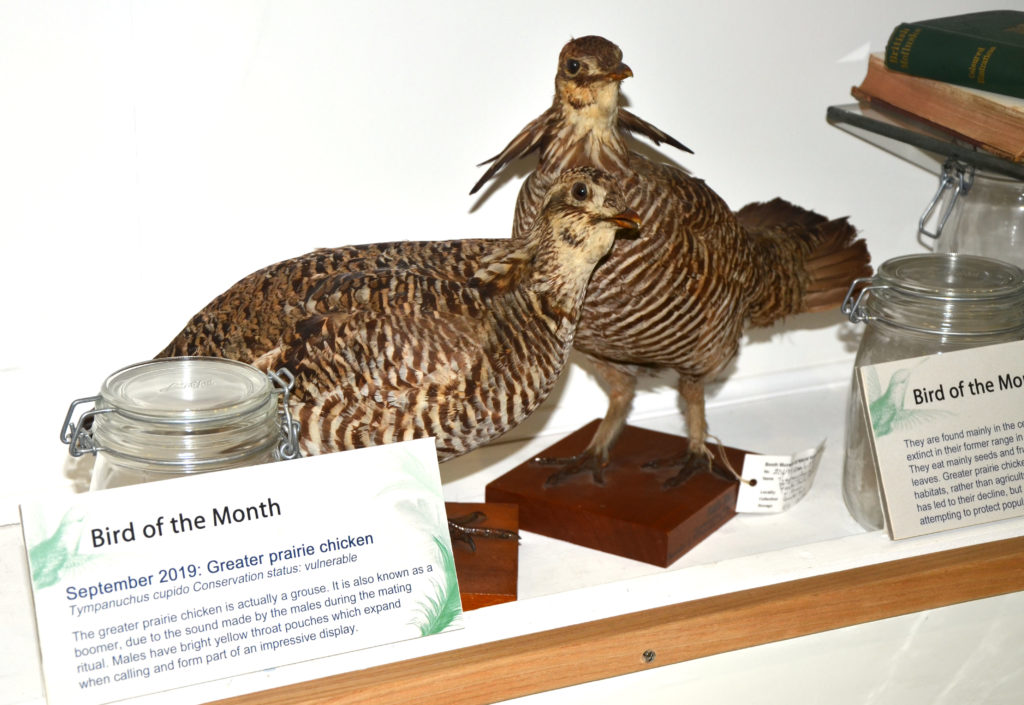
Booth Museum Bird of the Month, September 2019: Tympanuchus cupido

Greater prairie chicken, Tympanuchus cupido

This is a legacy story from an earlier version of our website. It may contain some formatting issues and broken links.

For September, the Booth focus on the Greater prairie chicken, Tympanuchus cupido

Conservation status: vulnerable

The greater prairie chicken is actually a grouse. It is also known as a boomer, due to the sound made by the males during the mating ritual. Males have bright yellow throat pouches which expand when calling and form part of an impressive display.

They are found mainly in the central states of the US but are extinct in their former range in Canada. They eat mainly seeds and fruit and will also eat insects and leaves. Greater prairie chickens prefer tall grasses and natural habitats, rather than agricultural land, this habitat loss has led to their decline. The species has also declined due to hunting but conservation efforts are attempting to protect populations.

Tympanuchus cupido, Greater prairie chicken

Tympanuchus cupido, Greater prairie chicken

Tympanuchus cupido, Greater prairie chicken

Kerrie Curzon, Collections Assistant and Lee Ismail, Curator of Natural Sciences
Suited

Brighton Museum, exhibition, Transology, LGBT, Hove, Brighton, 2017

This is a legacy story from an earlier version of our website. It may contain some formatting issues and broken links.

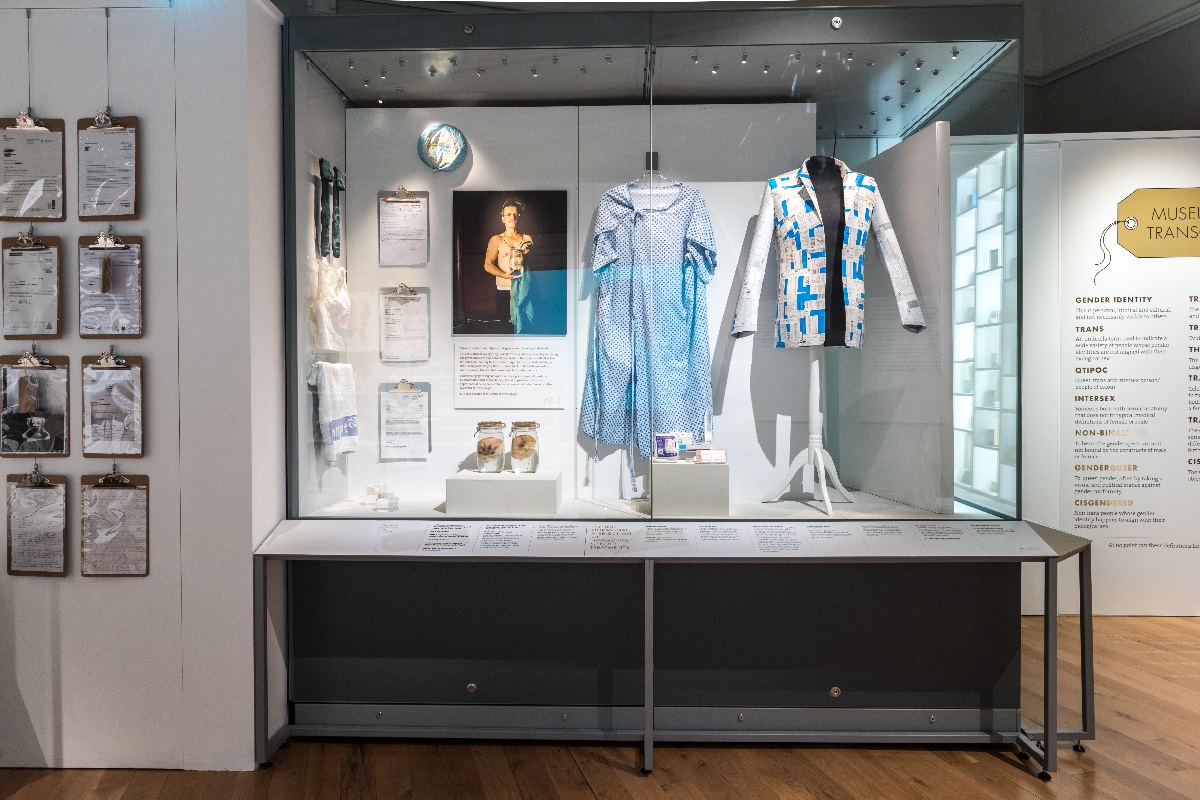
“Suited” is a life-size suit jacket made out of black card, collaged all over with the opened-out cartons from “Sustanon 250” (testosterone) injections, representing my personal usage for about 4 years.

For me, testosterone is a vital part of making my masculinity visible and experiential, like putting on a really well fitting suit.

Brighton Museum, exhibition, Transology, LGBT, Hove, Brighton, 2017

Why did I collect all those packets? It’s never been a question I’ve been able to answer very well. When I started, I certainly had no idea that they would eventually become part of an art work, so it wasn’t as if there was an original master plan behind it. In fact, I found it slightly hard to part with them – to cut them up to make the piece.

My best guess is that collecting them was to do with marking the length of my T usage in some way, marking a ‘trans age’ that differed from my biological age. It just seemed important at the time to keep them; to have some kind of visible, tactile record, squirrelled away in a cupboard.

I thought my stack of boxes was just me being peculiar, yet when I displayed the work, I discovered I wasn’t the only trans person that was collecting. I had more than one person approach me to say that they, too, held onto packets or similar items. On occasion they confessed they felt it was a bit odd that they did it and thought they were the only one.

Perhaps these are pictures from an adolescence most of us never had the opportunity to have; reflecting a life where both images of us as young people growing up, and images of us ‘growing up’ as adults can be challenging to own, to accept as part of a seamless whole.

Whatever the reason, the Museum of Transology is a wonderfully respectful repository for such precious records.

Simon Croft, Museum of Transology

Remix the Museum 2019: Young People’s Environmental Animations

Animations on display in Brighton Museum

This is a legacy story from an earlier version of our website. It may contain some formatting issues and broken links.

During the summer holidays, Remix the Museum ran animation workshops for young people at Brighton Museum and the Booth Museum, using collections to share messages around extinction and the environment.

A gallery with animations prejected on the wall on the right hand side with a bench in front. A door in the background.

Animations on display in Brighton Museum

Remix the Museum is a youth programme in which young people create animations inspired by museum collections. In the most recent workshops, young people created stop-motion animations to raise awareness of environmental issues and extinction with the help of animator Dave Packer.

The workshops started with tours of the Booth Museum and Brighton Museum by staff, specifically focusing on collections relating to extinction and the environment. Some striking topics used by animators include poaching of leopards, the effect of plastic pollution on turtles and the effect of global warming on polar bears’ habitats. However, some animators decided to focus on positive change in the environment, such as the Adonis blue butterfly species population recently increasing.

A gallery with animations prejected on the wall on the left hand side.

Animations on display in Brighton Museum

One environmentally-conscious young person decided to create an animation of lifestyle changes they would make to help the environment such as picking up litter, using more eco-friendly methods of transport and spending more time at the park.

After choosing their topics, the young animators began taking photos of objects in the museums and creating drawings to use in their animations. A lot of attention to detail went into creating the videos; keep an eye out for the opening jaw of a rhino skull or the moving arms of a sun bear.

One young person was so inspired that she wanted “to try doing [her] own animations based on the environment at home.”

The animations are currently on display on the South Balcony in Brighton Museum & Art Gallery.

[arve url=”https://youtu.be/nR6XpmPNnCI” align=”center” title=”Remix the Museum: Environment and Extinction Animations” description=”Animations created by young people at animation workshops at Royal Pavilion & Museums with Remix the Museum. The theme is environment and extinction and they are inspired by museum collections.” /]

Tasha Brown, Museum Futures Trainee

Friedrich Nagler Discovered

A photo of the artist Friedrich Nagler

This is a legacy story from an earlier version of our website. It may contain some formatting issues and broken links.

15 yr old Cate Deacon shares what she learnt about Friedrich Nagler during her work experience at Hove Museum – including her interview with members of the award-winning charity Outside In.

Friedrich Nagler was a Vienna born Jewish artist, who escaped Nazi occupation in 1938. He eventually settled in Hampshire and passed away in 2009.

A photo of the artist Friedrich Nagler

He is known for his incredible collection of work, with thousands of pieces and the range of materials used. Just some of his known materials include:

  • Bread – this is probably one of the most unusual materials that Nagler used. He carved and cut faces into toast and bread.
  • Nuts and bolts and nails.

Bread sculptures by Friedrich Nagler

  • Metal – some of Nagler’s bigger work was made out of commonly found pieces of metal and plastics that he used to create the effect he was after.
  • Nagler carved bone into faces and small animals

    Plastic cable and wire – his smaller pieces that came in thousands were made from things like big cable ties and wires.

  • Animal bone. In a short award-winning film that you can see at Hove Museum during the exhibition: ‘Friedrich’ (2011) – a documentary exploring the life and work of unknown artist Friedrich Nagler (directed by Kitty McMahon, produced and edited by Natalia Mirsaka), Nagler’s son recalls his own wife going to slaughter houses and collecting things like horse bone for Nagler to use. Not only did he make the small faces from the bone, he also created small animal sculptures.

As you can see, Nagler had a wide range of materials and was always saving sustainable materials, and even non-recyclable materials such as stickers from apples, paper seals from milk bottles and bottle tops.

Nagler’s exhibition at Hove Museum is all thanks to an award-winning charity called Outside In. It works to provide opportunities and a platform for artists facing barriers to the art world, as a result it offers extremely important support. To find out more about the work it does and the Nagler exhibition I spoke to two people from Outside In, Exhibitions Coordinator Cornelia Marland (C) and Communications Coordinator Laura Miles (L)

Why did you want to have an exhibition on Nagler?

C: He is a fantastic example of a non-traditional artist, as he had no formal training and that fits our organisation so well.

L: His work gives such an insight to the passion he had for creating, as can be seen from his resourcefulness as he worked with what he had.

What are some of your personal favourite pieces that he did?

C: I really like the animal sculptures, I find it amazing how he could represent an animal so well with using only a few nuts and bolts.

L: The bread, because it’s so unexpected and really makes you think – as does a lot of the work by Outside In’s artists – about what art can be .

What do you like specifically about his work?

C: The range of materials used is so varied which is very rare to see. Even by visiting this small exhibition of his works you can get a sense of this.

Faces in everyday objects made with imagination and humour.

L: And there’s also a sense of humour about his work, his ingenuity makes you smile. One of the most rewarding parts of the build up to the exhibition for me was speaking to his sons as you get a sense of what their family lifestyle was like due to their father’s compulsion to make art.

Do you think Nagler was trying to portray something through his work? If so, what?

C: His son’s, Martin and Mervyn Nagler, told us during a recent event at the museum that they think that some of his work comes from his early experiences, for example there are some sculptural heads with two faces and that might show the people in his life in Vienna changing under Nazi occupation.

C: One of his close friends actually became an SS officer and his son’s mentioned how this had a big impact on him. It’s clear that art was also a therapeutic practice for him.

Do you know roughly how many pieces Nagler produced in his lifetime?

C: The Nagler family are still cataloguing it actually, but there will be thousands.

L: Just for this exhibition alone we had more than 1,300 pieces to select from.

C: But I think that the fact he created so much, shows his real passion and need to create.

How did Nagler keep his bread work in good condition?

C: It could have been a varnish, or a paste that he put over, it looks like they may have been baked as well.

C: Although there was some bread that didn’t survive, it was clear he took great care in preserving it, his son’s mentioned that he didn’t like the heating being on too long since it might ruin his artwork.

What is the material Nagler used most frequently?

C:  You can see from this exhibition that he used a variety of different materials such as metal, plastic, bone and found objects.

L: The work acts like a diary really, you can tell what factory he worked at when he made a certain piece from the materials he could get.

What made you want to start working at Outside In?

C: I’ve always been interested with working with artists from all different backgrounds and ran a gallery in London called Geddes Gallery. I had been aware of Outside In for some time and worked with many of their partner organisations in a freelance capacity so had a sense of the important work they did.

L: I spent 10 years as a newspaper journalist, so it was definitely something different, but my background is the arts and English. The fact it offered a chance to combine my skills with my interests was a real draw and it has surpassed my hopes as being able to share the inspirational stories about these artists with the world is extremely rewarding.

Do you have a favourite success story from an artist your organisation has helped?

C: When I first joined Outside In an artist called Rakibul Chowdhury had also recently signed up as an artist. He was working with an art group called ‘Art Invisible’ when someone from Outside In visited the group and encouraged him to sign up. Raki’s work was taken to the Outsider Art Fair in Paris in 2017 where it was very popular, it has since been exhibited at Sotheby’s and Cerno Capital as part of an exhibition called ‘Outside In: Discover’. Raki has attended most of the exhibitions and it’s been wonderful seeing his confidence grow after witnessing so many people enjoying his artwork.

L: Clarke Reynolds is one of the first artists I interviewed. He describes himself as a ‘blind visual artist’ and says that with a smile. His work is a great example of reconsidering what you think you know about art. For instance what is a still life to someone who can’t see it? One of his pieces called If Cezanne can do it so can I answers this, it is an abstract painting  sprayed with citrus juice and exhibited with the sounds of fruit being chopped and squeezed so even if you walked into the room with your eyes closed your other senses could tell you what it was. He is really keen to share his story and show that being blind is not the end of a journey, even when you want to do a job that usually is very visual, but that it can be just the beginning.

What are the most rewarding things about working for Outside In?

C: For me it’s getting to see the artists reaction when their art is up in a museum or gallery. 

L: It’s also seeing the audience’s reaction to seeing the work. Many will walk into a gallery or exhibition and have expectations of what they will find, the work of Outside In’s artists opens people’s eyes. Whether it is due to the inspiration it draws from or the materials it is made from, you can see the impact it has on the viewer.

Cate Deacon, work experience student at Hove Museum

The View From Here

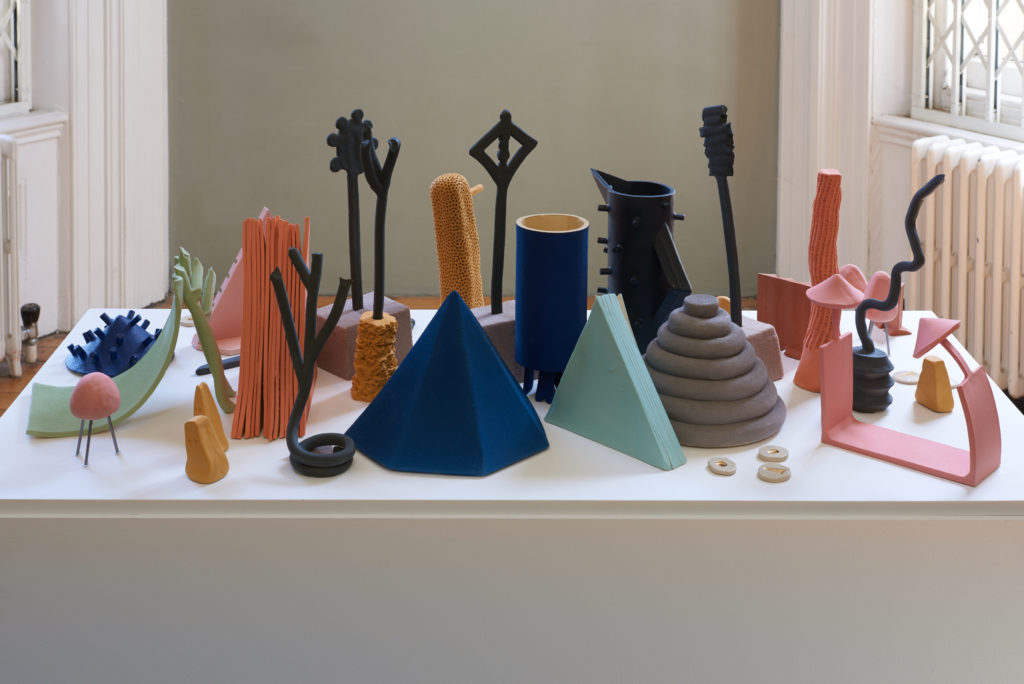
The View From Here, Photograph by Jonathan Bassett

This is a legacy story from an earlier version of our website. It may contain some formatting issues and broken links.

Lisa Jones, MA Craft student at Brighton University, explores our relationship with objects and the seemingly endless ways of displaying them in museums.

As an artist, I am deeply inspired by the vast array of artefacts that have been produced by civilisations over millennia. After visiting many museums over the years, I have become fascinated by the endless possibilities of grouping, naming and defining objects in exhibitions.

Photograph by Jonathan Bassett

This piece in ceramic and steel explores how the different methods of display affect our relationship with them. My work asks you, the visitor, should we value displays purely on an academic level or can we appreciate them more visually, as a form of abstract landscape?

Lisa Jones, MA Craft student

See Lisa’s display of ceramic and steel making a carefully constructed landscape at Hove Museum until September 

Windrush Presence: Celebrating the contribution of the Windrush generation

This is a legacy story from an earlier version of our website. It may contain some formatting issues and broken links.

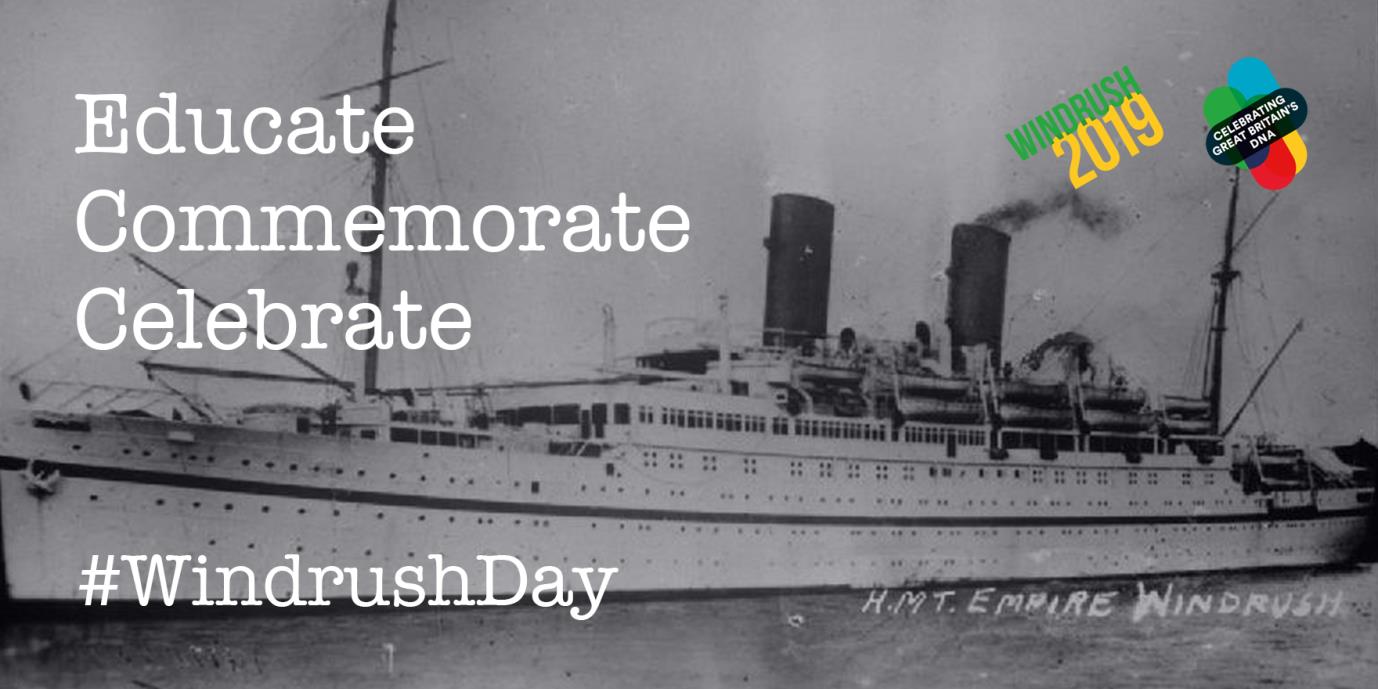
22 June 2019 marked the first ever Windrush Day. It was on this day, in 1948, that HMT Empire Windrush landed at Tilbury Docks, just east of London, bringing with it migrants from the Caribbean and changing British culture and society forever.

At Brighton Museum & Art Gallery, this important anniversary was marked with a Windrush Tea Party, at which the contribution of the Windrush generation to British history and culture was celebrated. Author Colin Grant read from his forthcoming publication Homecoming: Voices of the Windrush Generation before leading a discussion with two locally-based members of this generation: Dr Bert Williams MBE and Shirley Williams. Poet Akila Richards gave a Windrush-inspired spoken-word performance.

The event, which was organised by Royal Pavilion & Museums’ BME Heritage Network, was the first in a programme of celebratory events supported by Brighton & Hove City Council with funding from the Ministry of Housing, Communities & Local Government.

Members of BME Heritage Network with Councillor Amanda Grimshaw BEM at Windrush Day Tea Party. Stephen D Lawrence Photography

Further activities include:

12 October – 1 November 2019
Exhibition: Windrush Presence
BMECP Centre, 10A Fleet Street, Brighton, BN1 4ZE (see the BMECP website for exhibition opening hours: https://bmecp.org.uk/events/). Free, all welcome.
A display of work by a range of artists, in various media, which documents or reflects on the contribution of the Windrush generation to British culture and society.
Curated by Dr Gil Doron as part of the Socially Engaged Art Salon.
More information here – https://www.eventbrite.co.uk/e/exhibition-windrush-presence-tickets-69273658377

Saturday 12 October, 3-6pm
Exhibition Launch: Windrush Presence
BMECP Centre, 10A Fleet Street, Brighton, BN1 4ZE (see the BMECP website for exhibition opening hours: https://bmecp.org.uk/events/). Free, all welcome.
Windrush Makers present a celebratory opener event for the Windrush Presence exhibition Curated by Dr Gil Doron as part of the Socially Engaged Art Salon and featuring:
Diversity Lewes – A talk by Tony Kalume, producer of a short film that celebrates the African Caribbean presence in Sussex.
Socially Engaged Art Salon – A talk by the curator of the Windrush Presence exhibition, Dr Gil Doron.
Akila Richards – A spoken-word performance to accompany a display of textiles created in collaboration with Caribbean elders.
More information and to book – https://www.eventbrite.co.uk/e/exhibition-launch-windrush-presence-tickets-69274177931

Saturday 5 October, 1-4pm
Banyan Tree Theatre Group presents Real-I-Sing ‘Windrush Songs Workshop’
Brighton Dome, Founders Room
All welcome at this vibrant singing workshop inspired by Windrush where participants will learn songs that bring to life the anticipation and wonder of a defining moment in Black British history.
Drawing upon the experiences of local Caribbean elders, the workshop will feature songs that spark and ignite memories of new beginnings. Participants will be guided through classic songs including calypso master Lord Kitchener’s ‘London is the place for me’, and more.
To book: https://www.eventbrite.co.uk/e/banyan-tree-theatre-group-presents-real-i-sing-windrush-songs-workshop-tickets-69274288261

Saturday 6 October, 11am – 1.30pm & 2.30-5pm
Writing Our Legacy presents Windrush Presence Creative Writing Workshop
Brighton Museum & Art Gallery, Education Pavilion

Responding to archival images of the Windrush Generation, poet Hannah Lowe will run a creative writing workshop that responds to the theme ‘Windrush Presence’. The workshop is open to writers of all backgrounds and levels of experience. All contributors will be invited to read an excerpt from their work at an evening event at New Writing South on Thursday 17 October 2019 and publish it on the Writing Our Legacy website.
Tickets £5.98 including booking fee.
In case of queries, please contact info@writingourlegacy.org.uk.
To book, please follow the relevant link:
Morning session: https://www.eventbrite.co.uk/e/windrush-presence-creative-writing-workshop-morning-session-tickets-68690929419
Afternoon session: https://www.eventbrite.co.uk/e/windrush-presence-creative-writing-workshop-afternoon-session-tickets-71043546159


Thursday 17 October, 6.30-9pm
Writing Sharing Event
New Writing South, 9 Jew St, Brighton BN1 1UT
Join us for the evening sharing of three newly commissioned pieces of writing in response to Windrush images, along with new writing from our creative writing workshop.
Tickets £5/£3 concession. Light refreshments and drinks by donation will be provided. The venue is fully accessible.
In case of queries, please contact info@writingourlegacy.org.uk.
To book: https://www.eventbrite.co.uk/e/windrush-presence-evening-performance-tickets-68691802029

Saturday 26 October, 1-4pm
Banyan Tree Theatre Group presents Real-I-Sing ‘Windrush Songs Workshop’
Brighton Dome, Founders Room
All welcome at this vibrant singing workshop inspired by Windrush where participants will learn songs that bring to life the anticipation and wonder of a defining moment in Black British history.
Drawing upon the experiences of local Caribbean elders, the workshop will feature songs that spark and ignite memories of new beginnings. Participants will be guided through classic songs including calypso master Lord Kitchener’s ‘London is the place for me’, and more.
To book: https://www.eventbrite.co.uk/e/banyan-tree-theatre-group-presents-real-i-sing-windrush-songs-workshop-tickets-69275265183

Wednesday 30 October, 6.30-7.30pm
Diversity Lewes presents ‘Celebrating African Caribbean in Sussex past and present’
BMECP Centre, 10A Fleet Street, Brighton, BN1 4ZE. Free, all welcome.
A short documentary film celebrating the lives and contributions of locally-based members of the Windrush Generation. The film will be shown continuously during the Windrush Presence exhibition.
This evening event will provide an opportunity to hear from the film’s producer, Tony Kalume of Diversity Lewes.
Further information and to book: https://www.eventbrite.co.uk/e/diversity-lewes-presents-celebrating-african-caribbean-in-sussex-past-and-present-tickets-69275373507

Friday 1 November, 7.30-11pm
African Night Fever presents African-Caribbean Dance Party
Unitarian Church, New Rd, Brighton BN1 1UF. Tickets £5.00, include catering.
The programme ends in style with a final event celebrating the creative influence of African Caribbean music, food and dance styles.
Bring your dancing shoes!
To book: https://www.eventbrite.co.uk/e/african-night-fever-presents-african-caribbean-dance-party-tickets-69275852941

Legacy of Brighton-based ‘Godfather of Gay Journalism’

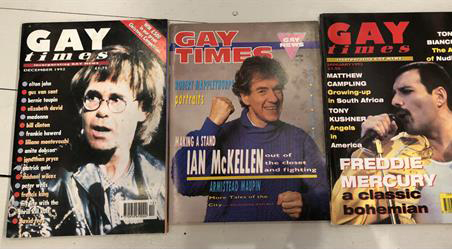
Gay Times – Over 4 decades – Burton interviewed some of the most famous gay people in the world. These date from the late 80s and early 90s. On loan from Torsten Hojer.

This is a legacy story from an earlier version of our website. It may contain some formatting issues and broken links.

Living in Gloucestershire in 1989 nothing got my heart racing more than the brown A4 envelope that fell through my letter box once a month.

Although ‘out’ at university, the anti-gay hysteria whipped up during the Thatcher years forced me back into the closet for my first job and the arrival of Gay Times each month was my touchstone to the world I’d temporarily left behind. Sealed and hidden in my briefcase until lunchtime, I would count the minutes before I could find a secluded corner and unwrap that month’s issue.

Gay Times - Over 4 decades - Burton interviewed some of the most famous gay people in the world. These date from the late 80s and early 90s. On loan from Torsten Hojer.

Gay Times – Over 4 decades – Burton interviewed some of the most famous gay people in the world. These date from the late 80s and early 90s. On loan from Torsten Hojer.

Which pop star or actor had been brave enough to be interviewed by the mag? How many handsome faces and bulging crotches would there be hiding within its pages? And what if – miracle of miracles – someone famous had joined the ranks of our number?

Of course, it wasn’t all reaffirming articles and witty repartee. There was the regular feature that trawled the world’s press for the most hideous stories of anti-gay feeling. Not to scare us I think. Though it often did. But to embolden us against our enemies. Prejudice and ignorance. There was also a large section devoted to films and books – often about people like me. And perhaps most importantly of all there were the pages telling me where I could actually meet these people.

Parallel Lives - One of the two volumes of memoirs Burton wrote about his incredible life. This one featuring his trusty typewriter. On loan from Torsten Hojer.

Parallel Lives – One of the two volumes of memoirs Burton wrote about his incredible life. This one featuring his trusty typewriter. On loan from Torsten Hojer.

Given the important role the magazine played in my life back then, you can imagine how thrilled I was when Queer the Pier was offered a number of artefacts belonging to Peter Burton, one of the most important people connected to the magazine and a resident of Brighton for over 30 years. Though a talented novelist and biographer, it was for his journalism that he is most remembered, often referred to as the Godfather of Gay Journalism.

The stand-out object amongst the ephemera we have been lent is the typewriter he used for much of his career. Peter it seems was no fan of computers! This remarkable survivor of a bygone age will be on display with a selection of Gay Times magazines from the 80s and 90s.

Typewriter -1960s ADLER typewriter on which Burton wrote most of his work. On loan fromTorsten Hojer

Typewriter – 1960s ADLER typewriter on which Burton wrote most of his work. On loan from Torsten Hojer

In a world that predated the internet, social media dating apps, where mainstream images of queer people were almost always negative and damning, it’s no exaggeration to say that magazines like Gay Times didn’t just inform and entertain. They probably saved lives too. Especially the lives of LGBTIQ+ people living in the sticks like myself. Thank you Peter. Thank you Gay Times. And thank you Torsten for lending them to us.

Peter Burton is just one of the lives celebrated by Queer the Pier. And this is just one of the blogs written by community volunteers about the exhibition. If you found this of interest please come back for more blogs inspired by objects in the exhibition.

Daren Kay, Queer the Pier working group member