Story Category: Legacy

What’s in the Box? Souvenir Crested China

What’s in the Box? Souvenir Crested China

This is a legacy story from an earlier version of our website. It may contain some formatting issues and broken links.

Here’s the latest story from our What’s in the Box display.

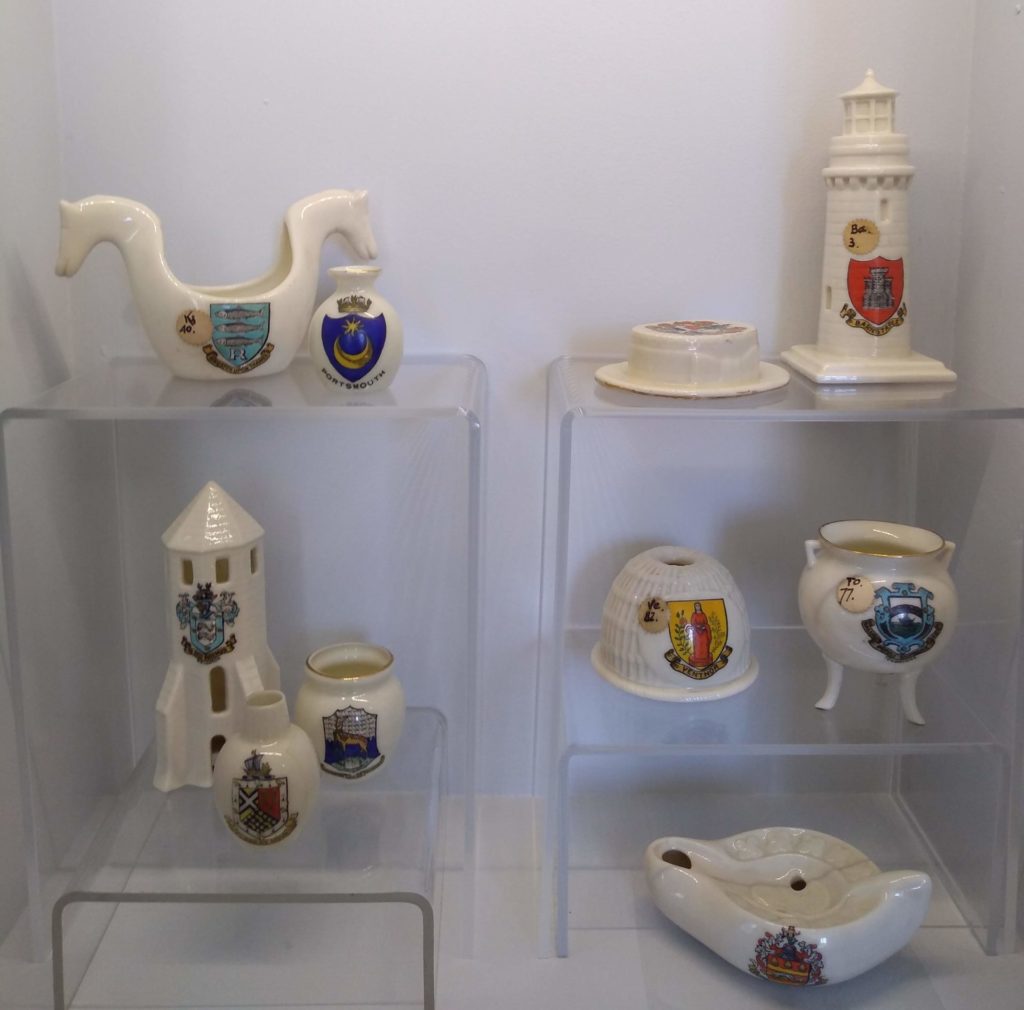
Do you recognise this china? These miniature porcelain models, with their crests of British seaside towns, were once hugely popular souvenirs. In 1910 most people in Britain owned one of these ornaments. W H Goss Ltd were the most popular makers but others, such as Arcadian, also produced the china.

There were a wide variety of designs including lamps, lighthouses, water bottles, swans, vases, lobster-pots, cannons, oars and hats. Many of the models were based on ancient objects, which had usually been found in different places than the towns represented on the crests. You might be able to spot ones for Brighton and Hove when you visit Hove Museum!

Find out More

Follow the What’s in the Box category on our blog to see what new items have come out from our stores.

If you visit Hove Museum in Church Road, Hove, look out for our What’s in the Box? display. 

Lucy Faithful, Collections Assistant

What’s in the Box? A Wooden Model of a Church Organ

What’s in the Box? A Wooden Model of a Church Organ

This is a legacy story from an earlier version of our website. It may contain some formatting issues and broken links.

Here’s the latest story from our What’s in the Box display.

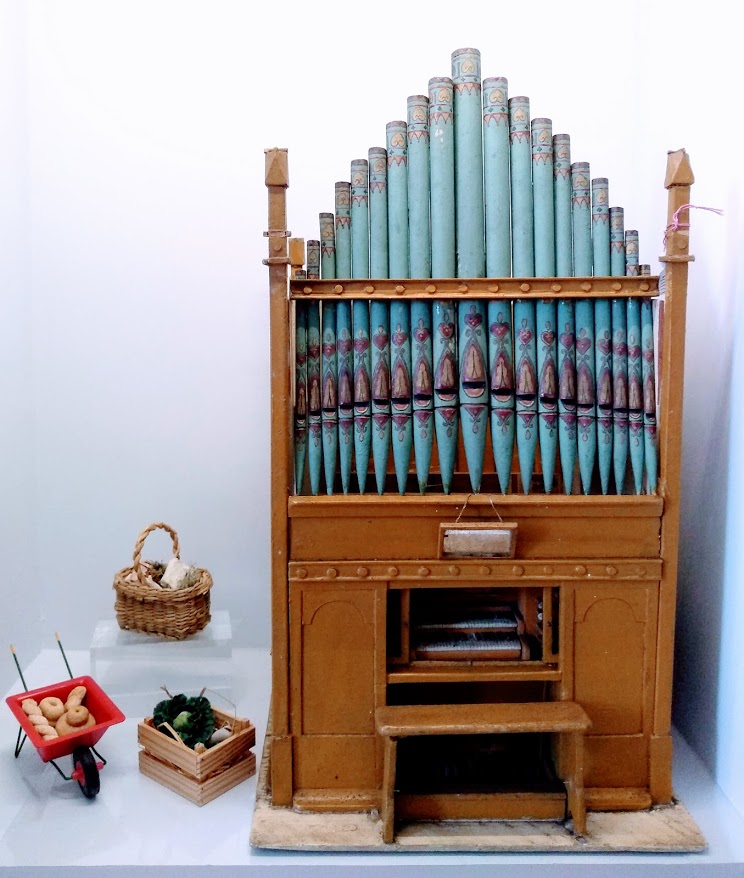
model organ

Model Organ of the one in Stanford Avenue Methodist Church (miniatures kindly loaned by C. Berridge)  

This beautifully made wooden model of the church organ in Stanford Avenue Methodist Church Brighton was made by a Mr DA Wright – perhaps a worshipper at the church? It was donated to the collection in 1974 by his son along with two postcards; one of the model organ and the other of a splendid Harvest Festival display of produce at the church in 1911. The model has some very old wiring which may have powered a light, or perhaps linked to recorded music. The actual church was built in 1897–98 to an Early English Gothic Revival design by E.J. Hamilton, so in 1911 it was still a relatively new building. At that time – before the full scale development of the Hollingdean side of Ditchling Road – the church was at close proximity to farmland, allotments and smallholdings so giving thanks for the fruits of the harvest would have been an important local celebration.

Postcard of the Organ in Stanford Avenue Methodist Church

The donation record also notes that Mr Wright made a toy taxi complete with driver, ‘from cigar boxes during the 1914-1918 war’. Only a few years separate the making of these two objects but one can only contemplate how much life may have changed for Mr Wright, his family and the locality, between the peaceful abundance of the pre war Harvest Festival and the Great War.

Find out More

Follow the What’s in the Box category on our blog to see what new items have come out from our stores.

If you visit Hove Museum in Church Road, Hove, look out for our What’s in the Box? display. 

Joy Whittam, Collections Assistant


What on Earth is going on in Box 9?

What’s in the Box Halloween Display at Hove Museum

This is a legacy story from an earlier version of our website. It may contain some formatting issues and broken links.

Here’s the latest story from our What’s in the Box display.

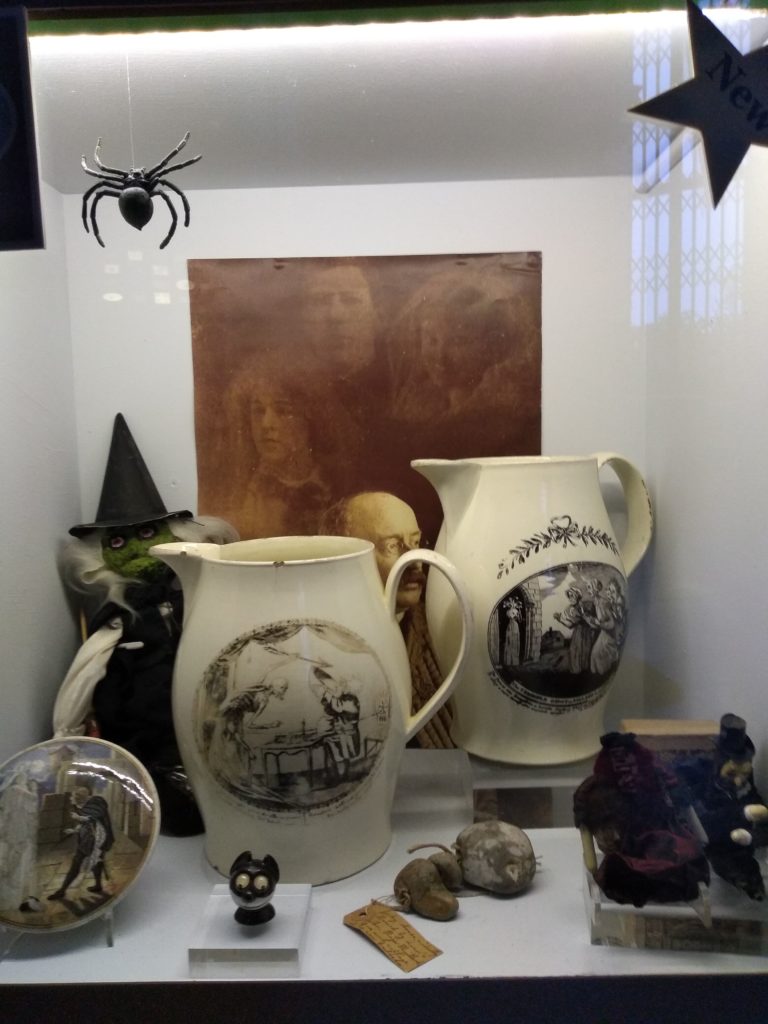
There is a suspicious gent and a headless lady

a man is hanging out with spirits

a ‘ghost’ is tormenting poor villagers

Death is greeting a drinking man

Hamlet is chatting with his father’s ghost

and a witch has made herself comfortable in the corner

– she better beware because lucky stones ward off spells

perhaps the black cat will protect her. But where is its body – on Hallowe’en?

Object List

  1. Suspicious Gent and Headless Lady, 2002, by Rachel Larkins
  2. Copy of ‘spirit’ photograph, c.1900, possibly taken by Mary Burkett in Brighton
  3. Creamware jug, c.1800. Inscribed: The Parson was brought in a horrible fright/To allay a mere turnip on a mopstick/Which an unlucky boy had placed in the porch/And in it alight a most terrible torch.
  4. Creamware jug, c.1790, by Thomas Fletcher. Inscribed: ‘To speed his draught grim death appears.
  5. Pot with lid, c.1860, F & R Pratt & Co; Jesse Austin
  6. Witch puppet – details unknown
  7. Three pebbles known as Witch Stones or Lucky Stones, with natural holes. From a cottage in the Eastdean area. Pre 1939.
  8. Toy cat, possibly Felix the Cat, c.1920 –30

Find out More

Follow the What’s in the Box category on our blog to see what new items have come out from our stores.

If you visit Hove Museum in Church Road, Hove, look out for our What’s in the Box? display. 

Lucy Faithful, Collections Assistant


Why is a Raven like a Writing Desk? Preston Manor’s 2019 Riddle Trail

Paula Wrightson, Venue Officer Preston Manor in the Drawing Room at Preston Manor

This is a legacy story from an earlier version of our website. It may contain some formatting issues and broken links.

During the summer season 2019 families visiting Preston Manor were challenged by a specially created Riddle Trail.

The trail took them on a journey around the house encountering Victorian brain-teasers, puns and puzzles on the way.

Paula Wrightson, Venue Officer Preston Manor in the Drawing Room at Preston Manor

Arguably the most famous riddle of the Victorian age was that posed by the Mad Hatter in Lewis Carroll’s Alice’s Adventures in Wonderland (1865)

“Mad Hatter: “Why is a raven like a writing-desk?”
“Have you guessed the riddle yet?” the Hatter said, turning to Alice again
“No, I give it up,” Alice replied: “What’s the answer?”
“I haven’t the slightest idea,” said the Hatter”

When I created the Riddle Trail Alice was my inspiration, as were two real-life Victorian girls, twins Diana and Lily Macdonald who were born in 1866 and grew up at Preston Manor. Without doubt Diana and Lily read Alice in their childhoods and puzzled over Lewis Carroll’s un-answerable raven riddle, as people still puzzle today.

Diana and Lily Macdonald

Since Preston Manor contains a number of Victorian writing desks and The Booth Museum of Natural History was able to provide me with a taxidermy raven I thought what better fun than pose the raven riddle to our summer visitors leaving pencil and paper handy.

The Riddle Trail has now ended, so here are the results from the brave few who attempted an answer:

Why is a raven like a writing desk?

“Because it can produce a very few notes though they are very flat” wrote Destiny.

Pam had a similar idea, “because it can produce a few notes”

“Kept on a writing desk as a sign of good luck” Jasmine offered.

“They both have the letter R in them” an unnamed person suggests.

“They are the two loves of my young fragile life” declares another, poetically

“HE IS NOT” writes a child employing faultless logic

Lewis Carroll’s answer

In his preface to the 1896 edition of Alice in Wonderland Carroll feels he must answer:

“Enquiries have so often been addressed to me, as to whether any answers to the Hatter’s riddle can be imagined, that I may as well put on record here what seems to be a fairly appropriate answer, viz: “Because it can produce a few notes, though they are very flat; and it is never put with the wrong end in front!’ This, however, is merely an afterthought; the Riddle, as originally invented, had no answer at all.”

My answer?

In relation to the raven and writing desk at Preston Manor: “one is preserved by stuffing the other is stuff worth preserving”

Looking to 2020

Preston Manor’s 2019 Riddle Trail proved popular with families who responded by saying how much children and adults enjoyed the hands-on activities, dressing up and doing something unexpectedly thought-provoking in a historic house.

Inspired, we are already planning a trail for summer season 2020. There will be a new theme and new activities with the trail running daily during normal opening hours free with entry tickets.

Preston Manor summer season begins on Wednesday 1 April, for more information see the Visiting page.

Paula Wrightson, Venue Officer Preston Manor

TV Stars at the Booth Museum

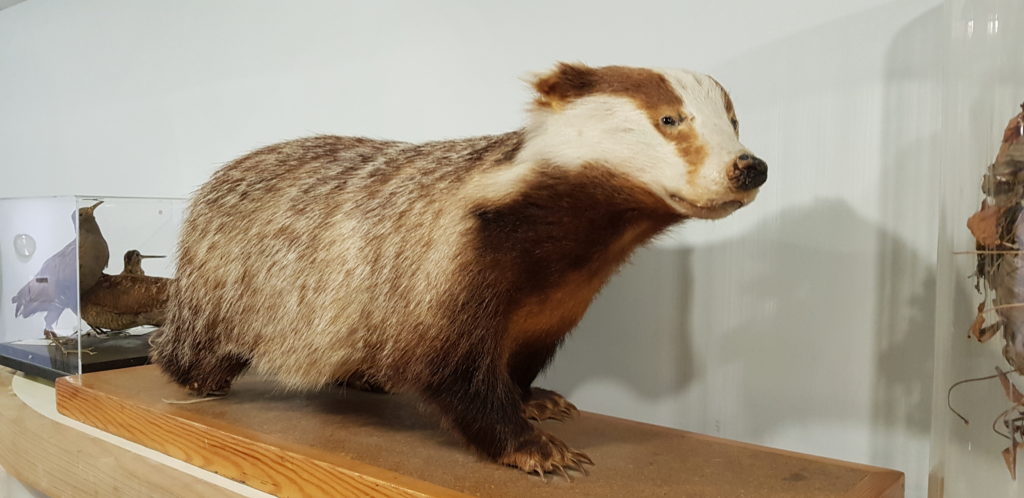
Our Booth badger has been digitised for the base of the CGI badger in the Prince Caspian movie.

This is a legacy story from an earlier version of our website. It may contain some formatting issues and broken links.

His Dark Materials on BBC1

[kad_youtube url=”https://www.youtube.com/watch?v=APduGe1eLVI” ]

In the trailer for the major new BBC series ‘His Dark Materials’ above, there is a brief appearance at 1:08 for a digitised version one of our specimens.

Two years ago several of our specimens were borrowed by the production team involved in making the visual effects for the new series. Though they had a very long list of objects, unfortunately many of their wishlist items (including Lyra’s daemon’s stoat form) were unsuitable for scanning due to being included in a diorama.

However, they did borrow moths, stag beetles and a hare. These items were in our loan collection, so were available for general use as the possibility of damage wouldn’t affect our research collections. The items were scanned and digitised in top secret (we were not allowed to reveal our involvement until the series had been officially unveiled). They used the scanned specimens as a basis for the CGI animations of the animals. Puppets were also created for the actors to interact with in front of the cameras (though we don’t know if these were based on our specimens!).

The most high profile of the specimens appears to be Lee Scoresby’s daemon Hester the hare. Having watched the first episode, the hare and stag beetles are yet to make an appearance, but a digital version of a moth form of Lyra’s daemon may be observed in the scene where Lyra hides in a seat during Lord Asriel’s speech to the Oxford academics, asking for their funding of his research. You can read more about Lin Manuel Miranda’s character and Daemon in an online interview for Entertainment Weekly.

The hare, moths and beetles join our badger in the list of TV and film stars at the Booth. Our badger had previously been digitised for the base of the CGI badger in the Prince Caspian movie.

Lee Ismail, Curator of Natural Sciences

Booth Museum Bird of the Month, November 2019: Whydah Vidua paradisaea

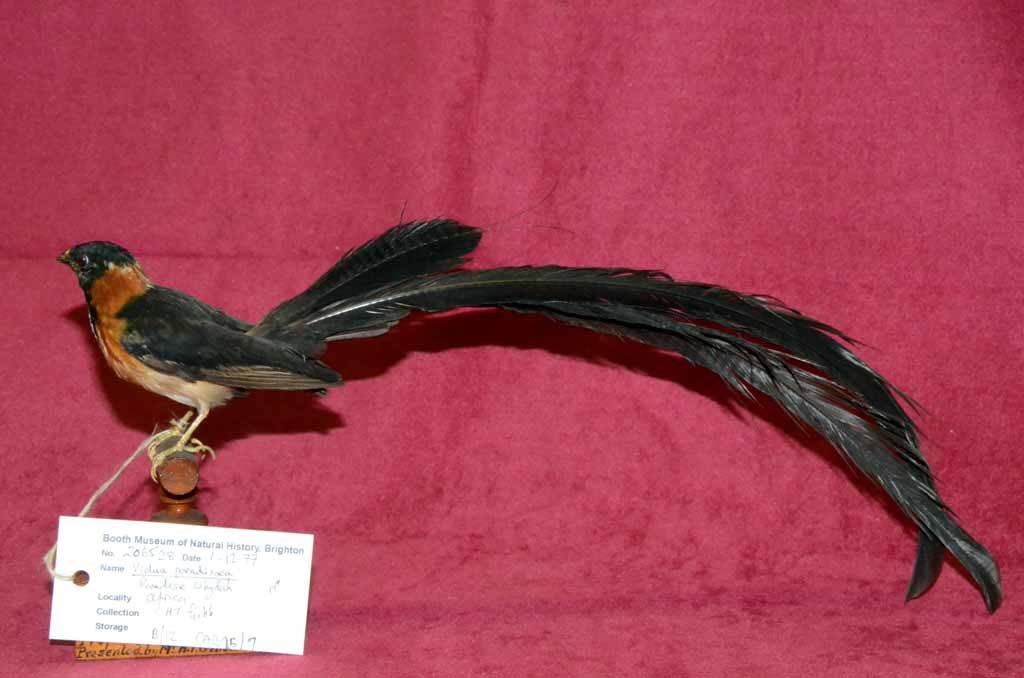
Long-tailed paradise whydah, Vidua paradisaea,

This is a legacy story from an earlier version of our website. It may contain some formatting issues and broken links.

The Booth focus on the Long-tailed paradise whydah, Vidua paradisaea, for November

Whydahs are brood parasites, like the European cuckoo, though they do not destroy the host’s eggs. Whydah chicks are larger and louder than the host’s, which means they are given more food. The long-tailed paradise whydah uses the green-winged pytilia (a type of finch) as a host.

The species can be difficult to distinguish from each other, therefore the host finch is often used to determine this. Whydahs recognise the song of the finch, which the male imitates.

Outside of the breeding season the male moults his breeding plumage, including the very long tail, making them difficult to distinguish from the females.

Kerrie Curzon, Collections Assistant and Lee Ismail, Curator of Natural Sciences

A Closer Look at ‘The View From Here’: Ceramics Inspired by a Love of Museums

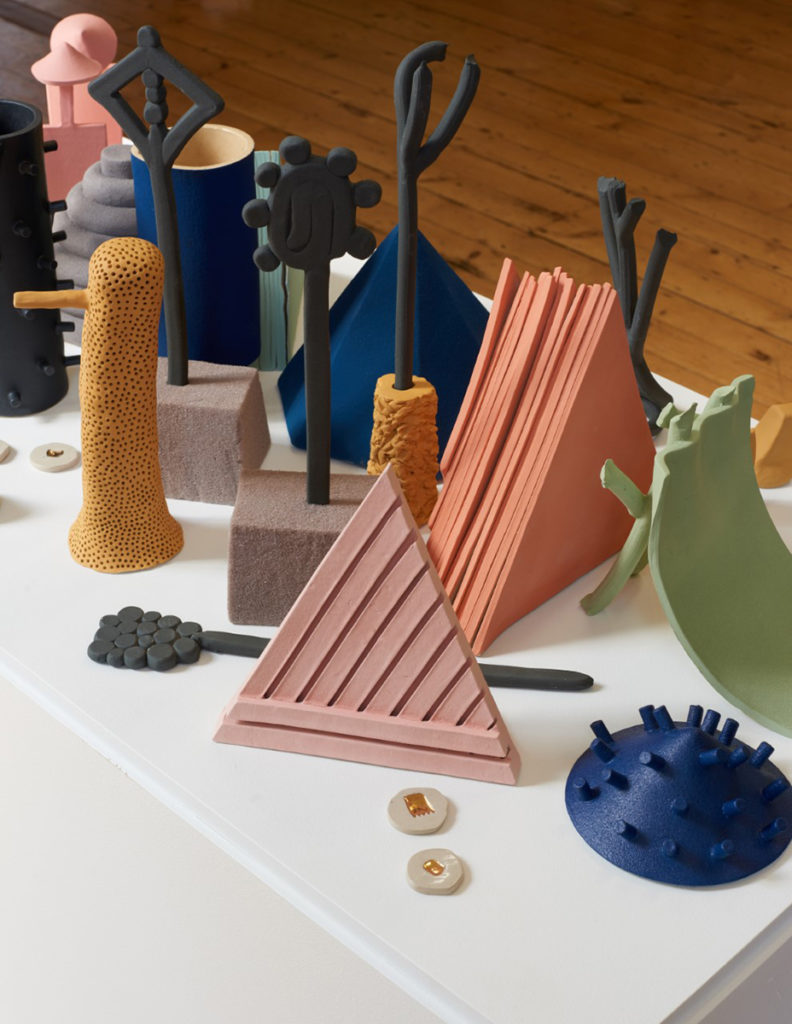
"The View from Here" was a colourful installation in ceramic and steel that was displayed at Hove Museum.

This is a legacy story from an earlier version of our website. It may contain some formatting issues and broken links.

The View from Here is a colourful installation in ceramic and steel that was recently displayed at Hove Museum.

When I saw this work at the museum I was intrigued by it and wanted to meet the artist to find out more about the way she works and the ideas behind her exhibit.

Lisa Jones is a ceramicist who is currently undertaking an MA in Craft at The University of Brighton.

Lisa says “By placing these ceramic sculptures together to create an installation I’m forming a sense of place, a topology of the museum and my response, through the material of clay, to the objects and the immense history of making”.

She suggests that we can enjoy the displays in museums a different, more aesthetic way, without so much concern for the history behind each piece.

It became clearer in conversation that Lisa is most interested in the subjective experience of the viewer. Passionate about museums (she always visits the museum when she goes to a new town) – she likes the idea that everyone can bring their own stories to each object to have an emotional response and that this makes it possible for everyone to participate.

Lisa’s work seems very playful. She spoke about her research acknowledging that while it is underpinned by theories of the politics of display, a great deal of it is practice-based. She learns from manipulating the clay, enjoying the forms and experimenting with texture. She uses both glaze and engobe and I learnt that engobe is a product that is in-between a glaze and a slip (clay mixed with water). It has a matt finish, sometimes with a texture. Colour is something that Lisa is only just starting to explore, as her previous works were monochrome.

With Engobe for texture, before and after firing.

With Engobe for texture, before and after firing.

We talked about how museum objects from different collections could share generic shapes and colours in our memories: The colours in Lisa’s installation reminded me of items from the Hove Museum craft display but she told me that her original inspiration came from displays in The Pitt Rivers Museum and Ashmolean in Oxford.

There are particular items that Lisa is drawn to in museum collections: staffs and wands, hats and loom weights, bartering tokens as well as peashooters! The objects that she is drawn to seemed to have some commonality in that they are all both useful items with the potential for a playful side: Hats are used by everyone regardless of class and income, though the actual use of the hat can differ – for safety and warmth or for pure display “frippery” as Lisa says. Mary of Wapping used a peashooter for the serious business of waking up the workers but in the hands of a school child it could be a tool of mischief and play.

Similarly Lisa wonders about the loom weights that has she has seen in museum collections: useful in weaving but without the loom they are just lumps of material ‘lumpen’ as she calls them. The ‘lumpen’ in her display have been given ever so slight human characteristics. Wands and staffs could bring to mind elders, leaders and decision makers with the weight of responsibility and wisdom, alongside thoughts about magic, fantasy and folklore.

Lisa’s installation, and many exhibitions in museums, remind me of assemblage art: an art form that started in the 1950’s that is typified by the use of three-dimensional, often found objects, placed together to make a whole. I wondered if this was an influence for Lisa – but she sees her work more like a mini museum made from individual pieces of ceramics that can also be separated to stand in their own right. Instead, her work is influenced by the ceramicist Matt Smith, who has exhibited at Brighton Museum and Preston Manor in the past. As well as creating his own ceramics, Matt Smith’s work involves curating museum displays so that they challenge the viewer’s perspective, recognising that these displays tell the story that the curator chooses to tell.

Matt Smith says: “ I am drawn instead to the emotional bonds between objects, makers, viewers and collectors in order to examine what these collections can tell us about human experiences’ and this seems to resonate with Lisa’s perspective.

Thank you to Lisa Jones for talking to me about her work. This conversation highlighted a particular way of looking at and responding to museum exhibits. It has at the heart of it a passion for spreading the enjoyment found from simply allowing a personal and emotional exploration of museum objects. We look forward to seeing more of Lisa’s work in the future.

More ceramics at Hove Museum

Cultural Icons: Remaking a Popular Pottery Tradition.

28th November 2019 – February 2020.

Six ceramicists: Joanna Ayre, Christie Brown, Claire Curneen, Stephen Dixon, Ingrid Murphy and Matt Smith have been inspired by Victorian flatback figurines and responded by making contemporary Cultural Icons.

For more information see Hove Museum Displays

Visit the Events page for details of a Gallery Talk 

Louise Dennis, Community Artist
Booth Museum Bird of the Month, October 2019: Flowerpecker Dicaeum sp.

Flowerpecker Dicaeum

This is a legacy story from an earlier version of our website. It may contain some formatting issues and broken links.

Flowerpeckers are October’s Bird of the Month.

Flowerpeckers are tiny birds that occur in Australasia and southern Asia. The genus Dicaeum contains over 40 species. The pygmy flowerpecker is only 10cm long, while the largest is the mottled flowerpecker at 18cm. The majority of flowerpecker species are resilient and not endangered.

Flowerpeckers have curved beaks and tubular tongues, which help them to feed on nectar. In certain species the tongue also has a feathery tip to further aid in nectar collection. They will also eat insects, spiders and berries, particularly mistletoe. Flowerpeckers are important dispersers of seeds and pollen. They make little pendant nests that dangle from trees.

Kerrie Curzon, Collections Assistant and Lee Ismail, Curator of Natural Sciences


The Hilton Sisters: Non-normative bodies, queer lives

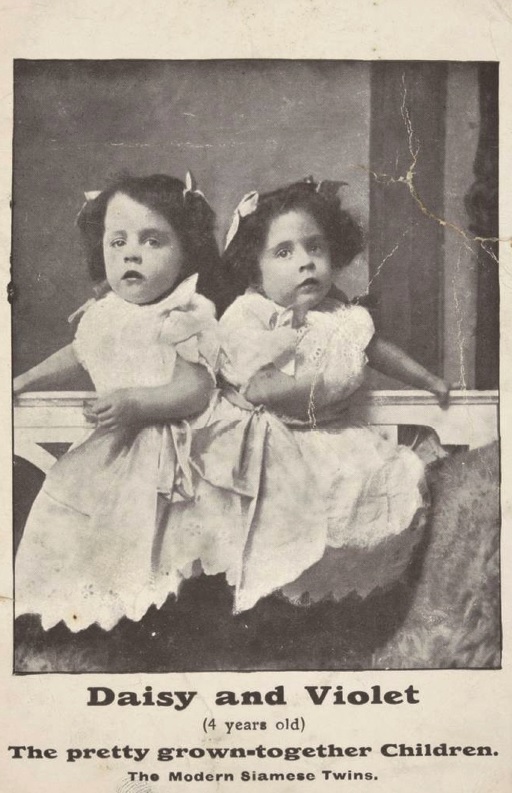
Violet and Daisy Hilton

This is a legacy story from an earlier version of our website. It may contain some formatting issues and broken links.

I was very excited to become part of the Brighton Museum & Art Gallery Queer The Pier community curators’ team.

My understanding of what we mean by ‘Queer’ has grown in recent years to include not only sexuality but a whole range of people and things considered ‘non-normative’. As a person with a disability, I encounter the physical challenges of a normative world with a non-normative body every day. It is likely this was true also for conjoined twins Violet and Daisy Hilton who were born in Brighton in 1908.

Violet and Daisy Hilton

The Hilton sisters became famous in Europe and Australia but made their fortune in North America. Their mother Kate Skinner, who was living in poverty in Riley Road, gave them up to her midwife Mary Hilton, who was also the landlady at the Queen’s Arms public house in Kemptown. They were put on show as a ‘curiosity’ to be stared at from only a few weeks old, before being toured round the world and trained to sing and dance. They regained control of their lives and some of the money they had been making aged 23. They went on to star in two films: the controversial Freaks (1932) and the exploitative b-movie Chained for Life (1952).

They returned to the UK just once, in 1933, performing up and down the country, including four sell-out shows in April at the Brighton Hippodrome. Intriguingly they both married men who turned out to be gay, and there were rumours amongst people who worked with them that Violet preferred the ladies. Their popularity waned in later years and they died within days of each other in North Carolina in January 1969. They were offered to be safely separated a few years before this but decided to remain as nature intended, forever together side by side.

Credit: Wellcome Collection

Violet and Daisy Hilton, Credit: Wellcome Collection

A local historian Alf Le Flohic has successfully campaigned for a blue plaque to be placed where they lived here in Brighton, which is to be unveiled in 2020. We are delighted to say we will use a short clip of them performing in Chained for Life, as Vivien and Dorothy Hamilton, as part of the exhibition Queer the Pier. You can see the trailer for the film on YouTube.

Launching 2020

Queer the pier will launch in 2020, but in the meantime:

Janet Jones, Queer the Pier working group member

Sunflowers, Syringa and Skill-Building on the Royal Pavilion’s Workforce Development Programme

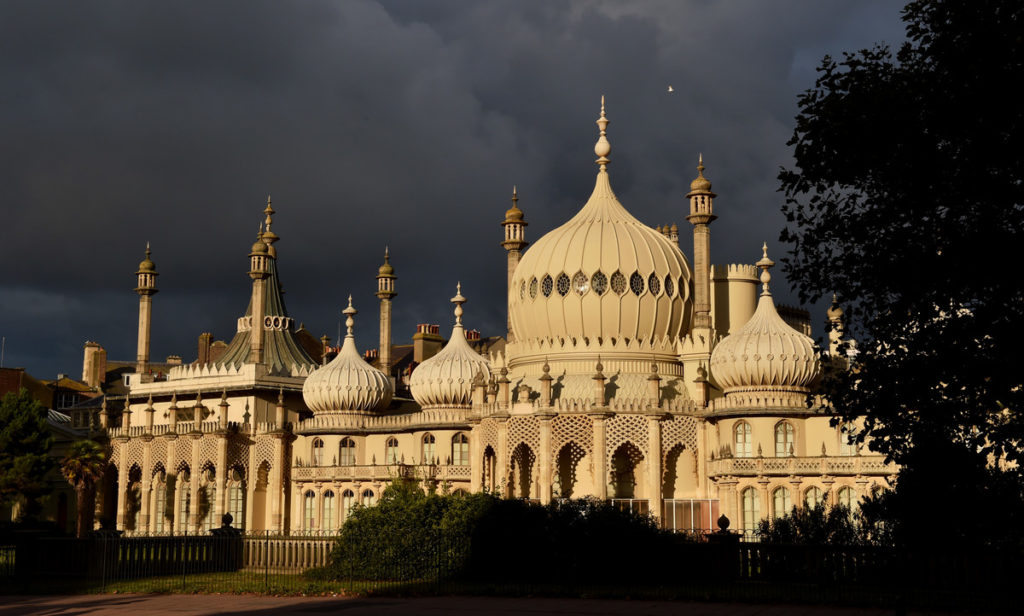
Royal Pavilion Sunshine in Brighton, credit: Simon Dack

This is a legacy story from an earlier version of our website. It may contain some formatting issues and broken links.

I had worked at the Royal Pavilion for about four years when another workforce development placement was suggested to me.

I had done two before – a great placement working with researchers to put together a new tour all about the servants working below stairs at the Pavilion, and another researching the museum’s fabulous collection of musical instruments and bringing some of them out of storage. In my day job, I enjoyed working as a Visitor Services Officer, introducing people to the wonderful and unexpected world inside the Royal Pavilion. What I hadn’t done before was pay equal attention to what was outside this curious building – the faithfully restored Regency gardens that surround the Prince Regent’s palace of pleasure.

Any observer of my interests outside work would have been surprised to learn that I had never substantially ventured into the garden as part of my job. A keen allotment grower, I had been studying for the RHS Level 2 in Principles of Horticulture, and had spent many lunch breaks out in the garden peering at plants. When an opportunity came up to spend a day a week working in the Pavilion gardens and learning to be a gardener the practical way, naturally, I jumped at the chance. Having been unable to take up a volunteering position as this would have meant sacrificing a day of paid employment, this was the only path open to me getting my hands on a garden for a significant enough amount of time to build experience.

Royal Pavilion Sunshine in Brighton, credit: Simon Dack

My placement started in November, a very busy time for the Pavilion as Christmas approaches and we decorate and start building up to Christmas events. A day a week in the garden was fantastic experience at this time of year – pruning and clearing from the excesses of summer and autumn, planting bulbs for a spring display and feeding the soil with mulches. While my colleagues walked past in the rain and made commiserating noises about the wet and cold, I was delighted to be outside and learning about winter in the garden, when the imaginary curtains close on the show and the real work happens.

Highlights of my placement were many, but I remember two in particular. One was a session of pruning to reduce a Portuguese laurel and a bay tree – but because it’s a Regency garden, it’s never just reducing anything. What we were doing was using our secateurs and loppers to create a picture frame – a picture frame that had grown out of shape. Once I’d learned to recreate the frame, the picture could shine through – the picture being the northern façade of the Pavilion at just the right angle to be painted in watercolours in 1819 (or Instagrammed in 2019, naturally).

Monochrome tinted postcard showing photographic image of the North Gate to The Royal Pavilion, Brighton.

The other highlight of my placement was spending all day pruning a rose. I had never devoted that much attention to one plant before, and Rosa “Petite Lisette” and I spent hours getting into shape. The pay off came, as with all gardening, months later, as I walked past on my way around the gardens and saw it flowering robustly and showing a lovely balanced form. It was days like these that made learning from Robert Hill-Snook, the head gardener at the Royal Pavilion, a real privilege – having been at the Pavilion for more than twenty years, he not only knows every detail of the planting plans but also how each plant has done in previous years – and the history of each species’ journey across vast expanses of ocean all the way to Brighton by 1826.

Royal Pavilion Gardens, credit: Simon Dack

My placement in the gardens was, in some ways, a self imposed test. I had applied for it so that I could see if I really wanted to change my career and work as a gardener, and thought if I could enjoy it even over the depths of winter, then I could be pretty sure it would work out.

The end of my placement loomed, and I started applying for gardening jobs. I’d passed my own test – I had absolutely loved it.

I am now saying a fond goodbye to the Pavilion and its Regency garden so that I can take up a placement on the Historic and Botanic Garden Trainee Scheme, run by English Heritage. My placement is at Osborne House, so I’ll be following in the footsteps of none other than Queen Victoria, who decided to leave her inherited Brighton summer palace in favour of the privacy of her new estate on the Isle of Wight. I’ll be extending my planting cut-off date (the date we use as a deadline to make sure planting is appropriately of the period) from 1826 all the way to 1901, and learning about the different challenges of gardening a 354 acre estate. I know I will take all the lessons I’ve learned in Regency gardening with me, as my placement enabled me to take up this amazing chance. Thanks to this placement, I’ll be changing my career and embarking on a whole new adventure in gardening and even island life.

Queen Victoria with Royal Pavilion in background, c1840

Update: I have now spent 4 weeks in my new job as a garden trainee and have enjoyed every moment! I am learning such a lot and it’s great to have the plant knowledge the Pavilion placement gave me to fall back on. It’s been interesting learning about a whole new (to me) style of formal gardening, especially the bedding schemes, and to work with exotic plants – and many of the same plants I know from the Pavilion beds.

Emily Hall, Visitor Services Officer