Story Category: Legacy

A Trainee’s Experience on the Art UK Sculpture Project

Photography in Museum Lab

This is a legacy story from an earlier version of our website. It may contain some formatting issues and broken links.

Art UK’s project of photographing sculptures in art galleries nationwide recently involved objects in Royal Pavilion & Museums’ collections.

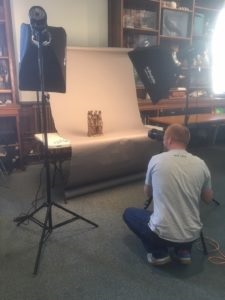
Photographer behind camera photographing small sculpture on table.

Photography in Museum Lab

The aim of Art UK‘s project is to photograph sculptures in public collections across the country to collate into one database. Being involved in the project was a great opportunity for me to learn about professional photography, especially as my Museum Futures traineeship has a digital focus, including the digitisation of museum collections. Although I initially joined the project as a fly on the wall, I ended up being able to gain some really valuable experience in object handling, conservation and documentation.

While assisting with the photography, I took some photos to document the process — although looking at the poor quality of the photos I took, it was obvious I could learn a thing or two from the professional photographer!

The photography is being done regionally and the Brighton-based part of the project took place in July 2019, starting with preparing the sculptures in Brighton Museum & Art Gallery’s Museum Lab and our off site store. This was the perfect opportunity for me to do some object handling; something I’d been hoping to do for a while. It mainly involved brushing dust off of the works, which ranged from life size busts of Brighton dignitaries to a miniature plaque of Princess Charlotte. As most of the objects had been safely tucked away in stores for many years, many of them required a fair bit of cleaning, done so by using a soft conservation brush to very gently remove any dust.


With the sculptures all newly cleaned, photography started the following week. One of the sculptures included in the project was a piece by Frank Stella currently on display in the Heyer Gallery in Brighton Museum, which bought about its own logistical challenges photographing it in situ. Nevertheless, between the team of photographers, curators and technicians, the photo was taken and photography was moving at a steady rate, which only progressed throughout the day. We had scheduled in two days of photography at the museum, but ended up only needing one.

A camera in the foreground with a table, grey backdrop and professional lights in the background.

Photography set up in Museum Lab

On day two, some of the team went to photograph a sculpture on display in Brighton Town Hall, before we all went to the off-site store for the rest of the photography, where the project continued for three more days. As the project progressed, my role increased from just observing to using our collections management system to check for duplicate records and to update object locations, as well as marking which objects had been photographed and cleaning the remaining sculptures which hadn’t been cleaned last week.

Because the project is on such a large scale, it will be a few months before the images are processed and published online. Until then, you can view our already digitised Fine Art collections on our Digital Media Bank.

Tasha Brown, Museum Futures Trainee

Friedrich Nagler Inspires Us to Make!

Two cork women and a mixed media dog – an afternoon’s work for a father and daughter.

This is a legacy story from an earlier version of our website. It may contain some formatting issues and broken links.

Louise Dennis, community artist, writes about her recent workshops inspired by the artist Friedrich Nagler, at Hove Museum and Art Gallery.

‘Creativity involves breaking out of established patterns in order to look at things in a different way’ (Edward De Bono)

It was my pleasure to run creative workshops recently at Hove Museum taking inspiration from the fantastic Friedrich Nagler exhibition. The only thing necessary to bring was your imagination and a willingness to look with fresh eyes at everyday objects as Friedrich Nagler did.

As De Bono said, ‘this simple process of focusing on things that are normally taken for granted is a powerful source for creativity’. Nagler was very skilled at turning the ordinary into something extraordinary and helping the viewer to see something a different way. To encourage this kind of creative ‘lateral’ thinking I collected a range of ordinary or recycled materials including metal clamps, bolts, screws, hooks, stones, pine cones, feathers, corks, plastic pegs, plastic bottles and loads more – the list could go on and on.

I was excited to see what would be created in the workshops  – and I wasn’t disappointed.

A little elephant – I love the paper clips used for his ears

One workshop took place in the room surrounded by Friedrich Nagler’s work, enabling us to directly refer to it. A young girl marvelled at the bread sculptures and everyone enjoyed the animals made from metal hardware. This workshop was full of laughter as people were amused and perhaps surprised by their creations.

Who would have thought you could make a singing diva out of a pinecone?!

A teenage boy looked intelligently at a small flattish, slightly curved stone. What did it look like? What would it become? ‘A crocodile!’ he said – and then I could see it too. He set about painting with great skill. His grandmother, who made a royal looking character out of a champagne cork (it was the metal fixing on the cork that inspired her), said that the afternoon had been very relaxing and meditative.

Stone painting

A royal character in gold.

Members of the Nagler family came along including his three great grandchildren. The youngest great-grandchild was very pleased with his creation: a dog that he had made from a stone – and delighted that he was able to take it home. The Nagler family children seemed to take very easily to the task of finding creatures and characters within the hardware available. They made a flat metal dog with ears cocked forwards and backwards and a face with intense eyebrows! Another delight was the stone painting of a face and a skull done on either sides of the same stone.

Creative work by the Nagler family

The atmosphere veered between exuberant and lively to very calm and almost meditative: children and parents worked alongside each other, everyone in their own creative zone. One parent commented that she had most enjoyed ‘the freedom of creativity’.

Two cork women and a mixed media dog – an afternoon’s work for a father and daughter.

More creatures and characters – spot Hove Museum’s Nadja Derungs immortalised in cork and pipe cleaners!


It was refreshing and fun to create in this way and it has renewed my ability to see ordinary objects in new ways – I hope those that came to the workshops took that away with them too.

Friedrich Nagler used such a wide range of materials including wood, found objects, metal, plastic, rubber, bread, clay and bone to make a truly vast collection of animals and characters. This exhibition provides such rich material to stimulate imagination and creativity – it was a delight to plan and facilitate these workshops.

You can still see the Friedrich Nagler exhibition until 17th September at Hove Museum.

Louise Dennis, community artist

What’s in the Box? Shell-Shaped Ceramics

What’s in the Box? Shell-Shaped Ceramics

This is a legacy story from an earlier version of our website. It may contain some formatting issues and broken links.

Here’s the latest story from our What’s in the Box display.

Collections Assistant Lucy Faithful on how a display of shell-shaped ceramics at Hove Museum can both twist your tongue and give an insight into the changing fashions and ideas throughout European history.

A word in your shell-like.

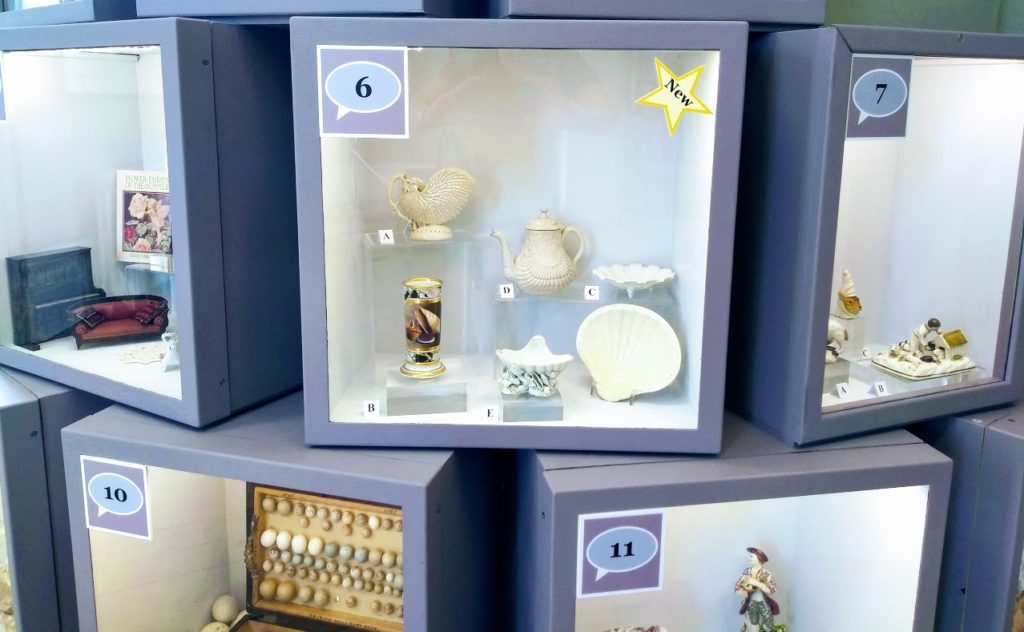
shell ceramics in display case

Shell Ceramics in the What’s in the Box? Display Case

The theme of our “What’s in the Box?” display at Hove Museum is moving from spring to summer. This is a great opportunity to display some of our rarely-shown shell-shaped ceramics (what a tongue-twister). We have quite a few, mostly British pieces, in our Decorative Art Collection – some in the form of scallop, cowrie or nautilus shells – dating from the 18th to the early 20th century.

porcelain spill vase

Porcelain Spill Vase, Early 20th Century. da320146

This elaborate, exquisitely fine, porcelain spill vase was made in the late 19th or early 20th Century by Belleek in Northern Ireland. Known as a ‘fancy’ it is shaped as a nautilus shell balanced on abalone shells and has a coral-shaped handle. Belleek was known for its delicate lustered glazes and designs inspired by sea creatures.

Most of the pieces on display were made from porcelain clay, which is pliable, smooth and perfect for moulding into intricate shell shapes. The clay itself is also associated with shells – and pigs.

Piglet by Petr Kratochvil, free domain

Porcelain in English is derived from the French porcelaine, which came from the Latin porcellana. There have been many variations on the origin of the word ‘porcelain’ over the years. One version is that it refers to the translucency of pig’s ears, another alludes to another part of the pig’s anatomy. A young pig is porcella in Italian.

Porcella in turn became an Italian name for a type of cowrie shell. The shiny surface of the shell being compared to the lustrous shiny surface of porcelain.

Shells have been used for decorative purposes for centuries but the exotic shells brought by sailors to Europe in the 17th century became wildly popular with the upper classes. Shells were displayed in cabinets of curiosities and their patterns carved in wooden furniture or moulded into plaster embellishments on ceilings.

Sweetmeat Dish, Late 18th century. da320268

This late 18th century sweetmeat dish was made by Leeds pottery who are still making them today. The scallop dish is balanced on little winkle-shell feet.

Some of the shell ceramics in our collection are in the neo-rococo style that became popular in Britain in the late 18th and 19th century, particularly in later years with the newly-moneyed middle-classes. Rococo itself was a decorative style, from the late 17th- early 18th century, that revelled in elaborate ornamentation.

Porcelain sweetmeat or salt dish, c 1750-52.

Porcelain Sweetmeat or Salt Dish, c1750-52. da320591

This porcelain sweetmeat or salt dish is shaped as half a clam shell supported by bivalves and other molluscs. It is an example of the rococo style and was likely made by Bow potteries, c 1750-52.

And so is this fancy Davenport teapot, c1830. The coral handle and scallop-shell knob weren’t quite elaborate enough so flowers and curlicues were added.

Teapot, c1830. da310041

Influenced by natural forms, the name apparently originates from the French word rocaille – a method of decoration using pebbles, corals, seashells and cement, which was often used to adorn grottoes and fountains. Louis XVI commissioned an extraordinary cottage richly decorated with shells for Marie Antoinette. Britain even had its own rococo style, which had more realistic natural motifs.

Here is stoneware teapot moulded with shells, dolphins and plants, c1750, made in Staffordshire. I love its little sea-serpent spout.

Teapot, c1750. da310002

The shell motifs also reflect the influence of Romanticism that developed in the late 18th century and which influenced art, literature and philosophy. Aside from its concerns with emotion, feelings and individualism, it also emphasised the importance of nature. This was partly a reaction to the advent of industrialisation. The land became romanticised as it disappeared into roads, towns and factories.

Romanticism was also a reaction against the Enlightenment and rationalisation. But this too had a long-lasting influence on representations of nature but in more accurate, scientific and realistic ways. Botanical recording gained popularity and rare specimens were depicted on porcelain.

This porcelain spill jar is one of my favourites here. The enamel decoration is quite beautiful with its unusually realistic depictions of shells and seaweed. When I first saw it, I presumed it had been made in the 1930s. In fact it was made around 1807-1813 by Flight, Barr & Bar in Worcester. They specialised in subjects such as flowers, shells and landscapes.

Spill Vase, 1807-1813. da324298

The use of shells as decoration on ceramics also reflected British preoccupations with the sea: long life-changing voyages to Australia and America, as well as naval battles with France, Spain and America. This c1820 plate has a border of shells and seaweed. Although it was made in Staffordshire, it commemorates an American victory against the British navy at the Battle of Lake Champlain in 1812.

Plate, c1820. da328495

This tea cup, c1830, was produced by Rockingham Works in Yorkshire and has a sea-shell and lilac design.

Tea Cup, c1830. da322130

The late pieces also reflect a Victorian fascination with nature: exploring, collecting, drawing, classifying, pressing, pinning, displaying. Christians demonstrated their wonder of God’s creation through paintings and ceramics at the same time as the works of Charles Darwin took hold and increased the interest in the natural sciences.

Sweetmeat Dish, 1892. da320715

Porcelain dish made by Worcester in 1892.

Find out More

Follow the What’s in the Box category on our blog to see what new items have come out from our stores.

If you visit Hove Museum in Church Road, Hove, look out for our What’s in the Box? display. 

Lucy Faithful, Collections Assistant


Booth Museum Bird of the Month, August 2019: Fringilla coelebs

Chaffinch, Fringilla coelebs,

This is a legacy story from an earlier version of our website. It may contain some formatting issues and broken links.

The Chaffinch, Fringilla coelebs, is the Bird of the Month for August.

Chaffinches are one of the UK’s commonest birds. They were originally woodland birds, though they are now often seen in gardens. Chaffinch numbers increase during the winter in the UK, as the resident birds are joined by those from Scandinavia.

Male chaffinches claim a breeding territory in February. The females take over the territory in April during nesting and the male keeps his distance from her.

You may see more chaffinches in your garden in years when there are fewer beech seeds (mast). They will often be seen below bird feeders, scratching around for fallen seeds.

Fringilla coelebs, Chaffinch

Fringilla coelebs, Chaffinch

Kerrie Curzon, Collections Assistant and Lee Ismail, Curator of Natural Sciences

Queer the Pier – Local LGBTQ+ Sex Work

Queer the Pier project logo

This is a legacy story from an earlier version of our website. It may contain some formatting issues and broken links.

Queer the Pier volunteers have been busy over the last few months!

Each of us have been researching areas of Brighton’s LGBTIQ+ history that are significant for us. From non-normative bodies and marginalised groups to the rise of drag in Sussex, we have explored a whole host of queer topics.

Whilst visiting the Keep, one of Sussex’s largest archives, I was very interested to find a collection of sex worker’s calling cards from the late twentieth century – a large percentage of which were aimed towards, or displayed by, the LGBTIQ+ community. Considering recent debate on sex work in the UK, I decided to pursue this subject and research how sex work has changed in our community since before the turn of the century to the present day.

In order to do this, Queer the Pier met with a group of Brighton’s LGBTIQ+ sex workers to show them the documents and listen to their responses to them. We discussed a range of topics, including; how calling cards compared to today’s methods of advertising sex; the impact of the internet on sex work and equally the role that shutting down certain online platforms has played in endangering sex workers’ lives; and also how being queer makes the industry different to cis/straight sex work. As a group, we had a lot of different opinions and experiences on these points but it made for an interesting discussion and will hopefully lead to a thought-provoking display in the exhibition.

One of the key outcomes from our meeting was how excited we all were to finally see some sex worker representation in a museum space. However, we were also all eager to give our display a strong message to those viewing it, in the hope that it will dispel some of the myths surrounding the industry and get visitors to consider how we can improve conditions for the sex workers in our community and beyond.

We want Queer the Pier to be an inclusive and accessible project for our community so, if you would like to get involved or learn more about the work we are doing, please join us at one of our meetings every other Wednesday and Sunday at Brighton Museum & Art Gallery or email us on queerthepier@gmail.com.
Launching 2020

Queer the pier will launch in 2020, but in the meantime:

Cameron Tallant, Queer the Pier working group member

Windrush Day Tea Party at Brighton Museum, 22 June 2019

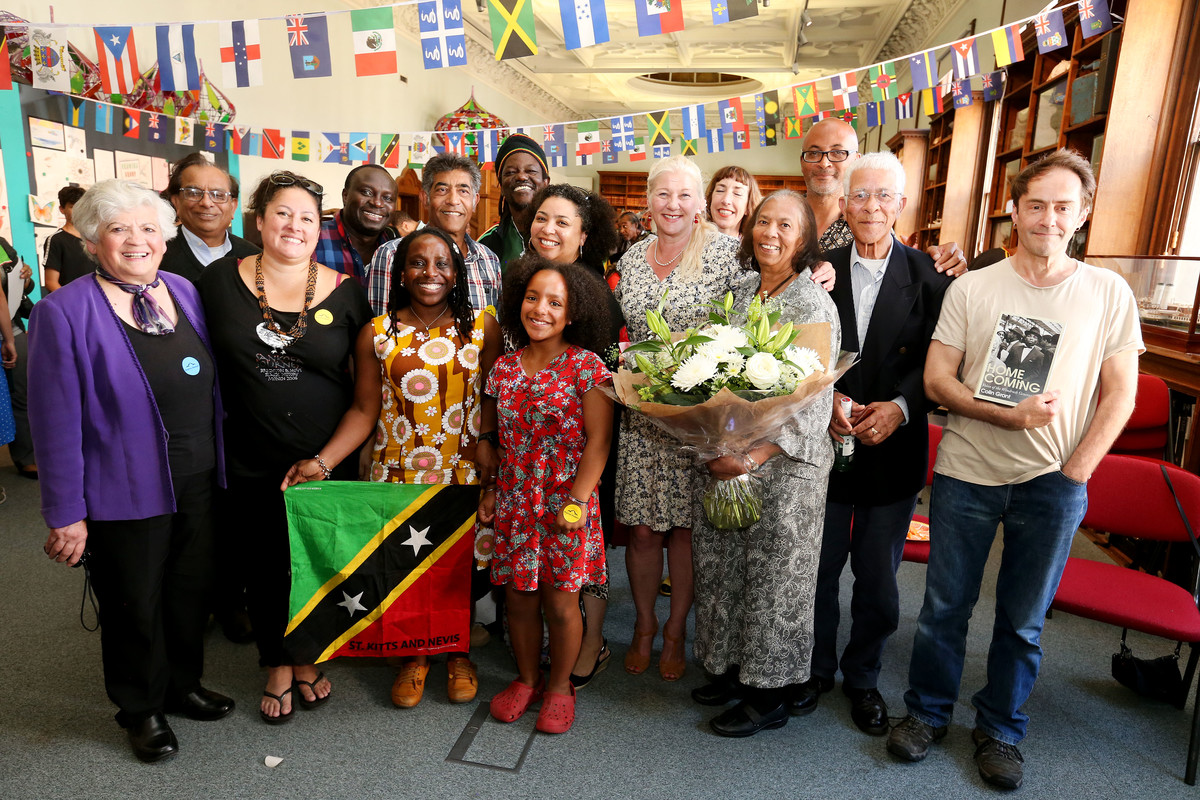
Group portrait of members of BME heritage network

This is a legacy story from an earlier version of our website. It may contain some formatting issues and broken links.

Last month we hosted a Caribbean themed tea party in Brighton Museum. Held on 22 June, the event marked the anniversary of the docking of MV Empire Windrush in London in 1948. This ship brough the first of several thousands of people from the Caribbean who helped rebuild Britain after the Second World War, and made a huge contribution to British life.

Members of BME Heritage Network with Councillor Amanda Grimshaw BEM at Windrush Day Tea Party. Stephen D Lawrence Photography

Organised by the BME Heritage Network, the event included a talk by Brighton & Hove based author Colin Grant, and a panel discussion by Dr Bert Williams MBE and Shirely Williams, two local members of the WIndrush Generation.

Gallery

Royal Pavilion & Museums on screen 2019

This is a legacy story from an earlier version of our website. It may contain some formatting issues and broken links.

Over half a million people visit our museums every year. But this year, many more will enjoy our buildings and collections without realising what they are seeing.

Here are two upcoming screen productions that show how Royal Pavilion & Museums help film makers tell their stories.

The Current War

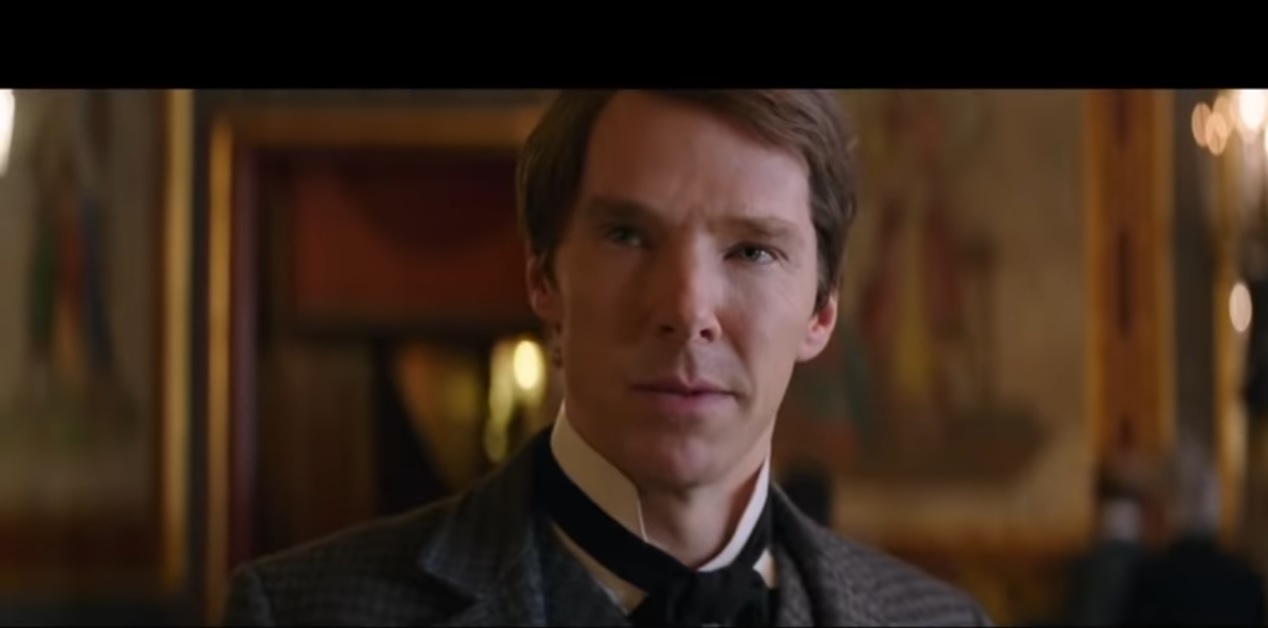
Movie fans need to keep their eyes peeled when they watch the new Benedict Cumberbatch film The Current War. Scenes from the new film were filmed at the Royal Pavilion in the winter of 2017 with top Hollywood stars, a zebra and llamas.

The Current War is set in 1800s America and follows the battle between Thomas Edison (Benedict Cumberbatch) and George Westinghouse (Michael Shannon) to light up America. The production also stars Nicholas Hoult, Matthew McFadyen, Tuppence Middleton and the current Spiderman Tom Holland.

The Royal Pavilion was used as a location to represent the World Trade Fair in Chicago, 1893 which features in the final scenes of the film. The building was closed to the public for four days in February as filming took place in the Banqueting Room, Long Gallery and the Music Room. They also filmed in the gardens with a zebra and llama, horses, and lots of extras.

You can catch a brief glimpse of the Banqueting Room 31 seconds into the trailer below.

[arve url=”https://youtu.be/kue18AxK1tU” align=”center” maxwidth=”800″ /]

The Current War is released in UK cinemas on 26 July 2019.

His Dark Materials

Our Natural Science collections have helped the BBC bring Philip Pullman’s His Dark Materials trilogy of novels to the screen.

The production team digitised a hare in our collection, and transformed it into an animated character for the upcoming TV series.

The hare can be seen hopping along at 1m 39 seconds in the trailer below.

[arve url=”https://youtu.be/64JAZKy8BpA” align=”center” maxwidth=”800″ /]

His Dark Materials will be released later this year.

Ruby’s Farewell

This is a legacy story from an earlier version of our website. It may contain some formatting issues and broken links.

I have worked with the Royal Pavilion & Museums since the tender age of 15 (that’s over six years now!) but it is with a heavy heart this month that I have left for pastures new.

Alongside my day jobs in the Bookings Office and on the frontline, I have been lucky enough to benefit from RPM’s Workforce Development initiative on plenty of occasions over the years.

It all began in 2015, when I caught wind of a Workforce Development opportunity with the Creative Programming Team in the run-up to our major fashion exhibition, Fashion Cities Africa. The role centred on promoting the exhibition via a number of digital channels, including Instagram and Tumblr. As someone with interests in both fashion and social media, this was right up my street. Much to my delight I landed the position, and spent the ensuing 18 months working closely alongside the Creative Programming, World Art and Fashion & Textiles teams. I watched the project blossom from a seed of initial ideas to a fully-fledged, ground-breaking exhibition discussed worldwide. I sat in on meetings on everything from the curators’ overseas research trips to the colour scheme of the exhibition galleries, documenting the curation process online for an audience of fascinated fashion and exhibition enthusiasts. I gained access to a behind-the-scenes world, learning suddenly just how much graft, research and attention to detail is required to present a successful exhibition. I felt overcome with a sense of admiration and respect for the knowledgeable professionals working tirelessly around me to bring together a show that would educate their audiences, inspired by the levels of responsibility and pride they took in their work.

Alongside all of this, I was also able to begin practising writing for online audiences – a skill that I’d long yearned for as a young person with dreams of pursuing a career in press, marketing or journalism. When the experience drew to a close, I felt immensely proud to have been involved in an exhibition so unique and informative – and far more confident in my communication and digital marketing abilities than when I set out. Four years on, these invaluable gains are continuing to serve me in ways I could never have imagined at the time. The experience was made particularly special by Creative Programming Curator Jody East, who mentored me from start to finish, ensuring I was never unsure of my responsibilities or direction, instilling me with confidence and making me feel nothing but welcome and valued in a curatorial domain that I otherwise had absolutely no prior experience of – thank you, Jody! Thank you also to every other member of staff involved in Fashion Cities Africa who inspired and educated me along the way.

Next came my Queer Looks experience – one that will forever hold a special place in my heart. Again, I was lucky enough to be drafted in for a similar digital ambassador role – but this time also engineering a microsite to accompany the Queer Looks exhibition. I worked closely with a Young Project Team of Brighton & Hove-based volunteers, who were, without a doubt, the most passionate, innovative and driven group of people I’ve ever had the pleasure to be inspired by. Together we made important curatorial decisions, such as deciding which contributors and outfits should be shortlisted for inclusion in the exhibition, and how to thematically categorise their stories. I relayed every step and conclusion to a dedicated Instagram following, not only offering the public a unique insight once again to the exhibition-building process, but generating an undeniable buzz around the incoming display at the same time. I worked tirelessly to craft a website that would accompany the exhibition both online and on a tablet in the gallery, elaborating on the stories told and providing a permanent and detailed legacy for a show that would otherwise have been temporary. It felt incredible to take ownership of such long-lasting and valuable elements of Brighton Museum’s exhibition history. My time spent working with the Queer Looks team not only enabled me to further practise my digital marketing skills, but furnished me with an all-new ability to build a WordPress site. However, perhaps more important than any professional experience or skill gained, this project enlightened me immensely, teaching me more than I ever thought I could be taught about our diverse and insightful local LGBTQ+ communities. My mind was expanded, my heart was warmed, and I came away feeling informed and inspired. In addition to the Young Project Team, for whom I hold the upmost respect, I owe a ginormous ‘thank you’ to Ellie Newland, who mentored me from Day One, ensured I was never without reassurance, a challenge or a sense of purpose, and went above and beyond to push me creatively in order to expand my self-confidence and skillset. Ellie, you are one talented and motivational woman!

Then I enjoyed a brief stint with the World Art team, wherein I helped to organise a wealth of data relating to the long-running Fashioning Africa project and begun using it to craft yet another microsite – this one to celebrate, promote and explain the project, which is geared towards developing Brighton Museum’s holdings of African textiles. It was an absolute pleasure to spend some time with the lovely Rachel Heminway-Hurst and Helen Mears and gain yet another fascinating behind-the-scenes insight into their busy world of work – my further developed website skills only coming as a bonus.

Most recently, I have been jammy enough to spend some time working with the lovely Press & Marketing Team as a result of a couple of different Workforce Development opportunities. In helping these guys to promote our visiting Hans Holbein painting and special events at the Booth Museum, I had the opportunity to embrace and practise my existing skills as well as learning some invaluable new ones, like writing press releases. However, it wasn’t solely these skills that landed me my fab new job as a Digital Marketing Officer for ethical jeweller Lebrusan Studio – but Caroline Sutton. Caroline (who’s known me since my college years, as a result of teaching me Journalism at BHASVIC!) was never short of advice and encouragement, and was in fact the star who gave me a heads-up about the job I now call mine. Thank you, Caroline and the rest of the Marketing Diamonds, for instilling me with lots of lovely confidence and drive!

Finally, I must say a special ‘big up’ to Nick Kay, who has coordinated the whole bonanza and ensured I never once missed the boat to apply for an opportunity that loaned itself to my skills and future dreams.

The Workforce Development scheme is an ingenious creation that serves so many positive functions. If it wasn’t for the opportunities I have been presented over the years, there’s no way I’d be where I am today.

Ruby McGonigle, Former member of Royal Pavilion & Museums, Brighton & Hove 

Flying the flag at Brighton’s Pride parade

Parade group and float in 2017.

This is a legacy story from an earlier version of our website. It may contain some formatting issues and broken links.

As Brighton Pride approaches, Rob White looks at the work that goes into creating a float for the parade, and how a dedicated group of museum staff decided to get involved.

August 2019 will be the third year that the Royal Pavilion & Museums have had our own float in Brighton’s Pride parade. I’ve been one of the leads of the small team responsible for our presence in Pride since the very beginning and am so proud to have seen the scale of what we have achieved grow each year.

My excitement is already starting to build and I look forward to the week before the parade almost as much as the parade itself. I love spending time with my colleagues and volunteers preparing and constructing our float – it gives us a good chance to get to know new people and share in something we all believe is so important for RPM to be involved in.

I expect there will be people who don’t think us taking part in Pride is important or a good use of money or time, but as a member of the LGBTQ+ community myself and someone who works for RPM I can say that it is absolutely a great use of both. Showing support for a community that is still not accepted across most of the world and faces homophobia, biphobia and transphobia on a regular basis, even in this country where incidents of each are actually on the rise, is vital. I hope that taking part in Brighton Pride is something that RPM commits to going forward into the future.

Towards the end of 2016 a small group of RPM staff decided to push for us to join Brighton Pride in 2017 for the first time – this group of people now make up the committee which have organised our participation annually since. Our involvement came on the back of other LGBTQ+ projects and exhibitions at the time – the LGBTQ+ trail, our Be Bold/Museum of Transology exhibition programming and a series of events for Brighton Museum. We recognised that our engagement and support of the LGBTQ+ community needed to extend out of our museums and be expressed in a more public way.

We didn’t expect organising our first Pride to be as much work as it ended up being. During the first year each member of the committee worked on Pride voluntarily and out of our regular work hours. We worked with a member of SameSky’s creative team to help us build and decorate a large model of the Royal Pavilion which would fit the size of our float (which was a mere 3 meters long).

Taking part in the parade, costumes including Martha Gunn and a film-themed outfit inspired by Hove Museum. 2017

Costumes in the parade themed on Martha Gunn and the film collection at Hove Museum. 2017

We wanted our Pride participation to be more than joining the parade and instead something that members of staff could be involved in creating. Along with the construction of the float we also made costumes reflecting the collections held at our five sites. It’s safe to say we certainly set ourselves an ambitious task which ended up taking much more time than we anticipated (doesn’t it always?!). The amount of ‘behind the scenes’ work was also somewhat underestimated by us – health and safety prep, paperwork, meetings, sourcing vehicles and sound systems, management of participants and volunteers and dissemination of information. We used one of the museum art rooms and arranged sessions for volunteers, some taking part in the parade and others not, to help us build each of the various elements.

Despite July of that year being quite stressful and the week leading up to the parade slightly anxiety-inducing; it was a great chance for members of staff to spend time together doing something outside of our usual work and collaborating to build something great. Everyone was passionate about what we were doing and this part of the project has given me some of the best memories from that year. However, we did all agree that if we were to take part in Pride again in 2018 we would need to make changes in order to relieve some of the stress from our small team.

Parade group and float. 2017

Parade group and float in 2017.

We did manage to achieve this, partially at least!

The biggest change for us in the second year was booking more of our provision through Brighton Pride themselves – this meant that we didn’t have to source our own vehicle, driver, sound system or generator and do all the work associated with each of these things.

We also wanted to use the same Pavilion structure but decorate and refresh it to cut down on the workshops and hopefully help make the last couple of weeks of July less hectic. We had some help from a member of Pride’s creative team who provided us with fantastic recycled materials which added extra colour and decoration to the float.

The day before a team made up of the main committee and other dedicated volunteers spent around 12 hours getting everything set up and the float fully decorated and ready for Saturday morning. We worked into the evening in the heat and managed to build a float that looked amazing and really showed off everyone’s hard work. We were themed on the colours of the rainbow, celebrating the anniversary of the pride flag, and it was so incredible to see around 70 people’s dedication to the theme with everyone coming dressed in outfits of one of the colours. It was inspiring and made me feel like all the work was totally worth it.

2018 was much easier to manage even though we had a truck 13m long (4 times bigger than the previous year!) and more than double the number of participants.

Parade group and float in 2018

Parade group and float in 2018

We all felt that last year was a huge success and I was so happy to hear from people who took part in the parade or who saw us from the crowd to say how great the float looked and how much fun they had. We came into 2019 wondering whether we would be able to top it!

The Pavilion structure got damaged last year so unfortunately has seen its last outing; though we are planning to use some of the domes this year in one way or another. We decided the focus of our float should be the adorned sides and everyone’s outfits – this would take more of the pressure off us to build something in July when the creativity of our float could be shown in different ways.

We have partnered with VisitBrighton for the first time this year and it’s been great to see a large number of their team joining us. New banners are being made and new playlists of fabulous music being put together. The theme for this year marks 50 years since the Stonewall uprising so people are using fashion inspiration from the 60s to now for their outfits.

As I write this we still have a week and a half to go but we already have a large number of participants from across both our organisations. Everything has gone smoothly so far and hopefully will continue to for the rest of the month. If you watch the parade on August 3rd keep an eye out for what I hope will be our best looking float yet!

Rob White, Marketing Support Officer & Booking Office Asistant

Booth Museum Bird of the Month, July 2019: Tachybaptus ruficollis

This is a legacy story from an earlier version of our website. It may contain some formatting issues and broken links.

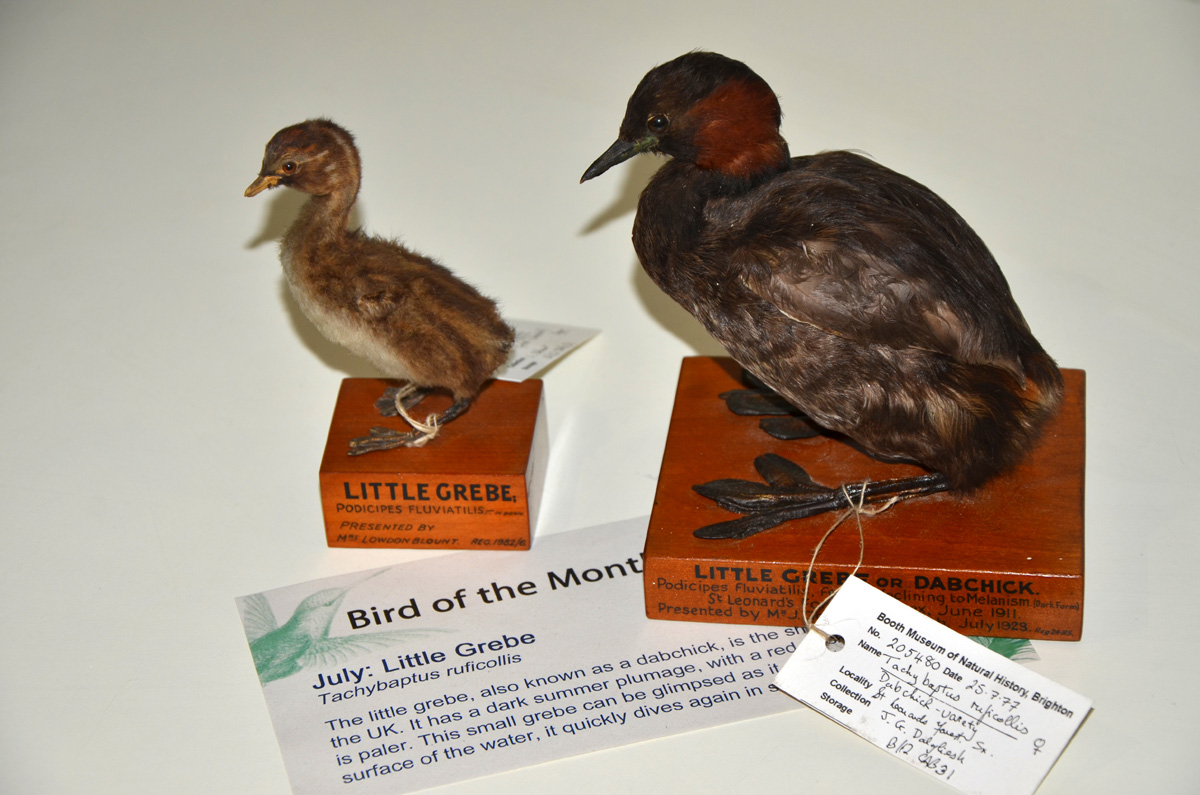
July’s Bird of the Month is Tachybaptus ruficollis or Little Grebe.

The little grebe, also known as a dabchick, is the smallest grebe in the UK. It has a darker summer plumage, with a red neck. In winter it is paler brown and white. This small grebe can be seen glimpsed as it rises to the surface of the water, it quickly dives again in search of food.

As an excellent swimmer and diver, its large feet are placed far back on the body, making it clumsy on land. It is usually only on land to breed. The nest is a floating platform made from waterweed. Little grebes, like other grebes will carry their young on their back.

Tachybaptus ruficollis, Little Grebe

Kerrie Curzon, Collections Assistant and Lee Ismail, Curator of Natural Sciences