Story Category: Legacy

The William IV Gate and a melancholy event, 1852. Part II: Monday

This is a legacy story from an earlier version of our website. It may contain some formatting issues and broken links.

As St. Swithin’s day approaches on the 15th we continue with the second part of our tragic true weather story from February 1852. Catch up with yesterday’s instalment if you missed it.

At the end of the first instalment, Bill was desperately tying to find help after the gate fell off its broken hinge, fortunately he came across a duty policeman and enlisted his assistance. The two men managed to push the gate back into position and closed the second gate against it. With the bolts shut, the gates were safe for the Sunday night.

On Monday morning of the 9th February 1852, Bill Snow surveyed the scene of The William IV Gate and considered his next move.

The William IV Gate

The William IV Gate

At 8.30 he reported the event to Lewis Slight, Clerk to the Town Commissioners – a man of considerable reputation. It was Slight who, almost single-handedly, and against much opposition had been responsible for the purchase of the Royal Pavilion only two years before for the bargain sum of £50,000.

Mr Slight listened to Bill with patience, and once he had established that Bill himself had not been injured, he reassured him that it had simply been an accident, was not his fault and that he should report the matter to the Surveyor’s office.

Finding no one at their desk, Bill returned to his Lodge, and with the morning fine and calm, he was able to open both the gates as usual, although the broken gate hung at an awkward angle, leaning against the wall. About ten minutes past ten, Bill was visited by Tom Oddy, an assistant in the Surveyor’s office. He had seen Mr Slight and heard about the broken hinge and been told to get it fixed immediately.

He and Bill examined the gate, and though he had no sense of imminent danger, said that he would issue an order from his office straight away.  At 10,30, using his official counter-foiled order book, he sent off an order to John Packham & Sons, iron-founders of Western Road to ‘Take off gate North Lodge of Pavilion, repair hinge and re-hang the same’. He gave this to a messenger, David Taylor, and told him to tell Mr Packham to get the job done immediately. But although the order was received, the verbal, urgent message was not.

By this time the Surveyor Richard Stickney had been told of the events surrounding the gate and seeing that an order for repair had been made, decided not to get involved. Later, he was to regret this, thinking that he should perhaps have given instructions that the gate was to be removed and leant against the wall, and that in hindsight, the hinges should have been made of wrought iron and not cast.

Meanwhile, Lewis Slight bumped into the contractor John Packham who told him that the order for repair had been received, but that nothing yet had been done and that his man was busy on Tuesday, but would attend on Wednesday. Whatever Lewis Slight thought of this delay, it was of little value to Bill Snow, who by the end of the day was faced with the difficult job of once more closing the gates.

He approached the Pavilion and asked Mr Edwards who was in charge of a group of workmen if they could lend a hand. Bob Newnham, a bricklayer together with another three workmen went over to help. With the aid of a lever they managed to get the gate into position. They placed wood underneath the gate to help support its weight, and a six-foot length of deal against it and jammed the end into the ground. Though Bill was happier with the gate now secured more safely he regretted that no one had come to repair the gate on that day.

Read the final instalment of the story tomorrow when Bill’s regrets turn to horror…


John Cooper, Volunteer & Training Manager

The William IV Gate and a melancholy event, 1852. Part I: Sunday

This is a legacy story from an earlier version of our website. It may contain some formatting issues and broken links.

As St. Swithin’s day approaches on the 15th we present a true tale of a weather disaster. From the 13th we take a look at a tragedy in three parts…

As Bill Snow emerged from his residence in the Lodge under the North Gate of the Royal Pavilion grounds on Sunday February 8th 1852, into a raw and gusty night, the weather was probably very much on his mind. It had been a harsh winter, with considerable loss of life. Rainfall throughout the country had been high with reports of disastrous flooding. In Brighton the winter had been bitterly cold, wet and windy, and on that evening, a gale was blowing.

The William IV Gate

The William IV Gate

As Porter to the North Gate, it was Bill’s responsibility to close the two huge gates of the Pavilion grounds, every evening at 5.30pm. At the time, the North Gate and its two lodges were only 20 years old, having been built in 1832 with Portland Stone to the orders of William IV at a cost of £3000. The Brighton Town Commissioners had bought the Royal Pavilion in 1850, and Bill had only been in his job for 17 months.

The wooden gates were high and ponderous, made of solid oak; each was thirteen feet high, seven and a half feet wide and three to four inches thick. They had been hung on Collinge’s Patent hinges made of cast iron, a superior construction which meant that in normal conditions, the gates, as heavy as they were, could be opened and closed with ease.

That evening, normal conditions did not apply. As Bill Snow stepped out of his snug Lodge and unbolted the western gate in an attempt to close it, a huge blast of wind tore the gate from his hands, threw him to the ground with great violence and the gate slammed against its stop.

The hinges, being made of cast and not wrought iron, were in fact liable to break under adverse conditions, not envisaged by the builders. And on this occasion, the topmost hinge snapped with a loud crack. The gate sagged alarmingly, and Bill ran to the Palace for help…

Find out if Bill finds the help he needs in tomorrow’s part of the story.

John Cooper, Volunteer & Training Manager
Brighton Celebrates the 1911 Coronation

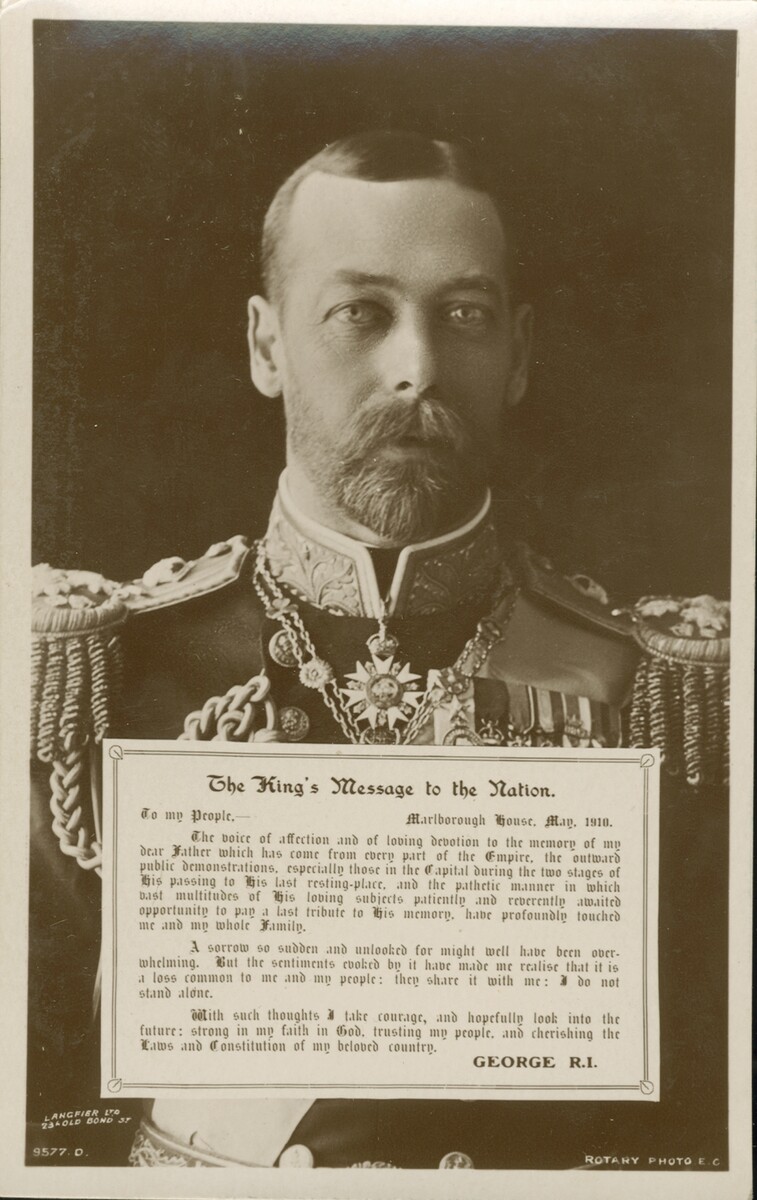
King George V with an inset panel containing text titled: The King's Message to the Nation.

This is a legacy story from an earlier version of our website. It may contain some formatting issues and broken links.

100 years ago, on the 22 June 1911, the country awoke on the coronation day of King George V and Queen Mary and it seems that Brighton had eagerly seized on the excuse for a celebration.

[slideshow]

The local press reports that preparations for the day had been intensive. Using 10,000 electric lamps a chain of  “jewelled illumination” had been erected along the 4 miles of seafront. Together with the illuminated piers this spectacle was so novel and impressive that steamer trips were run at night to allow viewing from the sea. Lights were also placed around the Aquarium, Regency Square, Victoria fountain and the Royal Pavilion, the latter had 6 foot high letters “G” and “M” picked out in lights .

Hotels had patriotic displays, and red, white and blue colour schemes were everywhere. A large “illuminated transparency” of the King and Queen with the Brighton Borough arms was erected on the Town Hall. In the evening of the 22nd there were to be firework displays from the piers and a beacon lit on the Racehill.

At ten o’clock on the day itself a solemn service was held in St. Peters attended by the Mayor, Aldermen & Councillors in full official robes, together with town officials. Music was provided by the Brighton Municipal Orchestra and the Parish Church Festival Choir.

At 11.45am there was a parade in Preston Park of all the naval and military units in the town with the firing of a Royal Salute to mark the moment of coronation. This was followed by a fusillade of rifle firing and a march-past with the salute taken by the Mayor in cocked hat and red robes, with macebearer in attendance. The Mayoress stood beside him “a study in biscuit and blue – the blue of intense, royal blueness”. It should have been quite a spectacle, but unfortunately, the Brighton weather did not hold out; not only did the sun not shine but the whole scene was shrouded in mist throughout.

Delia Ives, Volunteer Collections Media Team

Midsummer’s Eve and the Calendula officinalis – the Pot Marigold.

This is a legacy story from an earlier version of our website. It may contain some formatting issues and broken links.

Midsummer’s Eve usually relates to European celebrations that accompany the Summer Solstice, either on the actual solstice or between June 21 and June 24, depending on the culture.

The celebration predates Christianity and is thought to be related to ancient fertility practices and ceremonies performed to ensure a successful harvest. With the conversion of Europe to Christianity, the celebrations were adapted to honour St. John the Baptist. Some pagan customs still persist, such as the bonfires, which originally were believed to ward off evil spirits, and the focus on nature, which harkens back to when plants and water were thought to have magical healing powers on Midsummer’s Eve.

One such plant believed to have magical properties was calendula (marigolds) which flowers at the beginning of most months. Calendula has numerous mythological properties, such as the ability to strip a witch of her will, or wreaths of marigolds hung over a door would prevent evil from entering. They are specifically picked at Midsummer for their supposed healing properties.

There are a number of marigold species preserved in the Booth Museum collections, however the focus of this blog entry is an pressed example of Calendula officinalis – the Pot Marigold. Although commonly found in Southern England, this example was collected in St Petersburg, Russia.

I chose this particular specimen for its link to the world of medicine. It was collected sometime between 1800 and 1819 by Dr Alexander Crichton. Born in Edinburgh in December 1763, he qualified in Leyden, The Netherlands, in 1783, and worked as a surgeon in several European cities, including Paris, Stuttgart andVienna before moving to London in 1789 and joining the Royal College of Surgeons. By 1791, he had retrained as a physician and held the position of physician at Westminster Hospital from 1794 – 1801.

In 1803 Crichton was offered the position of physician to the household of Tsar Alexander I of Russia, and was evidently trusted as he was made personal physician to the Tsar and the Dowager Empress, as well as becoming the head of all medical services in Russia. He held the position until his retirement in 1819, gaining a number of Russian and Prussian honours on the way.

His position and travels across Europe allowed him to indulge his other passion for the natural world. During his time abroad, he collected a large number of plants, of which our humble Calendula makes up a tiny part of. These plants were all lovingly pressed and preserved in leather bound hardback albums.

One of Crichton’s volumes of plants

One of Crichton’s volumes of plants

Crichton probably had ready access to Calendula in his career, as it was traditionally used in a number of remedies. Modern pharmacological studies have shown fungicidal, anti-viral and anti-inflammatory properties in calendula extracts. It is also used in a number of treatments for acne and dermatitis, however studies are inconclusive on its effectiveness.

Crichton returned to England after his retirement, and died in Sevenoaks in 1856. His grandson, Col. E.D. Crichton donated seven volumes of plants, as well as a huge number of geological samples to the Brighton Museum collections. The majority had been collected by his grandfather during his travels.

Lee Ismail, Curator of Natural Sciences

Reflections on the Solstice

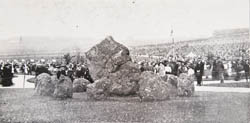
The Goldstone in Hove Park, 1906

This is a legacy story from an earlier version of our website. It may contain some formatting issues and broken links.

As the Summer Solstice approaches and thoughts turn to gatherings at Stonehenge to watch the sun rise, could it be Brighton and Hove once had its own ritual prehistoric stone circle? Sites such as the Neolithic enclosure at Whitehawk indicate that Brighton was a major prehistoric centre but where is the ‘Brighton Henge’?

The Goldstone in Hove Park, 1906

The Goldstone in Hove Park, 1906

A three metre high stone, known as the ‘Goldstone’, stands today in Hove Park surrounded by a circle of smaller sandstone blocks. This appears to be the product of early 20th century landscaping – but is the story more complicated than this?

The central stone once stood upright in what is now the area near the southern entrance of Hove Park. It attracted so much interest during the 1830s that the landowner buried it to avoid sightseers trampling his crops. It was later located, excavated and eventually moved to its existing location in 1906.

Uncovering the Goldstone

Uncovering the Goldstone

However, there is no real evidence this stone was part of any prehistoric monument.

What appear more interesting are the smaller stones, which currently surround the ‘Goldstone’. These stones originally occupied a site in the northern part of present day Hove Park and from a sketch made in c1828 by H.G. Hine it would appear they were carefully arranged next to each other in a circular formation, similar to other surviving prehistoric stone circles.

H. G. Hine’s sketch

H. G. Hine’s sketch

Around the same time as the burying of the ‘Goldstone’, these stones were removed and used to infill a local pond. They were not seen again until the re-siting of the Goldstone, when a few were used to form the surrounding small circle.

Although the present arrangement of the stones is a modern construction, it is possible that at least some of the stones once formed part of a prehistoric monument; which may have been used to celebrate the solstice. At the very least they act as reminders of Brighton and Hove’s fascinating prehistoric past.

Current view of the Goldstone in Hove Park

Current view of the Goldstone in Hove Park

Andy, Volunteer Local History & Archaeology

A Royal Table Returns

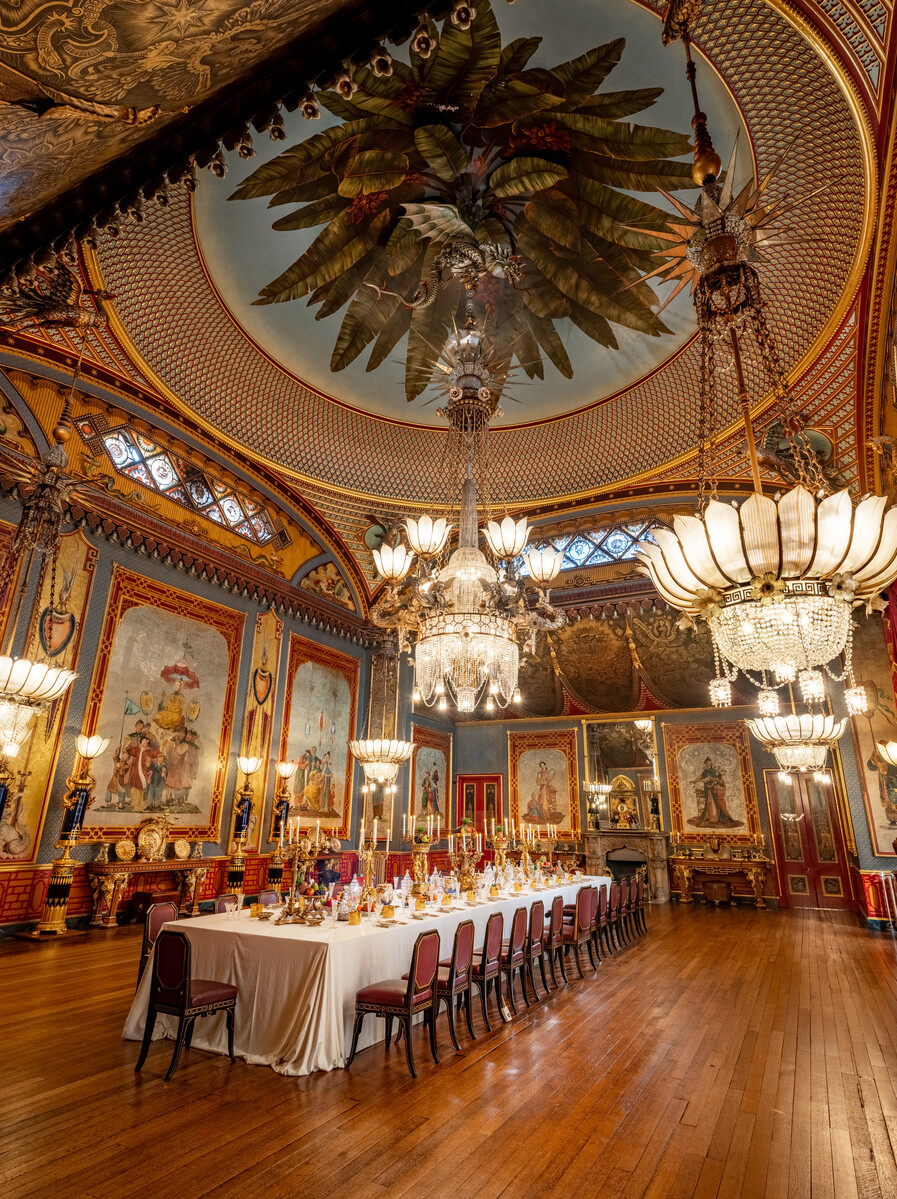
View of Banqueting Room showing long table and chairs. Two chandeliers hang above the room.

This is a legacy story from an earlier version of our website. It may contain some formatting issues and broken links.

Writing table commissioned by George, Prince of Wales, c1810. Photographed in the Royal Pavilion's Banqueting Room Gallery.

Writing table commissioned by George, Prince of Wales, c1810

Thanks to the generosity of the late Barbara Curd née Coombes, a writing table made for George, Prince of Wales, in about 1810 has returned to the Royal Pavilion. The mahogany writing table was removed from the Royal Pavilion by Queen Victoria between 1845 and 1850 and given by her to her third son Prince Arthur, later Duke of Connaught ( 1850-1942). The Duke had a distinguished military career, rising to the rank of Field Marshall. He spent part of each year at Bagshot Park, Surrey or at Clarence House, London. The table was probably used at one or both of these residences.

Charlotte Haskins, date unknown. Photograph by Madame Yevonde.

Charlotte Haskins, date unknown. Photograph by Madame Yevonde.

The Duke died at Bagshot on 16 January 1942, nursed in his last years by Charlotte Haskins (1897-1965 ). At some point he gave the table as a present to his nurse and it descended to Barbara Curd (1919-2011) who wished to leave it to the Royal Pavilion in memory of her aunt, Charlotte Haskins.

The table is marked on the underside PAVILION and carries the monogram of George IV. It is possible that it was made by the royal cabinet makers Tatham, Bailey and Sanders.

David Beevers
Keeper of the Royal Pavilion

London to Brighton Bike Ride

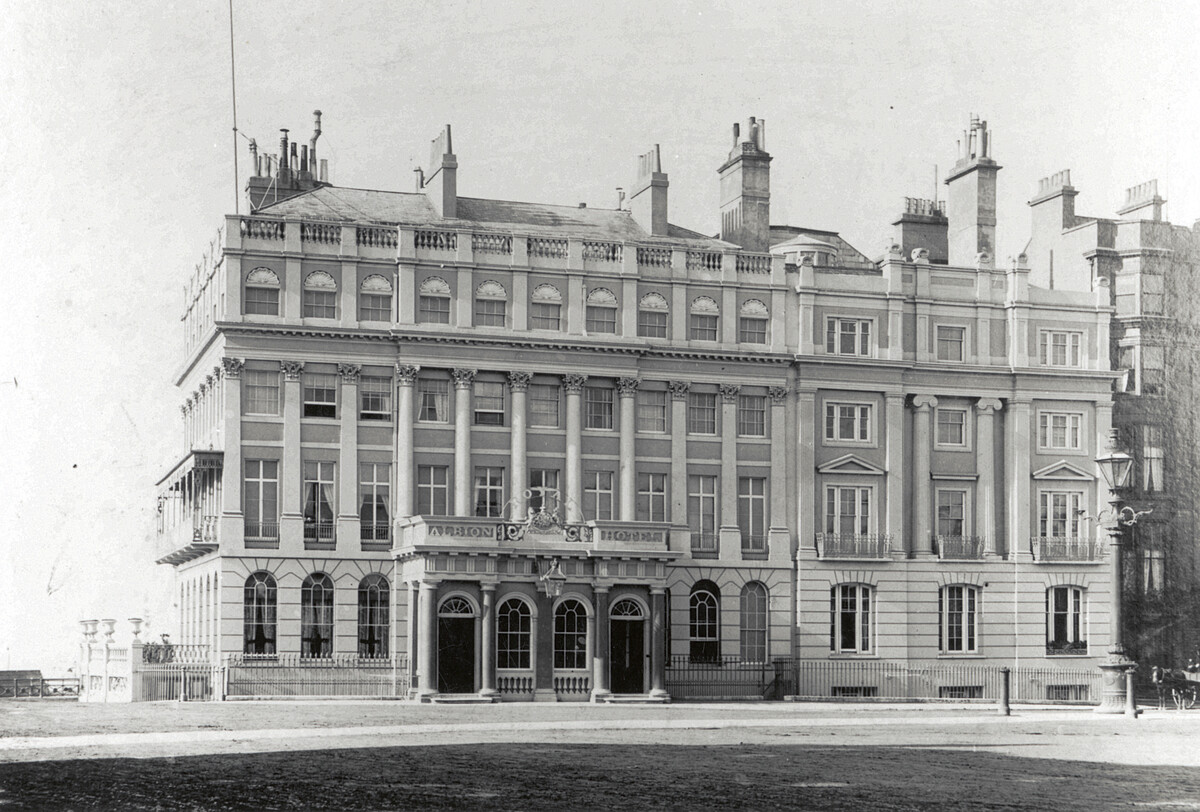
Royal Albion Hotel, c1900. View south from Old Steine.

This is a legacy story from an earlier version of our website. It may contain some formatting issues and broken links.

With the London to Brighton Bike Ride taking place on 19 June, many would be surprised to learn that a similar event took place as long ago as 1870.

Old Steine 1877

Old Steine 1877

Thomas Moon, son of the licensee of the Union Inn, Gloucester Road cycled from Brighton to London and back in a day. He was accompanied by Captain Fry of the Fire Brigade.

The run seems to have been quite leisurely, after leaving Brighton at 4.55am they stopped for breakfast for three quarters of an hour at Crawley and arrived at the Elephant & Castle Inn, London at 11.45am – a time of six hours.  They dined at the inn for two hours and started their return to Brighton 1.55pm arriving in the town at the Elephant & Castle, London Road at 10pm.  The entire distance of 104 miles was completed in fifteen hours.

The Brighton Gazette reported that Mr. Moon, ‘who is an expert bicyclist’, recently completed the run from London to Brighton in five hours and forty minutes, ‘the quickest time in which it has been known to have been run’.

The bike run in its present form seems to have begun in 1976 according to the

Queen Victoria

Queen Victoria

Evening Argus in 1983. That year all manner of bicycles were entered including unicycles, penny farthings, rickshaws and tandems. Theatre groups and brass bands entertained the cyclist on route and a bicycle boogie took place at the Royal Albion Hotel.

In 1976 there were thirty four entrants, eleven thousand in 1983 and twenty seven thousand in 2010!

Paul Jordan, Senior History Centre Officer

Living Chess and a loving Daddy — a postcard for Father’s Day

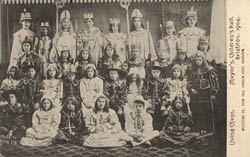
Living Chess, 1904, HA901542

This is a legacy story from an earlier version of our website. It may contain some formatting issues and broken links.

Living Chess, 1904, HA901542

Living Chess, 1904, HA901542

The Brighton Mayor’s Children’s Ball was a regular event. Usually held in the Royal Pavilion, it appears to have been a charitable occasion that took place in the early part of the year. The theme for 1904 was ‘Living Chess’, and this postcard shows the children dressed as black and white chess pieces.

Although the ball was, presumably, a fun occasion, the image seems stilted and awkward. The children are all unsmiling or supressing grins. Most likely, this is because the stiff poses of Victorian portraiture had yet to fade from the photographer’s art, but it could also be a reflection of the game. Chess may be fun, but it is a cold, logical, strategic type of pleasure.

As is often the case with postcards, the message side is a clear contrast. Written to ‘Miss M Hardwick’ in Putney, the sender’s message consists of three simple sentences.

Handwritten side of Living Chess postcard, 1904

Handwritten side of Living Chess postcard, 1904

‘I hope you are almost well & that it will not be long before you are able to come home. With love to Uncle Frank. Your loving Daddy.’

This message tells us very little. We don’t know the name of the sender, we don’t know what illness his daughter was suffering from, or whether she ever got better. We know nothing about Uncle Frank, or why the daughter had to convalesce with him. But we do know that this father missed his daughter. And, appropriately for Father’s Day, that’s the least mysterious thing of all.

Kevin Bacon
Digital Development Officer

Charles Dickens’ Links to Brighton

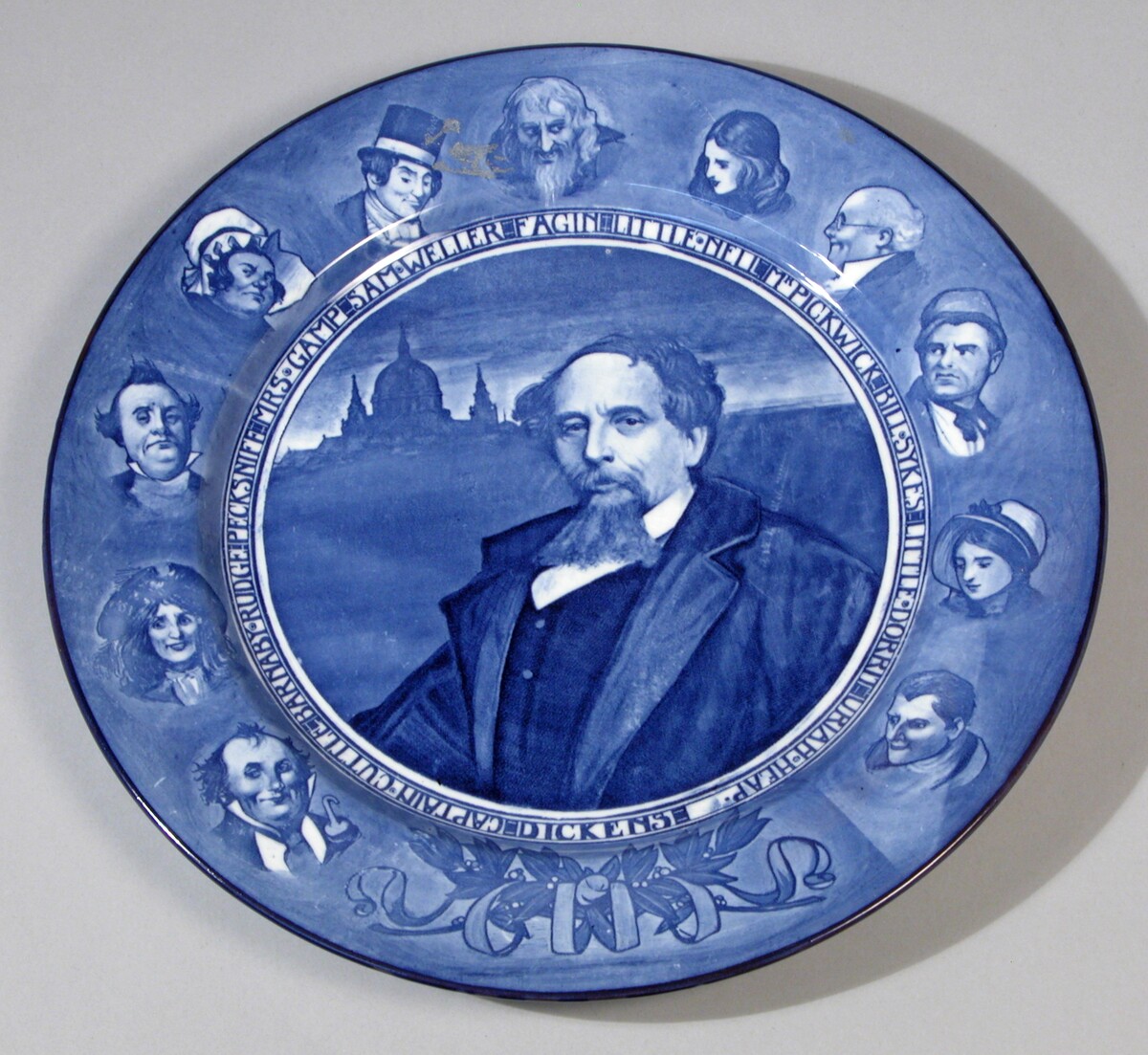
This blue-printed plate made by Doulton is a Charles Dickens Memorial Plate

This is a legacy story from an earlier version of our website. It may contain some formatting issues and broken links.

One of the most interesting aspects of our work at Brighton History Centre is answering enquiries from members of the public. These range from the very specific to the more general. We might be asked, for example, when the houses in a particular street were built, or who designed the city’s Victorian schools. Or, perhaps, how Brighton was affected by the coming of the railway.

Charles Dickens Farewell Tour

Charles Dickens Farewell Tour

Recently, we were asked if we had any information about Charles Dickens’ links to Brighton. How often did he come here? Where did he stay? It seems Dickens was a frequent visitor, coming first in October 1837, around the same time that Queen Victoria was making her first appearance in the town. Unlike Victoria, Dickens obviously liked what he saw and came back repeatedly over the next 30 years, staying in a variety of places on the seafront. The Bedford Hotel seems to have been a particular favourite, but he also ‘put up’ at the Old Ship Hotel and, from time to time, stayed in private lodgings with friends and family.

On one occasion, he and his entourage, which included the illustrator John Leech, were forced to flee their rented accommodation because the landlord and his daughter apparently went quite mad. Dickens described the scene vividly in a letter to a friend: ‘If you could have heard the cursing and the crying of the two, could have seen the physician and nurse quoited out into the passage by a madman at the hazard of their lives; could have seen Leech and me flying to the doctor’s rescue…you would have said it was quite worthy of me…’

While parts of Bleak House and Barnaby Rudge are said to have been written in Brighton, the novel that has the closest connection with the town is Dombey and Son, first published in monthly parts from 1846. In it, the young Paul Dombey, a frail and sickly child, is sent here by his father for the good of his health. He and his sister Florence lodge with Mrs Pipchin, whose home ‘in a steep bye-street at Brighton’ is thought to be based on a house in Upper Rock Gardens, and he is sent to Dr Blimber’s academy, which was probably inspired by one of the many private schools for young gentlemen that operated here at that time.

In later years, Dickens came to town for readings of his works, which always attracted a large and fashionable crowd. After one event at the Town Hall, Dickens wrote, ‘Last night I had a most charming audience for [David] Copperfield, with a delicacy of perception that really made the work delightful.’ In 1868, Brighton was included as part of his ‘farewell tour’, and again, each performance was hugely popular – a report in the Brighton Gazette describes ‘a room full to repletion’ at the Grand Concert Hall, where ‘the dialogue throughout was delivered by [Dickens] in his liveliest and most felicitous manner.’

For more information about Brighton History Centre’s Research Service, please refer to our website. To see images of Brighton Museum & Art Gallery’s Dickens-related objects, posted to commemorate the anniversary of his death in June 1870, vistit Flickr.

Kate Elms, Brighton History Centre

Two of a Kind

A photograph of the Archaeology Gallery in Brighton Museum

This is a legacy story from an earlier version of our website. It may contain some formatting issues and broken links.

This pair of flint axeheads were found together at Clappers Platts near Fulking in 1905 and were later purchased by Brighton Museum & Art Gallery. They date from the Neolithic Period, around 5,000 years ago.

Although they are unpolished, the axes have been finely worked so that they are almost identical in size and shape. The flint they were produced from was carefully chosen to ensure that the patterning and coloration match perfectly. Given the effort and care put into their production, it would seem unlikely that the axes were intended for practical use. They were probably made by the same person and then deliberately buried in an act that must have had some important ritual meaning.

The production and trading of stone axes, particularly polished axes, is an important feature of the Neolithic. At a time when land was being cleared of woodland and then cultivated to produce crops, the axe may well have been an important symbol of the change of lifestyle from hunter-gatherer to farmer.

This importance may be reflected in the deliberate burial of groups or ‘caches’ of axes which is fairly common at that time. In general, axes are found in unpolished pairs and because of the similarities in their production, it is thought that in each case the same person would probably have produced them. At the Neolithic site of Combe Hill, one of the six Sussex sites where axe caches have been found, three axes were found carefully placed in the eastern ditch of a causewayed enclosure. Local archaeologist, Professor Peter Drewett, has speculated that the eastern side may well have faced the wilder, uncultivated land and the burying of the axes may well have signified the boundary between the tamed and the untamed.

Although we have little information about the discovery of the axes at Clappers Platts it may well be that they were buried on a similar boundary, as Neolithic farming communities spread from West to East, using their axes to tame the wild woodland.

Andy, Volunteer Local History & Archaeology