Story Category: Legacy

Ice-skating at the Royal Pavilion

This is a legacy story from an earlier version of our website. It may contain some formatting issues and broken links.

Royal Pavilion Ice RinkI’ve just booked up our annual trip to one of the BEST things ever about living in Brighton – the fantastic ice-skating at the Royal Pavilion.

I can honestly say it is one of the most exciting and exhilarating highlights of my entire year.

It’s the fifth year the outside rink has been in the grounds of the Pavilion and there is nothing more Christmassy than gliding on the ice alongside the beautifully lit palace.

Some people hate ice-skating – they feel out of control, their knees lock and they spend most of their time panicking they’re going to fall over. When you’re a kid, falling over doesn’t hurt so much and falling as an adult can feel quite terrifying.

A couple of years ago, I ended up with concussion after a fall while holding hands with my son and hurtling around the rink. He slightly changed direction and I fell back and bashed my head. I definitely saw stars. That night I ended up at A&E, with the nurse shaking her head knowingly when I said it was at the ice rink.

Still it didn’t stop me and I was back about a week later, a little more cautious at the beginning, but once I got my confidence back, just as happy to whizz around feeling the cold air on my cheeks with a huge big grin on my face. It makes me feel like a big kid again and for that hour, I feel completely carefree and joyful

We’ve booked for Christmas Eve again this year and I can’t wait.  There’ll be skating, some mulled wine and then home to wait for you-know-who to visit

To find out more visit the Royal Pavilion Ice Rink website for tickets and prices.

Caroline Sutton, Blogger in Residence

[youtube https://www.youtube.com/watch?v=OUb1-bqTVOM]

Museum Tales 2: Pavilion Gardens

This is a legacy story from an earlier version of our website. It may contain some formatting issues and broken links.

The following piece was produced during the Creative Future Museum Tales course in the summer of 2014. The course, run in partnership with Brighton Museum and Art Gallery and funded by the Arts Council, enables marginalised writers to be inspired to write by museum artefacts and its surroundings.

Pavilion Gardens by Finn Andrews

It was a place I used to hang out when I was younger in the summer ten years ago. The sun was hot but there was a breeze. People used to meet as if by magic.

Different groups would linger and you could manoeuvre between them.

There were a few fights, mostly the homeless lot that came from the drinking club but that came with the territory. Tramp chic, trendy goths, townies and players.

Alcohol kept in their plastic bags in case of the old bill.

Now the fences are higher surrounding the garden, but you could still jump over them, if needed.


Taking Over Twitter!

This is a legacy story from an earlier version of our website. It may contain some formatting issues and broken links.

Wednesday 27th August was the Kids in Museums Teen Takeover Day. Charlie from the Museum Collective was our teen taking over. Afterwards she wrote a review on her blog.

Museum Tales 2: The Shabti’s Lament

This is a legacy story from an earlier version of our website. It may contain some formatting issues and broken links.

Creative Future run creative writing courses at Brighton Museum & Art Gallery for marginalised writers. Dr Claudia Gould, the group facilitator, encourages participants to use Museum objects to inspire their work. Funded by the Arts Council England, these  groups will be running again in June 2014 and spring 2015. If you’re interested in attending please contact Creative Future (01273 234780) for further information.

Creative Future run the creative writing workshops in partnership with Brighton Museum and Art Gallery.

The Shabti’s Lament by Vicky Darling

It’s not much of a life as a Shabti
with a mummy so wrapped up and quiet.
As employer she’s not satisfactory,
and down here it’s never a riot
of singin’ or dancin’ or chattin’
and she won`t use my skills as a cook.
There’s not room for swingin’ a cat in
and there’s no light for reading my book.
The Afterlife tends to be boring.
It is not what it’s cracked up to be.
My mummy just lies about snoring,
I wish she would find work for me.
Then there’s coping with Sekhemet’s rages,
(she is one of the goddesses here)
she sometimes goes off and rampages,
and fills the poor mummies with fear.
I am trying my best to keep cheerful,
and take every day as it comes,
but sometimes I get very tearful.
It`s not mummies we want but our mums.


The day the Taxidermist’s Daughter visited the Booth Museum

This is a legacy story from an earlier version of our website. It may contain some formatting issues and broken links.

I have blogged many times about the occasions when we receive visits from scientists interested in various aspects of our collections, ranging from Gorillas to fossil fish. But as anyone who is familiar with the Booth Museum will know that there are as many if not more visitors to the museum and our collections who do not have science in their minds but the arts. Locally we see many students from Brighton University and rarely does a University degree show go by without some reference to the Booth. Practising photographers, painters, sculptors, regularly visit the collections and sometimes borrow from us. But last week we were able to help a very special guest, who, it turns out, has been a fan of the Booth for many years.

Early on Friday morning I opened the doors to the many people who make up a film crew – camera man, sound man, director, producer and assistants, and once they had set up, we welcomed the star of the day Kate Mosse, novelist, non-fiction and short story writer and broadcaster. She is best known for her 2005 novel Labyrinth, which has been translated into more than 37 languages. Not only do her literary credentials sparkle, she was awarded the OBE last year. In 2000 she was named European Woman of Achievement for her contribution to the arts, and she holds an Honorary MA from the University of Chichester. She was also the 2012 winner of ‘The Spirit of Everywoman Award’, awarded by NatWest. In 2013, she was named as one of publishing Top 100 most influential people by the Bookseller and one of London’s 1000 most influential people in the arts by The Evening Standard.

So what was she doing at the Booth Museum? Well, it is now an open secret that the title of her next novel is The Taxidermist’s Daughter, described as an enthralling and haunting Gothic novel and due out in the autumn. There are few clues yet to its storyline, but Kate did say that it is built around four birds in particular: jackdaws, magpies, rooks and crows – all of which are well represented in the Booth’s collections. Filming within our Victorian ‘parlour’ was perfect to produce pre-publicity interviews and movies for the upcoming press launch in London, And of course the theme of taxidermy was all around!

Kate was a perfect guest and her crew very professional. More about the day plus many images can be found on Kate’s own website.

John Cooper, Keeper of Natural Science

Behind the Scenes of the Fashion & Textiles Store

This is a legacy story from an earlier version of our website. It may contain some formatting issues and broken links.

The Museum Collective is group of young people aged 15-14, who meet regularly at Brighton Museum & Art Gallery. One of the activities on offer to this group is regular creative workshops, inspired by our collections and buildings. Recently the group had a behind the scenes tour of the Museum’s Fashion & Textiles store, and were treated to a peek at the extensive fashion collection dating from the 16th century to present day.

Feeling inspired, the group decided they’d like to have a go themselves, and booked Traid to come and do a workshop with them in the Easter holidays. Traid are a fantastic charity working to stop clothes being thrown away.

Museum Collective member Elizabeth Carr, aged 18 will tell you more……

Most people don’t appreciate where our clothes come from, and t-shirts are especially bad for the environment. The making of one t-shirt uses as much water as we drink in 3 years! There’s also issues with the ways in which they are made – sweatshops and workers’ rights spring to mind but I’m sure there are many more issues to worry about.

So, if you’re going to buy t-shirts, it’s important to make the most of them, so upcycling is a great skill to have, and I’m really glad that Traid were able to teach us. One of the best things we discovered was how to make t-shirt yarn, which is very versatile. The easiest thing to do with your yarn is finger knitting, which we all managed to some degree – this can make jewellery, belts and handles for bags among other things. If you have something to weave on then yarn can also be woven.

The other key item we looked at making was a t-shirt bag. This was surprisingly easy, just a matter of cutting sleeves off and sewing up the bottom of the t-shirt. You could embellish them by sewing on other fabric or embroidering.

As soon as I got home, I wanted to share my newfound skills with my family and managed to find some old t-shirts – now I have a knitted t-shirt belt, two t-shirt bags and lots of yarn! If you ever get an opportunity to do an upcycling workshop, I would definitely recommend it!

Elizabeth Carr, Museum Collective member

Zoroastrian Marriage Apron, World Stories: Young Voices Gallery

This is a legacy story from an earlier version of our website. It may contain some formatting issues and broken links.

My Name is Neda, and I came to the UK from Iran in 2010. I am researching some of the historic objects in Brighton Museum & Art Gallery which have not been on display before.

One of these objects is, according to the auction house it was purchased from, a Zoroastrian marriage apron.

It is a large flat textile, formed of a red silk background square with two side panels which have been sewn onto it. The red square is embroidered with different symbols such as sun-faces, couples beneath trees, animals (cat, fish, bird, etc),  flowers and cypress tree leaves. The cloth consists of five panels; the two side panels have a green background with a floral pattern. I have not seen anything like this before in Iran, but my research revealed that dresses were sometimes re-cut and fine embroideries were reused after their initial use. Rebecca Bridgman, Curator for Islamic and South Asian Arts for Birmingham Museums viewed the textile later and said that she thought the silk brocade green panels may date from the seventeenth or the eighteenth centuries, and the red panels attached later on.

According to Mr Jabbar Farshbaf, a painter and specialist in Persian rug design, this needle work is called Zoroastrian stitching (zartoshti doozi). The Zoroasters believed that decorated cloths protect them from surrounding evils, and the more decoration on the cloths the more protective they will be.

The symbols reflect enduring concepts in Persian culture and originally may have been understood to tell stories. For example the sun with the lion face may symbolise masculinity. Cats, on the other hand, are associated with femininity, and their tail in a circular ring shape gives them spirituality. All plants, especially the cypress trees, symbolise strength and fertility.

Zoroastrian stitching is a style that is still being practiced in some areas of Iran especially in Yazd and Kerman where most of the Zoroastrian population exist.  During my research I found out about a workshop held among textile students at Tehran Art University in 2010. The workshop aimed to teach traditional embroidery techniques. According to the educator, Shirin Mazdapoor, who graduated in Designing Fabric from Yazd University, Zoroastrian embroidery has been used for centuries. At the birth of every girl relatives would begin to make her wedding clothes. Thus this art can be evidenced in a bride’s dowries and in celebration costumes. Silk thread is usually used with bright colours such as red, green and white. Zoroastrians do not approve of dark colours such as black. The symbols used refer to nature and include plants, flowers and cypress trees, or animals such as fish, peacocks or cats. A design is first drawn on the cloth, and then the embroiderer follows the designs in thread.

What is Zoroastrianism?

Zoroastrianism is an ancient Persian religion. In Zoroastrianism, ab (water) and atash (fire) are agents of ritual purity. According to Zoroastrianism water and fire are respectively the second and last elements to have been created. Religious scripture describes fire as having its origin in the waters. Both water and fire are considered life-sustaining, and are represented within fire temples. Zoroastrians usually pray in the presence of some form of fire or source of light. Fire is considered a medium through which spiritual insight and wisdom is gained. Fire is regarded as a great purifier and a means of communicating with Ahura Mazda (God); the fire itself is not an object of worship. Water is considered the source of that wisdom. Zoroastrians have enormous respect for the environment and the elements: earth, wind, fire and water.

Neda Kahooker, Researcher, Iranian collections

“I’m all ears…”: Preserving Voices from the Past

This is a legacy story from an earlier version of our website. It may contain some formatting issues and broken links.

In my recent role of Assistant Curator I was given the task of digitising material from the Local History collections. This is part of the preparation required before items are moved to the Keep, a new archive building for East Sussex. Having digital versions will make the collections more accessible and also help to preserve the original objects. Scanning images was not new to me but I was not accustomed to dealing with audio clips.

I started off with an introduction to the oral history collection by Kate Richardson, Curator of Community History. She talked me through the procedure of digitising recordings and showed me the Adobe Audition software used for this. Kate also gave me an overview of the Brighton & Hove Museums’ collection and the range of topics covered by the interviews, such as life and work in Brighton, youth culture clothing styles, the local Hindu community and LGTB memories of the Pride festival. These interviews have been gathered over the years for particular projects or exhibitions presented by the Royal Pavilion and Museums. In addition, the museums also hold collections created by other organisations, for example Radio Brighton and the Brighton Polytechnic History Workshop.

The History Workshop movement began at Ruskin College, Oxford. It was started by Raphael Samuel, an historian and tutor who supported the study of ‘history from below’, or history as seen from ordinary people’s perspective. Whereas history had traditionally been researched and recounted by academics, Samuel encouraged the participation and contribution of the general public. This was achieved by holding a series of ‘workshops’, the first taking place in 1967. The movement grew, continuing on until the 1990s. Regional groups formed and held their own workshops to gather local information and memories. 1976 saw the launch of the History Workshop Journal, which still continues today.

The first recordings I was given to copy were made in 1978 by Brighton Polytechnic History Workshop. These were a series of interviews with Edward Thomas or ‘Ted’ Sharman who had been an apprentice fitter/turner at the London Brighton & South Coast Railway 1916-1922. We do not have any accompanying documentation for the tapes so it was necessary for me to listen to the recordings and write out summaries of what was discussed. This provides a quick reference point when looking for information on a specific subject that may have been mentioned during the interview.  As someone with no prior knowledge of or particular interest in engineering and locomotives, I was slightly daunted at the prospect of listening to and summarising hours of very technical information.

However this was not the case. Ted clearly liked to chat and spoke fluently about the years of his apprenticeship and beyond. He recounted his early days in the different departments such as the machine shop, the fitting shop and the erecting shop. His descriptions of the appearance and characters of his co-workers brought them to life; from the assistant foreman, “a very military looking gentleman…[who] had a black moustache, waxed and twisted right out here” to the foreman of the machine shop, “ a little short man. He’d got bandy legs. I should know that because I drew a cartoon of him once and got into serious trouble.” However, despite his candid accounts of the management, Ted often mentions his gratitude to the men who taught him engineering and how this early training determined the course of his life.

Another key part of the conversations was Ted’s involvement with trade unions; his membership of the Amalgamated Society of Engineers aged 15 leading to a lifetime commitment to the trade union movement. He describes the somewhat mysterious sounding procedure he went through to join: “And I well remember going along to the public house…called the Springfield Arms on the evening of my ‘reading in’…being kept outside waiting for at least half an hour before I was permitted to go inside, and somebody opened a little window in the door, and that was the doorkeeper…the whole room was full of these fellows…and there I stood in front of them, whilst I was read into being a member, almost afraid of the scene I was in.” Eventually he outgrew his initial fear and later became very active in various political organisations, taking part in regular public speaking on the Level with the Independent Labour Party, and addressing a packed audience at the Dome as part of the No More War movement.

As well as explaining the industrial aspects of the railway works in great depth, he also gave a vivid account of life during the early twentieth century. He talked about the social activities he and his friends enjoyed and I was particularly pleased when he mentioned his local cinema, the Duke of York’s, as I share a fondness for this grand building. Entrance was fourpence but his spending money at the time was sparse and did not stretch to entertaining others. He recalls that ‘…if you were trying to meet a girl friend, you’d meet her inside because you couldn’t afford to pay fourpence to take her in!’

The more I listened, the more I wanted to know about the events, places and people described by Ted. I began to look up information relating to these things, in order to familiarise myself with what was being discussed. My investigations into the railway works led me to The Brighton Circle, a group dedicated to research of the London Brighton & South Coast Railway. At least one of the current members had actually been present during these interviews. Ted’s grandfather was an engine driver of the train ‘183 Eastbourne’, which I can now tell you is of the Gladstone class! Perhaps further research will turn up a picture of this to add to the archive?

Another line I started following was Ted’s athletic achievements. Sport was well covered by the railway company and there were staff clubs for cricket, football, boxing, athletics, rifle shooting and angling. During his apprenticeship Ted was part of the Brighton Railway Athletic Club and I was able to find accounts of some of his appearances at meetings reported in The Times. In 1926 he held the title of Ten Mile (Road Walking) Champion of Great Britain for Sheffield United Harriers and later went on to represent England against Italy.

So where I started with a fear of disappearing under the weight of boilers, axle-boxes, pistons and cylinders, instead Ted took me on a journey through time, into his world and I feel as though I have made a new friend. Although Ted is sadly no longer with us, the oral history archive allows his experiences to ‘live on’ and enrich the learning of future generations. These memories of so-called ‘ordinary’ people are not ordinary to those who grow up in completely different times and circumstances. Therefore it is essential that we preserve this valuable and irreplaceable resource.

And to echo Ted’s words from the end of the last interview, “thank you very much for your patience in listening to me.”

Alexia Lazou, Assistant Curator

Chilled to the Bone: a blogger’s view

This is a legacy story from an earlier version of our website. It may contain some formatting issues and broken links.

It’s taken more than a week but I finally found time to nose around the most recently opened exhibition at Brighton Museum, Chilled to the Bone: Ice Age Sussex, upstairs in the Spotlight Gallery.

Image

Probably I hesitated because it’s so flipping cold in real life. But that’s daft, the exhibition is great (and warm!): what a cunning way to bring home some of the grand realities of the ice age, by focusing it closely on the local landscape and history of Sussex.

Chilled to the Bone is full of bones and fossils; smart presenting of the science and makes dense, fascinating use of a relatively small gallery space to get across the sheer bio-diversity and constant shifting of Sussex landmass and coastline during the Ice Age period. It’s also got some cool nuggets on the social history of fossil-hunting and the gradual process by which ‘evolution’ went from being outlandish, revolutionary theory to the proven normality on which so much earthbound science is based.

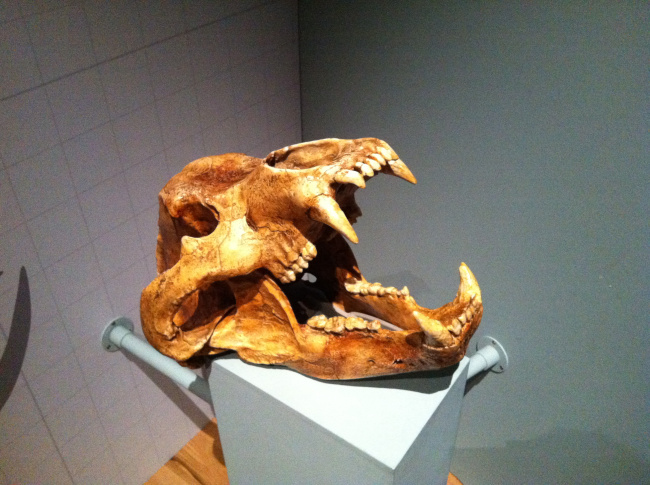
I particularly like the bears. I’ve been thinking about bears a lot recently; partly since I decided to call my next album The Bear. You know how, once you start thinking about a thing, often you’ll start to see that thing everywhere? I’ve been seeing bears all over the place, all over town. Then the other morning I was up at the Booth Museum and there is a large bear standing right in the doorway. It’s so odd that we’ve made bears ‘cute’ by turning them into soft toys, exaggerating the anthropomorphising of them… but that’s another blog entry. Here in Chilled to the Bone, they’ve actually included a few exhibits and artifacts borrowed from the Booth and there is a huge replica skull of a bear that you can touch, along with some interesting information.

Another big impact of this little exhibition (for me, anyway) was starting to think clearly about the timescales involved in the Ice Age, compared to time frames of human history. For example, compare this stuff to the Ancient Egypt exhibits downstairs. What we think of as “Ancient Egypt” entirely takes place in a window of a few hundred years – and was only a few thousand years ago. When you compare that to an Ice Age, which stretches back hundreds of thousands of years, you can start to comprehend our human scale in comparison with much huger geological timescales.

It’s so hard to think in those terms – which is partly why I imagine people struggle so much with quite simple ideas like evolution or the ‘likelihood’ of natural selection; because it’s so tough to even envision a million years, let alone fathom everything that can occur across a natural environment in that time period.

Anyway, I’m waffling. But Chilled to the Bone is warm, interesting and right by the Café, so I’ll be going back a few more times.

Chris T-T, Blogger in Residence

Kachin Soldiers

This is a legacy story from an earlier version of our website. It may contain some formatting issues and broken links.

The 17-year-long ceasefire agreement between the so-called ‘reform government’ of Burma and the Kachin Independent Organisation broke down on 9 June 2011 at the Burmese army’s initiation. So far the current civil war has already produced more than 100,000 Kachin refugees and internally displaced persons (IDPs). Within a year, numerous killings and instances of torture, rape and abuse committed by the Burmese soldiers have been documented.

On the Kachin side, civilians are involved in the fighting, alongside political leaders and soldiers. They are defending their national identity which is under assault by the Burmese military who are threatening the complete extermination of Burma’s Kachin community

In the current civil war, Kachin soldiers are playing an important role. Many of them joined the army to protect their land and cultural identity. For them fighting for future generations of Kachin people is more important than their own life. Their first intentions were not to become soldiers. They joined the army in the hope of resisting the brutal attacks waged against the Kachin people by the Burmese government and of preventing the inhuman acts of the Burmese soldiers.

Many of the photographs taken by Green in north-eastern Burma in the 1920s feature Kachin soldiers. These soldiers worked under the British colonial administration and served in the British Army. Green described them as the being amongst the ‘toughest and most disciplined’ of British military recruits.

Today the majority of the Kachin population respects and supports the Kachin soldiers since they understand their underlying desires. Moreover, Kachins believe that Kachin soldiers are brave and skilful as history has proved.

My name is Gumring and I am a member of the Kachin ethnic community of Burma. Facing many current political challenges and uncertainties, Kachinland is located in north-eastern Burma, between India and China.

I was awarded a scholarship from the James Henry Green Charitable Trust for my postgraduate studies at the University of Sussex. Currently I am working on the James Henry Green collection of photographs and textiles relating to the Kachin community in Burma. This is my third blog about this collection, which is cared for at Brighton Museum & Art Gallery.