This is a legacy story from an earlier version of our website. It may contain some formatting issues and broken links.
Kids in Museums’ Takeover Day – Friday 20th November 2015
Takeover Day is a celebration of children and young people’s contributions to museums, galleries, arts organisations, archives and heritage sites. It’s a day on which they are given meaningful roles, working alongside staff and volunteers to participate in the life of the museum.
 Whilst at 18 years and 5 months old I’m sadly no longer a “kid” (that was hard to admit), I am still technically categorised as a “young person” so am taking the opportunity to jump on the bandwagon of Kids in Museums’ Takeover Day today.
As you may already know, I am lucky enough to be a member of Brighton Museum & Art Gallery’s Fashion Cities Africa team, working alongside some seriously talented and experienced people on a workforce development placement. As well as this, I work in a retail position in the Royal Pavilion and Brighton Museum and often help out in the Royal Pavilion & Museums booking office. In other words, I am very much involved in the world of museums.
Today I am not doing anything particularly different from what I usually do in celebration of Takeover Day, but have decided instead to talk a little bit about how I “take over” on an almost daily basis. Over the past few months I have been running Fashion Cities Africa’s very own Tumblr, writing blog posts for our Brighton Museums blog about the progress of Fashion Cities Africa and posting regular updates on our Brighton Museums Instagram (@brighton_museums). Whilst this may sound like a lot of work, these have actually been some of the most fun, engaging and interesting months of my life.
Being the voice behind the social media accounts of Britain’s first major exhibition about contemporary African Fashion is more than just taking a few snaps, tapping out a couple of lines and throwing in some hashtags. Alongside doing all of these things, I have witnessed just how much time, thought and hard work goes into creating an exhibition; from the research trips halfway across the world, to the brainstorming about how to appeal to young people, to the in-depth discussions about which shade of turquoise to use on the marketing material. It has been these very meetings and discussions that have inspired so many of our social media posts, providing me with a never-ending flow of news and ideas to share with our followers.
I have also met loads of fascinating individuals along the way, from the permanent Brighton Museum-based members of the FCA team to authors, journalists, graphic designers and PR consultants. I have interviewed Mimi Mmabatho Selemela about her experiences of life and fashion in South Africa, chatted to Curator of Fashion & Textiles Martin Pel about his favourite Fashion Cities Africa moments so far, taken a trip out to the Brighton Museums warehouse to dig through our African textile collections with Keeper of World Art Helen Mears and travelled up to London to experience Africa Utopia, a festival hosted at the Southbank Centre; all of which are experiences that I have gone on to share online.
Not only have I loved having so much news, experiences and developments to tell our followers about, but I’ve also loved keeping an eye on what the people that we follow have been doing, too. Running Fashion Cities Africa’s social networking accounts has introduced me to a truly amazing online social circle, leading me to designers, photographers, models and bloggers who I’d never previously heard of. 2MNYSBLNGS and The Sartists are now some of my favourite Instagrammers of all time!
I hope you guys have all had a great day and have enjoyed doing whatever you’ve been doing! I’m loving Takeover Day too, but most of all, I’m loving having the opportunity to take over the social media accounts for an exhibition as amazing as Fashion Cities Africa every day!
As ever, thanks for reading guys!
Ruby McGonigle, front of house team member at the Royal Pavilion

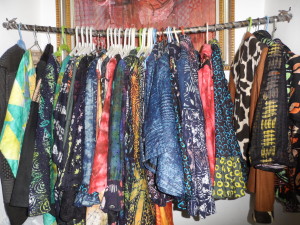

 s; Lanre’s husband works in oil and gas.
 show at Lagos Fashion and Design Week and Ghana Glitz.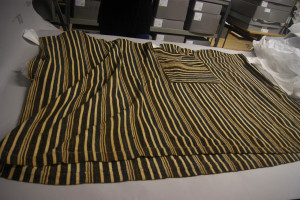
 , carefully laid across the table this striking Kanga textile, originating from Kenya in the 1940s. Kanga textiles usually begin as one long strip of fabric, before being printed with a vibrant pattern such as the one we see here, and being cut in half to create a two-piece outfit. Often, prints and motifs are incorporated into African textiles as a way of allowing wearers to make subtle political statements; this particular textile, which is adorned with the distinctive Swastika symbol and branded with an image of the Nazi, Japanese and previous Italian flags waving in unison with one another, is likely to represent the ally relationship between these three countries during WWII.
 anaian Batakari Gown. The immaculately hand-written tag hanging from the neck of this giant garment labels it a “witch doctor’s dress” from Kumasi, a city in Ghana’s Ashanti kingdom. This gown was most likely acquired when Kumasi was invaded in the Ashanti Campaign, a British punitive expedition which ran through 1873 and 1874. The implications of this left the atmosphere around the table feeling heavy for some time, as Helen, Stephen and I paused for a moment to admire the piece and its amazing workmanship. The protective amulets we see adorning the front of this gown are covered with various hides, such as crocodile skin. Traditionally, these amulets are often filled with miniature scrolls bearing sections of the Quran, as a form of spiritual protection from negativity or bad luck.
 masks in order to look like young maidens, as a way of remembering the spirits of beautiful girls who have passed away.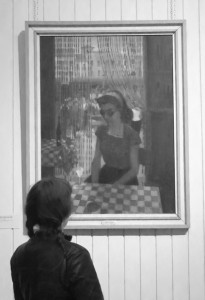


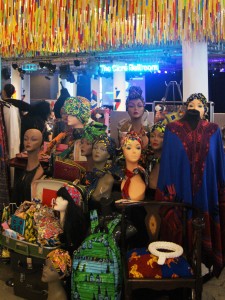


 f view, I found it really valuable to get a feel of Africa Utopia and come back to Brighton with feedback and ideas for the rest of the team that we may be able to feed into our own