This is a legacy story from an earlier version of our website. It may contain some formatting issues and broken links.
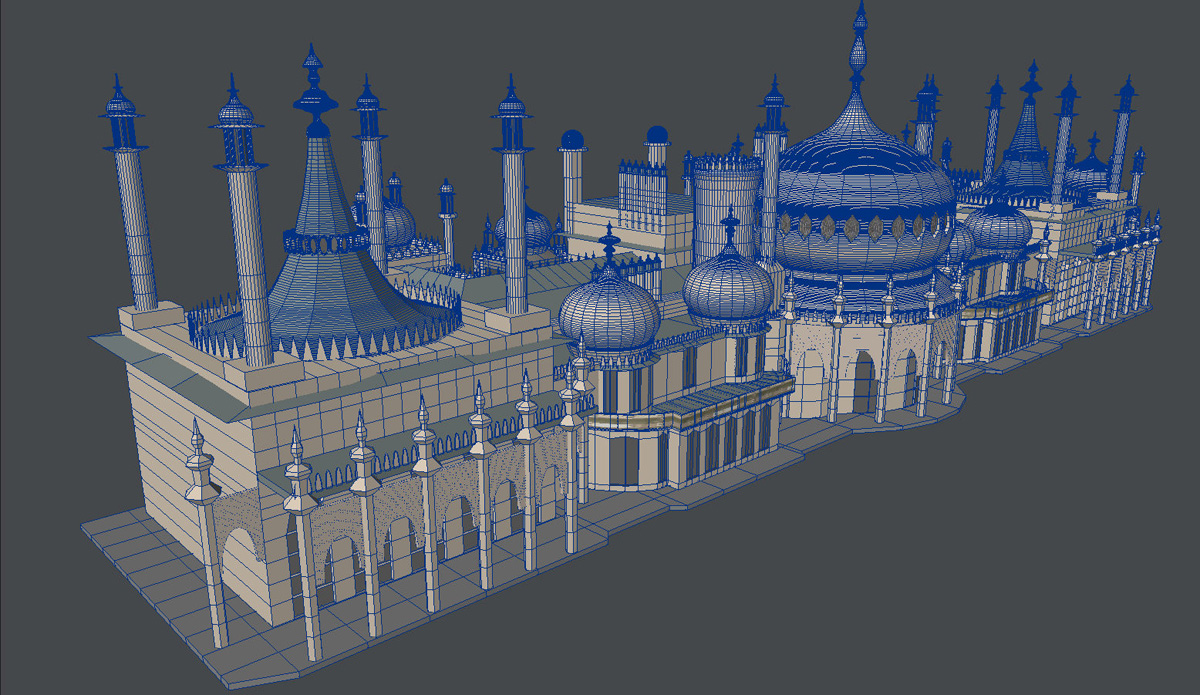
Recreating the historic Royal Pavilion Estate in 3D
This is a legacy story from an earlier version of our website. It may contain some formatting issues and broken links.
Recreating the historic Royal Pavilion Estate in 3D
This is a legacy story from an earlier version of our website. It may contain some formatting issues and broken links.
As part of the new series of talks, Pavilion Tales, I decided to find out just exactly what it was that was Inside George’s Breeches. A famously overweight king with the finest kitchens in Europe was sure to have a fascinating array of both regency delicacies and gruesome ailments. George did not disappoint.

Meg (right) showing off George’s breeches during the Pavilion Tales talk
George IV first came to Brighton as a dashing young prince, just twenty-one years of age, famous for his love of horses, women and having an altogether better time than his father George III really would have liked. He is better remembered, however, as a gluttonous, ailing monarch, riddled with gout and despised by his own people. Not only this but his behaviour was considered vulgar and unstatesmanlike. Rather than following an austere life of politics with his father in London in preparation for taking the throne, he preferred to take the six hour drive to Brighton to carouse with his fun-loving uncles, who had likewise eschewed the dour and prohibitive company of George III for a more rambunctious way of life. His very purpose in coming to Brighton then, was to escape the king’s puritanical ways, and to indulge.

The Prince Regent is shown as an oriental potentate.
The contrast between George III’s court and his son’s lifestyle at Brighton was stark. George III placed his son on a restrictive diet early in his life, to ward off a family propensity to being overweight. It prevented the young prince from eating the filling of a fruit pie, for example, and instead he was allowed only to eat the crust. At Brighton however, George embraced the French ways of the table. George not only took his lead from the French, but his chef as well, employing Antoine Carême, the finest chef of the day, to prepare haute cuisine in George’s The Great Kitchen in Brighton. Carême only stayed in George’s employ for eight months but it was in this period that he produced the dinner service of his career; the menu for which can be seen in the kitchens at the Pavilion today. They were the most technologically advanced kitchens in Europe and George was so proud of them he would often invite guests to look around them, and on one controversial occasion, even dined there.

George IV in the kitchen of the Royal Pavilion
The spectacular kitchens were stocked in bulk at vast expense. Between the 6th of May and the 5th of June 1816, Carlton House took delivery of 5264 lbs of meat “not including sausages, pork or poultry”. And no wonder when George’s favourite breakfast consisted of two pigeons, three beefsteaks, three parts of a bottle of white wine, a glass of dry champagne, two glasses of port and a glass of brandy. It should come as no surprise then that George was indeed rather rotund in stature, although that was not necessarily such a setback in the Regency period. The sudden taste for rich and fattening food from France led to a general upward trend in corpulence in fashionable British society. Lord Byron fell afoul of fattening, French cuisine and, much chagrined, made a great show at one ball of refusing all dishes offered to him in an effort to convince the company that he was dieting. This was somewhat undercut by his appearance at a local inn, shortly after the ball ended, dining on a hearty meal. From household accounts, it would seem that George himself made an occasional attempt at dieting. Sober meals of plain boiled salmon and rice soup appeared on dinner menus but one can only assume that these half-hearted attempts at dieting failed; especially considering that alongside these dishes were the somewhat less slimming sweetbreads and lobster-au-gratin.
All in all, George was destined for greatness, literally. And it was a fact that didn’t go unnoticed. His wife Caroline, on first meeting him, commented “he is very fat and he is nothing like as handsome as his portrait”; perhaps why the famously unhappy marriage didn’t take. The Duchess of Gloucester drew the comparison between George and “a great featherbed”. It supposedly took three hours to lace the King into his girdle and whale bone corset of a morning due to all the “bulging and excresiances”. Once girdled his waist measured 55 inches, however, this feat of engineering was such that the tightness of the girdle almost caused George to faint during his own coronation and contemporaries are recorded as saying that his natural stomach hung between his knees.

George IV depicted as a whale surrounded by people including Maria Fitzherbert.
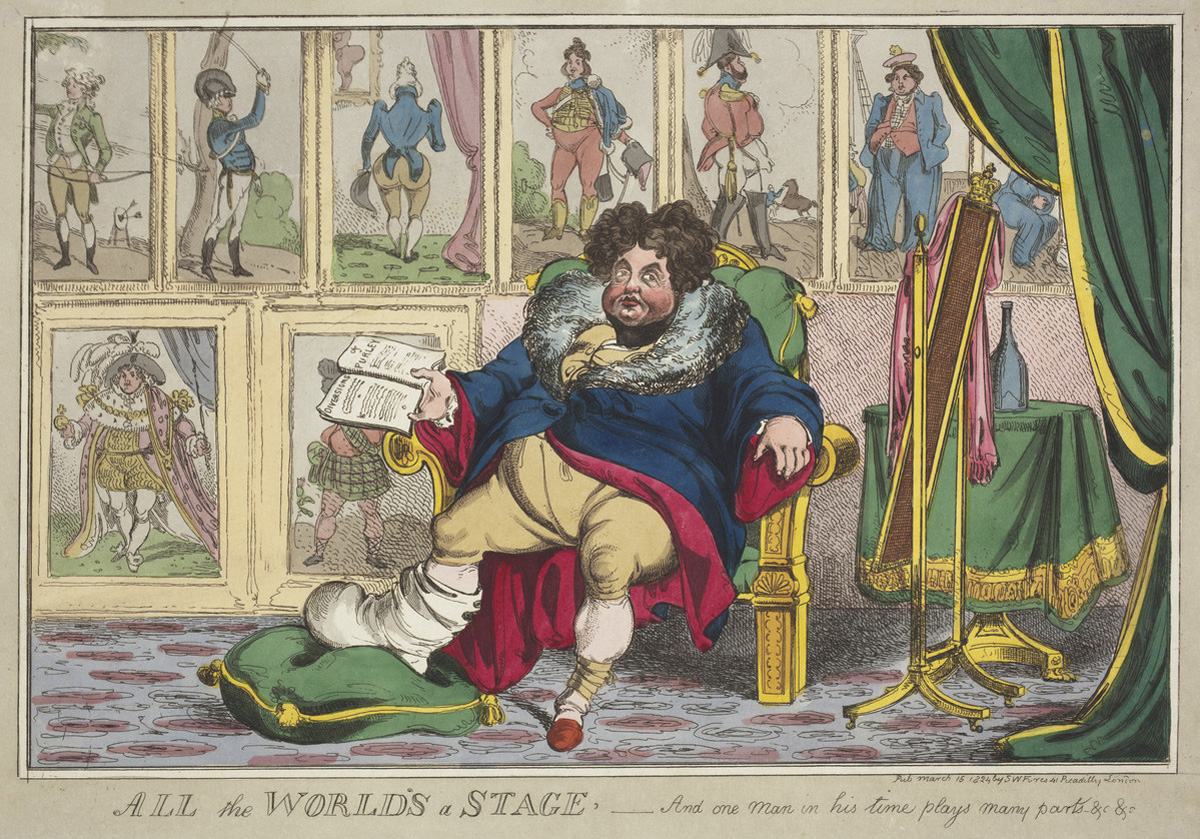
Sir Willie, who likened him to a “great sausage stuffed into the covering”, painted his portrait during his final months and found the endeavour hard to endure. Reflecting upon the experience he remarked that it was a “most difficult and melancholy business for the man was wasting away frightfully day by day”. The weight on his chest meant that lying in bed would almost cause him to asphyxiate and so in his last few months, he was able only to sleep on a day bed, propped in an upright position and on the brief occasions that he needed to move around he used a Merlin chair. Even small tasks were an ordeal as George’s swollen limbs were often so painful with excess fluid from his dropsy that he could not get dressed. Exasperated attendants had a stamp of his signature made because the gout in his hands was so extreme he simply refused to sign legal documents. He suffered from cataracts, a common occurrence among those blighted with gout, to the extent that he was practically blind

George IV with a bandaged gouty foot sits in front of mirror with images of himself in various costumes in the background.
By the time of his death on the 26th of June, 1830 at the age of 67, he had surpassed 24 stone in weight and even in death, his sheer size caused problems. The stairs and columns which the coffin was to be carried down and past were surrounded by wood to protect them from any potential damage should the coffin go rogue. Even when the coffin was lying in state, it was supported by ironwork to prevent the table giving way. In spite of all this, it was said by Thomas Raikes: “no man clung to life with greater eagerness than George IV, or was more unwilling to hear from those about him any hint or suspicion of his apparent decay”. Stubborn and eccentric to the end, George IV was truly a larger-than-life monarch and one whose influence can be still be felt today as you wander through the rooms of his most extravagant and ambitious building project, the Royal Pavilion.
Meg Hogg, Visitor Services Officer

This is a legacy story from an earlier version of our website. It may contain some formatting issues and broken links.
Ruby McGonigle has recently written a blog post for the Museums & Heritage Advisor website on her experience working on our Fashion Cities Africa exhibition. The post is produced in full below.
My name’s Ruby, I’m 18 years old and for the past few years I have worked front of house at the Royal Pavilion in Brighton. My position covers a range of areas; from selling admission tickets to handing out audio guides, welcoming large groups and working in the souvenir shop. I have always loved opening up the doors in the morning and not knowing who’s going to walk through them!
 In spring 2015 I was offered the opportunity to work alongside Royal Pavilion & Museums’ (RPM) Programming Team, helping to run the social media accounts for our upcoming exhibition Fashion Cities Africa, as part of RPM’s Workforce Development programme. This scheme offers members of RPM frontline staff a chance to develop both personally and professionally by moving between departments and experimenting with alternative positions, potentially even landing themselves new long-term roles.
As a self-diagnosed fashion addict and an aspiring journalist, the prospect of helping to promote an exhibition like Fashion Cities Africa seemed almost too good to be true, and I jumped at the chance! Almost a year later I’m having a wonderful time and still feel extremely lucky to be in the position I’m in.
Being the voice behind the social media accounts for Britain’s first major exhibition about contemporary African Fashion involves more than just taking a few snaps, tapping out a couple of lines and throwing in some hashtags. Over the past 10 months, I have interviewed fashion designer and PR guru Mimi Mmabatho Selemela about her experiences of life and fashion in South Africa, taken a trip to the Brighton Museums warehouse to dig through our African textile collections, and travelled up to London to experience Africa Utopia, a festival hosted at the Southbank Centre. I have taken part in social media workshops by Instagram phenomenon Philippa Stanton (@5ftinf), shotbehind-the-scenes snaps of a fashion shoot starring a member of Brighton’s African diaspora as part of Fashion Cities Africa’s wider community engagement project, made friends with the exhibition’s team of young digital ambassadors and had a real insight into the world of PR, thanks to super-helpful contributions from Ronke Lawal’s PR agency, Ariatu.
I don’t think that any of these are experiences I ever would have had if it wasn’t for RPM’s Workforce Development programme allowing me to join the Fashion Cities Africa team.
While my usual job of working in retail and on the frontline, undeniably, can be challenging, tiring and manic – particularly in the height of summer – the past 10 months have also taught me A LOT about the phenomenal amount of work that goes on behind the scenes here. From research trips halfway across the world, to brainstorming about how to appeal to young people, to in-depth discussions about which shade of turquoise to use on the marketing material – the Fashion Cities Africa team have given it their all. Watching my colleagues work tirelessly to ensure that this exhibition is the best it can possibly be has been truly inspiring, and has really taught me that behind every successful venture here is a whole lot of graft. Exhibitions DO NOT appear overnight!
Having the opportunity to meet new colleagues and work alongside people I may otherwise never have met has been, by far, one of the most enjoyable parts of this experience. I have now worked with members of our Programming, World Art, Fashion & Textiles and Marketing teams and, after working for RPM for three years, I am finally gaining a real insight into what all of these people do on a daily basis. As well as all of these permanent staff I have also met the likes of journalist and author Hannah Pool, artist and designer Lulu Kitololo and journalist, editor, author and the brain behind global media brand Nataal, Helen Jennings – all of whom I am admittedly still a little starstruck by!
Almost a year into my Fashion Cities Africa experience, I still can’t believe my luck in having been offered an insight into this crazy world of creativity, conscientiousness, passion and unbelievable talent. I have never before felt so inspired.
Next, I look forward to beginning my degree in English Language in the hope of eventually becoming a journalist. Running Fashion Cities Africa’s social media accounts has provided me with invaluable writing experience and has taught me more about PR, marketing and the global fashion industry than I ever could have dreamt. I feel that these experiences and insights will now stand me in amazing stead in pursuit of my dream career.
Ruby McGonigle
This blog post first appeared on the Museums & Heritage Advisor website.
This is a legacy story from an earlier version of our website. It may contain some formatting issues and broken links.
The centenary of the Pavilion Military Hospital for limbless soldiers (1916-1920) is currently commemorated in our exhibition Pavilion Blues: Disability and Identity. In this post, researcher, Jo Palache, tells the story of how one patient, Corporal Albert Clay, came to be treated at the hospital and how she came to find out about his story.
Whilst researching for the current exhibition, I have been looking for stories of the people who were treated at the hospital and the staff who cared for them. I was particularly eager to learn about the critical days before amputees arrived in Brighton, but I found little information on this until I heard the story of Corporal Albert Clay.
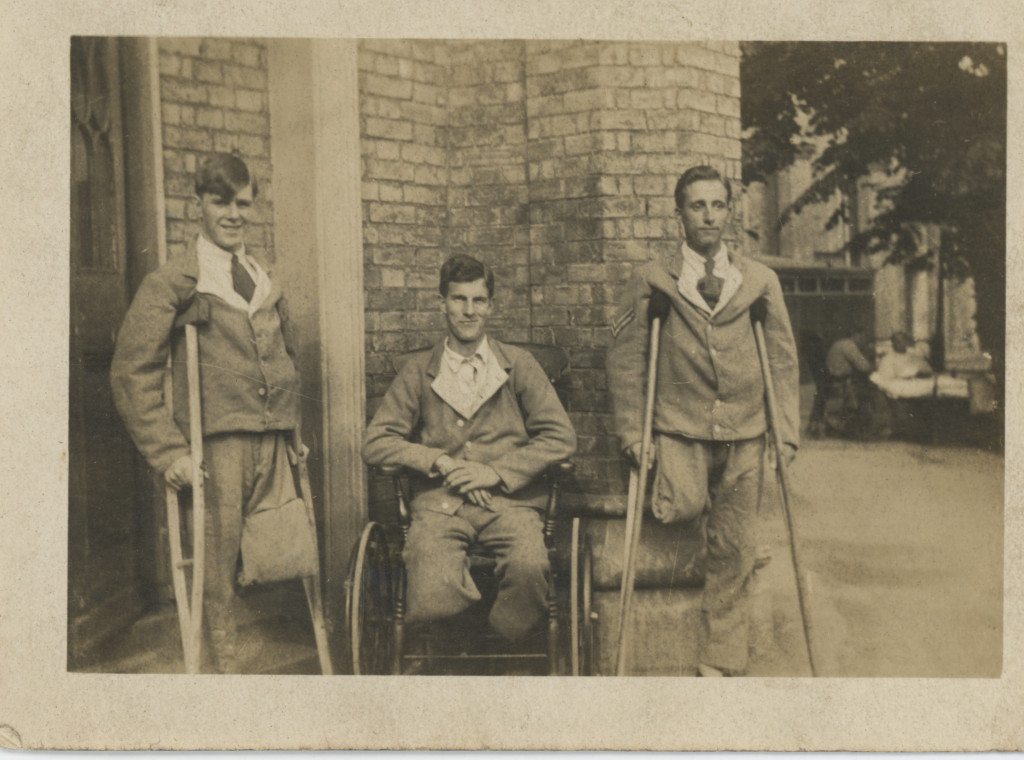
His son and grand-daughter, John and Yvonne Clay, had not known that Albert was treated at the Royal Pavilion when they booked places on a First World War tour of the estate. It was only once they arrived that they realised that three of their photographs of Albert were taken in the Royal Pavilion Garden.

Albert (far right) wearing the hospital ‘blues’ uniform with two fellow patients outside the Dome. Lent by John Clay
Albert was a young grocer’s assistant living with his family in Wirksworth, Derbyshire, when the First World War began. He had been on active service in France and Belgium for seven months before being wounded by shrapnel. A series of letters and army forms reveal something of Albert’s condition and his treatment over the following weeks.
Albert had kept a number of documents relating to the time he was injured. Of particular interest were the letters that traced Albert’s journey from being wounded at Ypres, Belgium, to returning to the UK. A letter from Sister Graham of the 2nd Canadian Clearing Station describes the treatment that followed his arrival on the night of 15th February 1917:
‘He was operated upon at once by the surgeon specialist and the wounds cleaned to try and save the leg. We almost thought for a little while that it could be saved, but it started to hemorrhage causing his already weak condition to become weaker. On the 22nd the surgeon specialist asked for some one to give some blood to be transfused into your son. As usual these men always offer and a healthy man from the Flying Corps was chosen. After the transfusion Corporal Clay was in much better condition and it was thought best to amputate the leg.’
Unfortunately the wound became septic and Albert’s condition remained serious. It took over three weeks to stabilise his condition enough to transfer him to a hospital in Boulogne and from there to the UK and the Pavilion Military Hospital. During this time the war diary refers to treating hundreds of casualties and suffering ‘heavy bombardment’, yet even under these conditions the Chaplain writes that Albert is ‘a splendid patient and a great inspiration to the other men.’

The letter from Sister Graham to Albert’s mother. Lent by John Clay
Albert’s condition remained serious and three operations followed in Brighton, but he survived and passed on his story and photographs of his experience. One was of Albert in bed inscribed ‘Last operation and still smiling’ (see below).

Albert Clay (far right) with a dome protecting his legs after the operation. Lent by John Clay
Albert went on to live an active life, but he kept the documents that record the treatment that saved his life. His family is particularly grateful to the Canadian nurse, Sister Graham, who had kept his mother so well informed, and Yvonne Clay has travelled to Canada to find out more about her.
Over six thousand patients were treated at the Pavilion Military Hospital. It is through stories like this that we hope to learn more of the human experience behind the statistics.
Jo Palache, Oral History and Life History Researcher
If you have any information on the Pavilion Military Hospital or would like to know more, please contact me at jo.palache@brighton-hove.gov.uk.
This is a legacy story from an earlier version of our website. It may contain some formatting issues and broken links.
Last Wednesday we held a one day workshop in London entitled ‘Digital: From Idea to Audience’. Supported by our Major Partner Museum funding from Arts Council England, the day was attended by about 20 delegates from museums across the UK.
The event was inspired by the response to a talk I gave at the Museums Association conference last November. After speaking at that event, I received a good 30 minutes of questions from the audience, almost all of which were focused on everyday practical questions: ‘How do you recruit a developer?’ ‘How can I test a website with my users?’ ‘How can I get other people in my organisation to contribute to my digital project?’
This workshop was a direct response to those questions, and intended to address some of the more practical issues museums face in developing digital products and experiences.
I was joined by three speakers at the event: Gavin Mallory, Head of Production at Cogapp; Graham Davies, Digital Programme Manager at National Museum Wales; and Tiana Tasich of Digitelling Agency.
I spoke about our recent work in gaining a better understanding of our online users, and how this work informed the launch of brightonmuseums.org.uk last year. I talked a little about a previous digital project, Story Drop, which failed to gain as much of an audience as we had hoped, and how the failures of this project informed the success of the web redevelopment.

Gavin gave a witty and entertaining talk with six top tips on how museums can achieve ‘digital excellence’. It included references to Michelangelo, a chance to play ‘Who Wants to be a Millionaire?’, and a display of ‘bad briefs’.
 Graham skillfully turned the premise of the programme on its head. Rather than developing ‘digital ideas’, he argued that museums should be working from the audience to the idea. With the aid of some beavers and divas he talked about how National Museum Wales have spread digital activity across the organisation, and a culture of user-centric thinking.
Tiana has a good deal of experience in the museum and arts sector, having previously worked at Tate and the Southbank Centre. She delivered a practical session on how to set up a usability testing session.
She began by insisting that although this is often described as ‘user testing’, we are not testing people; we are really testing how well people can use our digital products and services. This was a practical session that showed how to set up a testing session, and how to develop audience profiles. Tiana also made a very good point about how the boundaries of usability testing are changing: while this has often been very screen based, the growth of iBeacons and other location technologies means that we now also need to test usability in physical spaces.
My thanks go out to all the delegates who attended the day, and to the great speakers who joined me.

This is a legacy story from an earlier version of our website. It may contain some formatting issues and broken links.
For many people, the start of a new year is a good time to sort through piles of unwanted clutter around the house. Sometimes amongst this clutter are the inevitable family heirlooms. These are not always identifiable, particularly if they have been passed down with no explanation.
Magic lantern slides often fall into this category. It may be that an older family member had a lantern and for one reason or another, the slides have become separated. The lantern is disposed of because it takes up space, it doesn’t work or simply because no-one knows what it is!

The slides may be of more interest if they are photos taken by or of family members, or just because they are jolly coloured pictures of fairy stories. But lantern slides really only come to life if they are seen projected through a lantern, as they should be. Tiny details can be appreciated and even effects of degradation can produce startling changes to the images.

More recently I have been projecting slides from the museum collections at various events and viewers are often fascinated by different aspects – the subject matter, the quality of the photographs, the skill (or not!) of the hand tinting. They also enjoy seeing the actual lantern in action and learning that early ones were around during the seventeenth century, and not a Victorian invention as often thought.

So if you would like to unravel some of the mystery surrounding the magic lantern, come along to my ‘Pop-Up Lantern Slide Drop-In’, any time from 12-3pm on Saturday 6 February in the Temporary Exhibition Gallery (by the balcony café). The drop-in is free, other admission charges may apply.
If you have some lantern slides of your own which you have never seen projected, feel free to bring them along and I’ll try to get them up on the big screen! (However please be aware that any slides brought in will be projected at the owner’s risk.)
Read about other magic lantern events at Brighton Museum and the Booth Museum
The Film Galleries at Hove Museum have a permanent display of magic lanterns, slides and a slide show you can watch in the mini cinema.
Admission to Hove Museum is free; see the current opening hours for Hove Museum
Alexia Lazou, Collections Assistant
This is a legacy story from an earlier version of our website. It may contain some formatting issues and broken links.
With public tours of the Royal Pavilion’s basement and tunnel imminent, it is worth looking at how the building with its many deceptive features and hidden passageways has been used in fiction.
In 2012 it was the setting for a gruesome and gripping thriller (Not Dead Yet) by Peter James. I had great fun showing him around the palace and behind the scenes, trying to find suitable places to commit crimes or hide bodies. But Peter James wasn’t the first author to have set a crime story in the Royal Pavilion…

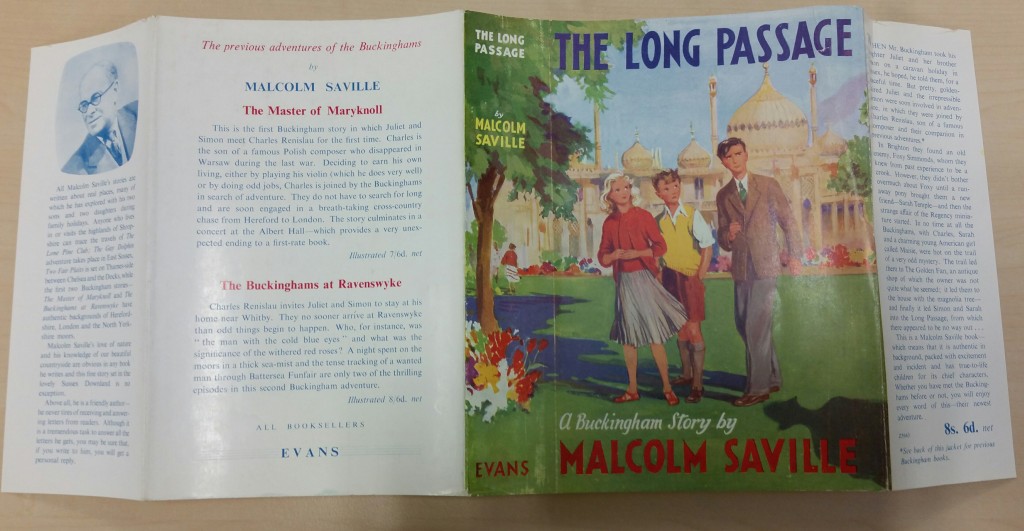
The dust-jacket of the first edition, 1954.
Half a century earlier another author, Malcolm Saville, must have asked for a private research tour of the Pavilion, with the aim of writing a detective story for children. He published The Long Passage, a story partly set in the Pavilion, its gardens, the Lanes and other parts of Brighton, in 1954, when he was at the pinnacle of his career as a writer and was about to move from Hertfordshire to Barcombe, near Lewes. The book was the third in the so-called ‘Buckingham Series’. Saville was born in Hasting in 1901 and wrote more than 90 children’s books between 1943 and his death in 1982, many of them set in the Romney Marsh borders of Kent and Sussex. Now relatively little known, he was in his time a hugely popular author, who encouraged his young readers to write to him and famously responded to most letters personally. He had four children of his own and frequently visited local schools. On 9 Dec 1960, for example, he visited Wallands Primary School in Lewes and talked to more than 150 children about reading and books. He also read to them from Kipling’s works and of course his own.

Illustration from ‘The Long Passage’ with the Royal Pavilion minarets in the background
His love for Kent and Sussex is obvious in his work. In the foreword to The Long Passage he gushes about ‘lively, sunny Brighton’ and ‘the gorgeous, fantastic Royal Pavilion’. He tickles his readers’ curiosity by mentioning that ‘When you go to Brighton you will be able to go round the Pavilion as Simon and Sarah did in this story and see the same treasures. You might even see the outlines of one of the walls of the secret door through which they slipped to escape their old enemy.’ Here Saville is clearly referring to the numerous jib doors in the Pavilion, for example to either side of the organ in the Music Room. I won’t give too much of the story away, but it involves a precious antique miniature, a chase through twittens in the Lanes, a tour of the Royal Pavilion (during which the children are told off by a ‘self-appointed guide’ for “failing to take advantage of the knowledge of their elders”) and a grand finale in the tunnel leading from the palace to the Dome.

Illustration from the book showing the protagonists in the Banqueting Room.
The dust-jacket for the hardback first edition (Evans Brothers Ltd, London) is a glorious example of mid-20th century colourful book design, showing the three teenage protagonists in the Pavilion gardens, with the east front of the palace in the background. The first edition also had two charming maps as endpapers, one of Brighton and one of an area near Chanctonbury Ring, allegedly drawn by one of the children during their adventure. The actual artist was Alice Bush, who also illustrated a number of Enid Blyton books. Among the illustrations in the text are amusing views of the Lanes, the Banqueting Room of the Pavilion, and – in prime position as the frontispiece – an eerie image of two of the children discovering the tunnel. From the accurate description of the scene it is clear that Saville must have seen the tunnel himself:
[pullquote align=center]
“Ahead of them stretched an arched and whitewashed passage. Electric light bulbs were in the ceiling but a little grey daylight coming from circular sky-lights at the top of stone-lined, narrow funnels at intervals in the ceiling of the long passage. They looked up at the one just over their heads and saw a shadow pass across the thick, greenish glass which, they guessed, must be on the ground level.”
[/pullquote]
These skylights (8 in total) are still in place and can be spotted between the stage door of the Dome and the north-western corner of the Pavilion.

The frontispiece of the book, showing the tunnel.

The tunnel as it looks today. Photograph: Strat Mastoris, 2015

One of the sky-lights of ‘thick, greenish glass’, as seen from inside the tunnel. Photograph: Alexandra Loske. 2015
The book was in print until 2012, when Evans stopped trading, but second-hand copies can still be sourced easily. Early editions with the original dustjacket are already becoming harder to find. Apart from it being a pretty good story, the book also throws an interesting light on how the Pavilion operated in the mid-20th century. It is very probable that Malcolm Saville was shown around the Pavilion by the inimitable Director Clifford Musgrave, who saw the Pavilion through the difficult war and post-war years, organised the Regency Exhibitions (with the help of a committee, including historian Antony Dale) and wrote several books on the Pavilion, Brighton and the decorative arts. He also lived in the Pavilion, in rooms at the north end of the building. By coincidence, we have just received three albums of photographs of the Pavilion, dating from the 1940s to the 1960s, donated by Musgrave’s son, and I will be looking very carefully through them, in case I spot Malcolm Saville on his research visit for this book in one of the photographs.

One of the endpapers of the first edition.
The Long Passage and other 20th century books inspired by the Royal Pavilion will be included in the display Visions of the Royal Pavilion Estate (14 March 2017 to 3 Sept 2017, Prints & Drawings Gallery, Brighton Museum & Art Gallery).
Alexandra Loske, Art Historian and Curator, The Royal Pavilion
This is a legacy story from an earlier version of our website. It may contain some formatting issues and broken links.
An update from me, Ruby McGonigle, on my experience so far as the person behind Fashion Cities Africa’s social media accounts.
So, it’s been six months now since I joined the Fashion Cities Africa team (I can’t quite believe it – time really does fly  when you’re having fun!) and I feel that now is a good time to reflect on my experience so far. My journey as part of the UK’s first major exhibition about contemporary African fashion kicked off last summer with a handful of really big, really important team meetings, wherein A LOT of brainstorming and scribbled notes took place. In these meetings I was lucky enough to meet some extremely skilful and knowledgeable members of Brighton Museum & Art Gallery staff, who I have since watch work their socks off to ensure that Fashion Cities Africa is the best it can possibly be. I was also introduced to Helen Jennings, Hannah Pool and Lulu Kitololo, all of whom are equally as talented and accomplished as one another in their fields of work (and who, I am not ashamed to admit, I am still ever so slightly star-struck by!) Following these introductory months, I was present for a visit from a group of international students participating in an intense training course at the British Museum and was jammy enough to be sent up to London for a day at Africa Utopia at the Southbank Centre. As far as first impressions go, it didn’t take long for me to get a very good feeling about what the next seven months in store…
The first step on my journey was really seeing to all of the important technical bits and bobs. I was introduced to our Fashion Africa  Tumblr account, given a mini masterclass on posting to our Brighton Museums blog and even helped to set up a Brighton Museums Instagram account. Before long it really felt as though the ball had gained some good rolling momentum and watching our social media follower counts grow soon became one of my favourite parts of being involved in Fashion Cities Africa. Since then, I have written a blog and Tumblr post in celebration of Kids in Museums Takeover Day, worked alongside our World Art team by regularly sharing their Tumblr posts to our Fashion Africa page and created some social media posts to commemorate the anniversary of the Moroccan Independence Manifesto in celebration of the Moroccan individuals involved in Fashion Cities Africa.
The following months saw me welcomed into the deepest inner workings of Brighton Museum, giving me a real feel for what it’s like to be behind the scenes. Since  September, I have taken a trip out to the Royal Pavilion & Museums’ vast artefact store on the outskirts of town with Keeper of World Art Helen Mears, interviewed Curator of Fashion & Textiles Martin Pel down in the museum’s goodie-packed costume store, delved through the museum’s basement in search of some furniture that could potentially be used in the exhibition gallery and sat in on countless juicy meetings.
I’ve also been fortunate enough to be around when the Fashion Cities Africa team has been visited by some really interesting and accomplished individuals. When Mimi Selemela flew over from South Africa to deliver all of the fabulous clothing that is going to feature in the Johannesburg sector of the exhibition, I grabbed an hour with her to chat to her about all sorts from her views on how post-apartheid politics have influenced fashion in South Africa, to her own fashion label, Designs by Music, to New York’s AFROPUNK festival – and of course, to snap a few compulsory selfies! I also met London-based designer Yinka Ilori when he popped down to Brighton to discuss with us the potential of up-cycling some of our battered old chairs to create some magnificent Nigerian parable-inspired seats to be used in the Fashion Cities Africa exhibition gallery. There has been no end to the new faces, fascinating stories and innovative ideas.
But, perhaps the most exciting part for me so far has been watching Fashion Cities Africa slowly take shape and become something absolutely spectacular. Over the past couple of months, I’ve attended design meetings and been shown final exhibition plans, complete with colour, photo, pattern and text. I have seen Fashion Cities Africa name-dropped in Vogue UK, Elle South Africa and on a range of prestigious websites and blogs. I have opened the Royal Pavilion & Museums ‘What’s On’ guide to find Fashion Cities Africa taking the first page, watched each of our social media accounts respectively reach the 100 follower mark and witnessed the unbelievably positive impact of help received from Ronke Lawal’s Ariatu PR.
The next few months are looking set to be the most exciting and jam-packed yet, and I cannot wait to continue sharing every step of the journey with you guys on our blog, Tumblr and Instagram. Keep your eyes peeled for more behind-the-scenes gossip and news!
As ever, thank you all for reading! Until next time,
Ruby McGonigle, retail and bookings office assistant, Royal Pavilion & Museums
This is a legacy story from an earlier version of our website. It may contain some formatting issues and broken links.
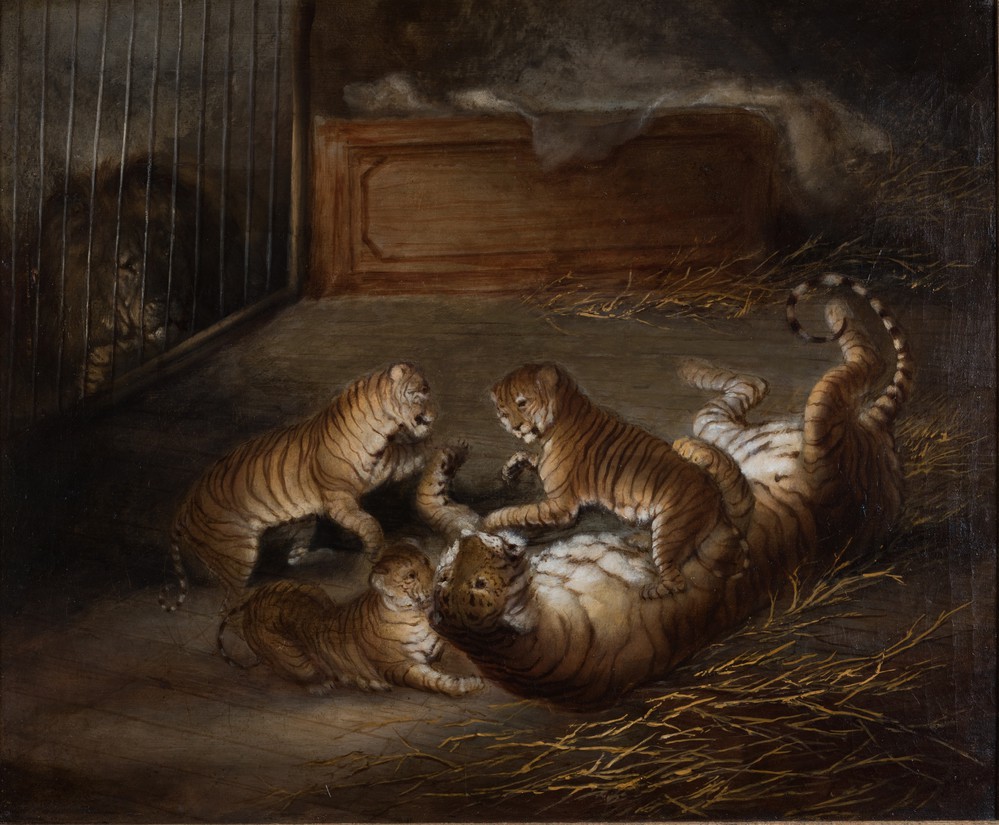
One of the stars of the Exotic Creatures exhibition at the Royal Pavilion (14 November 2015 to 28 February 2016) is a painting of creatures that had never before been seen in England. It shows Three ‘liger’ Cubs, the offspring of a lion and a tigress, who were born in the travelling menagerie of Thomas Atkins on 24 or 28 October 1824 at Windsor. The liger cubs – two males and one female – were possibly the first in Britain. Their births caused a sensation and the press reported soon after that they had already ‘attracted hundreds of spectators, being the only instance of the kind that ever occurred.’
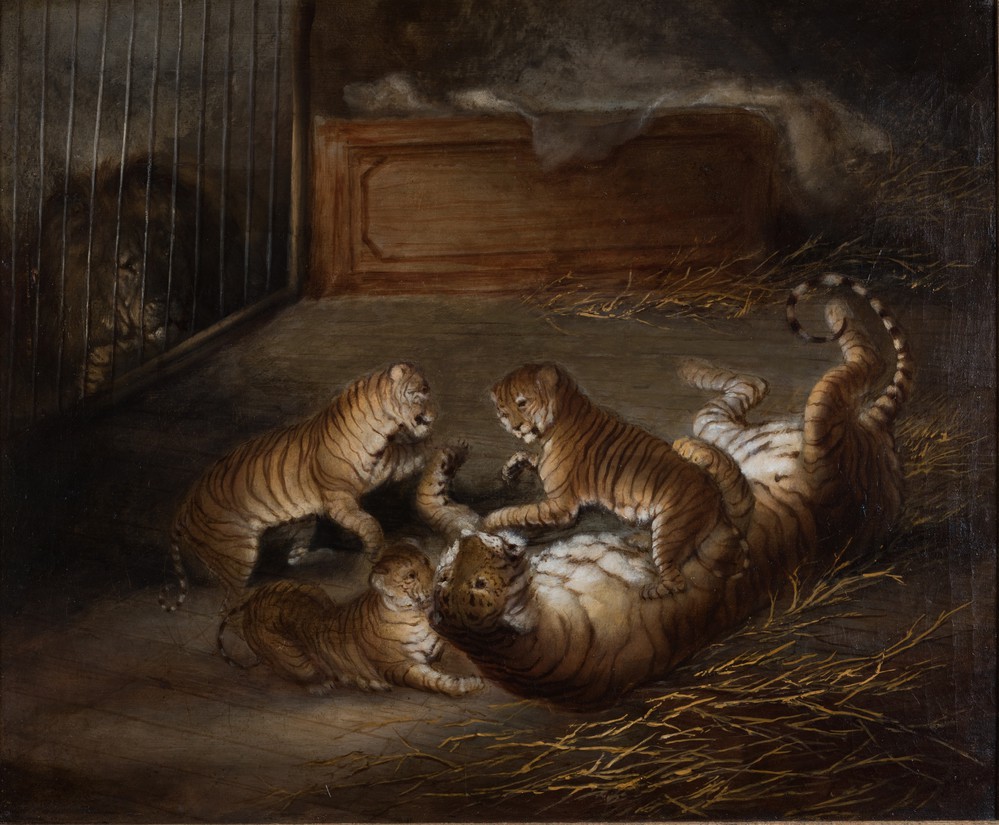
Three ‘liger’ cubs, bred between a lion and a tigress at Windsor Great Park in October 1824. Collection Stephen Pavey.
Lions and tigers can only interbreed in captivity, as they live on different continents. If ligers survive until adulthood they are often bigger and heavier than either parent, making them the largest hybrid cats. Male ligers can grow to the size of a pony and weigh over half a tonne. Most male ligers are infertile, so they very rarely procreate, and are considered to be of a gentle nature, due to the lack of testosterone. If the father is a tiger and the mother a lion, the offspring are called ‘tigons’.

The Nubian Giraffe, Jacques-Laurent Agasse, 1827. Courtesy ROYAL COLLECTION TRUST / HER MAJESTY QUEEN ELIZABETH II 2015
Several artists flocked to study and paint the unusual hybrids of Atkins’ menagerie, among them the famous animal painter Jacques-Laurent Agasse (now at the Yale Center for British Art in New Haven, Connecticut), who a few years later was commissioned by George IV to paint an even more exotic creature: the Nubian giraffe given to the king as a gift by the Pasha of Egypt (this large painting is on loan from the Royal Collection and hangs opposite the Three ‘liger’ cubs’).

Jacques-Laurent Agasse, 1767–1849, Swiss, active in Britain (from 1800), Group of Whelps Bred between a Lion and a Tigress, 1825, Oil on canvas, Yale Center for British Art, Paul Mellon Collection
Our painting is cautiously attributed to Richard Barrett Davis (1782 – 1854), who had strong connection with the royal family from 1789 onwards, but it has previously also been linked to James Northcote (1746 – 1831). The cubs are shown here playing with their mother, with the father looking on from behind bars, but the tigress reportedly refused to let them suckle. A female terrier was drafted in as a whet nurse, which is included in Agasse’s painting. George IV, whose private menagerie was nearby at Sandpit Gate in Windsor Great Park, heard of the birth of the ligers and immediately asked to see them. They were duly presented to him at the Royal Cottage in the Park. The papers reported that he called them ‘lion-tigers’, took one of the cubs in his arms and commented that they were the greatest curiosities he had ever seen.
Atkins left Windsor with his menagerie after a few weeks and appears to have made the most of this royal connection, advertising the liger cubs as having been blessed by the King with the words ‘Long may you live and prosper, and be beneficial to your master.’ This, however, was not to be, as they died within less than a year, but the same lion and tigress produced five more litters between 1825 and 1833. Most of these ligers cubs only lived for a few months and the fifth litter, born 1831 at Kensington, was shown to the young Princess Victoria (later Queen Victoria) and her mother, the Duchess of Kent. King William IV, too, asked to be shown liger cubs born in 1837 in a different menagerie.
The liger cubs featured greatly in 19th century literature. Their story was told and illustrated with images in James Rennie’s The Menageries (1829), Robert Huish’s The Wonders of the Animal Kingdom (1830), in Thomas Landseer’s Characteristic Sketches of Animals (1832), in John George Wood’s Illustrated Natural History (1853, 1874) and many other publications. . At the end of the 19th century attempts of systematic interbreeding of lions and tigers were carried out at the Zoological Gardens at Dublin and in 1896 an account of the history of ligers in Britain – beginning with the litter in this painting – was published in Richard Lydekker’s A Hand-Book to the Carnivora (Lloyd’s Natural History).

The stuffed Lion-Tiger, from: Richard Lydekker, Lloyd’s Natural History: A Hand-Book to the Carnivora. Part I. Cats, Civets and Mongooses, London, 1896

Two of the liger cubs in Atkins’ menagerie in December 1827. From James Rennie?s The Menageries (1829)

The Lion, Tigress and cubs. Hand-coloured etching. From Robert Huish?s The Wonders of the Animal Kingdom. London, 1830
The painting on display here has probably never before been shown in a public exhibition. It was recently included in a Sotheby’s auction sale of old masters, and acquired by Stephen Pavey, a local collector and supporter of the Royal Pavilion. It is slightly smaller in size and by a less accomplished artist than Agasse’s work, but is nevertheless extremely charming and adds another dimension to the liger cubs story, as it is the only one that shows the tigress and her cubs in playful movement. It would not have been possible for us to borrow the Agasse painting from the Yale Center for British Art, and we are therefore extremely grateful to Mr Pavey for having purchased the painting with the aim to support the Exotic Creatures exhibition.
Alexandra Loske, Curator of Exotic Creatures
This is a legacy story from an earlier version of our website. It may contain some formatting issues and broken links.
Well it’s over a week since our return from the Museum Association Conference in Birmingham, we had a fantastic two days but it was really exhausting and a full on experience, rushing from one event to the next. We both agreed on the journey home that we were brain frazzled, but somehow it was worth it. In the time since the conference Amanda has reviewed the delegate list and we were, as we suspected, just a handful of front line staff that were in attendance. Possibly five out of 100s!

This in itself was a very interesting experience, as many of the exhibitors in the hall were noticeably overly interested in hearing that we were from the Royal Pavilion & Museums. This faded quite quickly on hearing we were front line staff and not Directors or CEO’s with the authority to make decisions for their businesses. However we were not deterred and have left the conference feeling motivated, empowered and enabled.
The general atmosphere at conference was very friendly and welcoming, delegates went out of their way to say hello and share information. Networking was in full swing and we met lots of interesting people.
Attending some of the talks, we realised that the heritage sector in general is suffering severely from financial cuts. There was no beating about the bush for the way forward, it’s change all the way as the sector as a whole has to adjust to keeping going with less and less funds.
One event Amanda attended was titled From Resilience to Prosperity. It used a metaphor of a meteorite about to strike the earth to bring home the severity of cuts the sector is facing. Alternatives to the current business models were put forward, which acknowledged and accepted future changes, such as loss of revenue impacting on staff numbers. But it suggested ways to counter deficits by marketing opportunities.
Holly attended a session about how museums should be more like football clubs. This notion sounds ridiculous in the first instance but it focused on the smaller clubs like United FC formed from the disparaged Manchester United fans when an American took over the club a few years ago. Since then, United FC and several other clubs have developed strong community engagement programmes. The talk argued that museums could learn a lot from this sort of club who benefit from lifelong supporters.
As a sector we were told that we are in a better position than other public services to benefit from ‘social capital’ as it can be built on through culture and we are the keepers of culture so to speak. A crisis is upon us and as a sector we need to act rather than over react. This is all a new concept to us and we think we will have to research more to fully understand the implications. But it was interesting to see a position which promoted action and positivity and a way forward with a focus on drivers of commercial success to increase productivity and, in effect, be in control of our own destiny as an individual heritage building, by making bigger and bolder changes.
Lots of people we spoke to were already in museums which had gone to trust. One example is Birmingham Museums who went in to trust a few years ago as this gave them better protection from council cuts. As a trust they were able to start a campaign against the cuts with local and online support. Due to the campaign the planned cut was spread over two years allowing them to plan new methods of fundraising and savings. We also spoke to one of the curators at Birmingham Museum and Art Gallery, who left us feeling quite positive by acknowledging that whilst transition in itself can seem quite frightening, there is life after trust. A life more streamlined with the focus and emphasis on the strengths of the museum and the individuals within that museum. Strong brands with new models of delivery from an onboard workforce are successful.
On our first day at the conference, Amanda was flagging considerably by 5pm, but Holly being full of life and energy, insisted we went to yet one more event. I was so pleased we did as it was really informative. A very dynamic director from Bede’s World with a strong northern accent and a history of employment within the steel industry was fabulous. He emphasised the importance of the workforce ‘rubbing along’ together, not ‘rubbing against’ each other. He had transformed Bede’s World and seemed to have done so with a very down to earth pragmatic approach, which was based on common sense and facing reality. He had made decisions which empowered his staff and the community. He changed how the idea of a museum can extend into the community and even managed to set up a 6th form college for a group of failing students from a nearby school. Bede’s World is now looking to become a provider of education and also offers apprenticeships to those learners. This was inspirational!

Other events were just as inspiring and motivational such as the Museum Accessibility Talk for the Blind and Partially Sighted. It talked about a visit as a whole experience from planning through the threshold, to leaving. Its emphasis was on access for all being equal and gave advice on how to do this successfully. Apparently only 20% of museums have large print information. From this event I came away more informed on the use and advantages of vivid, varied language being given from describers. Also how important it is for all staff to be fully informed on accessibility and one of the most important things which I heard, not only at this session but another as well which focused on access for all, was that friendly, happy and well informed staff make museums more approachable and accessible.
Amanda also attended a session on LGBT collections within museums which talked about the Walker at Liverpool. This was really interesting and The Matt Smith Ceramics at the Queering the Museum exhibition, were just brilliant and is well worth Googling. I was really pleased to hear the lady from the Walker saying they have funding to work with us, how exciting I can’t wait!
Amanda’s last session at the conference was her favourite, it was called Travellers and Museums. She made a point of visiting this session as she already had an interest in the subject, due to her role of working with the Women’s Land Army on a voluntary basis. She had discovered that the Romany Communities involvement in the Women’s Land Army in World War 2 was very under researched. This, it seems, extends to the histories of the Romany, Gypsy, Travelling and Fairground communities in general in the Museums and Records office. For many reasons, one being the communities own reluctance to share their histories, and also a tradition of story telling amongst themselves.
The Oxford Museum has managed to forge links with an Irish Travellers Woman Group in the Oxford area. This in itself was quite a feat as the communities are hostile to outside approach. A charismatic lady called Kit who had been the mainstay and primary contact within the travellers group had been persuaded to attend the conference and talk. This had been quite a worrying decision as Kit explained that she was faced with fears of discrimination outside her community and was always expecting a virtual ‘slap across the cheek’. That very morning she had been asked within her own community why she was bothering to attend as no one would be interested.
Kit was dynamic funny and passionate and now loves museums after her work with Oxford University Museum. Why, she asks, are our histories invisible? Her enthusiasm and passion mixed with individuality and pure oomph were really inspiring. Oxford University Museums decision to make these bonds and work with the travelling community, facing what appeared to be many challenges, have really produced valuable links and a wonderful exhibition and highlighted the need for more links with communities across Britain from other museums. Kit highlighted how the travelling communities own histories have changed beyond recognition within the last 30 years and how her ‘daddy’s’ stories, which reflect long traditions of a life now vanishing, will soon be lost and how much they need to be included in visible histories reflected within museums. In her words “We have always been here”.
In another room in the vast complex that is Birmingham ICC, Holly attended some session on the visitor experience within the museum. The first was given by Shakespeare’s Birthplace Trust detailing how they have used primary sources from the Tudor period to create several school activities including Elizabethan shopping and Tudor recipes. These activities are available for teachers from the website, so even schools a distance from the museum can participate from their classrooms. The highlight of the Shakespeare Birthplace Trusts year is mid-March when they hold Shakespeare Week. In combination with museums and venues around the country they help organise events for children and adults to engage with Shakespeare in a new and exciting way. Part of the talk was given by the events programmer from Tatton Park who this year ran a number of events for school children and general visitors during this year’s Shakespeare’s week. But, I hear you cry, Brighton Museums have no connection to Shakespeare, why is this relevant? Well as explained during the talk, the connection does not have to be obvious, Sunderland FC are planning Shakespeare’s Dream Team event for 2016.
Holly’s last talk was given by the National Trust property, Erddig and TheWholeStory company. Erdding found that their visitors were not engaging with the information about the house, yet it had so many stories to tell. They allowed their volunteers to research stories about the house which TheWholeStory company came in to train them to deliver these stories to engage with the visitors. The stories that are told link the area of the house and gardens that they are in, for example a story about the carpenter next to the gates that he fixed. Erdding have found that their volunteers have found this a more fulfilling day and there is a waiting list to be trained as a story teller. While they have started to get positive name checks in the visitor surveys.
As you can see our trip to Birmingham was full of interesting information and amazing examples of brilliant people. We saw how they work future potential exhibitions, a way to look forward to the future realistically but positively and an insight into new approaches to running the museum, digital technology and the visitor experience. We thoroughly enjoyed every minute of it even though it was exhausting!