Story Category: Legacy

A look back and forwards at Fashion Cities Africa

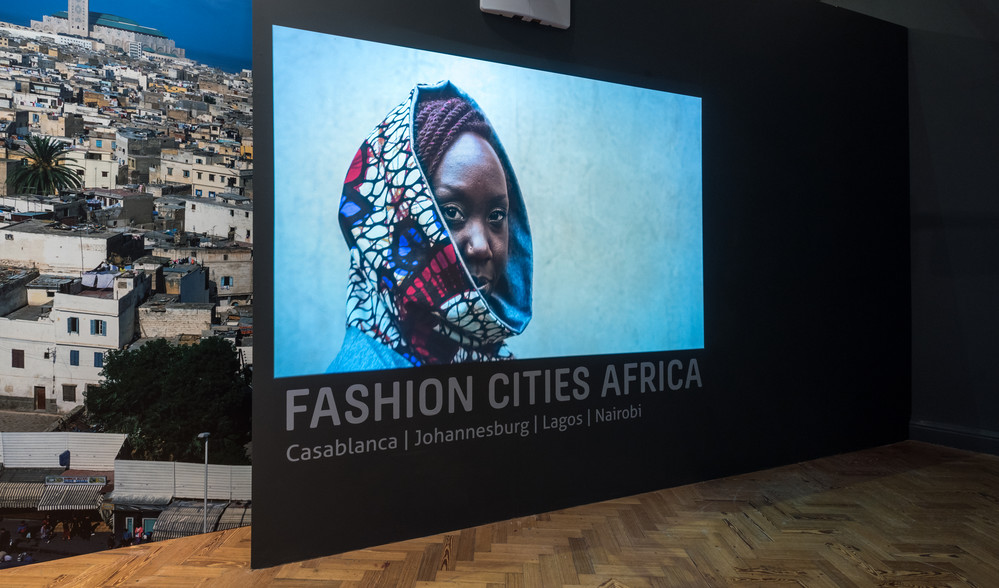
Fashion Cities Africa

This is a legacy story from an earlier version of our website. It may contain some formatting issues and broken links.

How on earth have we hit October already? It feels like only a few days ago that hundreds of us were crammed into every nook and cranny of Brighton Museum to celebrate the grand opening of Fashion Cities Africa on Friday 29 April; but apparently that was five months ago now!

Collection of gallery selfies taken at Fashion Cities AfricaSince that applause and bubbly-soaked evening, so much brilliant stuff has happened; both for Fashion Cities Africa and for myself, the voice behind our social media activity for the exhibition. At the end of May, South African fashion legend and brain behind the Leopard Frock label, Marianne Fassler, jetted all the way from Johannesburg to see Fashion Cities Africa in the flesh and host a public discussion about her experiences in designing and mentoring.

In June we were joined in Brighton by stylist, fashion consultant and key member of Nairobi’s creative powerhouse The Nest Collective, Sunny Dolat, and designers Katungulu Mwendwa and Kepha Maina; who worked together to host a relaxed evening in our fairly new Museum Lab space, chatting about their experiences of Nairobi’s diverse fashion landscape over wine and nibbles.

2ManySiblings at Fashion Cities AfricaAlso representing Nairobi later on in June came Kenya’s best-known style blogging pair, 2manysiblings. The brother-sister duo, also known as Velma and Papa, hosted their very first UK Thrift Social at the museum: a well-attended party which saw a thrift sale, dancing, drinking, eating, clothes swapping, up-cycling, fabric printing and live music into the night. A few days later, the siblings then appeared once more at the museum to chat with Hannah Pool, Helen Mears and a public audience (one of whom was my little sister, who loved her first museum event!), about their forays in art, blogging, fashion and style.

Pride weekend was celebrated with a Friday night private view of Fashion Cities Africa and a screening of Stories of Our Lives, a controversial Nest Collective film characterising the queer experience in Kenya, a country where LGBTQ rights are still very few and far between.

A fairly quiet stretch for Fashion Cities Africa then ensued, with myself and my colleagues utilising this time to pack our bags and head off on a few lovely holidays (sigh – where has that summer gone?)

A solid month of festival-attending, ray-catching and cocktail-sipping down the line and here I am, realising it’s probably time to get my serious on and get back down to business again. This week I started at the University of Sussex, with three years of studying for a degree in English Language & Linguistics ahead of me. So far so good, as far as first impressions go, and I’m really looking forward to finding out what the next few years have in store (besides a student bus pass, discounted clothes and ridiculously cheap weekday nights out). Unfortunately this lifestyle change will mean I’m no longer spending as much time in the museum as I once did – though there’s still a long while yet until Fashion Cities Africa is over and I’ll be continuing to stick my nose in given any opportunity!

We were recently joined by ground-breaking Johannesburg creative collective The Sartists, who’ll be discussing their explorations into fashion and style in a post-apartheid South Africa. As a bit of a fan of theirs, I wassuper excited to meet them! The end of October will then boast the Africa Arts Festival, a weekend celebration of African fashion, film, food, music and literature in and around Brighton Museum. This weekend will offer up all sorts of fun and games, from a creative writing workshop to various Q&As and talks featuring Hannah Pool to screenings of short films such as The Importance of Being Elegant.

So, as the long, lazy summer days draw to a close and we prepare ourselves for months of dark mornings and cold hands, we can also look forward to a fresh chapter, filled with new opportunities and exciting plans.

Thank you as ever for reading, guys and gals. I hope your autumn gets off to a wonderful start and that we see some of your faces at our Fashion Cities Africa events over the next few months!

Ruby McGonigle (Front of House staff member at the Royal Pavilion & Museums)

Slow time photographs in Silver Portraits

Silver Portraits at Hove Museum

This is a legacy story from an earlier version of our website. It may contain some formatting issues and broken links.

Step back into early photography and discover images outside time in the exquisite exhibition Silver Portraits at Hove Museum.

It’s a unique look, and often has imperfections from the old lens and from tiny variations in the chemistry and technique. I think most people find imperfection much more interesting than perfection”. Sean Hawkey 2016

img_3030_photo_martina-bellotto

In the middle of the perfection and speed of the digital age it is fascinating to talk about the imperfection and slowness of old equipment and chemical reactions. It brings us back to the passage of time and shows us the potential and the charm of analogue photographic methods.

Sean Hawkey is a photojournalist who normally uses digital equipment but over the last three years he has experimented with a technique that uses silver in its process. The exhibition Silver Portraits at Hove Museum shows the fascinating results of his adventures into this technique.

The wetplate collodian method was invented in 1851 and already obsolete by the 1870s. This technique involves coating a metal, or glass, plate with silver nitrate, therby creating a light sensitive surface. The plate is exposed to light by the simple removal of the lens cap and the image of the subject is captured on the plate. There is no negative and the image is therefore reversed, as in a mirror.

In using this very special technique for his project Hawkey is producing photographs as a craft and is keeping himself distant from the use of the computer and any digital technology. There are no Photoshop effects or Instagram filters.

img_3017_photo_martina-bellotto

In 2014 Hawkey traveled to Peru to take photographs of the Sotrami silver and gold miners as part of the Fairtrade Foundation Campaign, I Do, which encourages couples to buy Fairtrade silver and gold wedding rings. He learned how to use collodion specifically for this project and trained in his home town, Brighton, through taking portraits of local people. He shoots contemporary images with a taste of the past. His portraits capture our imagination around the stories hidden behind the faces.

From the series “local faces” in Silver Portrait exhibition:

img_3032_photo_martina-bellotto

“[…] And because the chemicals are sensitive only to warm light and UV – not the light spectrum we see with our eyes – the picture is never the same as what we see. It is always slightly surprising. So, before you say there’s an app for it, these images really can’t be made with an app”. Sean Hawkey, 2016 

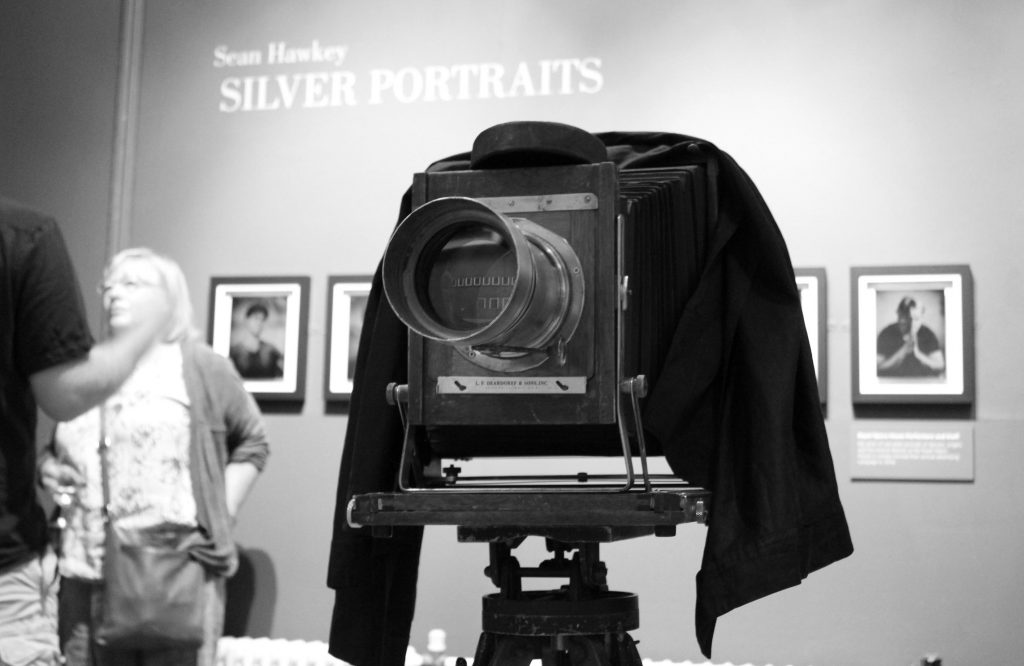
Hawkey uses a field view camera made of wooden bellows and the lens is one of the early British lenses from 1872, that presents some imperfections and aberrations. These defects make the final images unique as they give them a visual aesthetic that is not possible to reproduce with any sort of digital technology.

img_2976_photo_martina-bellotto

The use of old equipment is certainly an amazing way to obtain unique and captivating images. I can imagine the amazement of the Peruvian miners when they first saw Hawkey arriving with his heavy antique camera and lights. He also had to bring a mobile darkroom and laboratory as the wet plates have to be developed straight away before they dry. In Britain the development process has to be done within 10 minutes of taking the pictures but in the middle of the Andes Hawkey only had 90 seconds due to the temperature. A real challenge!

The silver used for the Peruvian portraits was the silver nitrate from Sotrami’s mines laboratory. Hawkey incorporated into his project not just the mine workers’ faces and stories, but also the product of their labors.

Each image in this series has a soul and deep eyes that seem to communicate the strength of these men who dig the earth for as little as one dollar a day, risking their lives in what is considered the world’s most dangerous industries. The miners prematurely-aged faces give us the sense of the quality of their lives. The exposure time of about 10-15 seconds heightens the intensity of their look.

“A ten second exposure records as much of a person as a ten second video. Although it’s a still, I think you can see that more is captured in the image. The results are typically soulful, intense, revealing portraits”. Sean Hawkey, 2016

The miners are not the only subjects in this series. One night in Peru some policemen knocked on Hawkey’s door – not for security issues as he believed, but to request a portraits of themselves!

From the series of portraits taken in Peru:

img_3033_photo_martina-bellotto

The latest work Hawkey has undertaken using the wet plate technique was a series of portraits of dancers, singers and musicians at the Royal Opera House in London. These portraits formed the RHO annual advertising campaign in 2016. The images evoke a deep exploration of the artists and show the soul and the passion for their creative work.

Images from the Royal Opera House series in Silver Portrait exhibition:

img_3175_photo_martina-bellotto

The three series of portraits “Local Faces”, “Peruvian Miners” and “Royal Opera House Performers and Staff” are exhibited in Hove Museum until the 15th of November 2016. Each one with its intensity, spirituality and drama.

Discover more about Sean Hawkey photographer in his website

Take a look at the Silver Portrait image gallery on our website

Silver portraits
Hove Museum, 8 September – 15 November 2016
Opening times:
Monday, Tuesday, Thursday, Friday and Saturday: 10am-5pm
Sunday: 2-5pm, Closed Wednesdays (except Bank Holidays)

Martina Bellotto, Hove Museum Assistant

A preview of Three Ways to 3D History

Digital 3D model of the Royal Pavilion Estate

This is a legacy story from an earlier version of our website. It may contain some formatting issues and broken links.

This Saturday (17 September) visitors to Brighton Museum will get a chance to see how 3D technology is changing the way we can understand history. As part of Brighton Digital Festival, Three Ways to 3D History will be an opportunity to see how virtual reality, 3D printing and 3D modelling can give us a fresh perspective on the past.

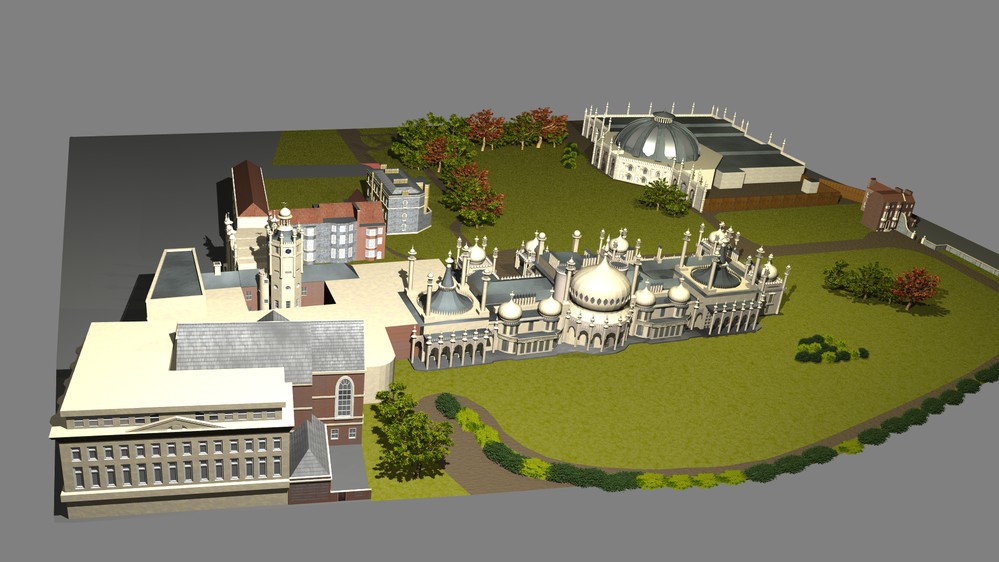
3D model of the Royal Pavilion Estate as it appeared in 1832. Colin Jones.

3D model of the Royal Pavilion Estate as it appeared in 1832. Colin Jones.


All our contributors are talented local people who have worked with the Royal Pavilion & Museums on previous and current projects.

Cultural Informatics Group

Part of the University of Brighton, the Cultural Informatics Group are working with us on several projects, ranging from looking at how 3D digitisation can support the use of archaeological collections in learning, to making scanned museum objects available online. Providing you have a compliant browser, the hand axe below is a nice example:

MOHARA

A local digital product studio, MOHARA will be showing how their Aura tool allows users to virtually explore the Royal Pavilion.

Now a sophisticated virtual reality authoring tool, Aura 360 has its roots in Murder in the Manor, a re-imagining of Preston Manor they developed back in 2013.

[iframe id=”https://www.youtube.com/embed/ICKjr3O8gn8″ align=”center” maxwidth=”800″]


Colin Jones

3D modeller Colin Jones approached us last year with a model of the Royal Pavilion he had created with Lightwave.

Since then, Colin has been working with our curators and conservators on the Royal Pavilion Time Machine, a series of 3D models showing how the Royal Pavilion Estate has developed over the years.

Meet, greet and tell us what you think

Three Ways to 3D History will be an opportunity to see this work in action and, more importantly, to talk to the people involved. I’ll be on hand too, and while I’m happy to talk about how I see 3D technology supporting our work, I’m much more interested in what you think!

One of the most exciting but challenging aspects of 3D is that there are so many different ways of bringing that third dimension to the telling of history. My job is to work out what techniques work best for people and where. As such It’s enormously helpful for me to get a sense of how people respond to 3D, whether they are keen technophiles or just casually curious.

So do join us in Brighton Museum on 17 September 11am-3pm. If you’re bringing children, they may also enjoy the Remix the Museum animation workshop upstairs in the museum from 10am-4pm.

Kevin Bacon, Digital Development Officer

Fashion Cities Africa: a Digital Ambassador’s view

Fashion Cities Africa exhibition

This is a legacy story from an earlier version of our website. It may contain some formatting issues and broken links.

Following Curator Jody East’s post last week about our Digital Ambassador’s programme for Fashion Cities Africa, Victoria Rodrigues O’Donnell has written about her experience working on the project.

This post was originally published on Victoria’s own blog at http://victorydoll.blogspot.co.uk/ but we’ve reproduced it here as part of our online archive for the exhibition. It was originally written as a two separate posts, but we have combined them here to give a sense of Victoria’s journey through the project.

Part One

A lot of work I’ve been undertaking at university has consisted of analysing museum practices, temporary exhibitions vs. permanent gallery arrangements and the various logistics of curating in general. Indeed, that’s meant a lot of reading, observing and considering how I would do things differently.

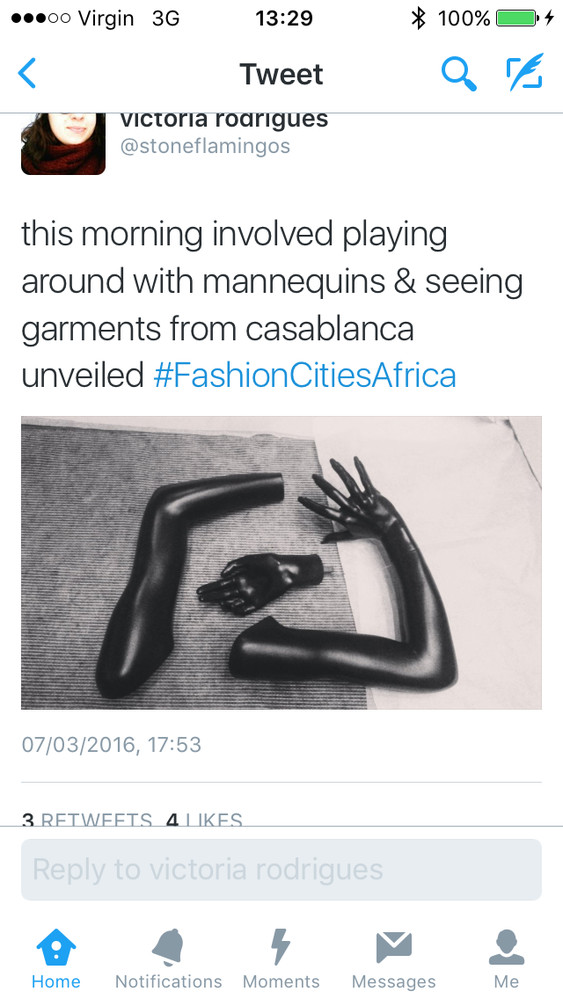
Screen grab from Victoria Rodrigues O'Donnell's Twitter post. Shows mannequin arms.Sitting from an armchair can often make you feel detached from what’s really going on in the art world (something which has arguably been changing with sites like Artsy and art:i:curate providing users/collectors with online platforms to curate artworks themselves), so it’s been a great pleasure to take part in the preparations towards the forthcoming exhibition, Fashion Cities Africa, at Brighton Museum & Art Gallery.

The exhibition is the first of its kind to be shown in the UK and being open from 30 April 2016 till 8 January 2017 will allow as many people as possible to catch a glimpse of what the four cities featured have to offer on a national and international level. Focusing on contemporary fashion from Casablanca, Nairobi, Lagos and Johannesburg, the displays will take visitors across the continent as they navigate through the three temporary exhibition rooms. From Moroccan couture to Kenyan street style, each compass point represented in the project has its own voice and defining characteristics. It’s with this in mind that, one of its co-curators Helen Mears, says “the exhibition aims to provide a snapshot of these cities and an introduction to some of the stories behind the style.”

Comprised entirely of loans and commissions, the displays will present a whole host of garments, accessories and images that illustrate different elements of contemporary design across Africa. This ranges from politically motivated pieces by The Sartists to Zhor Raïs’ reinvention of the caftan and the international success of Amaka Osakwe’s work.

You may be wondering where exactly I fit into all this? As a digital ambassador for the project, I’ve been sharing images and behind-the-scenes access across social media to help promote it. Being invited to see the installation process, meet the members of staff who’ve been involved in years worth of planning and inspect pieces up close has been fascinating.

View of entrance of Fashion Cities Africa exhibition.


Part Two

Screen grab of Instagram post showing African textilesAs if it wasn’t already great being given the opportunity to assist in the exhibition’s promotion, my university tutors coincidentally organised a visit to Brighton Museum for a class. I do love it when worlds happen to collide, and although they are more similar than not, it was so very convenient in helping me extract information about exhibition planning for both my own studies alongside social media.

The Museum’s Keeper of World Art, Helen Mears, has co-curated the exhibition with Martin Pel, Curator of Fashion & Textiles. Below are some thoughts and comments (collated into particular themes) I took away following a talk with the pair.

National vs. International

I established in my last blog post, that the exhibition focuses on contemporary fashion design from four major cities across the African continent: Casablanca, Nairobi, Lagos and Johannesburg. The curating has been done in a way to avoid sweeping statements / generalisations about each city. In order to achieve this with greater authority, Martin and Helen have used individual voices at the heart of each city’s display.

Specialists were brought in early on, including ‘fashion agents’ – bloggers, stylists, journalists etc., to collect and analyse particular examples of ‘New African Fashion’. Having written a book with this exact title, Helen Jennings has been working in conjunction with journalist and author Hannah Azieb Pool and Martin and Helen, to visit each city and help identify whose designs were worth exhibiting.

A key feature of the exhibition is how it seeks to present African designers who are interested in thinking globally. Having national presence as well as international visibility places them in the same league as those working in heavyweights of London, Paris, Milan or New York. One of the issues of wanting to express this vocality and strong sense of identity is negotiating their wishes with the logistics of curating. Creating a narrative, justifying the length of a loan and agreeing on its presentation with the designer proved just as difficult as deciding where to position lighting.

Audiences

Consideration of audiences was a key factor from the project’s inception – particularly engaging with African diaspora communities. Will as many visitors travel to Brighton to see the UK’s first major exhibition about African fashion as they would if it were being shown in London? I certainly think they should, as the capital’s art scene is not reflective of what can be found in other cities and towns across the country.

The museum’s collection already had a significant amount of eminent African textiles, forming a clear link with the exhibition. From couture to street style, the pieces on show can connect with anyone and everyone. Not only is it on display till January 2017, but a huge events programme has been organised to engage with visitors and locals alike. Nairobi-based pair, 2ManySiblings, was a definite highlight for those aged 14-25. Their playful and vibrant style is certain to have an influence on those who feel disheartened with their wardrobes and/or Instagram feeds.

Curating African Fashion Histories:

A collecting panel was in force right from the very beginning, so that decision making could be discussed and shared out before any acquisitions were made – especially as their wider project Fashioning Africa, intends on expanding the museum’s collection of African fashion to one that will cover 1960-2000. This will allow the museum to address the evolution of particular styles in relation to the independence of many African countries during the 1960s and Britain’s colonial past with them.

Considering how to source different material objects that could reflect trends in hair, beauty, clothing and accessories was no easy task and being wary of lumping every sartorial item under Pan-Africanism has constantly been at the forefront of their objectives. Particularly when stereotypes of African dress feature head wraps and wax prints, which are aspects of fashion that many current designers don’t use in their work. Awareness of cultural politics and representation does mean that a lot of the displays undoubtedly reflect on much bigger issues. An international conference, Creating African Fashion Histories, will take place in November to “discuss current and past narratives in African fashion”.

Whilst Helen approaches the pieces with a more ethnographic concern, Martin emphasises how they are also presenting a fashion show, which should have just as much entertainment quality as catwalk displays – after all, people are coming to see objects which must be visually enticing. By having the mannequins arranged upon staging, the exhibit not only embodies the dynamism of a real-life fashion show, but it allows visitors to look up at the garments and notice various little details.

Mannequins on display in Fashion Cities Africa exhibiton.

Alongside staging, other formats of display have been employed, such as huge columns with information about the cities on each of the four sides, blown-up images to complement the clothing, a screen showing a film (an element that has been paralleled on social media) and a corner which calls to question the debate over wax print.

Music from all four cities has been compiled into a playlist by local music producers, Guy Morley of No-Nation and Ebou Touray of African Night Fever. While this manages to engage with a host of partners (several club nights across Brighton play contemporary African music), it also enriches the experience and shows how multifaceted each city’s cultural scene is.

Being a Digital Ambassador is a brilliant opportunity for young people to get involved with exhibition planning and promotion, and also to learn more about the objects on show and their significance.

Victoria Rodrigues O’Donnell, Digital Ambassador for Fashion Cities Africa exhibition

http://victorydoll.blogspot.co.uk/

@stoneflamingos
Digital Ambassadors for Fashion Cities Africa

Tweet from Victoria

This is a legacy story from an earlier version of our website. It may contain some formatting issues and broken links.

I was a teenager once. Although it feels like a long time ago. It was definitely before mobile phones, Facebook and emojis. And I remember having to use books for school research rather than the internet. In reality it was less than 20 years ago but a lot of things have moved on since then and although I have tried to move along with them (I have a mobile phone, Facebook account and occasionally use 🙂 ), I am definitely seen as a grown up by most young people under 25.

IMG_0045So when we were putting together a proposal for the exhibition, Fashion Cities Africa, and we knew we wanted a good proportion of the audience to be 25 or under, I thought we might need to recruit some help.

We were working with PR company Ariatu and media partner Nataal, both of whom encouraged us to become more active on social media to help spread word about the exhibition. I started thinking about how I could combine the skills of young avid social media users with some of the amazing colourful, interesting content coming out of the development of the exhibition…..

Discussions with Royal Pavilion & Museums’ Digital Development Manager made me realize we were thinking along the same lines – let’s try and encourage conversations online, rather than simply giving information. A presentation organized by Culture 24, by 16 and 17 year olds from the Brit School, Croydon, emphasized the point that they are more likely to listen to recommendations or opinions of their friends than a faceless voice online. This seems obvious but how to make yourself known to that age group in the first place?

Three months before Fashion Cities Africa was due to open, we decided to recruit a team of Digital Ambassadors:  a group of young people, aged 16-25, with their own active social media accounts and a strong interest in fashion. I approached Brighton Fashion Week who contacted their database of volunteers on our behalf and ten young people said they would love to be involved. In return for their time, we offered them exclusive behind the scenes access to the exhibition installation, interviews with curators and designers, a training day with professional Instagram artist 5ftinf and Ariatu PR, invitations to the press launch and private view, and copies of the accompanying catalogue.

We had no agenda or control as to what they wrote on their social media accounts about the museum or exhibition. My role was to facilitate their access to content, which they could then do with what they chose. We were genuinely interested in their responses, good or bad.

I gave them a list of dates every few weeks where they could come in and see what was happening, take photos, meet people connected with the exhibition, and also said that if anything particularly took their interest then we could look at it in more depth. One of the participants said she was really interested in textiles so she accompanied the exhibition curator Helen Mears to a London market to buy fabrics for the exhibition.

Despite a broad interest in fashion it was really interesting to see the different approaches they all took and the different elements of it they found interesting. Molly and Hermione were really interested in the different fabrics and textiles in the exhibition. Victoria and Emma focused on how exhibitions are put together and meeting the designers and curators. Keilah took slightly quirky photos and created instavideos of the mannequins.

Victoria Rodrigues O_Donnell twitter 2Molly Raymer

There were nerves on both sides to start with. The Digital Ambassadors were all slightly hesitant that they were really allowed to take photos behind the scenes and ask questions to the curators who were installing. We were also nervous about giving access to the exhibition before it opened, so as not to reveal too much too early.

But I was keen not to edit the Digital Ambassador photos or posts. I asked them to be mindful not to give too much away until the opening and they respected that and produced some enticing, tantalising posts.

The Digital Ambassadors aren’t just ‘ones to watch’ for the future of blogging/Instagramming/tweeting; they are at the forefront of what is becoming a prominent means of communication and connecting with others. It’s impossible to tell whether social media posts by the Ambassadors translated into their friends or followers visiting the exhibition itself, other than word of mouth feedback. Has it impacted on the demographic of the audience engaging with the exhibition, whether online or in person? Does knowing this matter? It was a participatory experiment to try and discover how to make museum exhibitions and events excite someone under the age of 25 enough to talk about it to their friends. In the lead up to the opening, the exhibition and the role of Digital Ambassador held the interest of about six of the original ten participants. For whatever reason, not everyone made it to the opening night. But the six who came told their friends, who may even have told their friends…..it’s definitely a role we would like to explore further, with future exhibitions and different interest groups and even more Digital Ambassadors….watch this space.

Thanks to the Museums Association Transformers programme and Culture 24 for their support of this pilot project. Thanks also to Emma, Victoria, Ruby, Keilah and Molly for sharing their images with us.

Jody East, Creative Programming Curator


Shaping an image of China in the West: William Alexander (1767-1816)

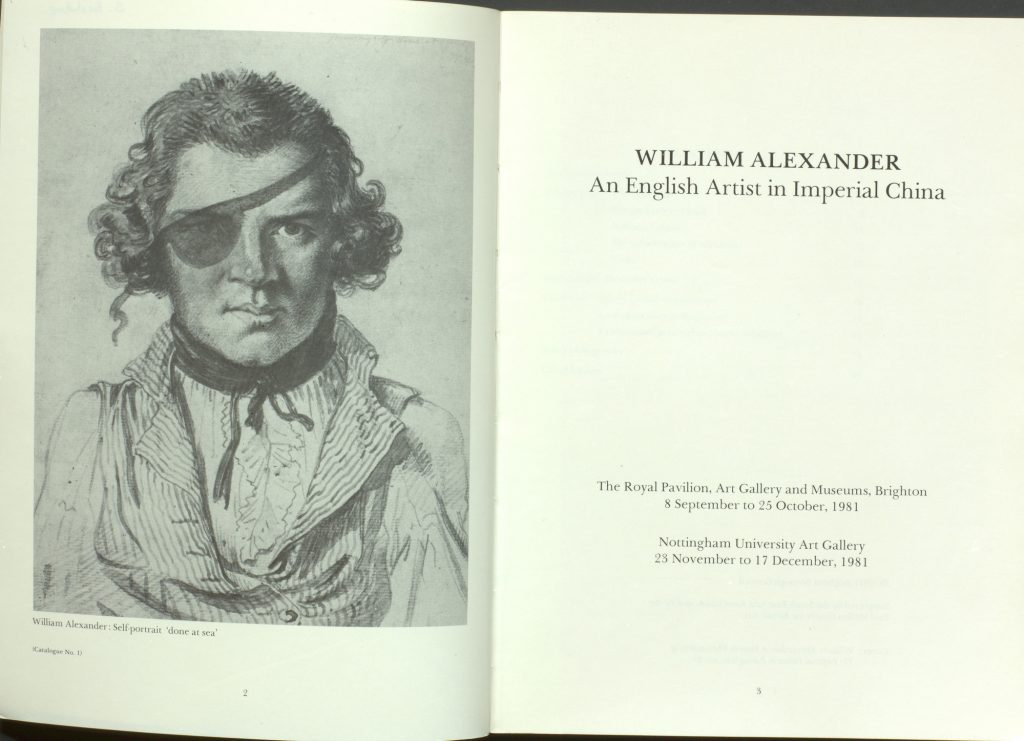
Title page of the exhibition catalogue ‘William Alexander – An English Artist in Imperial China’ (1981)

This is a legacy story from an earlier version of our website. It may contain some formatting issues and broken links.

The Chinese style of the Royal Pavilion’s interior owes much to one man who never even saw the building. Artist William Alexander produced many illustrations which shaped the vision of China that can be found in the Pavilion.

Towards the end of the 18th century the popularity of the Chinese style in interior decoration and architecture was waning. However, there was still a general fascination with China and other far away countries. This was made manifest by a number of new publications and images that became available shortly after 1794.

Alexander Peking Martyn Gregory

Watercolour of Peking (Beijing) by William Alexander, c1793. Private collection. Photograph@ Martyn Gregory Gallery, London.

William Alexander was born in Maidstone, Kent, in Southeast England, in 1767. He became a student at the Royal Academy in 1784. In 1792, at the age of just 25, he was given the opportunity of a lifetime: he was chosen to accompany Lord Macartney’s embassy to China as a junior draughtsman. Very few of his works dating from before this journey are known, so it is likely that this was Alexander’s first proper commission. It is thought that he was recommended by his teacher Julius Caesar Ibbetson, who declined to join the embassy, having returned recently from an earlier, abandoned embassy. The commission would define his career as an artist and there is no doubt that he realised its commercial potential. Perhaps luckily for him, the official artist appointed to the embassy, the portrait painter Thomas Hickey, appears to have produced next to no work on the journey, giving Alexander an opportunity to shine.

'The reception of the diplomatique and his suite, at the Court of Pekin' by James Gillray, published by Hannah Humphrey hand-coloured etching, published 14 September 1792 NPG D12463 © National Portrait Gallery, London

‘The reception of the diplomatique and his suite, at the Court of Pekin’
by James Gillray, published by Hannah Humphrey
hand-coloured etching, published 14 September 1792
NPG D12463
© National Portrait Gallery, London

The aim of the Macartney embassy was to negotiate fairer and better trading conditions in China for the British. Although carefully planned, it turned out to be a diplomatic failure, with the embassy hurriedly leaving Beijing months before they had planned to depart. The failure of the embassy was mercilessly caricatured by James Gillray. However, the images of China that Alexander produced on the two year journey were a new, reliable and exciting glimpse into Chinese life, art, landscape, architecture and customs. Like no artist before, Alexander shaped the West’s image of this far away country.

Nearly 30 years later another British artist, George Chinnery, would feed the West large numbers of images of China, but, unlike Alexander, he never visited Beijing. Some contemporaries of Alexander had visited China, for example John Webber and Thomas and William Daniell, but none of them were able to venture far inland, as Westerners working for the East India companies were restricted to certain trading ports and times outside the city gates of Canton.

3a.map of embassy's route

Map showing the Embassy’s route through China.

Despite gaining unprecedented access to inland China, there were also some disappointments for Alexander. He was not allowed to join the ambassador’s party on their trip to Jehol, north of Beijing, to meet the Emperor. Instead, he was confined to a building in Beijing, surrounded by high walls, without permission to move around freely in the city. However, he did produce drawings of Macartney’s group meeting the Emperor at Jehol, using a combination of eyewitness reports and other artists’ images. He also missed out on a long journey overland from Hangchow to Canton, having been told to continue the journey via the sea route.

Alexander made over two thousand sketches of China during the journey. Typically he worked up rough but well-observed initial pencil sketches into finished watercolours, often in multiple copies. Some of these were exhibited at the Royal Academy after his return. In a number of them he depicts himself, a tiny figure sketching away, often sitting in a boat or on a hill, assessing the scenery.

Alexander sketching det

Detail of one of Alexander’s watercolours, showing him sketching. Photograph: Martyn Gregory Gallery, London.

Many of his images were also reproduced as prints and used as illustrations in books about China, thus reaching a wide audience. His images were used in the first official account of the embassy, written by George Staunton, secretary to the embassy, and published in 1797 (Authentic Account of an Embassy from the King of Great Britain to the Emperor of China). But Alexander also published a number of his own books, mostly illustrated descriptive volumes documenting Chinese costume and scenes, featuring full-page hand-coloured engravings after his drawings. Of these, the most impressive is The Costume of China, a series of 48 aquatints etched by Alexander himself, with commentary, published by William Miller in 1805, with some plates dated as early as 1797. The plates show individual figures, figure groups and architectural structures. A later (1814) similar publication of his Chinese images was cheaper and not of the same quality, but proved popular and was even translated into French.

W Alexander China Pagoda image

‘Pagoda’, illustration from Alexander’s book The Costume of China (1805)

W Alexander China woman image

‘A Chinese Lady and her son’, illustration from Alexander’s book The Costume of China (1805)

Alexander’s pictures not only appealed to readers with a general interest in exotic countries, but they also influenced the decorative arts. From at least 1815 onward Frederick Crace, one of the interior decorators of the Royal Pavilion in Brighton, used Alexander’s images as inspiration for a number of decorations in the palace. The walls of the Music Room, for example, show many architectural structures lifted from The Costume of China and Staunton’s account of the embassy. One of the figures from The Costume of China, a colourful Chinese Comedian, can be seen on the large chandelier in the Music Room as well as on the landing of the North Staircase. We also have the original watercolour of the Comedian in our collection, but this is not currently on display.

Alexander Comedian and staircase

‘A Chinese Comedian’, illustration from Alexander’s book The Costume of China (1805) and the corresponding painted glass pane on the South Staircase landing in the Royal Pavilion


Colour. Royal Pavilion Collection, Brighton

‘A Chinese scene’, illustration from Alexander’s book The Costume of China (1805)

Colour. Royal Pavilion Collection, Brighton

Detail from a south wall panel in the Music Room, inspired by Alexander’s images, c.1817 – 1822

In 1981 Patrick Conner and Susan Legouix Sloman curated an exhibition on William Alexander at Brighton Museum, the catalogue of which remains one of the few publications on Alexander.

imperial_china0004

Title page of the exhibition catalogue ‘William Alexander – An English Artist in Imperial China’ (1981)

After his return from China, Alexander worked for several years as a teacher of landscape drawing, before securing a post as assistant librarian and first keeper of prints and drawings at the British Museum in 1808. It appears that he was much respected among his colleagues and in the art world. Although he continued drawing he remained best known for his carefully executed images of China. He died suddenly in 1816 of a brain disease at the age of only 49, and is buried in Boxley near Maidstone, his hometown.

Today Alexander is a relatively obscure artist, perhaps because his work is associated mostly with print culture, but his images of China are well known, and his works are in private and public collections all over the world. An 80 page diary he kept during his journey to China survives at the British Library but has not yet been published in its entirety.

Alexandra Loske, Curator, Royal Pavilion Archives

Alexandra will give a talk about William Alexander on 1 September 2016 at 12:00 pm, at which she will show a copy of The Costume of China. Location: Music Room, Royal Pavilion. Free with admission. For more information go to http://brightonmuseums.org.uk/discover/events/event/pavilion-tales-2/

Experimental Collective

Museum Collective’s latest project.

This is a legacy story from an earlier version of our website. It may contain some formatting issues and broken links.

What do you get when you give a group of young people some iPads, a selection of objects and the freedom to make whatever they want?

A masterpiece, that’s what.

That’s pretty much what happened with the Museum Collective’s latest project. After watching some experimental films and discussing some of the artists who would be included in an upcoming exhibition, we were given the chance to make our own experimental pieces. Over the course of around 5 sessions, we explored a number of different techniques that are used in film making such as using projections and creating montages.

One of my favourite sessions was working with stop-motion animation. Working in pairs, we used the iPads and whatever we could find in the art room to have a go at making our own short movies. We only had about an hour and a half, but we all came up with very different ideas. The piece that Dan and I worked on involved using cookies and goggley eyes to tell a story. I hadn’t realised how long animation takes since each movement requires a new frame, but seeing all of the hard work come together was definitely worth it.

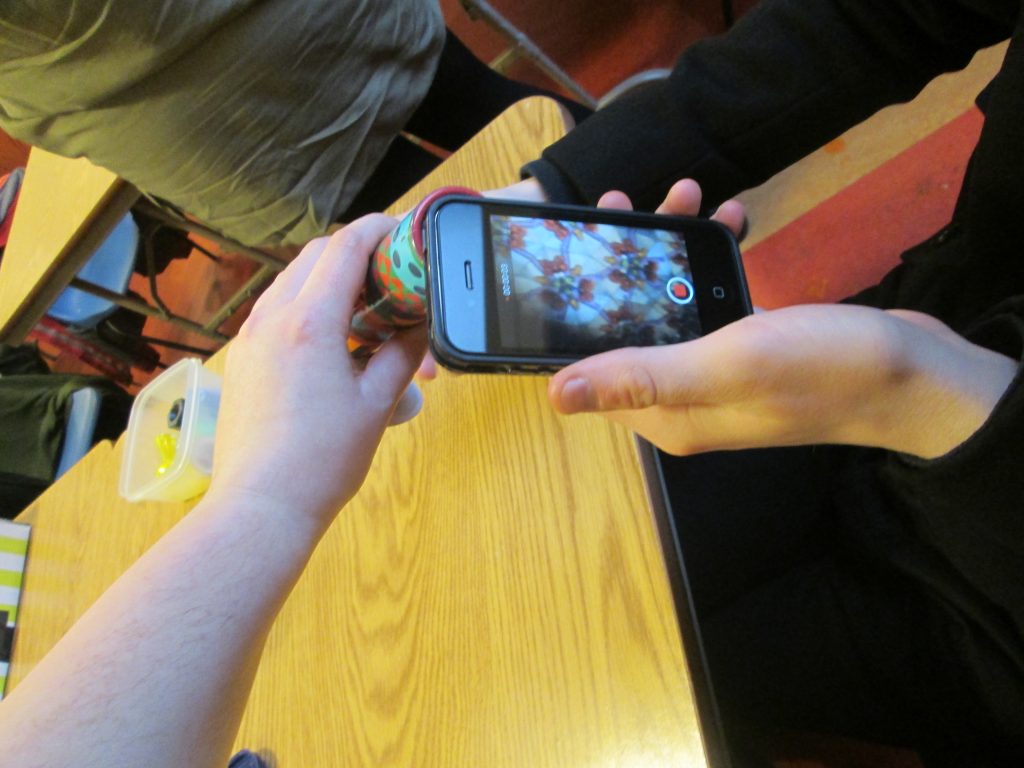
In another session, we used toys to create optical illusions. It was exciting as we were in the museum lab and had access to different parts of the collection including a range of masks and a replica skeleton. I was fascinated by the bugs because they were safely encased in plastic so I could see all of their detail. Usually, I’m running away from insects, but this time, not only was I holding them, but I was filming them too.

We used some toy lenses that created optical effects when you looked through them to give a different way of looking at things. They were really fun to play with but a little tricky to actually film through. It was a case of trial and error to see what worked, but it meant that we were really engaging with our creative side.

I hadn’t realised how easy it was to make experimental films. We were only using basic editing apps and iPads or phones, but the possibilities for what we could have made felt endless. In just a few short hours, each session we would discuss a technique before trying it out – it really was that simple. All it took was a bit of imagination and a willingness to try things out, and we created our own experimental pieces for the world to see.

Why don’t you give it a go and see what you can come up with?

Charlie, member of the Museum Collective 

Introduction to Conservation at the Royal Pavilion & Museums

Andy Thackray, Objects Conservator

This is a legacy story from an earlier version of our website. It may contain some formatting issues and broken links.

It’s a great privilege to be part of the conservation team at the Royal Pavilion and we wanted to share a little of what we do with you.

The Conservation team includes specialists in Buildings, Objects, Gilding, Paper, Glass and Paintings Conservation, three Assistant Conservators and Conservation Technicians and as a department we are responsible for the preservation, conservation and restoration of the buildings and collections, ensuring that they are safeguarded for present and future generations.

The Royal Pavilion and Museums consist of five different sites with a broad range of collections in each. These are the Booth Museum of Natural History, Preston Manor, Hove Museum, Brighton Museum and the Royal Pavilion.

The work we undertake is varied and interesting and it’s a pleasure to work in such inspiring surroundings.

Anne Sowden – Decorative Artist and Glass Conservator

Anne Sowden at work in the Saloon

Anne Sowden at work in the Saloon

I am Anne Sowden and I have worked in the department as Decorative Artist and Glass Conservator for 30 years.

After completing a degree course in Fine Art (Painting), I worked in museums and trained in conservation. I then worked in the ceramics industry as a designer dealing with both the creative and technical sides of the process.

My role here involves the conservation, restoration and recreation of decorative schemes. I also look after the chandeliers and lanterns in the Royal Pavilion. All of this can only be undertaken after careful research.

At present, I am working on the Saloon restoration project. I have designed the carpet, based on a fragment of the original Saloon carpet and on documentary and visual evidence. I am now recreating the hand painted wall decoration. A rigorous study and analysis of the original fragments of the 1822 Robert Jones scheme have informed the work.

Andy Thackray – Objects Conservator

Andy Thackray, Objects Conservator

Andy Thackray, Objects Conservator

I’m responsible for the conservation of 3D objects from the RPM collections. With such broad and eclectic collections, this means I get to work with a wide range of objects and materials. Objects can range from taxidermy from the Booth Museum, to furniture from the Royal Pavilion, silver giltware from the Decorative Arts Collection, historic toys from Hove Museum or mummified animal remains from the Egypt Collection. My work is generally driven by major redisplay projects, exhibitions work, and preventive conservation priorities.

I am also responsible for managing the Assistant Conservators and Collections Care team who carry out vital preventive conservation work to keep the collections in the best condition possible for future generations to enjoy.

Amy Junker Heslip – Paper Conservator

Paper Conservation in progress

Paper Conservation in progress

As the paper conservator at Royal Pavilion & Museums I am responsible for looking after all works on paper in the collection. This can vary from archive material, photographs, historic wallpaper, prints, drawings, pastels and more!

My days are varied and can involve tasks such as small repairs in situ of wallpaper that may have been damaged around the Pavilion or getting works ready for in house exhibitions or external loans — I’m currently working on loans to Tunbridge Wells, Paris and New York. My days are also spent working on my rolling programme of rehousing and conserving works in the collection which is curator led. I might also be carrying out handling training for in house staff and volunteers, giving a Bite-sized Talk in the museum or working with the rest of the conservation team on a large project. At the moment the Saloon project is keeping everyone busy but I suspect another of the team will write more about that in their blog.

In short, it’s a busy, wonderful place to work. I come across some fantastic and fascinating objects and get to work pretty closely with them. I look forward to sharing more about that with you soon.

Hannah Young – Assistant Conservator

Hannah Young at work

Hannah Young at work

I’m an Assistant Conservator at the Royal Pavilion & Museums, concentrating on the remedial conservation of objects.

I am lucky enough to work on a broad variety of objects and different materials from the collections which spread over the five museums.

My material specialism is in metalwork conservation, of which there are many objects to keep me busy, but I also work on other objects ranging from toys and furniture to the repair of taxidermy birds and animals, which is a new interest for me.

I am currently assisting in our main conservation project which involves the restoration of the Saloon, one of the principle rooms in the Pavilion. Through this I am learning to water gild under the instruction of the Pavilion’s Gilding Conservator.

Hannah Young, Assistant Conservator

‘Hope Welcomes All Who Enter Here’: the Royal Pavilion’s workshop for First World War amputees

This is a legacy story from an earlier version of our website. It may contain some formatting issues and broken links.

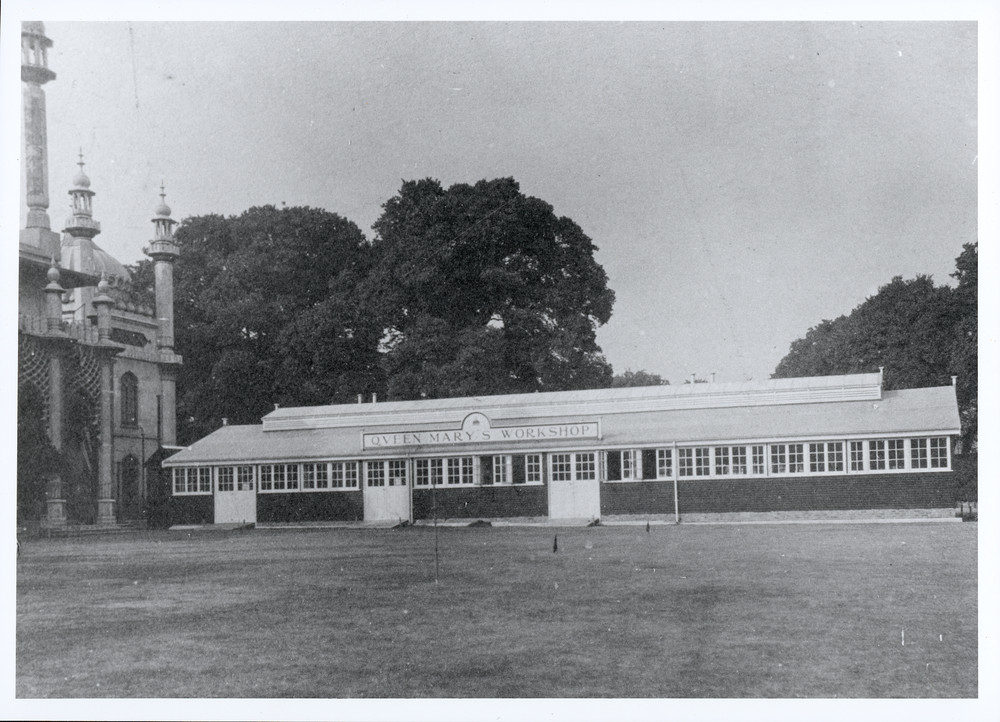
The 7th July 2016 marked the centenary Queen Mary’s Workshop on the East Lawn in the Royal Pavilion Garden. During the years 1916 to 1920, the Royal Pavilion was transformed into the Pavilion Military Hospital for Limbless soldiers, which included a workshop to provide classes for amputees to learn new skills and prepare for work in civilian life.

Over the workshop ran the motto ‘Hope Welcomes All Who Enter Here’, which is said to have been chosen by Queen Mary herself. It was a literary reference to the words over the gate to Hell in Dante’s L’Inferno, ‘Abandon Hope All Who Enter Here.’ These men had already experienced the Hell of trench warfare and now were encouraged to look towards the future with hope.

Queen Mary's Workshop on the East Lawn of the Royal Pavilion

Queen Mary’s Workshop on the East Lawn of the Royal Pavilion

Before the First World War, disabled veterans depended on the goodwill of charities, but with increasing numbers of amputees returning from the battlefields the government took action to prepare the men for civilian life. The workshop was the first step to help amputees find jobs if they were no longer able to return to their previous work. Here they could retrain in a number of trades, such as typing, carpentry, motor mechanics, shoe repair and cinema projection operating.

There is rarely a mention of Queen Mary’s workshop without reference to its Superintendent, Mr A G Baker. He stated that his aim was to give ‘a higher form of education than they had previously had’ as many soldiers will have left school by the age of 12 and only been trained for manual work.

Although only in his forties, Mr Baker had retired from business at the beginning of the war to offer his skills to the war effort. He is described as bringing ‘kindness, tact and devotion’ to his work, and as being highly respected by all.

Superintendent of Queen Mary's Workshop, Mr A G Baker The Pavilion "Blues", November 1916

Superintendent of Queen Mary’s Workshop, Mr A G Baker The Pavilion “Blues”, November 1916

Each new patient would be visited by Mr Baker soon after their arrival and assessed as to whether he would be able to continue his previous job in civilian life. If he needed to be retrained, he would then be encouraged to sign up for 18 to 22 hours of classes a week to fit around his medical treatment.

Students learning typing skills at Queen Mary's Workshop. The Pavilion "Blues", December 1916

Students learning typing skills at Queen Mary’s Workshop.
The Pavilion “Blues”, December 1916

As well as preparing the men for work, classes also kept the men occupied during long periods of treatment at the hospital. Mr Baker was concerned that the men could become institutionalised and writes:  ‘Card playing is the most formidable hindrance; once a man has got into a group of gamblers, he can only be got out of it by fatherly kindness and firmness.’ (Reveille No 1 August 1918)

In addition, a Red Cross report refers to the work done at Brighton as and comments that classes also helped the men to exercise their limbs and speed up healing (The Development in England of a State System for the Care of the Disabled Soldier John Culbert Faries, PhD). Indeed, it is referred to as an early form of occupational therapy. 

The Mechanics class at Queen Mary's Workshop The Pavilion "Blues", December 1916

The Mechanics class at Queen Mary’s Workshop The Pavilion “Blues”, December 1916

The workshop opened without ceremony, so that classes could start as soon as possible and the formal opening by Lady Falmouth took place a month later on 9th August 1916. Queen Mary herself did not visit for two more years, but when she did, her visit was filmed by British Pathe News. This can be viewed at the exhibition Pavilion Blues: Disability & Identity

A stall celebrating the work carried out at Queen Mary's Workshop in honour of her visit on 9th August 1918. The Pavilion "Blues" September 1918

A stall celebrating the work carried out at Queen Mary’s Workshop in honour of her visit on 9th August 1918. The Pavilion “Blues” September 1918

When the men returned to civilian life, further formal training was offered at technical colleges in addition to the war pension. However, the reality of the post war years meant that jobs were scarce and only about 90% of amputees were able to find work in the early days after the war. They formed Limbless Associations to offer each other support, which eventually combined to create the British Limbless Ex-Servicemen’s Association (BLESMA).

The efforts of Mr Baker and his staff were not forgotten as their work here at the Pavilion Military Hospital, as well as at Queen Mary’s, Roehampton, became the model for the Ministry of Pensions’ training scheme for veterans.

There is a postscript to this story as the workshop was moved to Hollingbury Golf Course where it served as the clubhouse for many years until it was finally demolished.

Jo Palache, Oral History and Life History Researcher

More about the Pavilion Military Hospital can be learnt in the exhibition Pavilion Blues: Disability & Identity and The Royal Pavilion as a Hospital for Limbless SoldiersAll editions of The Pavilion “Blues” magazine are available to be downloaded from the Royal Pavilion & Museums Image Store, free of charge.

Fabula – Artists in residence

Fabula – Artists in residence

This is a legacy story from an earlier version of our website. It may contain some formatting issues and broken links.

Have you heard the expression ‘lupus in fabula’? It means ‘the wolf in the tale’. Well, at Hove Museum we have ‘museum in fabula’ – we are putting the museum in the tale! What do we mean? We have the Fabula Collective as artists in residence at Hove Museum.

IMG_2464_photo Martina Bellotto

We have invited Fabula Art Collective to use our space for inspiration, new readings and interpretations of the collections. The residency runs for five months and will culminate in the exhibition ‘Many ways to tell a story’ (December 2016 – March 2017).

A museum is a non-profit, permanent institution in the service of society and its development, open to the public, which acquires, conserves, researches, communicates and exhibits the tangible and intangible heritage of humanity and its environment for the purposes of education, study and enjoyment.

ICOM (International Council of Museums), Vienna, 2007.

Museums are not just about the pure observation of inanimate works of art; museums are interactive and dynamic because they are made of people. The definition of museums is constantly evolving, in line with developments in society. I love this evolution and I like to see that museums are not just static institutions that hold collections or are touristic attractions. Museums are nowadays playing a powerful role with communities and can offer a wide variety of benefits: they are active spaces for connection and meeting, for learning and sharing, for meditation and conversation. They can be a space for growing through reflection and action, observation and dialogue.

And this is exactly the purpose of Hove Museum’s artists in residence programme: make the museum a working space, open to research, questions and answers.

IMG_2472_photo Martina Bellotto

Fabula is a multi-disciplinary, Brighton based collective which formed in 2014. The group originated among students from the MA Sequential Design/Illustration and the MA Arts and Design by Independent Project courses at the University of Brighton. The group is made up of 21 local and international artists coming from a variety of backgrounds and disciplines including illustration, moving image, writing, narrative textiles, art therapy, fine art, and graphic desig,n and are connected by a desire to tell stories through images, objects and text.

Fabula are working on personal research in response to the collections of Hove Museum but also on a collaborative project inspired by fairy stories and the museum’s artworks. Every other Monday starting on 4 July and running until the exhibition opens in December, they are ‘invading’ the galleries and the workshop space.

I was lucky to see them in action last Monday: some of them were sketching in the Toy Gallery and in the Contemporary Craft Gallery and others were focused on developing personal research in the education room.

IMG_2481_photo Martina Bellotto

IMG_2491_photo Martina Bellotto

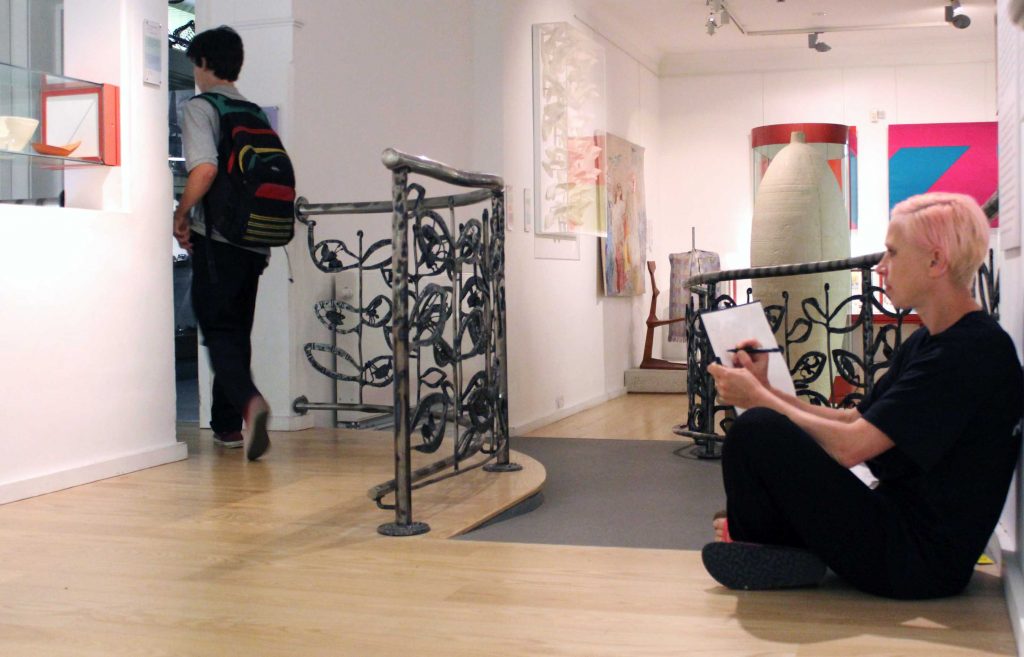
We are really exited to have them around concentrating on their work but at the same time open to engage with the public who have the opportunity to interact with them. The artists are easy to recognize – they are the ones with the sketchbooks and black t-shirts with a question mark. We encourage our visitors to take advantage of their presence and stop to chat with them. Ask them about their project and find out more about their art.

The exhibition in which the residency will culminate will be a fantastic opportunity to discover the museum from a different perspective, to look at it with the eyes of the artists who have turned the museum collections into magic stories. This will include a rich programme of activities open to a wide range of audiences. For children and families there will be storytelling (including mysterious ghost stories inspired by the museum’s collections) and practical making workshops. Fabula are also planning a series of adult story making workshops and a day seminar on illustration. All workshops will be led by members of the collective themselves, with input from guest specialists. There will be something for everybody’s taste, so keep up to date and follow this work in progress through our website and social networks.

You can also follow the Fabula blog for a weekly update.

You can meet the artists in residence next Monday August, then every second week following. Entry at Hove Museum is free so just come along, discover our collections and exhibitions, and get to know the individual and collective stories held by our museum. Museums are not It, museums are Us. 

Martina Bellotto, Hove Museum Assistant

More information