Story Category: Legacy

The ‘Gipsy’ Fortune Teller Machine in Brighton Museum

This is a legacy story from an earlier version of our website. It may contain some formatting issues and broken links.

In this guest post, University of Brighton student Olivia Terry discusses a clairvoyant exhibit in Brighton Museum, and how it records the history of the English seaside resort.

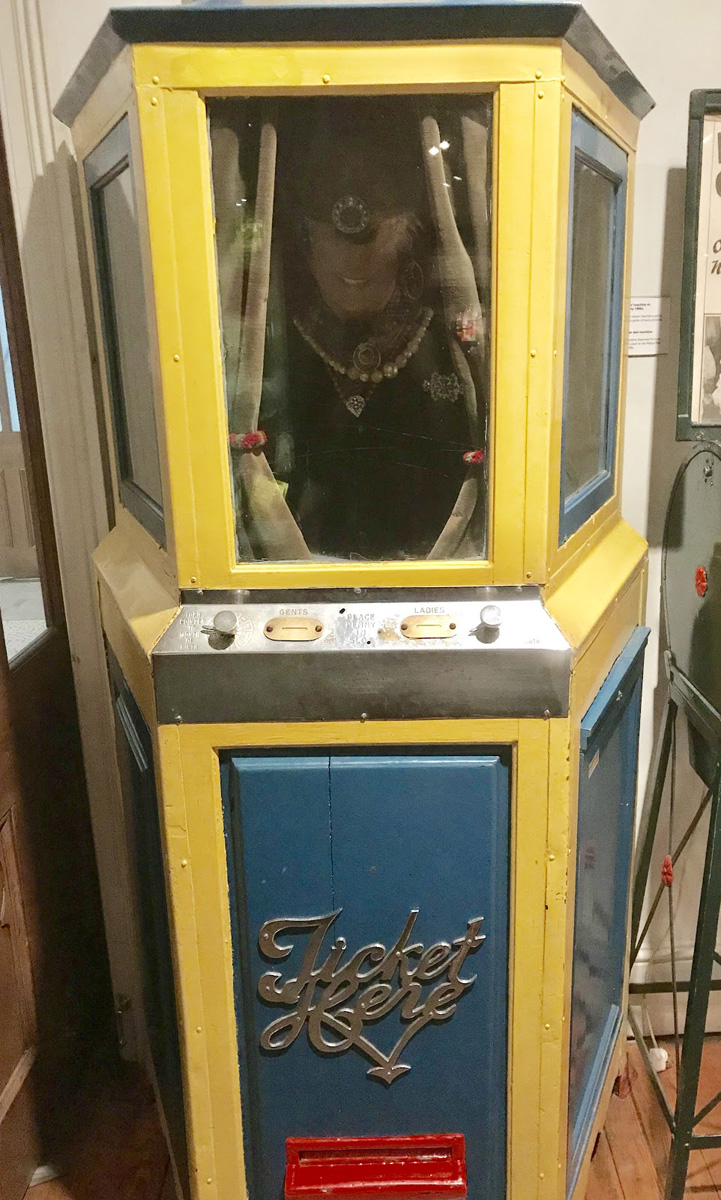
Photo of a blue and yellow fortune telling machine, with seated mannequin of a 'gipsy' behind glass.Tucked behind the entrance door of the Images of Brighton Gallery in Brighton Museum is a fortune-teller machine. The nearby caption titles this exhibit as “The Gipsy Fortune-Teller Slot Machine” which once resided on the Palace Pier and dates from the early 1930s. Trapped in a tall yellow and blue box is a one-eyed woman, decked out in gaudy jewelry seemingly busy writing fortunes with a quill. On the outside, the fortune-teller invites her audience to place a penny in the appropriate gender slot, and there are knobs that can be adjusted to select the viewer’s birth month. Towards the base of the box, a fortune was supposed to shoot out of a red aperture with golden cursive writing stating “tickets here” above it.

Machines like this were once a big part of the British seaside resort holiday culture. People would come from all over to take part in the fun that was seaside amusement parks and indulge in the thrills it had to offer. However, during the 1950s, amusement parks reached their peak in popularity when people started finding newer ways to entertain themselves such as visiting cinemas, concert halls and live shows, and the massive cost of the Second World War weighed heavily on the funding for amusement parks. Anya Chapman states ‘the decline in demand led to the closure of many attractions, tourist infrastructure and accommodation from the 1970s onwards,’ so novelty machines like the “Gipsy Fortune-Teller Slot Machine” would often become decrepit due to lack of upkeep.

Despite the near extinction of old amusement park games, there has been a rise in so-called ‘old penny’ arcades. These celebrate the nostalgia of antique slot machines similar to the Gipsy and now more than 20 reside in towns in Britain, the majority of them in seaside towns. Brighton has one fifty yards from Brighton Pier called “Mechanical Memories Museum”, and it contains machines ranging from the 1900s to the 1960s, including a fortune-teller, similar to this one in Brighton Museum.  It is through old arcade games that we may understand Brighton’s rich history of being a town known for its many amusements, fun, and cheap thrills.

Olivia Terry, student on BA (Hons) Fashion and Dress History, University of Brighton

Bibliography

Chapman, Anya, “ “The ‘Heritagisation’ of the British Seaside Resort: The Rise of the ‘Old Penny Arcade,’” Journal of Heritage Tourism (2011) : (n.p) Taylor and Francis Online. Web. 17 Oct 2018.

“Mechanical Memories Museum.” Steam Heritage, Steam Heritage Publishing Ltd. (n.d) Web. 17 Oct 2018. https://www.steamheritage.co.uk

Who was Patrick Burke? A look at the artist behind our new exhibition in Hove Museum

This is a legacy story from an earlier version of our website. It may contain some formatting issues and broken links.

Our new exhibition in Hove Museum is a retrospective of a local artist, Patrick Burke.

Thanks to Latest TV you can watch Andrew Polmear, a collector and friend of Burke, discussing the artist and the exhibition. Below, you can also find a short biography of the artist.

[arve url=”https://youtu.be/zCz4k6E5fIo” align=”center” maxwidth=”800″ /]

Biography

Black & white head shot of Patrick BurkePatrick Burke (1932-2010) was a Shoreham-born painter and writer who gained success in London, Rome and New York. The works from the height of his career are alive with colour, inspired by the time he spent in Italy.

Burke lived for the latter part of his life in Brunswick Square, Hove where he continued to paint images of Hove seafront and buildings. This display shows the range of his work including early etchings and sketches of Brighton life, paintings, sketchbooks, notebooks and diaries.

Burke started drawing as a child and continued all his life. He went to Varndean Grammar School for boys, now Varndean College.  After a move to Rome in 1957 he moved into pure abstraction and gained recognition in both Rome and New York.

By the sixties, he had moved to a figurative style influenced by Magritte and Mondrian which he later rejected saying: “I copied the style but didn’t understand the first thing about the purpose.”

He found his own style in the 1970’s combining both the abstract and figurative elements and continued working in this style for the next 25 years. The work was colourful and full of playful images as well as references to other artists’ work. He also taught for many years at the Brighton College of Art which became part of Brighton Polytechnic and later Brighton University.

In 1991 Burke planned to retire to Rome but after three weeks there realised he had made a mistake and moved back to Hove. He lived in a flat in Brunswick Square and regularly painted local scenes including a series of promenade paintings of people on Brighton seafront, packed with bizarre characters dancing on the prom with a ship on the sea in the distance.

In later years, Burke suffered back problems and so was not able to produce as prolifically as when he was young. His work became more muted but he continued to work until his death in 2010 in Brighton & Hove.

More information

Introducing Queer the Pier

Queer the Pier project logo

This is a legacy story from an earlier version of our website. It may contain some formatting issues and broken links.

For almost two years now, the Brighton Museum has housed the UK’s largest collection representing trans lives; The Museum of Transology.

The exhibition currently displays diverse artefacts, including everything from prosthetics to train tickets, donated by Brighton’s vibrant trans community. This bold collection has achieved so much in terms of deconstructing myths surrounding the trans experience and promoting the representation of LGBTIQ+ people in a museum setting. Unfortunately though, The Museum of Transology will close in October this year. However, do not fear. The next exhibition in the Spotlight Gallery will continue to reclaim and uncover our local LGBTIQ+ history.

The project, titled Queer the Pier, is community led – a collaboration between the Queer in Brighton heritage project, a working group of local LGBTIQ+ volunteers and Brighton Museum & Art Gallery.

In this upcoming exhibition we aim to highlight the rich cultural history of the LGBTIQ+ community here in Brighton that has been disregarded for too long. By searching through the Museum’s own archives, working with artists and local ally organisations, and accepting donated items from community members; we will showcase the variety of LGBTIQ+ life and love in Brighton through history and today.

We want Queer the Pier to be an inclusive and accessible project for our community so, if you would like to get involved or learn more about the work we are doing, please join us at one of our meetings every other Wednesday and Sunday at the Museum. Also if you have any mementos that you would like to be considered for inclusion in the exhibition, please speak to us at one of Queer in Brighton’s monthly LGBTQ+ History Club or email us queerthepier@gmail.com

Queer the Pier will launch in 2020 but in the meantime, keep an eye on this blog for updates on our progress and come to Brighton LGBTQ+ History Club for more inspirational stories from our community.

Cameron Tallant, Queer the Pier working group member

The ‘New Candidate’ with 100 eyes: a look at the launch issue of the Brighton Argus, 30 March 1880

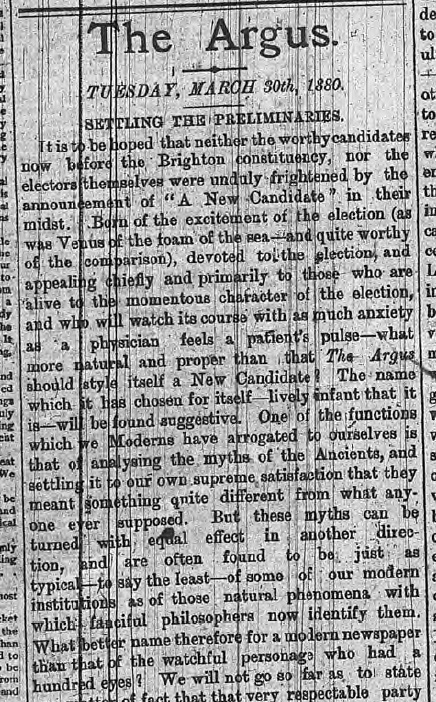
The first issue of the Brighton Argus, published on 30 March 1880.

This is a legacy story from an earlier version of our website. It may contain some formatting issues and broken links.

We have just released over 2,700 digitised copies of the Brighton Argus on to our Digital Media Bank. All these issues date from the 1880s, and can be downloaded and re-used free of charge.

The only local newspaper that survives today from the 19th century, the first issue of the Brighton Argus was published on 30 March 1880. It launched during the early days of campaigning for the Parliamentary elections that year, and the Argus’s editor proudly proclaimed the newspaper to be the ‘New Candidate’.

‘Born of the excitement of the election (as was Venus of the foam of the sea — and quite worthy of the comparison), devoted to the election, and appealing chiefly to those who are alive to the momentous character of the election, and who will watch its course with as much anxiety as a physician who feels a patient’s pulse — what more natural and proper than that The Argus should style itself a New Candidate?’


Named after a figure in Greek mythology who was reputed to have 100 eyes, the Argus’s all-seeing gaze covered local affairs, national politics, and international events. One of the more striking stories was sourced from the New York Herald, concerning an unusual divorce case in the United States:

‘By a decision of the Supreme Court of New Jersey… Sarah Peterson has been re-united in marriage to James V Peterson, although the parties were divorced 13 years ago, and notwithstanding the fact that Mr Peterson committed suicide.’

Why have we just published the Argus from the 1880s?

These newspapers have been digitised from microfilm copies that were once held in the Brighton History Centre. The digital images have been converted into PDFs, but all require additional processing with optical character recognition software to make some of the text readable. This is a time consuming process, taking 20-30 minutes per newspaper.

As a result, we are releasing our digitised newspapers in batches. This release of Argus newspapers accompanies a previous release of over 4,500 copies of the Brighton Herald, another local newspaper.

In addition to searching by date it is possible to run keyword searches for specific names and phrases. Take a look at our Digital Media Bank search tips for advice on how to do this.

Kevin Bacon, Digital Manager

‘The Prodigal Son in Misery’, 1780: a study of a teapot in Brighton Museum & Art Gallery

This is a legacy story from an earlier version of our website. It may contain some formatting issues and broken links.

University of Brighton student Kayleigh Peters looks at the back story to a teapot in Brighton Museum that tells a biblical tale.

This short study investigates a teapot, which is on display in Willett’s Popular Pottery, a gallery on the ground floor of Brighton Museum. I will ask, who made it and why it was made?

Photo of three pieces of crockery in a museum display case

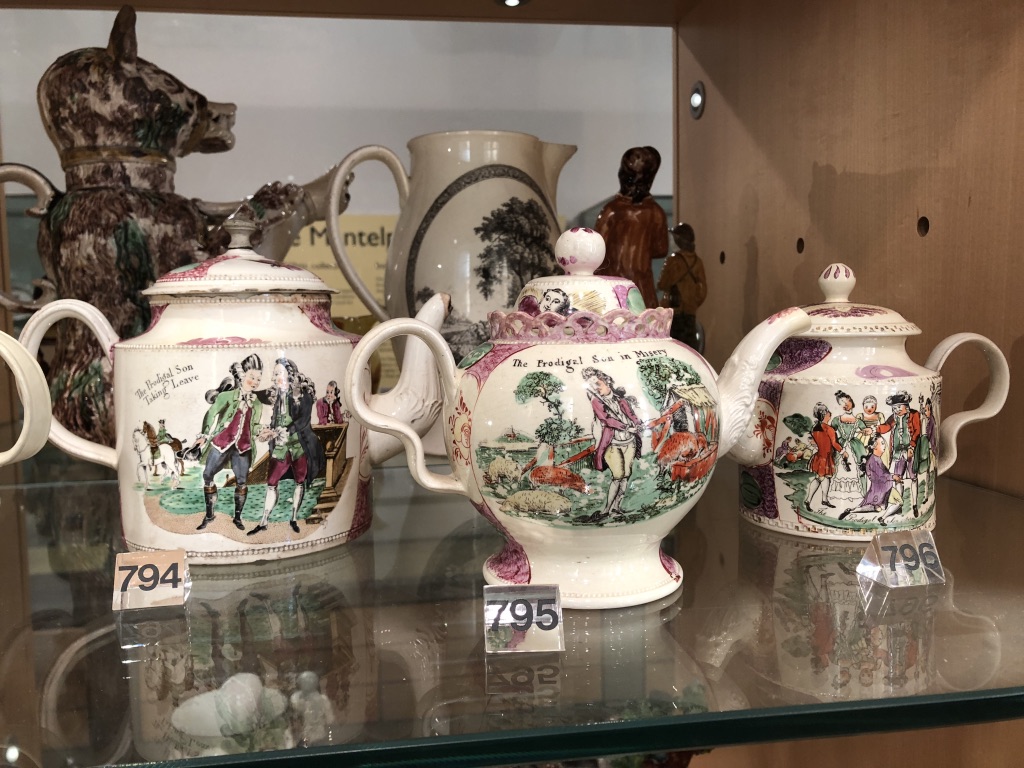
Teapot by William Greatbatch, c1780, The Prodigal Son in Misery. A creamware teapot, decorated with enamel and print. Mr Willett’s Collection of Popular Pots, Brighton Museum. Personal photograph by the author. 18 Oct. 2018


The teapot was made in about 1780 in Staffordshire in England, by William Greatbatch (1735-1813) when he was a prominent potter in the town of Fenton. It is a highly decorative pot; printed and enamelled, in fashionable white earthenware clay or ‘creamware’. It is entitled ‘The Prodigal Son in Misery’, from the biblical parable of the prodigal son, which was a popular design for teapots during the mid-eighteenth century in England. The actual design is derived from a set of six engravings of paintings by the French artist Sebastien le Clerc II. Later, the engravings were re-worked by Richard Purcell, and Greatbatch followed these designs closely, keeping the position of the characters, whilst updating their hairstyles and clothes to the 1780s.[1]

To give some context to the rise in pottery production in the 1780s, Great Britain was experiencing the far-reaching effects of industrialisation. In turn, this brought greater prosperity, resulting in a raise in living standards, which drove demand for refined practical household pottery and tableware, and the teapot became an especially desirable possession. With its rich seams of clay, North Staffordshire saw a greater number of small potteries than anywhere else in Britain, and  the collection of pottery towns became known simply as ‘The Potteries’. It was the creation of The Piecemeal, a network of inland canals, which allowed the faster transportation of goods, which ensured the success of The Potteries. This was a time of transition in ceramic production, from what we term ‘cottage industry’, meaning pottery workshops in people’s homes, to the industrial workshops or manufactories, situated away from people’s homes. In all, over 130 working potteries were set up in the region.

The Potteries made significant progress in ceramic technology. An important development was the use of a cream-coloured earthenware clay, with great plasticity, known as ‘creamware’. Creamware was ideal for refined tableware and other notable potters such as Josiah Wedgwood made fortunes from new technology, and especially creamware.[2]

At the time of making this teapot, Greatbatch was working in collaboration with other potters Thomas Whieldon and Wedgwood. Due to the rapid sale of the ‘Prodigal Son’ series, Greatbatch entered a period of successful manufacture at his manufactory in Fenton. However his good fortune did not continue and he suffered heavy financial losses leaving him bankrupt. Luckily, his talent was recognised by Wedgwood, who took him on at his Etruria Works, offering him a lifetime wage of five shillings a day, including a rent-free house.[3]

To summarise, this decorative teapot with its ornate features and biblical narrative, stands in Brighton Museum as a testament to another time. It demonstrates a time when Britain was changing; rising living standards led to changes in the way food and drink was consumed, and tea-drinking became hugely popular across society. It was a time of fast-paced development in ceramic technology in Staffordshire, and potters such as Wedgwood became very successful, and whose company is still producing work today.

William Greatbatch had a varied career as a talented potter, and this teapot was made at a time where he saw great financial success, which unfortunately was not to continue. This teapot signifies the way an object can both represent a moment in history, and also give insight to someone’s life. ‘The Prodigal Son’ is therefore a fascinating time-capsule of historical information.

Kayleigh Peters, student on BA (Hons) 3-D Design & Craft, University of Brighton

Bibliography

Beddoe, Stella. A potted history: Henry Willett’s ceramic chronicle of Britain. Suffork: ACC Art Books, 2015. Print.

Barker, David. William Greatbatch a Staffordshire Potter. Milton Keynes: Jonathan Horne Publications, 1991. Print.

Cooper, Emmanuel. 10,000 Years of Pottery: Craft into Industry Britain 1750-1950 London: The British Museum Press, [1972] 2000. Print.

Richards, Sarah. Eighteenth-century ceramics: products for a civilised society. Manchester: Manchester University Press, 1999. Print.

Thomas, John. The rise of the Staffordshire Potteries. Bath: Adams and Dart, 1971. Print.

Towner, Donald. Creamware. London: Faber and Faber, 1978. Print.

Footnotes

[1] David Barker, William Greatbatch a Staffordshire Potter. (Milton Keynes: Jonathan Horne Publications, 1991) 100, 229.

[2] Emmanuel Cooper, 10,000 Years of Pottery: Craft into Industry Britain 1750-1950 (London: The British Museum, [1972] 2000) 226-228.

[3] Donald Towner, Creamware. (London: Faber and Faber, 1978) 38.


George IV and his horses: a trot through All the King’s Horses in Brighton Museum

This is a legacy story from an earlier version of our website. It may contain some formatting issues and broken links.

George IV was a keen and able horseman, who admired the beauty and power of horses. The stables he constructed on the Royal Pavilion Estate are remembered in All the King’s Horses, our new display in Brighton Museum.

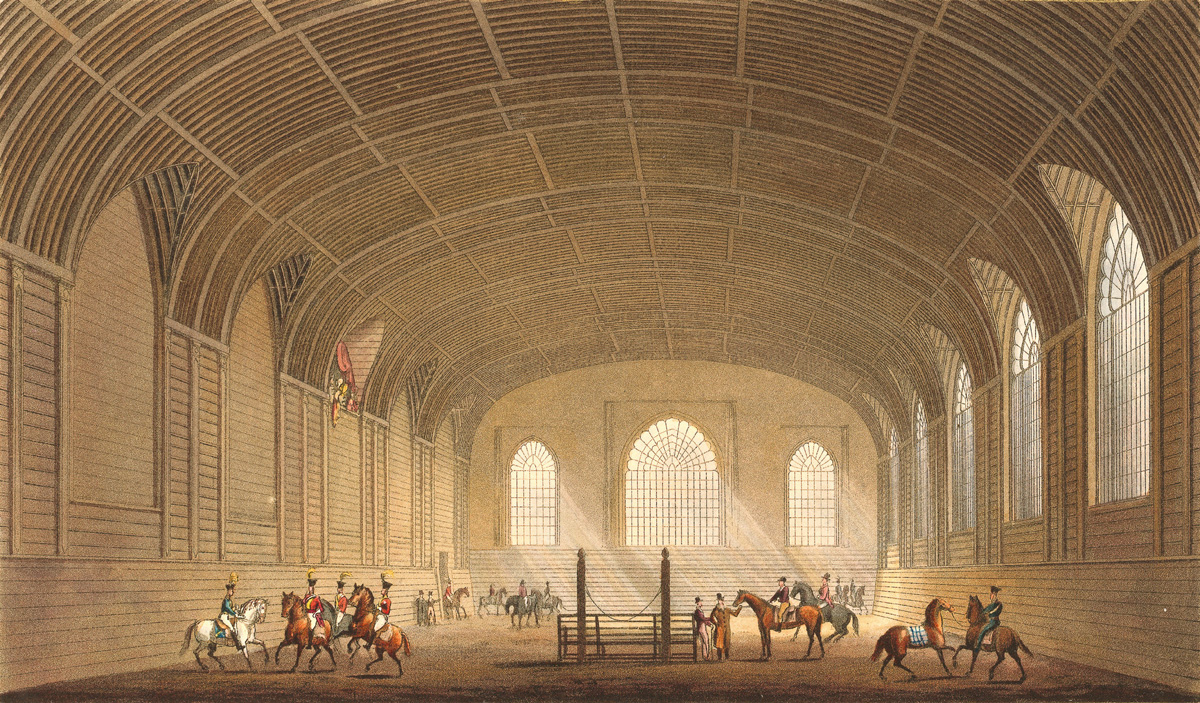
The stables, created between 1803 and 1808, was one of most ambitious and largest buildings of its kind in England, with room for at least 44 horses, as well as accommodation for stable staff and an adjoining Riding House used for exercising and training. The Riding House later became the Corn Exchange, which is now part of the Brighton Dome complex.

Riding School of Royal Pavilion Estate, 1826

In addition to spending vast amounts of money on building and running stables, George owned one of the most famous racehorses of the time, Orville.This horse put George in an awkward position in 1805 when he won the Brighton Cup, a magnificent silver cup awarded to the winner of the Brighton Races. As George had personally commissioned the cup and did not wish to award it to himself, he presented it to Chris Wilson, who had sold him Orville a few months earlier.

The cup, along with a letter from George to Wilson written at the Pavilion, can be seen in the display.

You can learn more about the display and watch an interview with curator Alexandra Loske in this film by Latest TV.

[arve url=”https://youtu.be/ue1vPzgc3qI” align=”center” maxwidth=”800″ /]


Brighthelmstone: Brighton in the Middle Ages

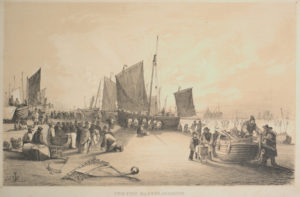
Fish market, Brighton. Nibbs, Richard Henry; C Moody, 1846

This is a legacy story from an earlier version of our website. It may contain some formatting issues and broken links.

Amidst the modern buildings of today’s Brighton are an abundance of medieval churches, streets and manors which may go unnoticed to many residents.

The term ‘medieval’ refers to the Middle Ages, a period of European history which is broken into three subdivisions: Early Middle Ages (5th century – 10th century), High Middle Ages (10th century – 13th century) and Late Middle Ages (13th century – 15th century).

One of the earliest mentions of Brighton was in the Domesday Book of 1086 commissioned by William the Conqueror, in which the town was referred to as Brighthelmstone.

Topographic print of fish market on Brighton beach in 1846

Fish market, Brighton. Nibbs, Richard Henry; C Moody, 1846

In 1313, King Edward II granted a charter to hold annual fairs in Brighthelmstone as well as a three-day fair in celebration of the Feast of St Bartholomew in August. Charters were first used in the Early Middle Ages as an early form of documentation and record keeping which allowed a town a certain amount of rights. Once granted a charter, the town was considered founded. This allowed the town to flourish and daily fish markets were held on the beach, although these markets were not made official until the 1773 Brighton Town Act was passed. This followed a charter granted for John de Warenne, 7th Earl of Surrey in 1312 to hold an annual fair in Portslade in celebration of the Feast of St Nicholas on 6th December.

Built in the 13th century, St Bartholomew’s Grange was one of Brighthelmstone’s earliest buildings. It was founded by St Pancras Priory, Lewes, and stood on St Bartholomew’s Square where Brighton Town Halll now stands. The grange was burned down during a French attack on Brighton in June 1514 along with almost every other building in the town.

St Nicholas Church

St Nicholas Church

The oldest remaining building in Brighton is St Nicholas Church on Dyke Road. Its history dates back to at least the 11th century with its first mention in the Domesday Book, with reference to a church valued at £12. However, only some of these features can still be seen; most of the current building is 14th century. Although there is no physical evidence remaining today, there was a record of a church in the same place in the early 10th century. The Norman font is the oldest surviving relic of the church, dating to c1170.

In fact, churches are arguably the most valuable insight into medieval life in Brighton as there are many churches dotted around the city which date back to the Middle Ages.

All Saints Church, Patcham

All Saints Church, Patcham

As for All Saints Church, the Domesday Book suggests that a church existed in Patcham at the time but it was rebuilt in the 12th and 13th century with some features still remaining today, including a blocked-off doorway in the north aisle which is still viewable from both inside and outside the church. Above the chancel arch is a 13th century Doom Painting, a type of wall painting found in medieval churches depicting the Last Judgement.

St Peters Church, Preston Park

St Peters Church, Preston Park

Dating back to the 13th century, St Peter’s Church in Preston Village boasts a truly impressive history. The current building replaced a previous church which was mentioned in the Domesday Book. In 1830 a series of 13th and 14th century frescoes (a type of mural) were discovered under a layer of plaster which had been covered during the Reformation. They depict the Nativity, the murder of Thomas Becket (Archbishop of Canterbury from 1162-1170) and St Michael weighing souls.

St Helen's Church, Hangleton

St Helen’s Church, Hangleton

The 11th century Hangleton Manor was owned by William de Warenne, 1st Earl of Surrey. Although this part of the building is not visible today, the Old Manor House, built in the late 15th century, is. The nearby St Helen’s church has a similar Norman history, also dating back to the 11th century and St Helen’s Green, adjacent to the church, was used as a plague pit for victims of the Black Death in the 14th century.

St Wulfran’s Church in Ovingdean originates from the 12th century with 13th century additions, including a tower and aisle, although little remains of these original medieval features.

Portslade Manor ruins

Portslade Manor ruins

One of the most fascinating treasures of Brighton’s early history is Portslade Old Manor, a 12th century manor house of which the ruins still survive. Even more fascinating is the life of one of its owners, Hubert de Burgh. His political career began as Earl of Kent and was later appointed Chief Justiciar in 1215 under King John and continued into the reign of John’s son and successor, Henry III. At the time, the role of Chief Justiciar was possibly the highest ranking position in the country except for the king. The ruins are next to the 12th century St Nicholas Church. Read the February 2006 issue of the Pavilion Review for more information on the manor.

Image showing digital reconstruction of a Saxon village in Brighton

Saxon Village Digital Reconstruction, Grant Cox

In Brighton Museum’s Elaine Evans Archaeology Gallery is a display focused on Anglo-Saxon Brighton. It features skeletons excavated in Brighton and a facial reconstruction of the individual known as Stafford Road Man. The gallery also features a digital reconstruction made by Grant Cox of ArtasMedia of a village in the Saxon era, which gives an insight into how Brighton may have looked in the Early Middle Ages.

Tasha Brown, Museum Futures Trainee


The Paul Follot dressing table and chair in Brighton Museum

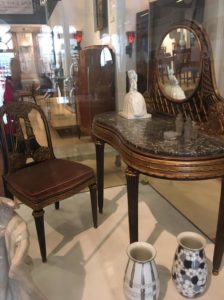
Paul Follot dressing table and chair.1913-20. Ebonised and gilt carved wood, dressing table has a marble top. Personal photograph.

This is a legacy story from an earlier version of our website. It may contain some formatting issues and broken links.

University of Brighton student Ruby Mitchell discusses a dressing table and chair designed by Paul Follot that can be seen in Brighton Museum’s Twentieth Century Art & Design Gallery.

Photo of dressing table with mirror in Brighton Museum

Paul Follot dressing table and chair.1913-20. Ebonised and gilt carved wood, dressing table has a marble top. Personal photograph.

On a visit to Brighton Museum I was immediately drawn to this beautifully crafted and highly detailed set of furniture, comprising a dressing table and matching chair. They radiate timeless elegance and are very much luxury items. Standing in front of the pieces I was transported back in time, I envisioned a lady dressed in 1920s glamorous attire, sitting at her dressing table, perhaps putting on her makeup – a true image, and symbol, of femininity.

The dressing table and chair were designed by Paul Follot (1877-1941) a French designer of luxury furniture and decorative art objects, in the years before and after World War I (1914-1918). He was one of the leaders of the ‘Art Deco Movement’, and he had huge influence on other designers at the time.

This set is a striking example of the treatment of ornament and materials that characterised Art Deco in the early years of the twentieth century.[1] The table and chair were designed for the singer Germaine Lubin, a Parisian soprano. Clearly designed with luxury in mind, which the Art Deco movement is known for, it was produced just after the First World War, when the dressing table became a very popular and desired item of furniture, something of a shrine to cosmetics and fashion. Paris led the fashion world and the Art Deco movement was inspired by fashion designers; therefore Paris was the epicentre of the luxurious ‘1920s look’.[2]

The Art Deco style arose in the years after WW1, primarily for the French luxury market that relied on quality French craftsmanship. It was influenced by the cultures of ancient Egypt, Africa and Japan, and it was also an expression of the ‘Jazz Age’, which was a time of celebration following the end of WW1. The 1920s are remembered as ‘les années folles’ when people claimed the right to live as they pleased, to discard the old and moral conventions and to have fun after the dark days of the War.[3]

Ever since the time of Marie Antoinette, French design has been associated with opulent and lavish lifestyles, and French style encapsulates luxury and indulgence. For example, I see similarities between Art Deco and the Rococo designs of the mid-1700s; whilst appearing very different they share a preference for decoration and ornamentation and the finest materials. Art Deco feels like a sleek, modern take on Rococo; flowers have become geometric and clean lines have replaced the swirls and curls of the earlier designs, yet the two styles share a love of luxury.

Fine materials were also very important. The dressing table and chair are made in deluxe and expensive materials; ebonised and gilt wood, with marble. Bruhammer and Tise tell us:

‘the fine carved details of the scalloped edges and gold floral design really showcases the quality and opulent style of Follot’s design works, making vague references to French historical styles’[4].

Follot’s pieces are examples of the fine Art Deco luxury that people yearned for: modern, new and exciting. A woman’s dressing table is quite a personal item, similar to that of a handbag, and thus it can give an insight into somebody’s life. These are the kind of pieces of design I dream of owning one day, and I can see them being passed down through the generations and adored by everyone who comes across them: beautiful, luxurious and inspiring pieces of French luxury design.

Ruby Mitchell, student on BA (Hons) 3-Design & Craft, University of Brighton

Image Gallery

References

[1] Brunhammer, Y. and Tise, S. (n.d.). French Decorative Art, 1900-1942. 52.

[2] Klein, D. (1987). All colour book of Art Deco. Hong Kong: Cathay Books, p.24. p.4.

[3] Lesieutre, A. (1978). The spirit and splendour of Art Deco. Secaucus, N.J: Castle Books, p.19.

[4] Brunhammer, Y. and Tise, S. (n.d.). French Decorative Art, 1900-1942. 52.

Celebrating women in STEM at the Booth Museum of Natural History

This is a legacy story from an earlier version of our website. It may contain some formatting issues and broken links.

Latest TV recently helped us celebrate the role of women in STEM (science, technology, engineering and mathematics) at the Booth Museum of Natural History.

The short film below covers the even, including a rare interview with legendary 19th century fossil collector Mary Anning….


[arve url=”https://youtu.be/ypbdbJHjghU” align=”center” /]

Taking George IV and the Royal Pavilion to deepest Texas

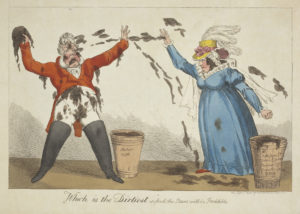
‘Which is the dirtiest so foul the stains will be indelible?’ Print by William Heath, 1820

This is a legacy story from an earlier version of our website. It may contain some formatting issues and broken links.

Last summer I was invited to give a lecture about George IV and the Royal Pavilion at a major exhibition of British royal portraits at the Museum of Fine Arts in Houston, Texas.

Alexandra Loske standing outside of a yellow school busAs they would fund my trip, I accepted the invitation, but had to ask for the last available lecture slot before the exhibition closed, as there was the small issue getting hold of an up to date passport for crossing the Atlantic. The exhibition Tudors to Windsors: British Royal Portraits from Holbein to Warhol, curated by David Bomford – a British curator and conservator who I knew through work on colour – brought together dozens of the best known and most important paintings from the National Portrait Gallery in London, with some superb additions from other collections.

David asked whether I could give an entertaining, informed lecture that would introduce George IV to an American audience, with a particular focus on the Royal Pavilion. How could I say no to a trip to a US city I had never been to, but I knew had some seriously stunning museums and art galleries? It was a long journey from Brighton to Houston, but I decided to embrace this opportunity and see as much of Houston as possible in a few days. I gave myself plenty of time for the visit, and was able to add a few extra days either side of the lecture as, luckily, I have friends in Houston who offered to put me up. That way I was even able to witness the total lunar eclipse that took place on 20 January.

Man wearing red and a woman wearing blue throwing mud at each other

‘Which is the dirtiest so foul the stains will be indelible?’ Print by William Heath, 1820

The Museum of Fine Arts is one of a cluster of magnificent museums and art schools in the area, and a 20 minute walk away is another stunning area of museums and public art, the Menil collection, which includes the famous Rothko Chapel. I was in art heaven for a week, and David Bomford and his wife Zahira Veliz Bomford, a renowned conservator, treated me like a royal guest. At first I didn’t know how to pitch the lecture to an American audience and asked David for advice. He explained that I may have to explain a bit more about the line of succession and other British monarchs who had an interest in art and architecture. The exhibition, which was packed with visitors when I went to see it, did not include any Georgian caricatures, so I wondered whether I could show some of the naughtier ones in the lecture. David assured me that they audience would love them, and he was right. I had to pause at times, as the audience were laughing hysterically at the sight of some of the Cruikshanks and Gillrays.

Alexandra standing in front of a large image of the Royal Pavilion

The lecture was titled Talent, Wit, Buffoonery: George IV’s Life, Loves, and Tastes (after a quote by the Duke of Wellington), and it attracted an audience of more than 120 people. I had brought along promotional material about the Pavilion, an offcut of the Saloon silk, and presented a virtual walk through George’s exotic pleasure palace. In the exhibition one of Nash’s Views of the Pavilion was displayed as a gigantic reproduction, filling a whole wall. I was showing a few friends around the exhibition and started talking about the building, and almost immediately dozens of other visitors stopped and started asking me questions. Some of them had not realised that the Pavilion exists and thought it was a fantasy palace, never built.

We should not underestimate the impact of the Royal Pavilion. I suddenly realised how easy it is to forget just what a special historic building it is and how lucky we are that it has survived. I was proud to have been able to represent the Royal Pavilion in Houston, and introduce the curious, creative, strange George to an audience less familiar with him than we are here. And even outside the museum there was a reason to talk about George and the Pavilion: the vibrant yellow of US cabs and school buses is Chrome Yellow, used in large quantities by George in the Yellow Bow Rooms and elsewhere in the building, when the pigment had just become commercially available. Any excuse to chat with some of the incredibly friendly people of Houston. And in case you were wondering, yes, I did buy myself a cowboy hat. I bet George would have done, too.

Alexandra Loske, Royal Pavilion Curator