Posted on January 1, 2011 by KrystynaPickering -
This is a legacy story from an earlier version of our website. It may contain some formatting issues and broken links.
‘I like Hove. I like its surroundings and I like its climate
King Edward VII

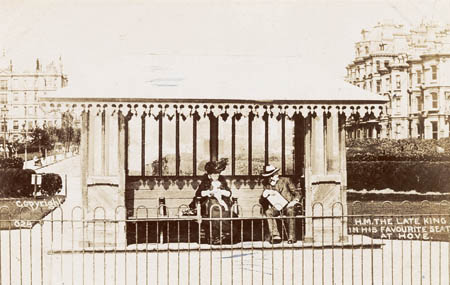
King Edward VII and Queen Alexandra relaxing in Hove, c1909
22 January will mark the 110th anniversary of King Edward VII’s accession to the throne. Unlike his mother, Queen Victoria, Edward was fond of Brighton and Hove. He first came to Brighton as a baby in 1842; while his parents did not return to the town after 1845, Edward remained a regular visitor for the rest of his life. After the sale of the Pavilion in 1850 Brighton lacked a royal residence, but Edward frequently stayed with local friends, such as the Sassoon family. Once he became King in 1901, Brighton once again found itself a favoured resort of the monarch. In his last years, however, more of the King’s time was spent in neighbouring Hove.
Because of this, Edward is widely remembered in Hove. Kingsway, the coastal road, was named after him in 1910, and the statue opposite Embassy Court, more commonly known as the Peace Statue, was unveiled as a memorial to him in 1912. Yet the spot with which he was most personally associated is a public bench at the bottom of Grand Avenue.
The bench was situated near the home of Arthur and Louise Sassoon in King’s Gardens, and became one of Edward’s favourite spots. After his death in 1910 it became a poignant, if unmarked, memorial. This was reflected in numerous postcards such as this one, which shows Edward and his wife, Queen Alexandra, relaxing on the bench. It’s a crude photograph, and has clearly been taken from a distance in order not to disturb the couple. But it is a simple and unaffected portrait and one that was entirely fitting for the King. In contrast to his mother, Edward had cultivated a persona of easy familiarity and affability. As such, this unpretentious and everyday view is an appropriate memorial for one of Britain’s most popular monarchs.
Kevin Bacon, Curator of Photographs
More information
Posted on January 1, 2011 by KrystynaPickering -

This is a legacy story from an earlier version of our website. It may contain some formatting issues and broken links.
1911 Dance Card
[slideshow]HA106891
This dance card was produced for the Children’s Fancy Dress Ball held on Twelfth Night, 6 January 1911.
Generally, a dance card would have been used by a woman to list the names of her dancing partners.
The Mayor and Mayoress, Mr. and Mrs. Charles Thomas-Stanford presided over the proceedings that night in the Royal Pavilion. The children were taken into the King’s Drawing Room and from there were led by Father Christmas into the Banqueting Hall to be met by the Mayor.
They were entertained by a Punch & Judy show in the Music Room and musical chairs in the saloon, while dancing took place in the Banqueting Room.
The Brighton Herald and Brighton Season covered the event in great detail. Several well known Brighton families were represented, including the Vokin sisters, whose family had a large department store in North Street.
The newspaper described the scenes as ‘Maid Marion jostled with a Christmas Bon Bon’, (played to great effect by Vera Mogridge). Bertie Buckwell, as the Knave of Hearts, came with ‘fanciful but uneatable tarts’ and Gladys Rusbridge, dressed as a representation of Brighton Tramways Corporation, came in a costume covered with over two thousand tram tickets.
One of the children attending was seven-year-old Vera Garbutt. She was dressed as a witch in a scarlet dress, black conical hat and a cat on her shoulder. Only nine years later, Vera would establish the Vera Garbutt School of Dancing.
For more about Vera Garbutt, see Personality of the Month – January 2011.
Paul Jordan, Senior History Centre Officer
Posted on October 5, 2010 by KrystynaPickering -
This is a legacy story from an earlier version of our website. It may contain some formatting issues and broken links.
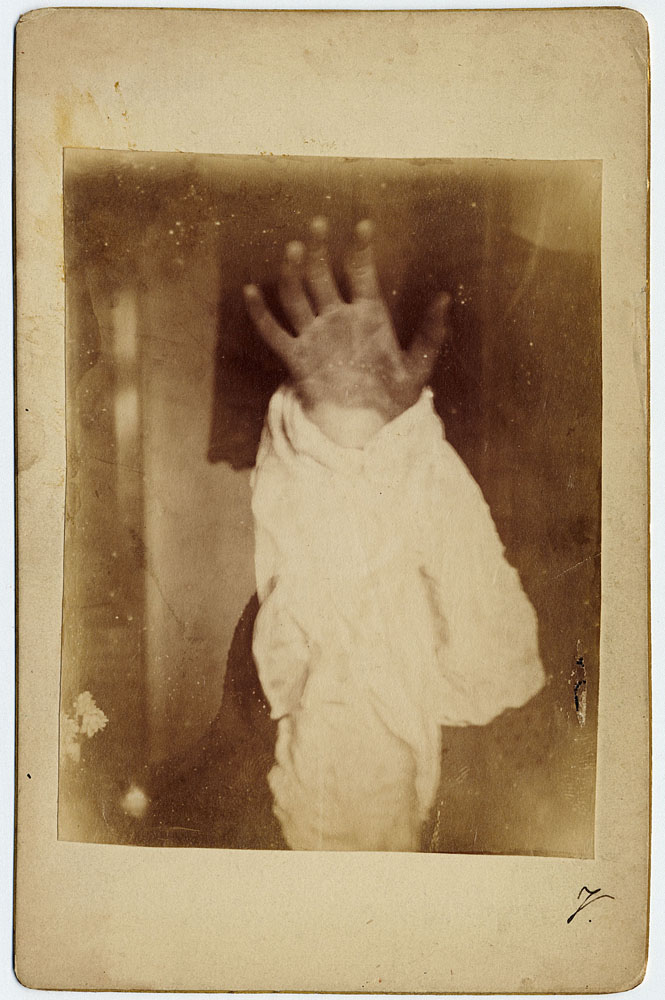
It is the 27th October, 1886. Alone in her room, Mary Burchett takes a photograph of herself using a remote device to operate the camera. When she develops the image on paper, she finds that her face is obscured by a shrouded and disembodied arm. As Burchett notes on the reverse of the photograph, ‘of course the spirit hand which appears in front of me was not visible to me’.

‘Spirit’ photograph by Mary Burchett, 1886

Annotated reverse of ‘spirit’ photograph, 1886
Is this proof of an afterlife? For many in the nineteenth century and beyond, spirit photographs have been regarded as scientific proof of the existence of ghosts. But what is most striking about this photograph is that it is an obvious fake. If one looks at the top right of the image, the neck and shoulder of a figure wearing black can be made out. Follow the line of the arm down, and the shrouded arm is clearly attached to an earthly being. This is not so much proof of an afterlife, as it is an example of the fraudulent methods used by spirit photographers.
The technique used here is double exposure. A glass plate negative would be used to take a photograph using a short exposure. The exposed plate would then be used for a second photograph. The original translucent image would appear overlaid onto the new image. If the photographer was unaware that the plate had been previously exposed, he or she could be entirely mystified by the sudden appearance of a spirit form.
This photograph is one of a series we hold which feature Burchett and a variety of ghostly phenomena. Most of these photographs were produced in collaboration with William Eglinton, one of the most famous mediums of the day. Eglinton is not generally associated with spirit photography, and was more renowned for psychic feats such as levitation and the ability to materialise spirits at séances. But Eglinton almost certainly had a hand in the production of this photograph; perhaps even the hand depicted in this example. The unconvincing appearance of these images may be one of the reasons he retired as a medium the following year.
Eglinton later moved to South Africa and became a successful journalist and newspaper proprietor. By the time he died in 1933, his psychic past was largely forgotten. But one who remembered his days as a medium was the escapologist and illusionist Harry Houdini. Houdini devoted much of his later life to denouncing false mediums, and regularly used examples of Eglinton’s tricks in lectures he gave in the 1920s. Had Houdini known of this photograph, it would have provided very persuasive evidence.
Kevin Bacon, Curator of Photographs
Posted on September 8, 2010 by KrystynaPickering -
This is a legacy story from an earlier version of our website. It may contain some formatting issues and broken links.
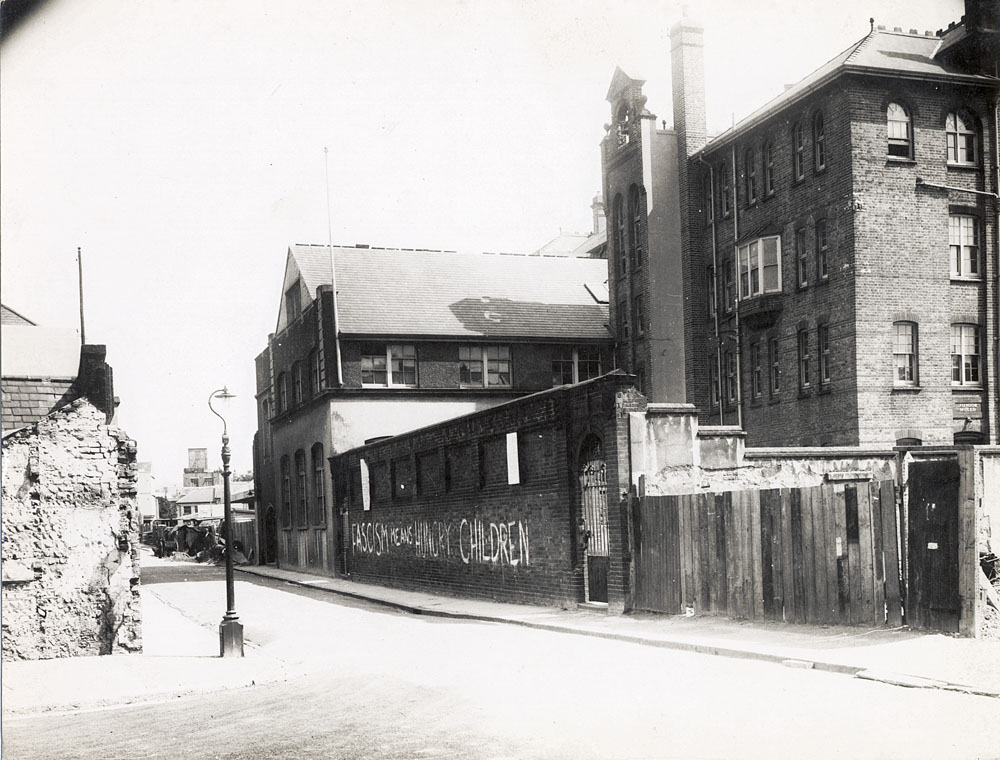
This photograph shows Circus Street School, Brighton, in the late 1930s. It was taken shortly before the area was redeveloped in 1937. But this photograph is not merely a record of a vanished school; more surprisingly, it shows how the Spanish Civil War spilled onto the streets of Brighton.

The Spanish Civil War (1936-1939) was far more than an internal conflict. It was seen throughout the world as the first armed resistance against the spread of fascism. Writers and photographers such as George Orwell, Ernest Hemingway and Robert Capa made the struggle international news. But this story was also told by anonymous authors, such as the simple piece of graffiti that can be seen painted on the side of the school.
‘Fascism means hungry children’: as a political slogan, this is ingenious. Depicting the plight of children during warfare was a common propaganda tool: Manic Street Preachers fans will be familiar with the famous Republican poster showing a child killed by Nationalist bombing raids. Yet this piece of graffiti is far subtler and more sophisticated than a simple glance may suggest.
First, it broadens the dangers of fascism. Mussolini’s Italy and Hitler’s Germany had quickly proven to be repressive regimes, and the Italian invasion of Abyssinia (now Ethiopia) in 1936 had demonstrated their military threat. Hungry children were a less obvious result, but the Spanish Civil War had caused this. Military action by fascist-led Nationalists had resulted in the death of thousands of civilians, and had left a large part of the population without food or shelter.
Second, the slogan brings the struggle to England. It is no accident that this message was painted on the side of a school. It was a reminder to parents and passersby that the hungry children in Spain could easily be their children. If Spain fell to the fascists, there was an increased fascist threat at home, whether through invasion or local movements. This was a subtler way of conveying the message of the famous Republican poster: ‘If you tolerate this your children will be next’.
Kevin Bacon, Curator of Photographs