This is a legacy story from an earlier version of our website. It may contain some formatting issues and broken links.
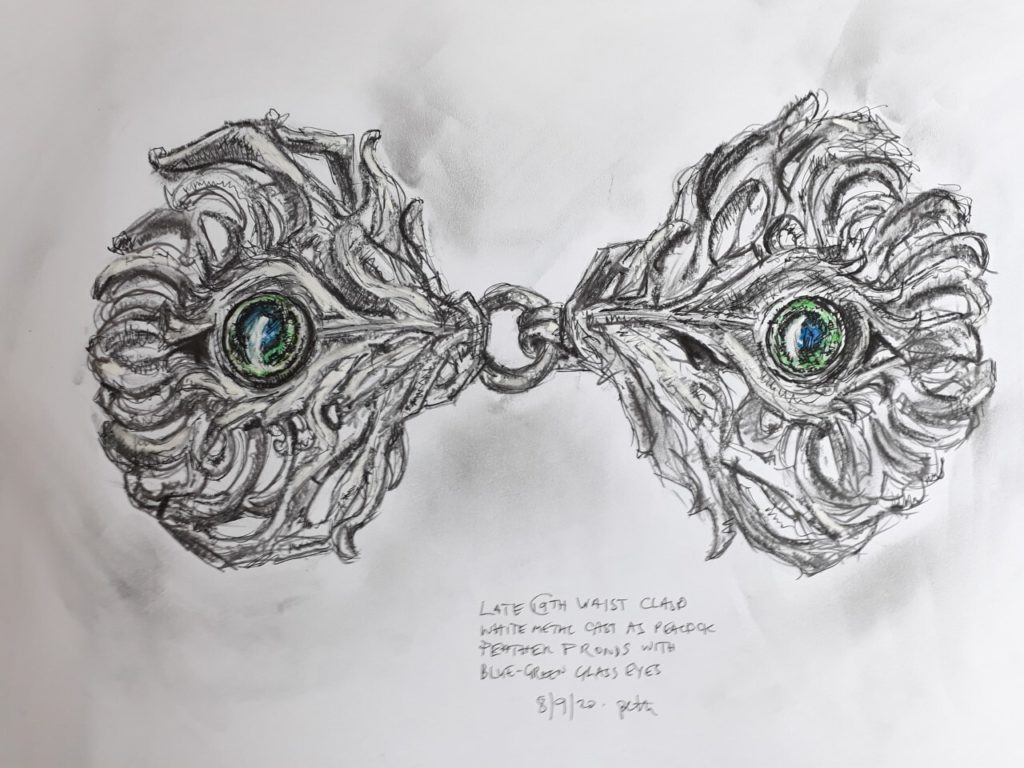
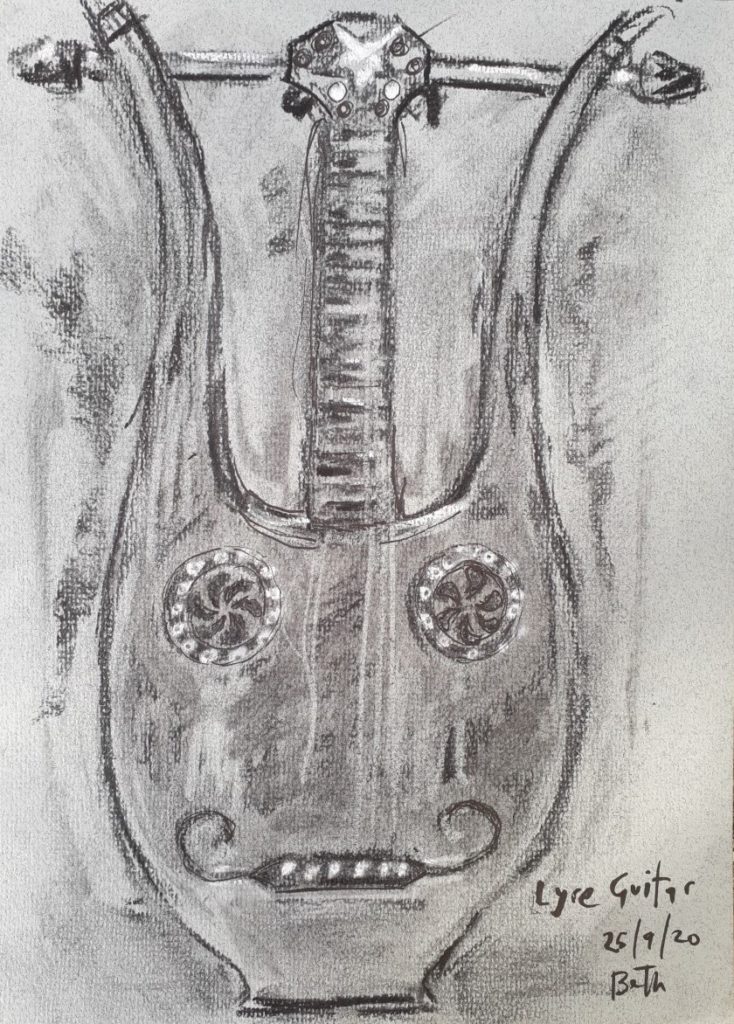
Beth has changed her tune to the theme of musical instruments for this week’s Draw.
Join In
If you are tempted to have a go, please share your drawings with us! We would love to see them. Email them to Beth at beth.burr@brighton-hove.gov.uk.
Tweet @BrightonMuseums or tag @brighton_museums on Instagram. If you are uploading them to Facebook with pride, share the url in the comments section below.
Come back next Wednesday to see what new objects Beth has chosen.
This week’s additional ideas:
Make yourself a music playlist to draw to, if you do not have one already. It’s interesting to see what how different types of music can inspire your creativity. For instance, try playing some fast music whilst sketching to make your drawing style free itself and dance across the page! Have fun!
This is a legacy story from an earlier version of our website. It may contain some formatting issues and broken links.
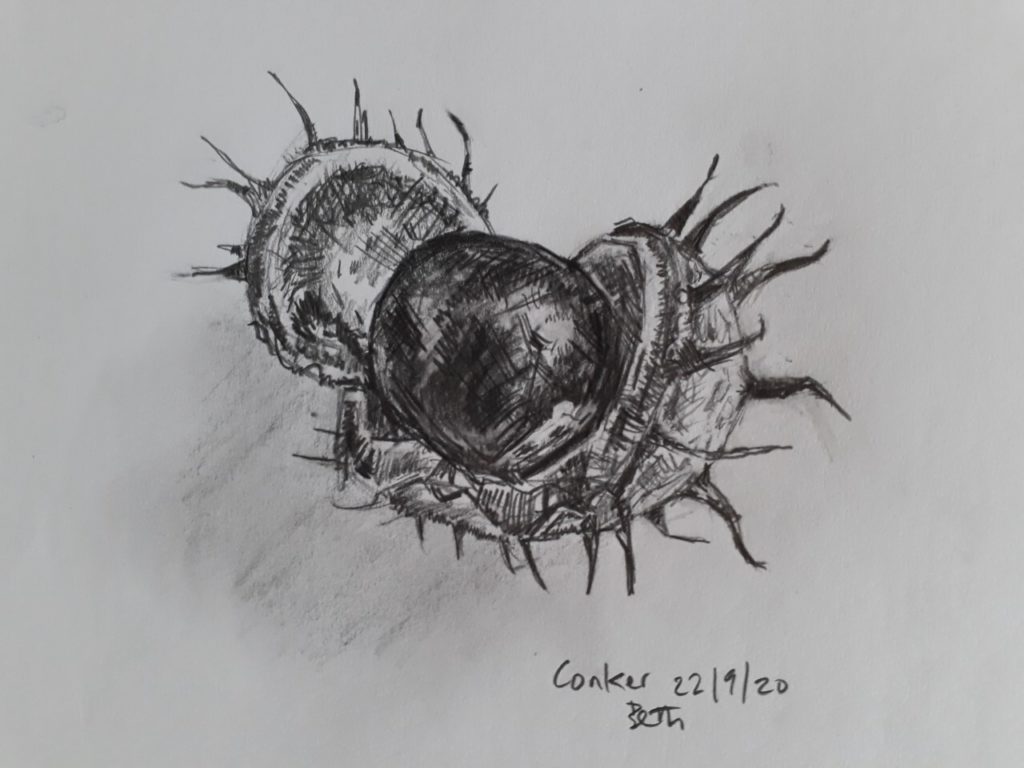
To coincide with the start of the Autumn Equinox on 22 September, Beth has an Autumnal Draw this week and is going bonkers for conkers.
Conker sketch in 4B pencil
Conker as single line
Draw Artists
We are very pleased to see that some of you have taken part in our online Mid-Week Draw, here are some of the fantastic works that have been sent in.
Sam autumn wave
Sam autumn wave
Join In
If you are tempted to have a go, please share your drawings with us! We would love to see them. Email them to Beth at beth.burr@brighton-hove.gov.uk.
Tweet @BrightonMuseums or tag @brighton_museums on Instagram. If you are uploading them to Facebook with pride, share the url in the comments section below.
Come back next Wednesday to see what new objects Beth has chosen.
This week’s additional ideas:
Go outside and find some interesting leaves to study. Fill up a whole page with various autumnal leaf sketches. You will see how different they all are in terms of shape and colour. Flatten and then glue the leaves next to your drawings if you would like to see a comparison!
This is a legacy story from an earlier version of our website. It may contain some formatting issues and broken links.
Kangas are a form of textile associated with Swahili-speaking cultures of East Africa.
Their design is said to have been inspired by cotton handkerchiefs brought to the region by Portuguese traders. Local women stitched together two rows of three handkerchiefs to make a rectangular cloth. Later these were manufactured as printed cotton cloths, usually sold in pairs and used as clothing (a wrap skirt and shoulder cover), as a baby or child carrier, or as a bag. The name kanga is related to the Swahili term for guinea fowl and the textiles often feature a spotted background, reminiscent of the bird’s plumage. The kanga is also distinctive for the text which appears at the bottom centre of the textile. These can include proverbs, slogans and sayingsand make the kanga an important communicative tool.
The huge range and diversity of kangas produced made them a compelling focus for the Fashioning Africacollecting project. Two members of the Collecting Panel – Tony Kalumeand MaryFrancesLukera – told us about the important social and political role these textiles play in East Africa. 25 examples were acquired for Brighton Museum’s permanent collection. This post provides a brief introduction to three of them.
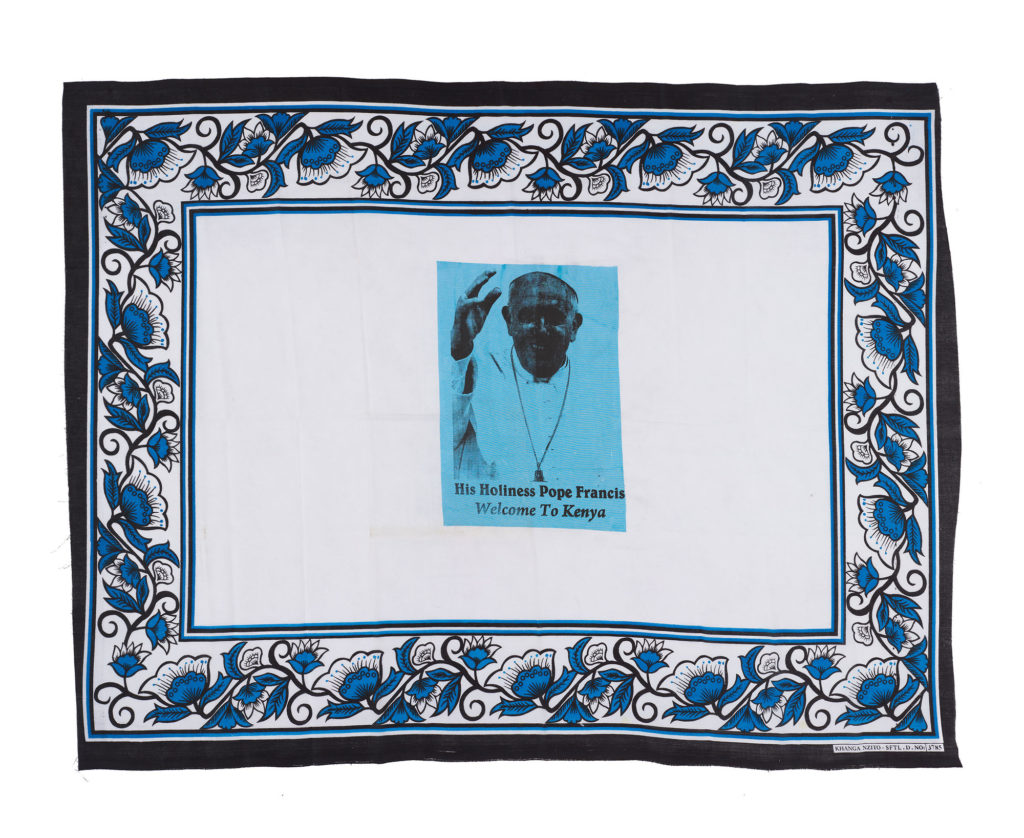
Wrap (Kanga), Kenya, Africa, Post-2017
The first example carries an image of Pope Francis and the wording “His Holiness Pope Francis Welcome to Kenya”, and commemorates the Pontiff’s visit to the country in November 2015. During his visit the Pope met the president, Uhuru Kenyatta, held meetings with various members of the clergy and an open mass at the University of Nairobi, and visited a slum neighbourhood. Huge crowds turned out to welcome him. Christianity is the predominant religion of Kenya and approximately a quarter of the country’s population are Roman Catholic.This kanga was purchased at Gala Clothwear onBiashara Street, Nairobi, Kenya on 2 June 2017 for 475 Kenyan shillings.
Wrap (Kanga), Kenya, Africa, Post-2017
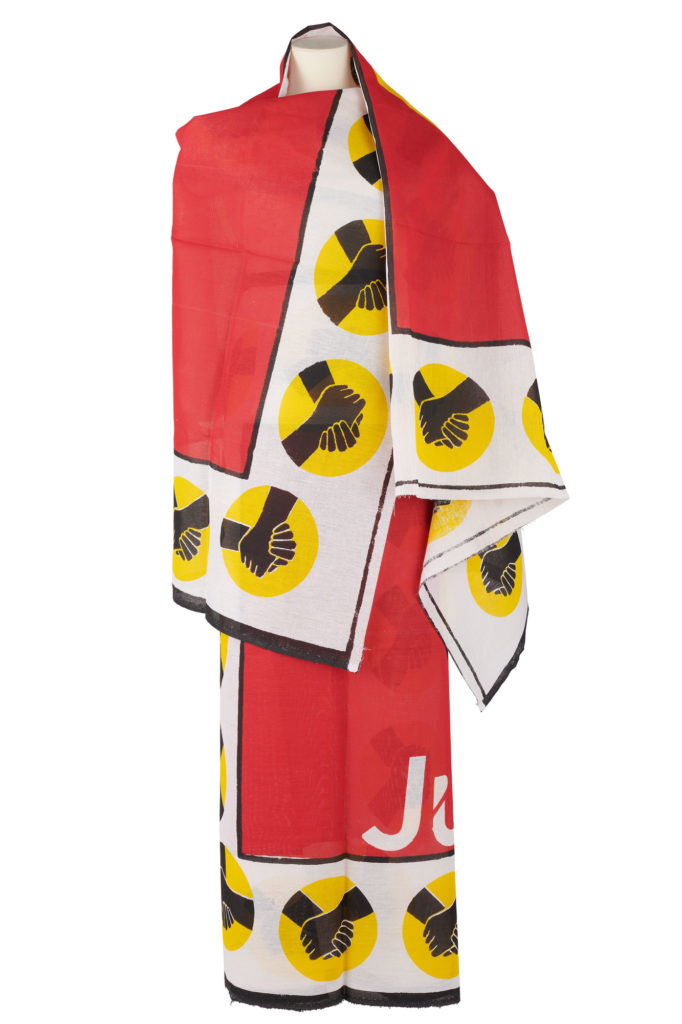
The second kanga provides an example of the use of this textile form to promote a political agenda. This pair of kangas were used as part of election campaigning by the Jubilee Party, a Kenyan political group founded on 8 September 2016 following the merger of 11 smaller parties. The kangas, which features the Party’s name, colours and logo of joined hands, were given out to supporters during the 2017 general election. The election, which was marred by violence and unrest (and ultimatelyhad to be repeated), saw the Jubilee Party secure a plurality of seats in Parliament. Jubilee party leader, Uhuru Kenyatta, was re–elected president. This pair were also acquired on 2 June 2017 (the week in which election campaigning began) from aRivatex(a Kenyan textile manufacturer) outlet on Biashara Street, Nairobi, for 450 Kenyan shillings.
Wrap (Kanga), Kenya, Africa, Post-2017
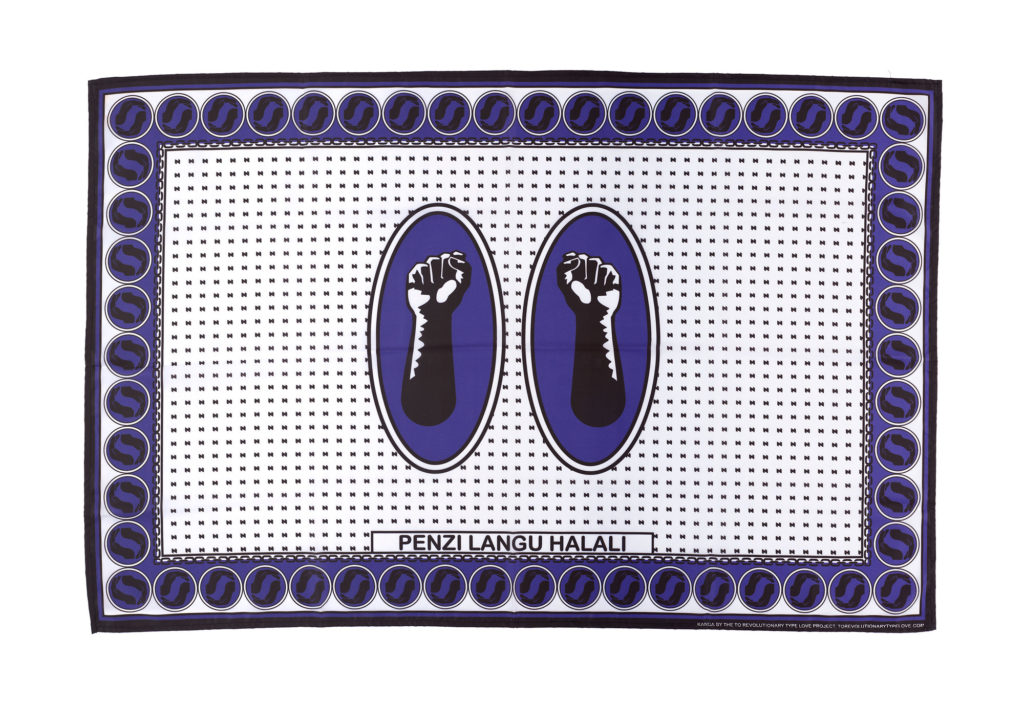
This kanga was designed by artist KawiraMwirichia (b.1986) in 2017 as part of her To Revolutionary Type Love series. Mwirichia is a Kenya-based artist and activist. As she has described, Kenya has two forms of art market: one for art and craft inspired by traditional forms and one for contemporary art. The series of kangas she created seeks to generate a dialogue between these different art markets. The kangas also celebrate queer love. Mwirichia has said that she aims to create a unique kanga for every country of the world, the design of which is inspired by pivotal moment in that country’s fight for LGBTQ rights. This kanga commemorates the battle for LGBTQ rights in Kenya. The text at the bottom “Penzilanguhalali” can be translated as “My love is valid”. Currently, the Kenyan government does not recognise relationships between people of the same sex; same-sex marriage is banned under the Kenyan Constitution and sexual relationships between men are a punishable felony.For more information about the series visit the WePresent website.
These kangas were acquired as part of Brighton Museum & Art Gallery’s Fashioning Africa project, which was supported by a grant awarded through the National Lottery Heritage Fund’s Collecting Cultures scheme. Museum staff are grateful to Kenya-based arts collective The Nest, to Sunny Dolat and to Nicola Stylianou for making these acquisitions possible.
Discover More
Visit the Fashioning Africa website to find out about changing fashion in Africa post-1960
Helen Mears, Keeper of World Art / Member of the Fashion Cities Africa exhibition team
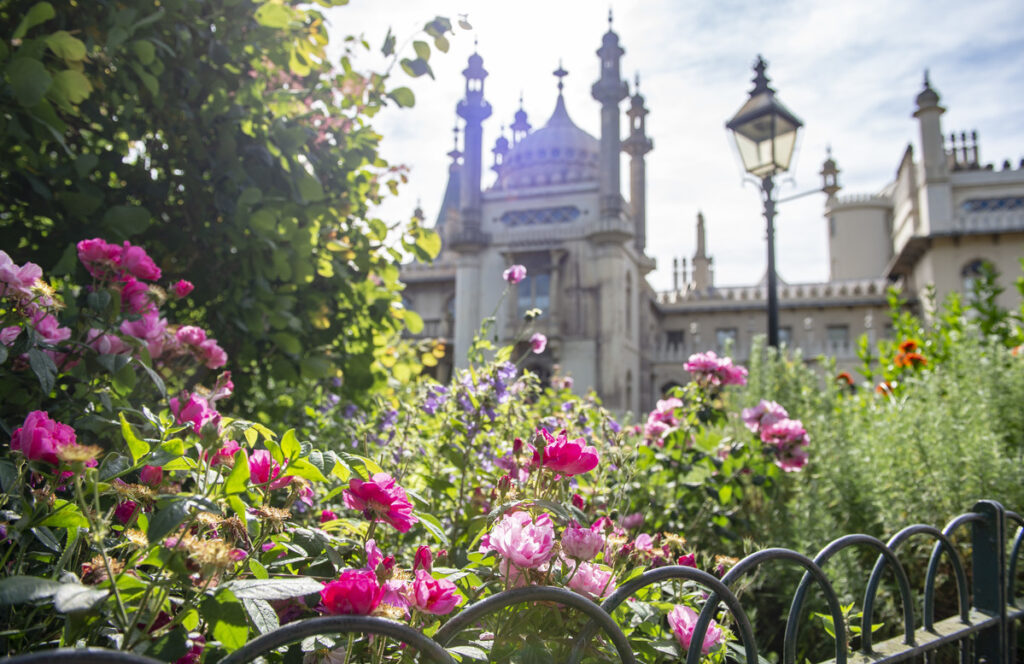
Our last digital offer for the festival is still screen based, but it’s something that’s designed to be used outdoors, in a way that complies with social distancing. Called The Mindful Garden, it’s a short experimental tour for the Royal Pavilion audio guide — albeit one that tries to rewrite the rules about what an audio guide should sound like.
Mindful moments
The tour was written by Dr Craig Jordan-Baker, an academic and novelist at the University of Brighton. It has been produced as part of an AHRC funded project called DigiPiCH, which is researching ways in which civic museums can use digital technology in more inclusive ways.
As Royal Pavilion & Museums is a partner in the project we are using this as an opportunity to run a small-scale experiment exploring how we can create content for mobile phones that encourages a more mindful appreciation of the visitor’s environment. In some ways, this is building on previous experiments with mobile interpretation, such as last year’s Gift collaboration with Blast Theory and the One Minute app, which both explored very different methods of encouraging visitors to look at museum exhibits in a slower and more thoughtful way.
We’ve previously explored the wellbeing potential of the Royal Pavilion Garden on our blog with regular posts by our gardener and volunteers. But these posts are written to be read at home; they are a great way of explaining to people what they can see when they next visit, but no one will read a blog post standing in a garden. If we want to encourage a more mindful experience in the garden, we need a different approach to storytelling.
As a professional writer and researcher who has previously worked with the Booth Museum and run health walks, Craig is an ideal collaborator.
Facts vs reflections
I have no expertise in mindfulness, but I am interested in attention and behaviour patterns in heritage environments. It seems to me that traditional ways of telling heritage stories, such as through an audio guide, aren’t compatible with a more mindful approach.
According to a quote on the NHS website, mindfulness ‘means waking up to the sights, sounds, smells and tastes of the present moment’. If mindfulness is about focusing on the here and now, where do stories about the past fit in? Heritage stories, such as how the Pavilion Garden was once part of a royal estate, tend to be rich on facts and require the visitor to be receptive of what they are told. That may make for an entertaining and inspiring experience, but probably not a mindful one.
To put it simply, most of the stories we tell at heritage sites are focused on facts about the past. What happens if we tell stories that invite people to reflect on the present? What if we ask questions rather than make statements?
The tour
The Mindful Garden tour can be found on the new version of the Royal Pavilion audio guide that we launched in July. We’ve had some good feedback on the guide and about 40% of visitors are using it. I hope some of those visitors use it to explore the garden after their visit but it’s also available for anyone to use for free, even if they don’t come into the Pavilion.
I think Craig has produced something playful, engaging and thought-provoking. Rather than providing explanations, each stop on the tour feels like the start of a conversation. As someone has spent many years working on the story of the Royal Pavilion’s use as a WW1 Indian Hospital, I found that Craig’s take on the Indian Gate made me reconsider it’s meaning today.
At the very least the Mindful Garden tries to address the challenge of making a mindful experience with a different form of storytelling from anything we’ve used in the past. You can listen to an excerpt below:
Let us know what you think
This tour is an experiment and we would appreciate any comments or feedback on the approach. You can do this using the comment box on the audio tour.
We are certainly not suggesting that this style of storytelling should or will replace more traditional fact-based ways of interpreting the past. But this may be a new narrative tactic that we can weave into the experience we offer our future visitors.
Kevin Bacon, Digital Manager
Discover more
Visit the Heritage Open Days website to learn more about England’s largest festival of history and culture, 11 – 20 September.
This is a legacy story from an earlier version of our website. It may contain some formatting issues and broken links.
If you’d have gone down to the woods at Three Cornered Copse in Hove last month, you’d have been sure of a big surprise as you might have come across the New Note Orchestra dreaming up a brand new piece of music.
In a first get-together since lockdown restrictions eased, the musicians met to create a unique composition to accompany an online display of some of Royal Pavilion & Museum’s best-loved artworks.
Music & Wellbeing
New Note Orchestra is the first recovery orchestra in the world. They use music and storytelling to help people sustain their recovery from addiction. The participants have also experienced homelessness, social isolation, poor mental health and are at risk of suicide. New Note provides a safe space for people to be creative, build their confidence and develop relationships with people away from drugs and alcohol.
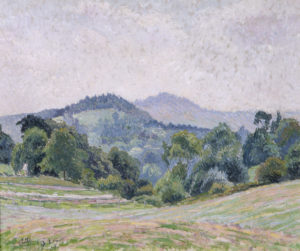
Inspired by some of the rich images of landscapes that appear in the display, the orchestra took to the woods for the day and the result is a very ethereal arrangement with the calming chime of hand bells taking centre stage. The musicians also used the natural environment around them to enhance the music, using sticks and gently knocking on tree trunks for added percussion.
New Note’s guitarist Roger describes the piece:
‘It’s very subtle, some bells and guitar, a little percussion. Nothing erratic, just very chilled. It was beautiful that day listening to the trees, with a bit of light rain.’
New Note’s association with Royal Pavilion & Museums dates back to 2019 when the orchestra was invited to take part in a special day at Brighton Museum to celebrate music and its connection with wellbeing.
Listen to the musical piece whilst absorbing yourself in the beautiful images in the video below.
Art & Music
[arve url=”https://youtu.be/l4FgeeQSTn0″ title=”Into the Woods, with New Note Orchestra and Brighton Museum” /]
To find out the title and artist for each individual painting, click on an image below.
[envira-gallery id=”29472″]
Jody East, Programming Curator
Discover more
Visit the Heritage Open Days website to learn more about England’s largest festival of history and culture, 11 – 20 September.
This is a legacy story from an earlier version of our website. It may contain some formatting issues and broken links.
Our latest Heritage Open Day Hidden Nature post looks at how nature has provided the materials for the Royal Pavilion’s elaborate decoration.
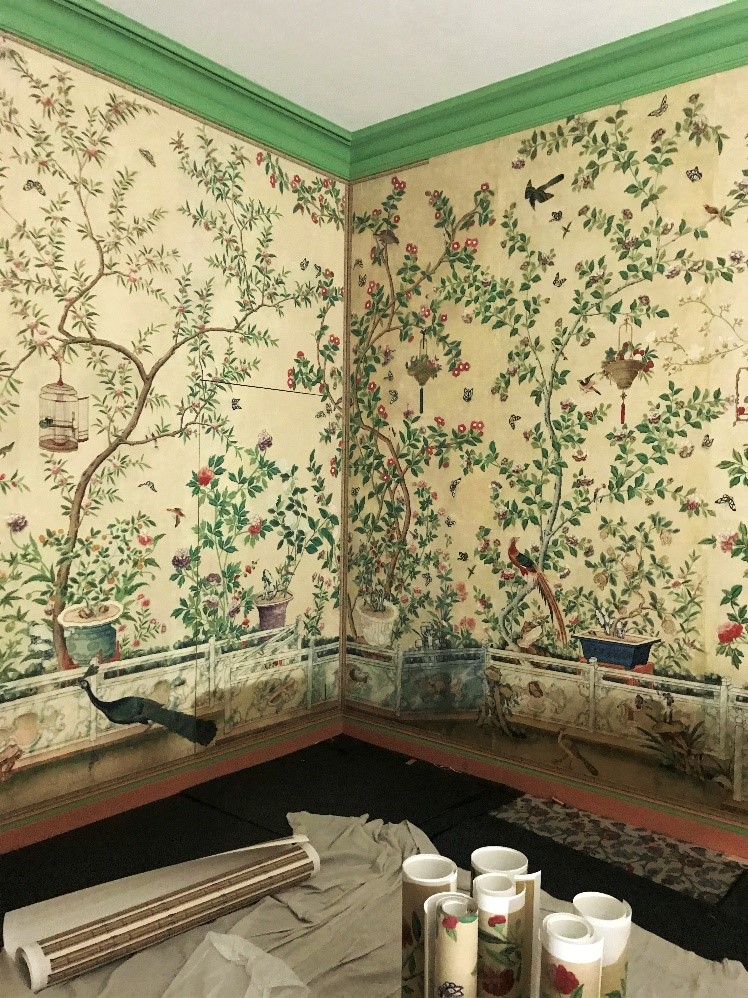
When one looks at the Chinese wallpaper in the Pavilion, it is impossible not to get drawn into the wonderful colours and designs on the paper and the sheer scale of the papers in the rooms. My job as a paper conservator is to look at the detail and if you look closer than the design of the paper, not only do you see beautiful scenes of birds and flowers on the paper design, but you see the true natural world used to create the whole object.
One of my favourite things about being a paper conservator is the material that the art work is upon; paper. Paper is an incredibly strong and resilient material, although this changes a lot with the beginnings of machine made, mass produced paper, but that is a very different story. The Chinese wallpaper in our collections largely date from around the end of the 18th century until the mid–19th century and when you look at these amazing, beautiful Chinese wallpapers around the Pavilion, spare a thought for the craftsmanship that went into the making of the paper support.
Section of Queen Victoria’s Apartment during recent restoration
The paper making starts with the stripping of the wood, usually using the inner bark of the tree (a variety of paper making specific trees are used here). This is then soaked in water to soften it and then pounded and or boiled to a make a pulp. Screens were dipped into the pulp, drained, and the paper sheets produced were left to dry in the sun. Consider all of this work that has taken place on the multiple sheets of paper that make up the long and strong sheets of wallpaper, before any of the decoration has been applied.
In the image below you can see top left to right; boiling/pounding, soaking. Bottom left to right; screens dipped in pulp and sheets left to dry in the sun.
Chinese Paper Making from Northern Han Dynasty
And it is also worth a quick mention that the adhesive used to attach all of these papers is usually a starch (rice) based adhesive, so again harvested from the natural world close by.
Looking past the paper support itself, we have the vibrant and not so vibrant colours remaining to conjure up the vivid garden scenes, and of course many of these are harvested from the natural world around us. Here let’s spend a few minutes looking at just two of these wonderful colours with their origins intrinsically connected to nature.
Gamboge isa pigment used throughout the background of the Chinese wallpaper you can see in the newly restored Queen Victoria Apartments. It is a natural pigment used from the 8th century and is a natural resin produced by trees in southeast Asia.Gamboge is most often extracted by tapping a resin from various species of evergreen trees. The bright pigment was very popular (both as a pigment and later for medicinal purposes; prescribed in the mid-18th century in the UK as a powerful laxative) but proved to be very light sensitive. And so the wallpaper that you see now at the Pavilion is a very muted example ofthe wallpaper that you would have seen originally.
In the photo below you can see the original colour the wallpaper would have been, it had been protected by something laying over the top of it. The faded area would have been exposed to light hence its much-bleached appearance on the left.
Another very intriguing colour commonly found in some of our Chinese wallpaper is found in the pink or red details. This colour can often be Carminic acid. Again very much from the natural world, this rich crimson colour is surprisingly created from the driedCochineal beetle, then mixed with aluminium or calcium salts to make carmine dye, also known as cochineal,Carmine or Crimson Lake. It is one of the oldest organic pigments.Today, carmine is still used as a colourant in food and in lipstick.
Possible carmine in the Chinese wallpaper in Queen Victoria’s Apartment
Pigments and paper at the Pavilion are all reflections of the natural world they depict. Look closer and there is a wondrous world behind.
Discover more
Visit the Heritage Open Days website to learn more about England’s largest festival of history and culture, 11 – 20 September.
This is a legacy story from an earlier version of our website. It may contain some formatting issues and broken links.
Today’s Heritage Open Day Hidden Nature post examines the Tiger-lily found within and around the Royal Pavilion.
During Covid-19 lockdown I started cataloguing Mike Jones’s wonderful drawings of plants and flowers in the Royal Pavilion Gardens. Where possible, I try and find out a little bit more about them and look out for them elsewhere in and around the Royal Pavilion.
After the ubiquitous peony, which can be seen in great abundance on the Chinese export wallpaper in the Pavilion, my next flower is the intriguing tiger lily. It gets its name from its intense red-orange colour and dark spots that look a bit like a big cat’s markings. William Blake’s famous line ‘Tyger Tyger, burning bright’, comes to mind when looking at Lilium lancifolium (or Lilium tigrinum) in full bloom.
The tiger lily, drawn by Mike Jones, 2002
The tiger lily is native to Asia and was grown in China for its edible bulbs. Here in Europe they were highly prized in George IV’s time, and certainly would not have ended up on a Regency dinner plate. They appear in botanical publications, such as Curtis’s Botanical Magazine, from at least 1796. Bulbs bound for Brighton arrived atKew Gardens around 1811. They had been packed and sent from Canton by William Kerr, a gardener who had been trained at Kew and was dispatched to China for the sole purpose of sourcing indigenous plants, bulbs and seeds to be sent to the United Kingdom. At Kew the royal gardener William Townsend Aiton received the precious cargo and successfully propagated the slightly menacing looking tiger lily. By 1812 he had distributed more than 10,000 bulbs. A few dozen were planted in the Royal Pavilion Gardens, in an area close to the Pavilion entrance. When the gardens were restored in the early 2000s, forty-eight tiger lily bulbs were planted again, corresponding to the original accounts. With a bit of luck you can spot them in late spring and early summer, vying for attention with their fiery spotted heads.
Tiger lilies in the Royal Pavilion Gardens
The tiger lily became synonymous with strangeness and exoticism and features in several Victorian novels, both as a plant and as a name for characters. In Lewis Carroll’s Through the Looking Glass, and What Alice Found There (the sequel to his famous Alice’s Adventures in Wonderland), Alice enters a ‘Garden of Live Flowers’, where she finds a flower bed in which she finds a tiger lily. To her astonishment, the flowers can all talk, but none more so than the tiger lily, who is bossy, loud, and orders the other flowers to be quiet, while ‘waving itself passionately from side to side, and trembling with excitement’ at the sight of Alice. There is even an illustration by John Tenniel of this encounter in the first edition of the book.
John Tenniel’s illustration of Alice with the tiger-lily in Through the Looking Glass, 1871
It is one of the many intriguing passages in the book, and I wonder whether Lewis Carroll ever saw the tiger lilies in the Pavilion Gardens and was perhaps inspired by them. He often stayed here with his sister, who lived at 11 Sussex Square in Kemptown at the eastern edge of Brighton, between 1874 and 1887. This was of course after the publication of Through the Looking Glass (1871), but it is possible that he had visited Brighton before staying with his sister. At the very least he would have been reminded of the loud-mouthed floral character from his book when he wandered around the Pavilion Gardens.
A possible lily or iris on the Chinese wallpaper in Queen Victoria’s bedroom
In Chinese culture lilies are associated with enduring happiness and happy unions and are given as presents on many occasions, including weddings. I was curious to find some on our recently restored and now re-hung Chinese wallpaper in Queen Victoria’s Apartment. As most flowers are depicted in stylised form and not botanically correct, it is hard to tell whether an intensely coloured and marked flower next to a magnificently rendered peacock could be a tiger lily, or even just a different kind of lily. It is lacking the protruding stamen with the anthers that carry the pollen, and the colour is clearly not that of a tiger lily, but it does have a strong stem typical of lilies. If it isn’t a lily it may well be a Siberian Iris.
Discover more
Visit the Heritage Open Days website to learn more about England’s largest festival of history and culture, 11 – 20 September.
This is a legacy story from an earlier version of our website. It may contain some formatting issues and broken links.
As part of Heritage Open Days, Beth has chosen the theme of hidden nature for this weeks draw.
Join In
If you are tempted to have a go, please share your drawings with us! We would love to see them. Email them to Beth at beth.burr@brighton-hove.gov.uk.
Tweet @BrightonMuseums or tag @brighton_museums on Instagram. If you are uploading them to Facebook with pride, share the url in the comments section below.
Come back next Wednesday to see what new objects Beth has chosen.
This week’s additional ideas:
Choose an object from your house and give it a Hidden Nature addition ie animal tail for a handle, or a feather toothbrush. The crazier the better!
This is a legacy story from an earlier version of our website. It may contain some formatting issues and broken links.
Continuing the Heritage Open Day series and its theme of Hidden Nature, we take a look at dragons!
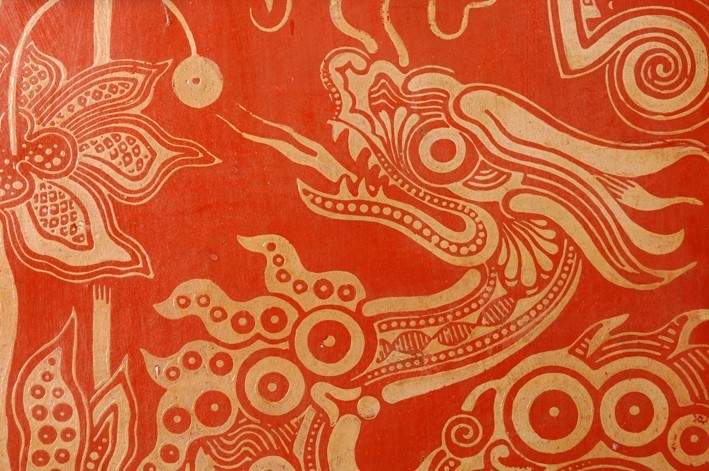
Hidden within The Royal Pavilion’s elaborate interiors are a huge variety of animals and mythical beasts. Perhaps its most famous beastly residents are the hundreds of dragons hidden in the wallpaper, on the tops of chandeliers and even crawling up the fireplaces. But is there any evidence to prove that dragons really existed? We explored our natural science collections to find out.
Detail of the wallpaper in the Red Drawing Room, Royal Pavilion
Dragon Tails
Hidden behind the scenes at the Booth Museum of Natural History are objects which some have said are the remains of dragons. This can’t be right, can it? And if not, who or what left these objects behind?
Object 1: A dragon’s tongue?
Dragon’s tongue?
In Europe during the middle ages, fossils like this one were widely accepted to be the petrified tip of a dragon’s tongue, and were given the nickname “tongue stones”. A dragons tongue would be lost through combat or death and would become petrified after leaving it’s body, turning from flesh to stone. This theory was common until it was debunked in the 17th century. But what really left this ‘tongue’ behind?
It’s on the tip of my tongue…
If we look at this photo the correct way up, we might be able to get closer to the tooth. Yes, this is a fossilised tooth! A tooth of an ancient apex predator; this predator had the strongest bite of any known living animal, feasted on whales and grew to around 15 meters long. This tooth belonged to…
Megalodon (Odotus megalodon)!
Megalodon, artists interpretation by Karen Carr CC BY 3.0
We’ve got bigger fish to fry
Odotus megalodon lived in warm seas between 20 million years ago and 3.6 million years ago. Their huge serrated teeth would have been perfect for slicing into huge prey including whales and other sharks. The name Megalodon literally means ‘giant tooth’; the largest fossil teeth that have been found are around 18cm long, which is around 3 times the size of the largest teeth of a Great White Shark!
Contrary to many reconstructions, the Megalodon didn’t look like colossal version of a Great White Shark. Megalodons had a much shorter nose and flatter jaw than the Great White Shark; it also had extra-long pectoral fins to support its weight. Megalodons were not the ancestors of the Great White Shark and they may even have been in direct competition with them!
Object 2: Dragon scales?
Fossilised dragon scales?
It’s easy to see how scaled fossils like these were presumed to be the skin of giant lizards. A larger version of this fossil was exhibited in 1851 in Wales and advertised as a “fossil of a giant serpent of immense strength”.
This fossil may not have come from a dragon or a serpent, but it certainly came from a giant — some individuals of this species measured up to 30 metres (100ft). These lifeforms were also covered in densely packed scales and inhabited low-lying swampy areas. But don’t worry — it’s bark was bigger than it’s bite…what could this scaly giant be? Have a quick think before you scroll down to reveal the answer…
The scale trees (Lepidodendron)
You’re barking up the wrong tree!
The diamond-shaped “scale” shapes on this fossil were left by the leaves on the tree as the fell from the trunks and stems. Scale trees grew in the Carboniferous 360 – 290 million years ago and were one of the most abundant trees of this period. Their trunk was green in colour, grew barely any branches and reached up to 1.8metres (6ft) in diameter. Only living around 10-15 years, they grew rapidly and reproduced only once towards the end of their lifetime by producing spores.
Object 3: Dragon teeth?
Close up of teeth from Mosasaur, Mosasaurus gracilis, jaw
Arturo de Frias Marques CC BY-SA 4.0 (Varanus komodoensis) Head portrait of a Komodo dragon, tongue out, tasting the air. Komodo, Indonesia
If you thought these fossilised teeth were from a ferocious dragon then you wouldn’t be that far from the truth. These teeth belonged to an ancestor of a living dragon; the Komodo dragon.
The Komodo dragon’s ancestors lived in the oceans around 65 million years ago and are nick-named by scientists as the T.Rex of the sea.
So, have we finally found our dragon or, at least, a giant sea serpent? Let’s find out who this tooth belonged to…
Marc from A Small Eastern Seaboard Island, United States / CC BY-SA 2.0
That’s the tooth!
Mosasaurs were clearly not dragons or even dinosaurs, but aquatic reptiles belonging to a group know as the squamates. There has been recent evidence to suggest that these animals were highly aggressive towards one-another causing an extreme amount of damage in vicious battles. Most species were around the size of a small dolphin, but the largest species was Tylosaurus. This species reached a colossal 15 meters (50ft) in length!
In the Hollywood blockbuster Jurassic World, Tylosaurus was one of the stars of the show. However, the filmmakers definitely beefed Tylosaurus up in this movie – some have estimated the movie version to be around twice the size of any known specimen – well, I guess that’s showbiz for you!
Part of lower jaw of a Mosasaur from the Booth Museum collection found in Photo by Bob Foremam
Can’t start a fire?
Unfortunately, we haven’t found evidence for real dragons, but I hope you agree, there is still an amazing array of life that has lived and still lives on our planet. That said, I will leave you with the wise words of Jeff Goldblum…
We use cookies to improve the functionality of our website.
Please accept these or set your preferences.
Functional
Always active
The technical storage or access is strictly necessary for the legitimate purpose of enabling the use of a specific service explicitly requested by the subscriber or user, or for the sole purpose of carrying out the transmission of a communication over an electronic communications network.
Preferences
The technical storage or access is necessary for the legitimate purpose of storing preferences that are not requested by the subscriber or user.
Statistics
The technical storage or access that is used exclusively for statistical purposes.The technical storage or access that is used exclusively for anonymous statistical purposes. Without a subpoena, voluntary compliance on the part of your Internet Service Provider, or additional records from a third party, information stored or retrieved for this purpose alone cannot usually be used to identify you.
Marketing
The technical storage or access is required to create user profiles to send advertising, or to track the user on a website or across several websites for similar marketing purposes.



 Our last digital offer for the festival is still screen based, but it’s something that’s designed to be used outdoors, in a way that complies with social distancing. Called The Mindful Garden, it’s a short experimental tour for the

 New Note Orchestra
 Inspired by some of the rich images of landscapes that appear in the display, the orchestra took to the woods for the day and the result is a very ethereal arrangement with the calming chime of hand bells taking centre stage. The musicians also used the natural environment around them to enhance the music, using sticks and gently knocking on tree trunks for added percussion.
 New Note’s guitarist Roger describes the piece: