Story Category: Legacy

Vesta Tilley, trailblazing entertainer

This is a legacy story from an earlier version of our website. It may contain some formatting issues and broken links.

A woman who became a Hove resident later in life was music hall star and celebrity, Vesta Tilley.  She had visited Brighton and other places in Sussex many times in her career, performing in particular at Brighton’s Hippodrome and the Theatre Royal, regaling audiences with her cheeky drag act. 

One of the most popular and successful stars of the Edwardian music hall, her trademark act was to appear on stage dressed as a variety of male characters, a judge, a policeman, a soldier, or the dimly-witted, upper-class ‘Burlington Bertie’ a well-dressed yet idle toff about London who lays in bed until late in the morning and fritters away his inheritance, making audiences laugh with her comical skits and songs.  Phenomenally successful, Vesta was the most highly paid female entertainer on the British stage before the First World War.  

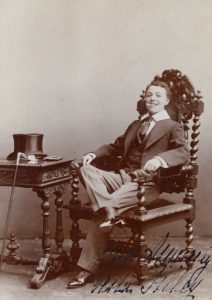
Publicity photo of Vesta Tilley

Born to a large working class family in Worcester, Vesta’s real name was Matilda Powles (1864 – 1952).  She first appeared on stage in Gloucester at the age of three.  By age five her act had expanded to impersonating a boy and she was so good at perfecting the boyish swagger she was her family’s main breadwinner by eleven.  It stood to reason that, as she grew up, she would take her brilliant comic timing into the thriving world of the music hall, changing her name to the more memorable ‘Vesta’ – named after the popular match brand –  as she went.  

Other female cross-dressers trod the boards and found fame, such as Bessie Bellwood, Ella Shields, Hetty King and Millie Hylton, but none became as huge a star as Vesta, whose rare kill in connecting to audiences and making them warm to her – honed from age three – was legendary.  The sight of Vesta, who never tried to hide her womanly singing voice, swaggering confidently on stage in trousers was notorious enough to send a frisson through the audience without straying too far from the boundaries of the double-entendre ridden, saucy music hall milieu.  Yet, however popular, Vesta did have a few critics. 

Vesta Tilley

Apparently, during the 1914 Royal Command performance, Queen Mary and the women in her entourage preferred to look away during Vesta’s performance rather than watch the shocking sight of a woman in trousers.  In 1879 she made a rare appearance as a female character, playing the Queen of Hearts at Brighton’s Theatre Royal. 

Poster for Vesta Tilley performing as Burlington Bertie

During the early days of the First World War, Vesta, dressed as a soldier, put her act to the service of army recruiting, singing songs such as ‘We Don’t Want To Lose You But We Think You Ought To Go’, sometimes urging men to come onto the stage and join up there and then.  So successful, she was even described as ‘Britain’s Best Recruitment Sergeant’.

In 1919 Vesta decided to hang up her trousers for good.  In 1890 she had married entertainment entrepreneur, Walter de Frece.  Knighted for his services to entertainment during the war, de Frece was determined to have a political career, so Vesta, knowing music hall star wasn’t a suitable career for a politician’s wife, and wanting to help him, embarked on a year long farewell tour, the proceeds of which were donated to children’s charities.   With her husband the newly elected Conservative MP for Ashton-under-Lyne and later Blackpool, the new Lady de Frece spent much of the rest of her life at her house in Monte Carlo.  Sadly her husband’s career in politics wasn’t to be as stellar as hers on stage.   Following her husband’s death, Vesta returned to the town which had always given her a warm welcome and settled in a seafront apartment in St Aubyn’s Mansions.  Now in her eighties, it would be good to think that Vesta, on stage since the age of three, could finally relax.  St Aubyn’s Mansion was also chosen as a retirement home by another local entertainment Great, Clara Butt.  Blue plaques commemorate both women today. 

Programme from Brighton Hippodrome


Written by social historan, Louise Peskett

Find out how Vesta Tilley’s story features in the current exhibition at Brighton Museum, Queer the Pier. 

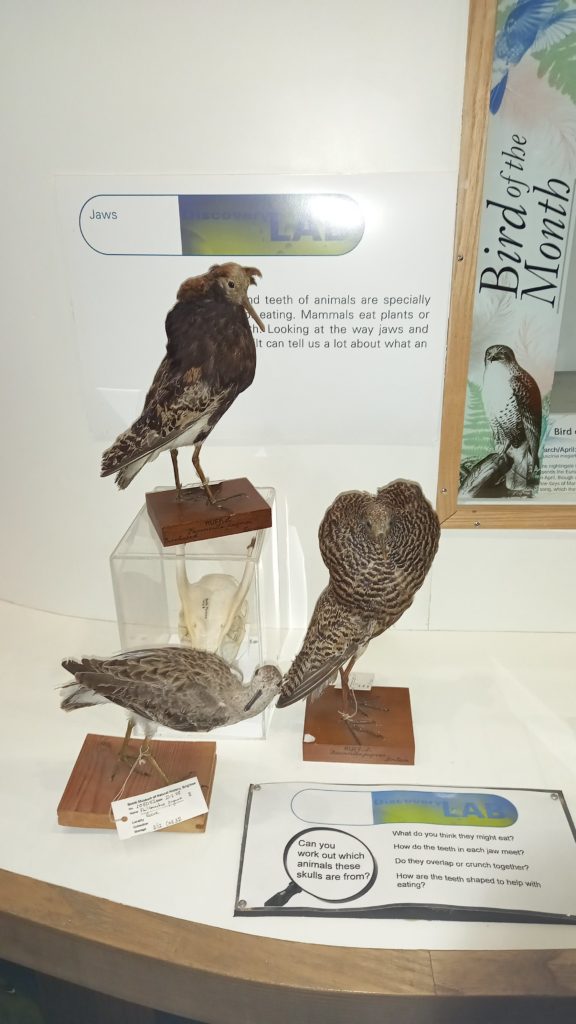
Booth Museum Bird of the Month, June 2022: Philomachus pugnax

Taxidermy birds on display

This is a legacy story from an earlier version of our website. It may contain some formatting issues and broken links.

For the return of our Bird of the Month series, we focus on the Ruff.

The Ruff is a migratory bird that spends northern winter in Africa and the tropics, and breeds in wetlands in the colder regions of Northern Eurasia. They are a wader bird, feeding in shallow water and wetland areas near the coast and lakes. They travel in very large flocks that can contain hundreds or even thousands of individual ruffs. One example from Senegal contained a million birds!

The female is called a Reeve and tends to be much smaller than the male. Whereas non-breeding ruffs have long necks with small heads and are light fawny brown in colour, the males develop impressive plumage during the breeding season (May- June) to attract mates (Reeves) in a competitive display known as ‘lekking’. They are one of the few birds that direct this display towards males rather than females.

There are three forms of male Ruff: satellitesterritorial males and faeders. Those with large white plumage are called satellites, and although not usually dominant enough to mate with Reeves will still attempt to couple. The territorial male has a dark neck ruff, and the faeder is a very rare variant with a plumage like the Reeves.

Famously associated with the elaborate stiff fabric ‘ruff’ collars worn during the Elizabethan era that ranged in size and pattern, there is debate whether the large collars were named after the bird or vice versa. Mostly likely this is where the bird got its name. The ruff’s original name, dating back to at least the 15th century, is the ree (derived from a term meaning ‘frenzied’). This name still relates to the female of the species, turning into the name Reeves.

Currently the Ruff has a population of 2 million, but in the last ten years the European population has declined by 30%. It has been suggested that the ruff might be a good indicator species for the monitoring of climate change due to its sensitivity to global warming and other changing conditions.

Rebecca Lean, Collections Assistant

Local hobby collector dreams of a real museum

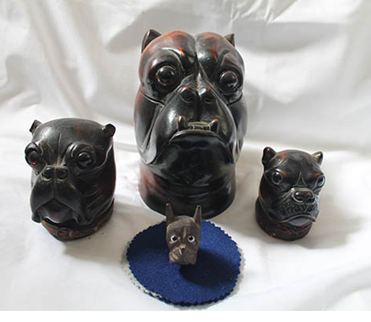
Group of bulldog figures

This is a legacy story from an earlier version of our website. It may contain some formatting issues and broken links.

Many of the objects we hold in our museums were once collected by individuals with a keen interest in a topic. But what drives collectors to collect?

In this guest post, Eiffion Ashdown of our Museum Mentors group describes his passion for English bulldog memorabilia. What has he learned along the way?

Introducing Eiffion

Hi readers. My name is Eiffion Ashdown I’m a resident of Brighton, a member of the Museum Mentors’ art group. I’m al local hobby collector that dreams of a real museum and here’s another blog article so off we go!

Let’s start at the beginning — it always helps lol — a little about my personal challenges. I am diagnosed with a complex personality disorder, OCD & magical thinking, the low times can be all consuming. I have a care plan and team behind me, this consists of a psychiatrist a doctor a CPN, and community support like Brighton museums art group and the staff that run it.

My dream of one day running a real museum comes in part from attending Brighton Museum on a regular basis, imagining my own bulldogs on display like the objects exhibited in the Willets Gallery ….no offence here, it is a beautiful collection!

Building a collection

I can’t tell you how many hours its taken, to create a world beating bulldog memorabilia collection. Some might think the collection has taken many decades to create, yet I created this all in less than 10 years.

The collection consists of English bulldog memorabilia going back over 200 years. For those that might worry, the collection is family friendly. There is no connection or affiliation to bullbaiting, this was banned way back in 1835.

So before I talk to you about one day wishing as a hobby collector to have a real museum I do have collectibulldogs.com This is the world’s first English bulldog memorabilia research and blogging website.

Out of nearly 2,000,000,000 websites that are currently live, Collectibulldogs is the only website of its kind and that’s in the world. The website was created in 2015 has gone for seven years and 4.4 million visitors have passed through the website.

Dream big

Thinking that I can just create a museum out of thin air is out of the question and my title ‘Local hobby collector dreams of a real museum’ does not do justice to the amount of work, effort, time and money it’s taken to create this collection.

Bragging is for others, I aim to be humble. Why collect you might ask?

Most of all – to create a lasting legacy.

I wish to leave my daughters something one day.

I didn’t realise it would teach me so much, not just about bulldogs but about the world around us too.

Collectibulldogs.com has taken me around the world from my own country of the U. managing different sellers as I collected and became a consultant buyer for a lady living in Hawaii!

The dream job! I was put in charge of sourcing buying and researching bulldog memorabilia, antiques and collectibles for this one special buyer. This relationship sometimes went both ways and I’d get a surprise offering in the post.

The picture you see is a beautiful crystal bulldog made by a top American company and normally created and presented as gifts and awards. My bulldog cost about four hundred dollars, there is not another like it.

You can find English bulldog memorabilia in our collection from many countries with a few that really pushed out bulldog history in object form. Some countries are older than others and this would affect the social demographic. An example would be the youth of American history, yet its love for the bulldog can be found everywhere. You can check out this link https://www.collectibulldogs.com/mack-trucks-americas-past-american-antiques-special/ for great bulldog vintage and antique related memorabilia from the USA.

English bulldog collectors are dwindling in numbers and bulldog memorabilia becomes even more expensive with many pieces out of the reach of collectors. If you wish to stay in touch then my Facebook page contains hundreds if not thousands of posts, you can and meet over seven thousand other interested people that support collectibulldogs.

I have 11 years’ experience of loving and caring for my own live bulldogs as well as all the memorabilia and all the antiques related to them. As a chap with a huge life passion, I think this is one of the biggest and best of any breeds. If anyone wanted to start a collection feel free to join in and enjoy all that collecting brings. I am so glad that I chose the English bulldog as my collection theme. Maybe you have another passion…. jewellery, teapots, clocks, records, anything to do with cats? What would you collect?

Learning about each part of the collection has been either a joy or a headache, either way it has helped me to add interesting and creative content to my website blogs. I hope that readers may learn and enjoy as I have. I hope you can share in the joy from this past time passion of yesteryear.

Yearning for learning!

In 2017 I participated in a display with other art group members. This was, I understand, the world’s first ever bulldog exhibition / display. It lasted seven months and gave me the idea that Brighton wouldn’t be worse off if it had a dedicated memorabilia photo museum… maybe the first in the country?

If you don’t mind, I would like to talk a little more about what I have learned. As a hobby collector of English bulldog memorabilia, my approach and research often delves deep…. please understand, the 11 years of just researching this niche has given me so much.

At times I might say it’s given me a structure and a purpose in life.

The collection I feel is a great reflection of diversity and different cultures. There are items from England, Denmark, Germany and Japan. 80% of the worlds English bulldog memorabilia has travelled vast distances around the globe. Some of the collection pieces are post World War II German. Japanese pieces are hugely admired and currently highly collectible.

The style colour and stance of a ceramic bulldog can tell you a lot about where it comes from and who made it. Identifying a piece – this does take a little bit of skill and at times isn’t 100%, I mostly get it right, checking double checking and triple checking various sources gives as much accuracy as anyone can hope for.  By looking at the finished colour most of the time in the dog’s face, I can reveal a lot about an item and its past.

When you learn about a bulldog piece, you’re learning about history too. I notice which pottery house it was made in. I research questions such as:

  • What was going on during the date that it was made?
  • Where it was made?
  • Is there more I can discover about the village/town/city?

From Staffordshire to Kuala Lumpur

Royal Doulton in England, Royal Copenhagen in Denmark. These are just two factories of ceramics that I could research for days and days on end. The same with the Nymphenburg factory in Germany. German ceramics have fascinated me. I have found thousands of production outlets in Germany alone.

England itself has over 1000 different pottery houses. In the 1800s a lot of these were in Staffordshire and Derbyshire. You can find out much more about the most famous ceramic production houses here, I hope you enjoy dipping in and out of the many blogs on Collectibulldogs.

Pottery houses are just one part of the big bulldog collection story as it stands there are around 15 subsections in the collection consisting of nearly 5000 pieces. Ranging from, ceramics, metals, art and illustrations. Additionally featuring an active bulldog club, the antiques and pieces go back in history as far as Queen Victoria, a few predating the Victorian era.

I hope one day that my dream of owning or running a bulldog museum does come true, this feels more than just a pipe dream. One day it will be amazing for the country as a whole to have a new kind of community-based project.  A project developed by one person (with a fair bit of support love & kindness in the wings – big respect here to my family friends and followers) for the whole world to see….

…..and that’s why I wish to own my own bulldog museum.

A big thank you

Collectibulldogs would like to thank Brighton Museum for this content creation opportunity. I love blogging and it always feels more special when I’m guesting for my own local and city-wide favourite museum. Myself and my fellow Museum Mentor client’s (add a project related link here) are lucky as we get to walk the museum each week and millions more only see the website.

Let me finally finish by saying if you visit Brighton do not think for a minute that Brighton Museum is old fashioned or emulates the Pavilion as this cannot be further from the truth, with wheelchair access to the first floor and looking down on what could have been the Prince Regent’s tennis court, this museum has a bit of everything for everyone. Brighton Museum has great installations and is a very interesting building not just a place to escape the rain so book your tickets (in advance really helps this charitable organisation). When you visit our beautiful city, you can just get your sticker and enjoy a visual feast.

Email ask@collectibulldogs.com

www.collectibulldogs.com

Eiffion Ashdown
The ill-fated Music Room

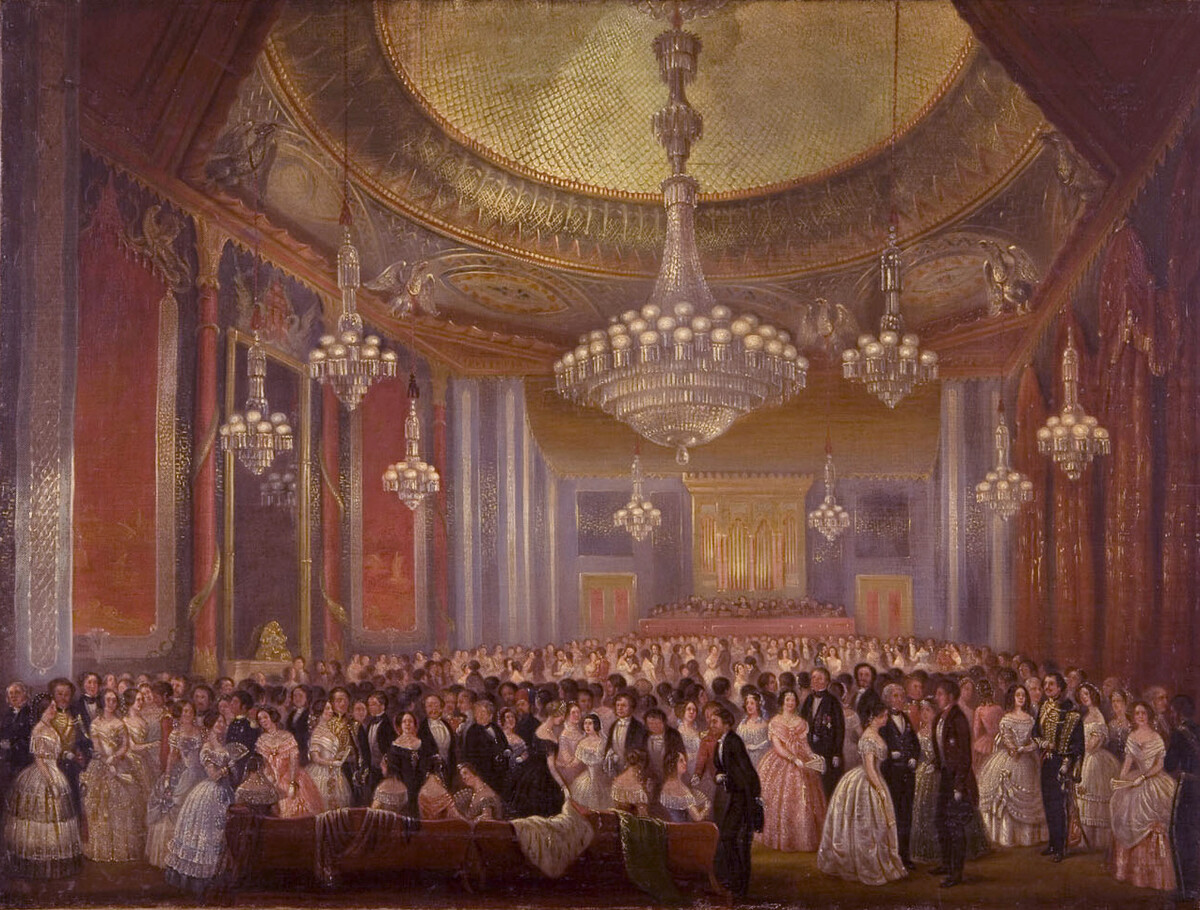
The Music Room, Royal Pavilion: The Grand Re-Opening Ball

This is a legacy story from an earlier version of our website. It may contain some formatting issues and broken links.

The Royal Pavilion Music Room is well recorded having suffered major damage from a fire in 1975, which then took eleven years to restore.

The Music Room, Royal Pavilion: The Grand Re-Opening Ball

The Music Room, Royal Pavilion: The Grand Re-Opening Ball

A year later in 1987 it was to suffer again during the Great Storm in October. One of the stone balls from the minarets on the outside of the Pavilion came crashing through the Music Room ceiling and embedded itself into the newly laid Axminster carpet. This resulted in a further five years of restoration.

Music Room Storm Damage 1987

Music Room Storm Damage 1987

What is little-known however, is a century earlier in May 1863, an explosion occurred which could have lost the Royal Pavilion.

West Front of The Royal Pavilion, Brighton. Edward Fox, 1850

An evening’s entertainment had been arranged in the Music Room. Collin’s Christy’s Minstrels were to perform. The room was filled with a crowded audience by the time it became evident there was a strong smell of gas. The large chandelier was lit, but none of the others appeared to be turned on. The audience became quite anxious.

The officials hunted around the room seeking out the leak. One of Christy’s men brought in a lighted taper to test where the escaped gas was coming from. Unfortunately, the taper set fire to the gas, which then carried through the pipes, lighting the various chandeliers in the room on fire, ‘almost instantaneously the gas ran about as it were like wildfire,’ which immediately caused an explosion.

A light was seen to be passed along the wall about seven or eight feet from the floor. Instantly, a great patch of flames was seen, then another explosion occurred further along and higher up the wall. A third but lesser explosion followed towards the roof. This brought down a mass of plaster, woodwork and broken glass, which crashed to the floor, luckily escaping the crowd.

Dense volumes of smoke filled the room and extinguished the large chandelier. The terror-stricken crowd rushed to the doors, which became blocked, but luckily no one was seriously injured. It was fortunate that William Thomas Quartermain, the Superintendent of the fire engines was present. Mr De Val, the Custodian of the Pavilion, thinking quickly, went and turned off the gas supply immediately, and having an excellent water supply the fire was soon extinguished.

The Chairman of the Pavilion Committee, Alderman Burrows and Alderman Martin were also present to render their services, and for all their prompt action prevented the spread of fire that may have resulted in the destruction of the ‘greatest ornament to the town of Brighton.’

Many of the windows in the Music Room were shattered and the damask curtains caught fire. The damage was considerable and would take some time to restore it to its former state. The building itself was deemed safe and therefore Collin’s Christy’s Minstrels were able to perform the next day in the Banqueting Room instead.

Royal Pavilion Banqueting Room

Royal Pavilion Banqueting Room

Carol Homewood, VSO 

The Booth Museum, an update to the Victorian Parlour

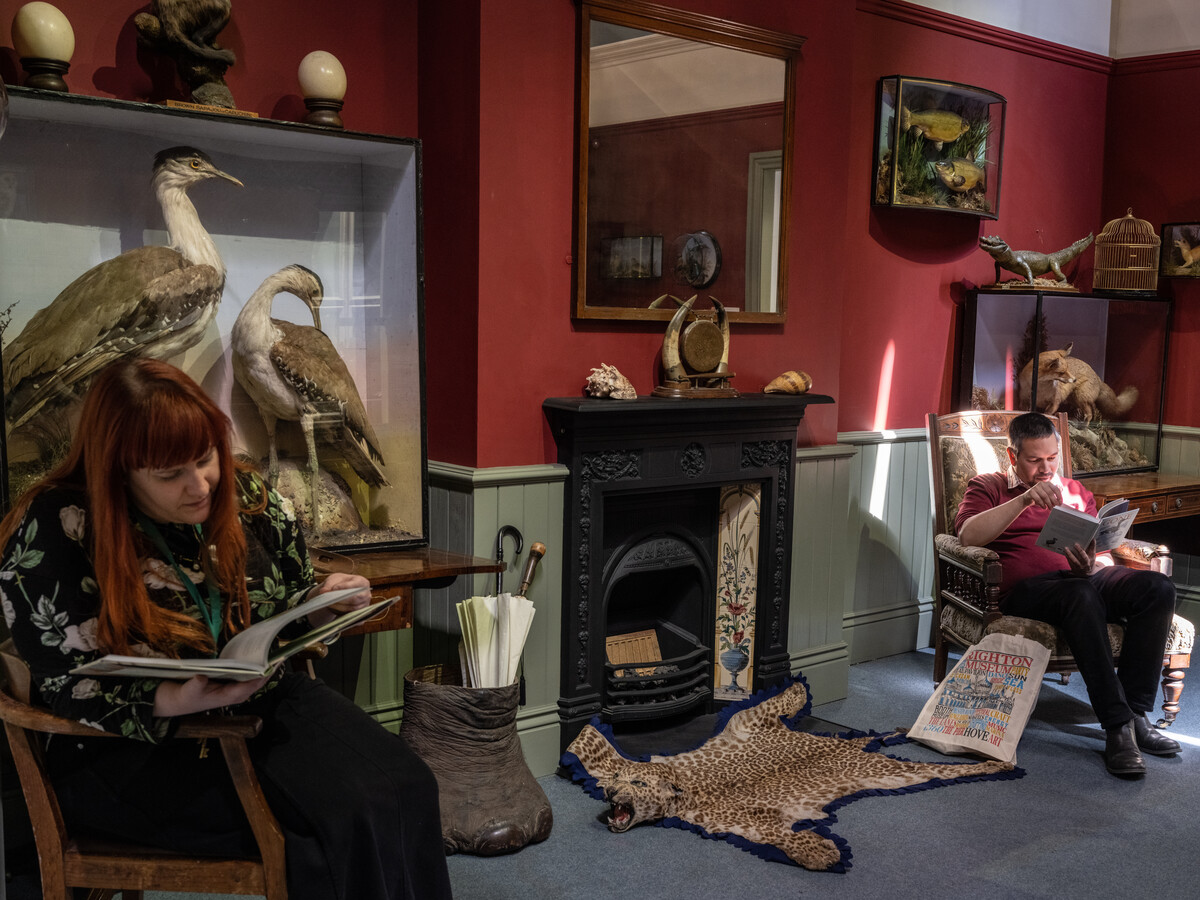
Two people seated and reading in recreated Victorian parlour.

This is a legacy story from an earlier version of our website. It may contain some formatting issues and broken links.

We have made some adjustments to the Victorian Parlour in the Booth Museum to increase its accessibility and encourage a more hands on experience.

Victorian Parlour

Victorian Parlour

Visitor feedback has indicated that people would love to sit down and touch objects in the space, so we have removed the rope and alarm from one side of the space, introduced a new chair for visitors to sit on, and added a different leopard rug to encourage younger visitors to explore on the floor.

Victorian Parlour

Victorian Parlour

We will be opening up the other side of the space soon and adding some more engagement touches. Please do feel free to touch and explore when you’re next at the Booth, take a picture of yourself enjoying the new look parlour and tag us using #boothmuseum

Lee Ismail, Curator of Natural Sciences  

Introducing the Pagodas Project

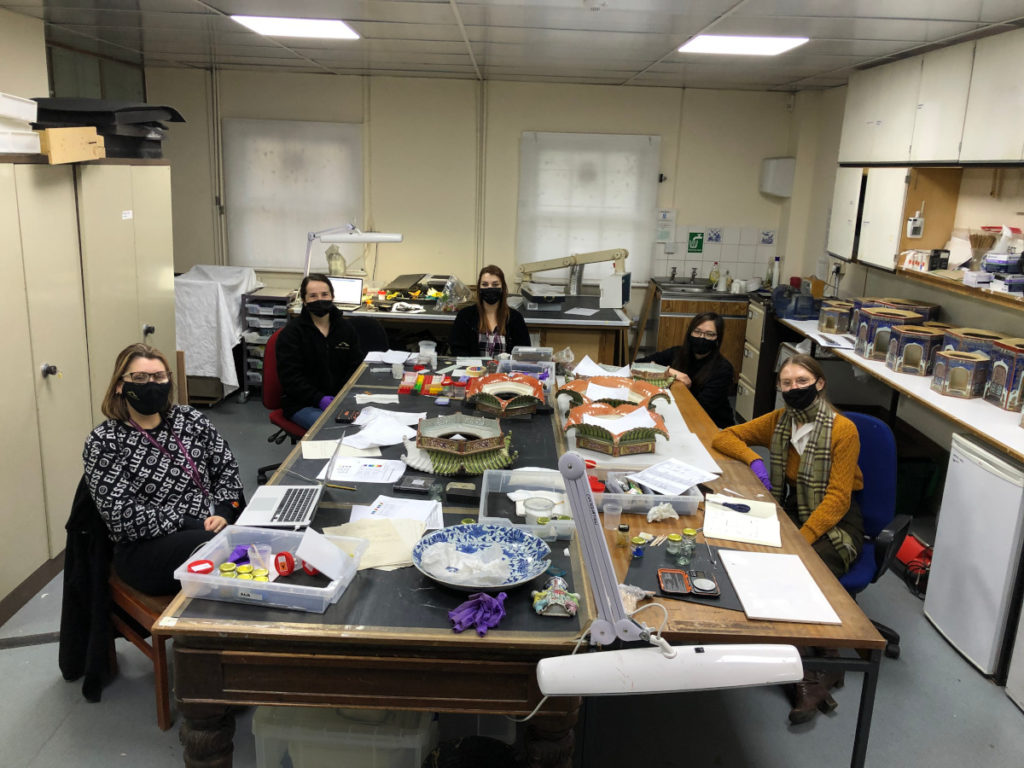
Group of conservators seated around a table.

This is a legacy story from an earlier version of our website. It may contain some formatting issues and broken links.

In December 2021, after a pause due to both the Covid pandemic and a change in contractor, conservation work has recommenced to complete the conservation of two large ceramic pagodas from within the Royal Pavilion & Musuems Trust (RPMT) collections.

The project is now being undertaken in the RPMT Conservation Workshop by a group of talented emerging conservators, supervised by Object Conservator Andy Thackray ACR. The funding of the project is heavily supported by generous donors and will result in not only two restored pagodas on display in the Music Room, but also the establishment of three conservators that can go on and hopefuly have fruitful careers looking after our cultural heritage. This is the first blog of a series that will document the experience and undertakings of the team as we carry out our work. Meet our team: Ana, Bernarda, Hannah, Vivien and Samantha (left to right).

The large ceramic pagodas were acquired from Sir Kenneth Clark in 1949, before which the provenance is unknown. Little is known about these objects but it is known that a few identical objects came to Britain along with the commercial trade from China around the late 18th/ early 19th century. Four similar pagodas were originally displayed between the window piers in the Music Room at the Royal Pavilion, Brighton. All of these are accounted for in the Royal Collection and they were recently temporarily loaned back alongside many other objects for the A Prince’s Treasure Exhibition.
The group of pagodas loaned by the Royal Collection, in the Music Room of the Royal Pavilion during the Prince’s Treasure exhibition. These pagodas were originally commissioned by George IV for this room and later taken to the Buckingham Palace during Queen’s Victoria reign. Royal Collection Trust/© Her Majesty Queen Elizabeth II 2022

Believe it or not, the pagodas purchased for the Music Room were further embellished and enlarged with grand bases and finials in order to perfectly fit the scale and decorative scheme of the room. The pagodas that this project seeks to restore are almost identical to the original Music Room pagodas, albeit appearing in the form they took prior to these embellishments.

Another pair of almost identical pagodas came up for sale at Christie’s in 2013. You may find more information on these from the Christie’s website.

Aside from these, only one other example in the V&A East Asia Collection is known of as well as another that was sold into a private collection from Woburn Abbey in 1954 which had many damages plus five whole tiers, the finial and all of the applied ornaments missing.

V&A Museum Pagoda - © Victoria and Albert Museum, London

V&A Museum Pagoda – © Victoria and Albert Museum, London

Detail from the V&A Pagoda, showing a couple of the exquisite and unique porcelain figurines that live in each tier – © Victoria and Albert Museum, London

The pagodas are made of soft paste porcelain, with beautiful colourful decorative glazes and striking details like dragons and painted landscapes. They are composed of nine tiers made up from nineteen stacked components. They have decorative detachable metal bells, metal carp and both ceramic and metal Fu dogs. When fully constructed, the pagodas reach over 2.5 metres high.

Some pagoda tiers in their bespoke storage crates

Top roof tip ornament with hanging bell suspended from a rod (the bell may be original but the rod and finial are likely to be later replacements)

Gilt metal carp surmounting roof tips with a hanging bell. The carp are likely replacements as the gilt brass carp on other examples are less crude and are oriented face down (see images above of the V&A pagoda). The originals were most likely attached to the ceramic by a pin extending from the throat so that their tail extended upwards. A chain was most likely attached to a loop on the fish belly from which the bell was hung.

Gilt brass lions which are likely original

A few remaining porcelain lions which judging from the decoration are likely to be original. It’s unclear at this stage how the brass and porcelain lions were distributed over the pagodas.

The pagodas have presented several structural and aesthetic conservation problems for us to solve,losses, fragmentation and previous treatments that needed to be revised. We have started with photography sessions, documenting the initial condition of the pagodas before any treatment done by us.

The team photographing one of the tiers from one of the pagodas

The photography set up used by the team.

Tier 1 and 2 of one of the pagodas photographed by the team to document the condition before treatment. We can easily see the losses (image on the left) and historical fillings from previous treatments (image on the right).

We have also used these photographs to map their condition. These maps will document all the conservation issues, past treatments and new interventions.

Before doing any planned treatment, we have carried out a series of tests and trials. These tests will help us to chose optimal materials and methodologies for our treatments.

Mixing epoxy resin, filler and pigment ingredients

Test mixtures of epoxy resin, fillers and colouring agents to gauge working properties and appearance at imitating porcelain

A novel use for children’s building blocks to hold silicone rubber in place while it cures. It is initially poured into these enclosures to create moulds of undamaged sections. From these moulds we can cast accurate reproduction sections to compensate for losses elsewhere on the pagodas.

Silicone rubber mould experimentation

So far, we have been amazed with the project. The pagodas are such an interesting and beautiful part of the Royal Pavilion collection. We are excited to keep you updated with the different phases of this project and we hope you can see the restored pieces in the Royal Pavilion in the near future. Until then, please stay tuned for our next blog.

Ana Vilela, RPMT Conservation Assistant

Marilyn Stafford: A life in Photography Story behind the picture: Algerian Refugee in Tunisia, 1958

Black & white photo of an Algerian Refugee

This is a legacy story from an earlier version of our website. It may contain some formatting issues and broken links.

As photography fans are flocking to the Marilyn Stafford: Life in Photography exhibition at Brighton Museum, we asked Nicola Jeffs, who is a member of the Marilyn Stafford Working Group Collective, to tell us more about her work.

Until recently, Marilyn Stafford kept her archive of black and white photographs of 20th century icons, portraits from the reporting fields and swathes of pictures of the high and low societies of post-1945 Paris, London and the Middle East out of the limelight, in her home in West Sussex.

Lately, she’s been having her well-deserved moment in the (flash bulb) light with a raft of cleverly curated retrospective exhibitions across the globe, the latest being her biggest exhibition to date, here at Brighton Museum.

You will have glanced at the now infamous picture of Albert Einstein hunched in his armchair back in 1948 in newspapers, books and websites. Or have seen the deft images capturing a resplendent Indira Gandhi ascending from a plane bedecked in furs and oozing matriarchal confidence. Or, perhaps you have viewed the gamine fashion snaps of Twiggy or Sharon Tate, now frequently called upon as mid-20th century inspiration by Vogue editors rifling through the archives to find that special shot of the swinging 1960s. These are all Marilyn’s work.

To me, some of Marilyn’s most interesting photography, however, is of lesser known but equally strong and significant women in history. She is a self-identified humanitarian and a documentary photographer who also worked in fashion.

She says, “I was doing one (type of photography) as it’s what you believe in, the other for survival” in reference to her double life as a documentary news and fashion photographer.

Let’s rewind to 1958.

Marilyn was drawn to Tunisia, from her adopted home in Paris. The French government were engaged in an extremely brutal guerilla war with anti-colonial forces. A long, bloody conflict employing mass murder, terror and torture had resulted in the displacement of 2 million Algerians who spilled over the border into neighboring Tunisia where Marilyn headed to help tell their story.

I was living in Paris and I was always interested, since World War Two, in displaced peoples; migrants. When the French bombed a Red Cross Hospital on the border, the international interest in Algeria grew. So, I went down to Tunisia and made contact with the Liberation Army and said I wanted to do a story,” she recalls.

Unlike many of Marilyn’s other fashion or celebrity portraits, the name of this woman is not A-list or associated with a special brand or campaign. In fact, it is not given or known. We have no knowledge about her as a person other than the title which indicates her refugee status and where she was when it was shot.

Algerian Refugee in Tunisia, 1958 © Marilyn Stafford

Algerian Refugee in Tunisia, 1958 © Marilyn Stafford

“I know nothing about her other than this picture, nothing at all”, Marilyn adds.

The traditional dress and the bare feet in the photo marks her as an Algerian from a poor background. The image, shot in black and white, emphasizes the distressed, layered North African garments. The folds and shadows in her clothes hide stories. The cloth of her dress is reminiscent of the women’s dresses from the final scene in the film Battle of Algiers. You can almost hear the shrill, guttural throat singing and see the cloth of the spinning cloaks cascading towards the French policemen and army.

The woman in this portrait looks angry and defiant. Her face is uncovered; unveiled. This is revealing now, looking back, in showing the status of women at the time of Independence some four years later.

Marilyn was 5 months pregnant when she traveled to Tunisia and this was surely in her mind when taking this image. “Something must have happened”, she tells me. It’s a universal image of motherhood and protection of a child against adversity. A baby is swaddled in heaps of ragged materials, possibly the only things the woman had to keep the baby as safe as she could. Marilyn adds, “I called her my Madonna.”

One is reminded of Dorothea Lange’s portrait of the Migrant Mother (1936) in Marilyn’s image. Except, the woman in our photo addresses the camera with her gaze face on. She is part of a defiant group, albeit desperate economically, who had been brutally forced from their homes amidst fire, rape and gun shot, not wearily searching for something as those in the Midwest were. Her anger and dissent are palpable in the photo. Noteworthy, too, perhaps, is that Depression-era America is the land of Marilyn’s own childhood.

Other images from this series, men praying and landscape shots of the refugee camps, appeared in The Observer in March 1958, to tell the story of what was taking place in Tunisia. A quick dig in the online archives tells us that The Observer that year was concerned with NATO, détente and UK divorce law. That an image of an emaciated woman caught up in the post ‘45 French colonial disentanglement should have been a front cover choice for British newspaper readers is striking and unique.

The tones of black, white and grey in this image evoke someone, on the edge, on the border, between two countries. The woman sits on a wall with dark stone on one side and clean white stone on the other. This could be taken to represent her refugee status and her life in flux, caught between her place of refuge and her former home. The composition of the image also places her very much in the foreground, emphasizing her as the subject, as a woman first and her circumstances second. She sits proud in front of the slumped sand sack behind her.

The young, ambitious Marilyn worked with Henri Cartier-Bresson to hone her craft of street photography and the candor of her mentor’s work shines through into Marilyn’s own work. You can see this in this image we have been discussing. Given less than a day in the refugee camp, Marilyn took scores of images that day evoking her mentor’s ‘decisive moment’ style. He thought so too, as it was Cartier-Bresson who sent the images to their publisher The Observer, after Marilyn showed them to him back in Paris.

To me, she is a Joan Didion with a camera, a bird-like frame, neat bobbed hair, with a sharp wit, and a kind heart. Marilyn’s ability to get to the places she needed to in order to get the shots she wanted; with sharp reflections about women, from a woman grafting in a male industry, were perhaps unparalleled at the time. It is fitting her work is now getting the recognition it deserves.

Nicola Jeffs, Marilyn Stafford Press Officer

East Lawn TLC

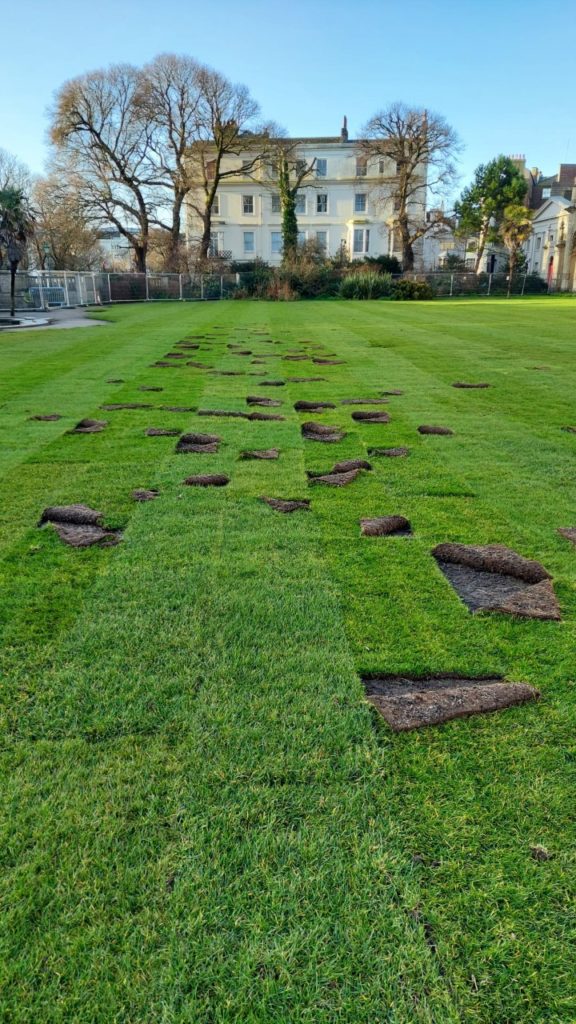
Lawn with pieces of turf being laid.

This is a legacy story from an earlier version of our website. It may contain some formatting issues and broken links.

You may have noticed some interesting activity on the East Lawn of the Pavilion Estate over the past few weeks.

Since the deinstallation of the ice rink, the garden and pond have received some much-needed TLC. As we prepare to reopen the lawn for the public to enjoy the glorious spring sunshine, take a look at why it has been fenced off.

It began with the reinstatement of new turf on the East Elevation lawn.

We’ve been lucky this winter in not receiving regular heavy downpours, which can hinder both soil preparation and re-turfing. So plans began to rotavate the compacted soil surface in readiness for turf laying.

Fencing was left in place around the new turf until it established a rootzone. We were hoping for Easter, although the plan was subject to change and dictated by our unpredictable weather! But we got lucky. 

The re-turfing team lay 1000s of rolls of turf for the lawn to return to its magnificent green.

Time was needed for it to bed in, as long as the pesky seagulls stayed away!

We bought a new hawk decoy and waited to see if Brighton seagulls would fall for such a ruse!

After the lawn, came the pond clean. Thankfully the Sussex Pond Doctor was on hand to help and gave it a much needed drain and clean – look at some of the discarded items they fished out of there!

[arve url=”https://www.youtube.com/watch?v=epNOdwTuCes&ab_channel=SussexPondDoctor” align=”center” loop=”no” muted=”no” /]

Now the lawn has reopened for everyone to sit, relax and enjoy. Please do so and take care to treat it kindly, so it doesn’t fall to the dark side again.

Rob Boyle, Head Gardener

Ada Rose Brown, the Census, and Secrets

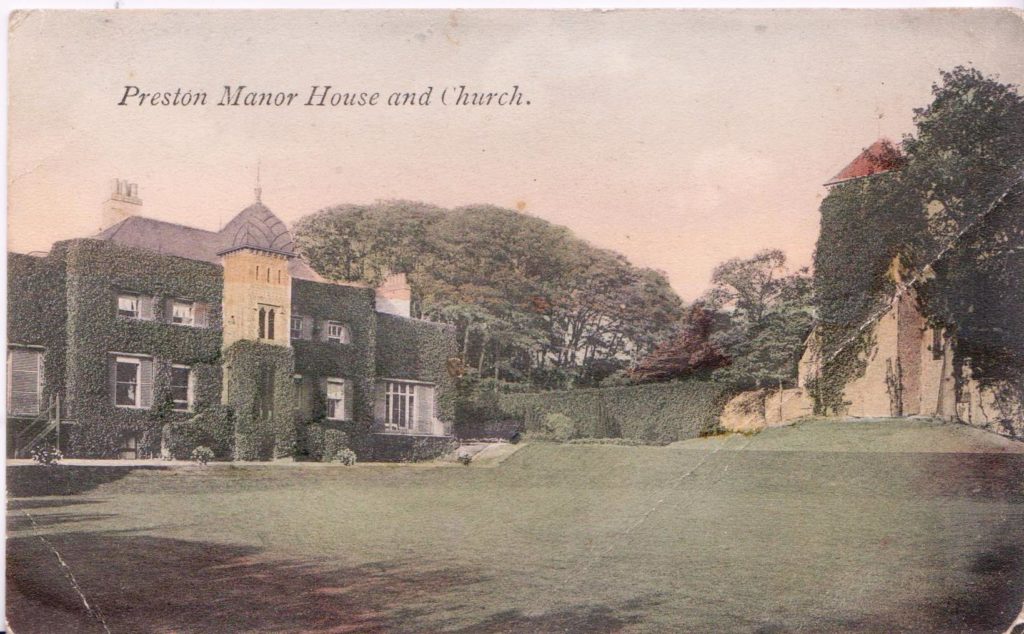
Postcard showing Preston Manor and church

This is a legacy story from an earlier version of our website. It may contain some formatting issues and broken links.

Ada Brown worked as a housemaid at Preston Manor appearing on the 1901 census with six other servants. She then disappeared from history and ordinarily her life would be forgotten.

However, the opening of the 1921 census in 2022 began a trail of clues that uncovered Ada’s secrets.

Preston Manor

Preston Manor

Ada’s birth, the mystery begins

Ada’s birth was registered in the January to April quarter of 1871. The census taken on 2nd April records Ada as two months old, putting her birth as early February 1871. The 1881 census of 4th April has Ada aged 11 or born 1870. Why the discrepancy? As today, parents had 42 days to legally register the birth of a child. If Ada’s parents missed the deadline a legally acceptable date may have been concocted to avoid censure.

Ada was the fifth daughter and youngest of seven children born to a poor family. Her arrival was unremarkable. Records show Ada never knew her birth date.

Ada’s humble beginnings

Ada’s story was not destined for the history books. She was born to a laundress mother and agricultural labourer father in Great Marlow Buckinghamshire. Girls like Ada could expect a basic education before a brief period working in domestic service then marriage as soon as possible. Ada’s older sisters, Margaret, Clara, Emily, and Laura married in the 1880s between the ages of 18 and 29. Emily’s husband Francis Cracknell will later feature in Ada’s secret life.  

1891: A Cornish mystery

Aged 22, Ada is working as Second Housemaid at the grand Whiteway House at Chudleigh, Devon. A hundred miles away in the laundry block of a mansion called Trelissick House, Ada’s married sister Emily Cracknell is giving birth to her second child, daughter Alice. The birth is attended by Ada and Emily’s mother, Alice Brown who the child is named after. Emily and Alice are far from home employed as laundresses. Where is Emily’s husband Francis Cracknell?

Chudleigh Devon

Chudleigh Devon

1901: Ada lured by the bright lights of Brighton

Ada moves to the enticing seaside town of Brighton working as a housemaid for 76 year old widow, Mrs Eleanor Macdonald at Preston Manor. Mrs Macdonald dies in 1903 although servants stay on. A re-development project begins at the Manor with the construction of a new dining room, veranda corridor and West Wing bringing numerous workmen to the house and much interest to the domestic staff. In 1901 Ada’s mother dies, so too does Queen Victoria heralding a brighter more exciting time to be alive. Ada is tempted to live this new thrilling life to the full.

Mr Elphick's postcard of Preston Manor donated by him in 1979

Preston Manor

1905: consequences, an illegitimate child

On 14th February 1905 Ada gives birth to a baby girl registered on 25th March in Brighton. Brave resilient Ada names her baby girl Maggie Gordon. Is this a clue to Maggie’s father’s name? Maggie’s birth certificate shows a blank for father’s name and occupation. Ada gives her occupation as ‘housemaid (domestic) but she cannot work and care for her baby. In 1905 there is no state help for unmarried mothers. At the age of 34 and with no mother of her own and no chance of employment or respectable marriage, Ada’s position is precarious. She must give up her child for adoption or turn to family for support.

Maggie Gordon birth certificate 1905

Maggie Gordon birth certificate 1905

1907: A family tragedy strikes

Two years after Maggie’s birth Ada’s family is plunged into tragedy. Ada’s niece, born mysteriously in the laundry block at Trelissick, is now aged 15. Alice is her mother’s precious daughter, a healthy happy girl with four older brothers, Frank, Alexander, Leonard, and Jack. On 18th February 1907 Alice dies suddenly. Her death certificate records cause of death as “meningitis due to an infection by a pneumococcus” registered as “death by natural causes.” Meningitis is a serious and sudden-onset bacterial infection of the brain and spinal cord. Today preventable with vaccination and treatable with antibiotics, the illness was a death sentence in 1907. Alice was not taken to hospital because nothing could be done for her. The family live at the Birling Gap Hotel where Alice’s father, Francis Cracknell is hotel proprietor. It is here Alice dies. A more pitiful picture cannot be imagined of the dying girl surrounded by her grieving parents and brothers on the bleak winter cliffs.

1907 Alice Cracknell death certificate

1907 Alice Cracknell death certificate

Sister Emily’s mental health breaks down

Ada’s sister, Emily Cracknell had a history of mental health problems. Records on the UK Lunacy Patients Admission Register show her incarcerated in 1903, 1907 and 1911. Emily enters the Hellingly County Asylum in East Sussex on 24th October 1907 traumatised by her daughter’s death that year.

At this time in history women were often admitted into asylums for short periods to recover from what were termed ‘nervous breakdown’ – once rested they were sent on their way. However, Emily never left Hellingly for she died there on 4th November 1912 aged 46.

Hellingly Hospital former asylum

Hellingly Hospital former asylum

1911: A bigamous marriage?

Ada appears on official record on the 1911 register of UK Births, Marriages and Deaths revealing marriage to her brother-in-law of 23 years, Francis Ernest Cracknell at Eastbourne in the first quarter of the year.

Two historical secrets are uncovered: Ada’s husband’s first wife, her sister Emily, is still living, and Ada is pregnant again. No record of a divorce exists for Francis and Emily Cracknell. Without a divorce Ada and Francis are not free to marry. Yet they go ahead. Ada already carries the stigma of being an unmarried mother once in her life. She is to be spared the disgrace twice, even if her husband must break the law to do so. This series of events show that Ada took refuge with family after Maggie’s 1905 birth. Possibly she put her housemaid skills to work helping at the Birling Gap Hotel. Certainly, she and Francis gravitated together.

Birling Gap

Birling Gap

1911: the census begs more questions

The 1911 Kelly’s Directory lists E. Cracknell as Proprietor of the Birling Gap Hoteland here the newly re-constructed family appear on the census taken on 2nd April. Ada, the former domestic servant, is now a respectable married woman employing a servant of her own, a 22 year old local girl called Edith Christmas. An extra hand is needed because of Ada’s pregnancy. Ada’s six-year-old daughter Maggie has been sent to live with her aunt Clara, living at Southall in Middlesex.

The 1911 census return shows Francis Ernest Cracknell and Ada Rose Brown as husband and wife ‘married for less than one year.’ The four boys are recorded as ‘by first wife’ but where is first wife, Emily? She won’t be admitted into the Hellingly Asylum until October.

Kelly's Directory

Kelly’s Directory

1911: Another daughter for Ada

On 4th July 1911 Ada gives birth to her second daughter. Winnifred ‘Winnie’ Cracknell, a sister for Maggie born at the Birling Gap Hotel. Neither girl will marry nor leave a trace in history until their death registrations. Maggie died aged 80 at Eastbourne in 1985. Winnie died two days before her 93rd birthday at Worthing, West Sussex, in 2001.

1921: Complex family life 100 years ago

The 1921 census shows Ada and Francis Cracknell running the Red Lion Hotel at Stone Cross, Westham near Pevensey. Maggie is aged 16 and Winnie will soon turn 10. Three of Ada’s nephews, Francis’s adult sons, who are also Ada’s step-sons, live and help at the Red Lion. The family have a visitor staying, Ada’s widowed 58 year-old sister, Margaret who lives in Tooting. Her late husband William McKnight worked all his life as an asylum attendant. Perhaps it was he who helped the family admit Emily into the asylum system?

1939: History’s goodbye to Ada Rose Brown

Ada died in the first quarter of 1939 as Ada Rose Cracknell, aged 68 or 69. In September that year a national UK register was taken of the civilian population to be used for wartime purposes. Francis Ernest Cracknell, retired hotel keeper, is listed as living at a house called ‘Norfolk’ on the long Rattle Road, Pevensey. 34 year old Maggie lives with her step-father and works as a barmaid. Francis outlived Ada by twelve years, dying aged 91 on 4th March 1951 at his residence, ‘Norfolk.’ Probate records name Maggie Brown, spinster. Francis’s effects are worth £1,005 (equal in value to around £35,000 in 2022)

2022: Ada Brown lives on!

While Brighton’s museums were closed by Covid-19 pandemic Royal Pavilion & Museums Trust learning team re-developed the popular long-running Key Stage 2 school session ‘Victorian Role Play’ at Preston Manor. Characters from Preston Manor’s past were chosen from the 1901 census to demonstrate the work of Victorian servants and Ada Brown’s name was selected (along with butler, Benjamin Beesley). Today, visiting children dressed in Victorian costume arrive at Preston Manor and meet a housemaid called Ada Brown and spend time with her immersed in the work of a Victorian servant. The real Ada Brown would be astonished at her legacy.

Paula Wrightson, Venue Officer Preston Manor 

Water Buffalo gets a head start at the Booth Museum

Water buffalo and other animal heads on display.

This is a legacy story from an earlier version of our website. It may contain some formatting issues and broken links.

As part of the Booth Museum closed period, we have been rotating the display heads mounted in the gallery, and replacing those on display with some which haven’t yet been displayed.

These include a tiger and warthog, but one head that has always been too difficult to move, has finally been displayed with the help of staff on site during the closed period.

Water Buffalo Head

Water Buffalo Head

This is the first time the water buffalo head has been displayed at the Booth Museum since it was originally transferred here from Brighton Museum & Art Gallery in the 1970s.

Water Buffalo Head

Water Buffalo Head

The picture features VSO Jennifer Robinson and the African Cape Buffalo skull for size comparison! We hope you can come and see for yourself when we reopen this Saturday 12th. 

Lee Ismail, Curator of Natural Sciences