Story Category: Legacy

Eighteenth Century Architectural Styles at Preston Manor

Preston Manor

This is a legacy story from an earlier version of our website. It may contain some formatting issues and broken links.

Many visitors have fallen in love with the beautiful Edwardian interiors of Preston Manor. For RPM Visitor Services Officer Naomi Daw, it is the influence of Palladianism and sense of balance of the exterior which has captured her attention.

Preston Manor is located on the outskirts of the city of Brighton and Hove, on Preston Drove. It is set on the edge of the grounds of Preston Park, a public park and focal point for local events. Inside the building, the beautiful Edwardian interiors have been restored so visitors can experience what everyday life was like during the Edwardian period.

My interest is in the exterior of the building, which shows the influence of Palladianism, and the garden spaces around the building. I will be exploring both the exterior of the building and the gardens around Preston Manor in this piece.

The building has been owned by Brighton and Hove City Council, previously the Brighton Corporation, since 1932. It was left to the people of Brighton ‘by deed of gift, dated 30th March 1925’, by Sir Charles Thomas Stanford, who owned the house. The first record of Preston Manor is in the Domesday Book of 1086, where it is recorded as one of eight manors belonging to the Bishopric of Chichester. It then passed to the ownership of the Elrington family in 1510, and then to the Shirley family in 1569. The Western family acquired the property in 1712, and kept it until 1794 when it was bought by William Stanford for the sum of £17,600. The Manor building has changed drastically since its mention in the Domesday Book. Thomas Western completely demolished the original building in 1738, rebuilding it according to the fashion of the time, and adding two small wings in 1750. Few additions or changes were made to the building in the nineteenth century, other than the building of a stone tower in 1880. The tower has since been destroyed, although the base remains. In 1905, Ellen Stanford made significant additions to the building, including a new servants’ and visitors’ wing, and a ‘Regency-style veranda’. After passing in to the ownership of Brighton and Hove City Council in 1932, the building has not been changed at all, and ‘Preston Manor has remained a living testament to the Stanford family and a reflection of their daily lives at Preston Manor’.

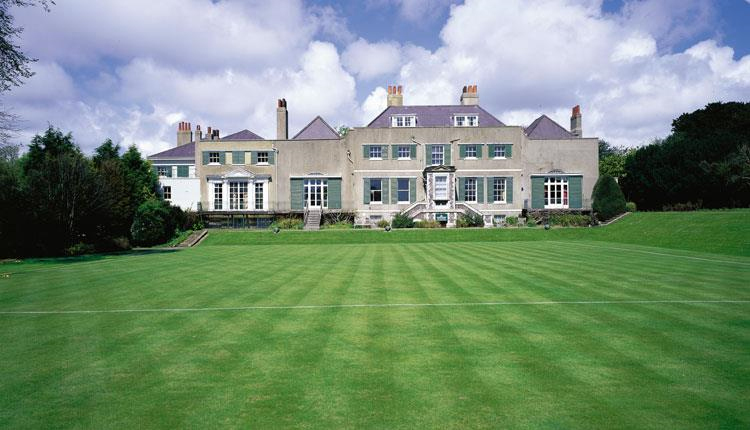
Photograph showing the rear elevation of Preston Manor from the lawn. Image © Royal Pavilion and Museums

When you observe the exterior of the building, the balance and symmetry of the building is particularly noticeable. This has been achieved by Thomas Western’s 1750 addition of two smaller wings. The use of balance and symmetry shows the influence of Palladianism, an architectural style that was popular in Britain in the period between 1715 and 1760. Palladianism was a style based on the designs created by Andrea Palladio (1508-1580), a sixteenth century Venetian architect who was inspired by Roman and Greek architecture and its emphasis on perfect proportion. In Britain, neoclassicism developed into a distinctively British style with plain exteriors that highlighted the rules of symmetry, perspective and proportion. The neoclassical style was most famously applied to British architecture by Inigo Jones. At Preston Manor, you can clearly see the neoclassical influences on the portico and the pilasters on the front and back of the building. Thomas Western’s addition of the two wings give the building a sense of balance, an element that Johann Joachim Winckelmann thought was essential for buildings in the neoclassical style. Winckelmann argued that buildings in the neoclassical Palladian style – like Preston Manor – should display ‘noble grandeur and sublime symmetry’.

There are similarities between the architecture of Preston Manor and other stately or manor homes created in a neoclassical style. For example, there are notable similarities in Colen Campbell’s (1676-1729) designs for the façade of Stourhead Castle and that of Preston Manor. Both buildings have a central wing flanked by two smaller ones. As in the designs for Stourhead Castle, the porches at the front and back of Preston Manor are positioned centrally, and help to establish the symmetry of the building.

In the grounds at Preston Manor, there are walled gardens that date from 1600 and the layout of the gardens is in the style of this period. The Walled Garden is divided into four main sections around a central fountain and directly contrasts with the more open, sculpted land of Preston Park. The landscaping of Preston Park is reminiscent of other areas of landscaped parkland around the city, such as Stanmer Park. Landscaping wider areas of parkland was made fashionable in the eighteenth century by designers such as Lancelot ‘Capability’ Brown (1716-1783). Both the landscaping of the gardens and the symmetry of the house can be seen clearly in sketches of Preston Manor from the early nineteenth century. Later additions to the Manor, like the Regency-style closed veranda added by Ellen Stanford in 1905, represent changing attitudes to the use of the house and a nostalgia for earlier styles experienced in the Edwardian era.

Naomi Daw, Visitor Services Officer
 

Mid-Week Draw Online: Week 2

This is a legacy story from an earlier version of our website. It may contain some formatting issues and broken links.

Every Wednesday afternoon our Museum Support Officer Beth organises the Mid-Week Draw in Museum Lab at Brighton Museum & Art Gallery.

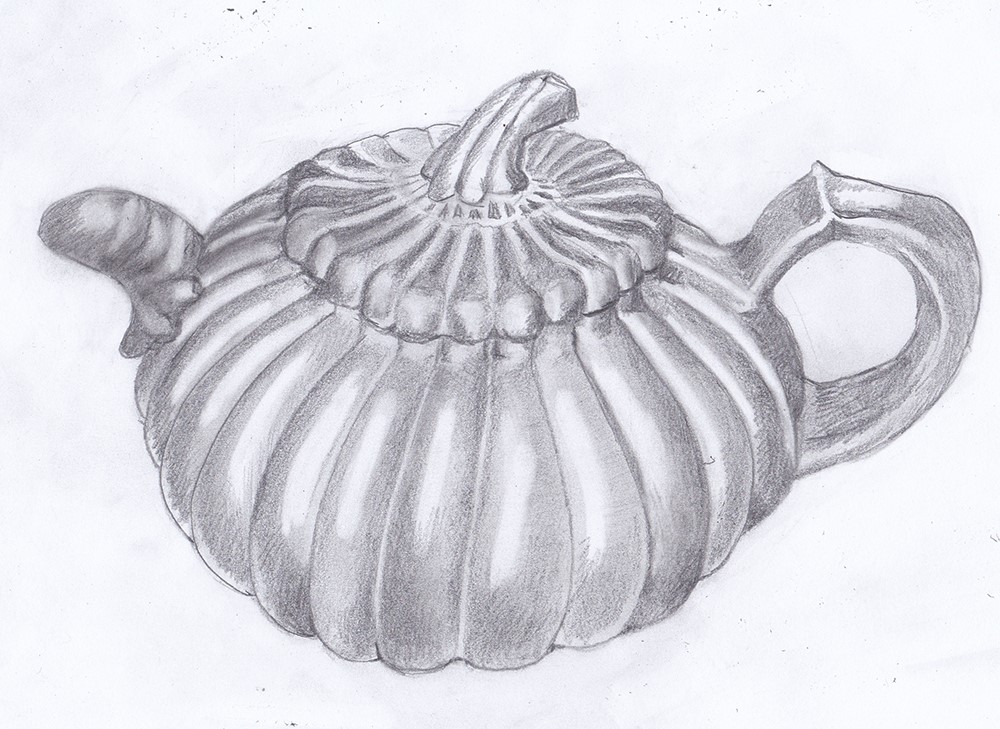
Last week we decided to move the Draw online, so those of you at home who wanted to continue drawing objects from our collections could do so. Beth has chosen a new selection for this week and has drawn them herself to inspire you to do the same. Take a look.


Draw Artists

We are very pleased to see that some of you have taken part in our online Mid-Week Draw, here are some of the fantastic works that have been sent in.

Jenny

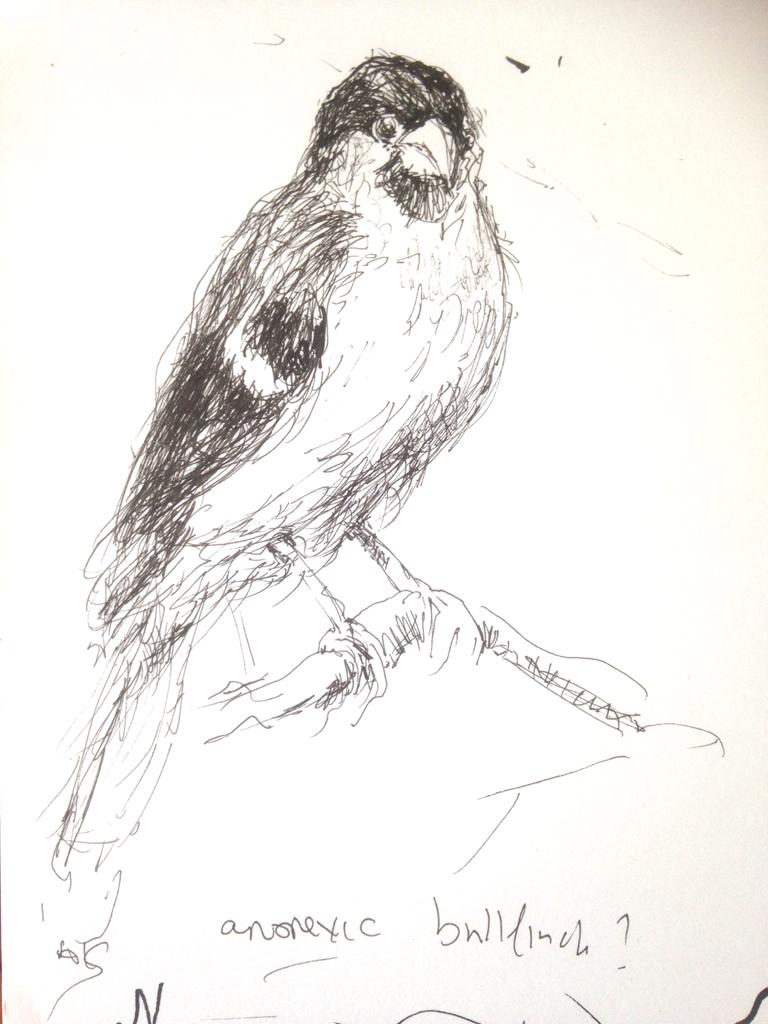
I chose the great green bug and used water colours! – Lauren

Steve

Join In

If you are tempted to have a go, please share your drawings with us, we would love to see them. Email them to Beth at beth.burr@brighton-hove.gov.uk Tweet @BrightonMuseums or if you are uploading them to Facebook with pride, share the url in the comments section below.

Come back next Wednesday to see what new objects Beth has chosen.

Other alternative ideas, in case you want something different or additional to draw:

  • Sketch your hands in different positions (or holding an object). Draw your feet
  • Draw an old pair of shoes
  • A simple object from nature, such as a pine cone

Discover More

The Mid-Week Draw

Beth Burr, Museum Support Officer

The Dragon’s in the detail: designs for the Royal Pavilion by John and Frederick Crace

This is a legacy story from an earlier version of our website. It may contain some formatting issues and broken links.

Before we had to temporarily close our doors due to the Covid-19 virus, I was busy preparing a display showcasing the work of two of George IV’s principal designers, or interior decorators, at the Royal Pavilion.

This exhibition, which was due to open in May 2020 at Brighton Museum, is now delayed. This doesn’t stop me giving you a bit of a taste of what is to come: delicate drawings, daring designs, colourful enamels, porcelain, wallpaper and any number of dragons. Here is the first of these visual appetisers.

The Royal Pavilion’s extremely colourful and ornate interiors make it the most exotic looking of all royal buildings in this country and quite possibly the whole of Europe.

It is easy to forget that these large-scale and ambitious design schemes all began with small and intricate drawings and designs. The Royal Pavilion is a great example of interior decoration becoming a genre in its own right in the early nineteenth century, quite separate from architecture.

The architect John Nash, responsible for the Pavilion’s distinctive Indian and Gothic exterior look from 1815 onwards, had little to do with the interiors. Instead George employed designers John Crace (1754–1819) and his son Frederick Crace (1779–1859) from 1802. They were later joined by the hugely creative Robert Jones (active 1815–1835) about whom we sadly know very little.

We do know a lot about the Craces though. The family Messrs Crace & Sons worked at the Royal Pavilion between 1802 and 1823, and further redecoration and restoration work was carried out by John Dibblee Crace (Frederick’s grandson) in the 1880s and 1890s until the firm folded in 1899.

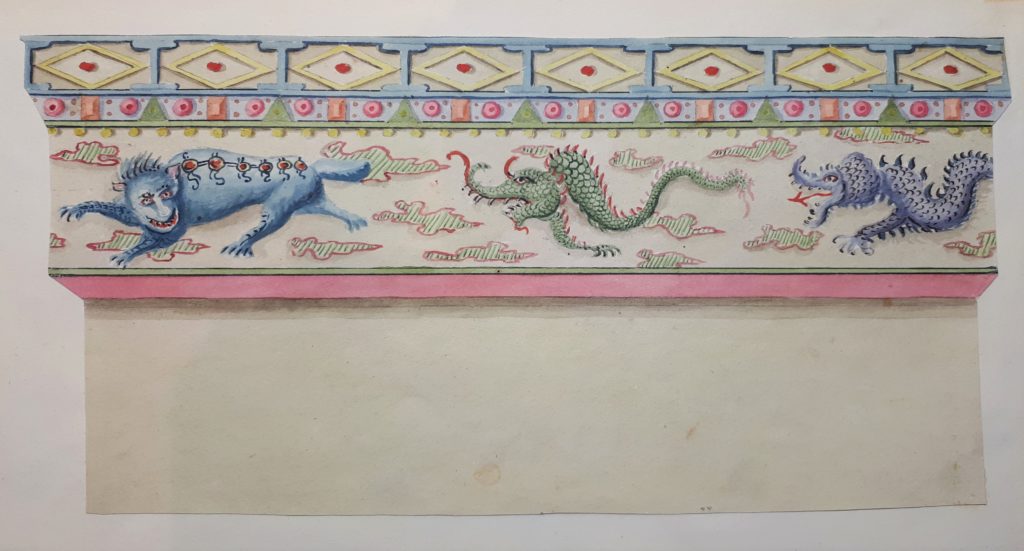
A drawing by Frederick Crace, c1815, based on a plate in William Alexander’s The Costume of China (1805).

A significant collection of Crace drawings relating to the Pavilion is in the Cooper-Hewitt Smithsonian Design Museum in New York but we are very lucky to have around 230 loose sketches and an important complete sketchbook in our collection. Most of these drawings are attributed to Frederick Crace but it is hard to be precise about this and only very few are dated. Some of these drawings and the objects that inspired them were going to be shown in a new exhibition in the Prints & Drawings Gallery of Brighton Museum in early May. This is now delayed  but we are able to show you some of the objects in this blog post.

I am curating the Crace exhibition with conservator and artist Gordon Grant, who has been working on the restoration of the Pavilion interiors for many years and has a real eye for ornamental detail. We have already finalised our selection for the display, and our intention was to make new links between some of the drawings and specific parts of the Pavilion interiors.

A detail from a plate in William Alexander’s book The Costume of China (1805)

The highly detailed and brightly coloured design drawings reveal the Craces often copied directly from decorations on Chinese porcelain, wallpaper, Canton enamels and embroidered textiles with little deviation from the original colour schemes. They also used printed sources such as the books published by the artist William Alexander (1767 – 1816) who accompanied the Macartney Embassy to China in the 1790s.

In some cases there is a direct line from the original source via the Crace drawings to the final ornamental detail in the Pavilion. An example is in this sketch of Chinese mythological beasts, which the Craces lifted from a plate published by William Alexander in 1805 showing a scene inside a Chinese temple. These motifs would eventually appear in adapted form on laylights upstairs in the Pavilion. It just goes to show that it is worth looking at the detail, whether you are searching for the devil, dragons, Foo-hum birds or grotesque beasts.

Alexandra Loske, Curator, Royal Pavilion

You can see a digitised copy of William Alexander’s book The Costume of China in our Tales from the Pavilion Archives.

Animal, Vegetable or Mineral? Mystery Egg 3

This is a legacy story from an earlier version of our website. It may contain some formatting issues and broken links.

Time for my third blog in the Booth’s Mystery Egg series for Easter.

Having worked at the Booth Museum for several years, I have seen a lot of really bizarre objects behind the scenes, some of which I have taken photos of and others which are just stuck in my mind’s eye. Normally, I would bring these objects out from behind the scenes to show visitors at the museum but under the circumstances  we thought we would write three special additions of our usual Animal, Vegetable or Mineral? quiz online to show you some unusual eggs, made by some pretty incredible animals.

These are all objects we have behind the scenes at the Booth Museum. Here is Mystery Egg number 3 of 3.

Mystery Egg 3

Mystery Egg 3, specimen from the Booth Museum of Natural History

Clue 1

The family of animals that made Mystery Egg 3 have a reputation for being one of the most intelligent invertebrates of the ocean. They are famed escapologists and problem solvers, even giving the Great Houdini a run for his money.

[arve url=”https://www.youtube.com/watch?v=abRPaXgJGQg” /]

Clue 2

The species of animal that builds this delicate, almost paper-thin shell sails the seven seas for months on end, just like an adventurer engaged in an epic quest. In fact, if these animals were to star in any movie, it would definitely have to be this one…


And the answer is… Drum roll please!

The Argonaut (Paper nautilus), Argonauta sp.


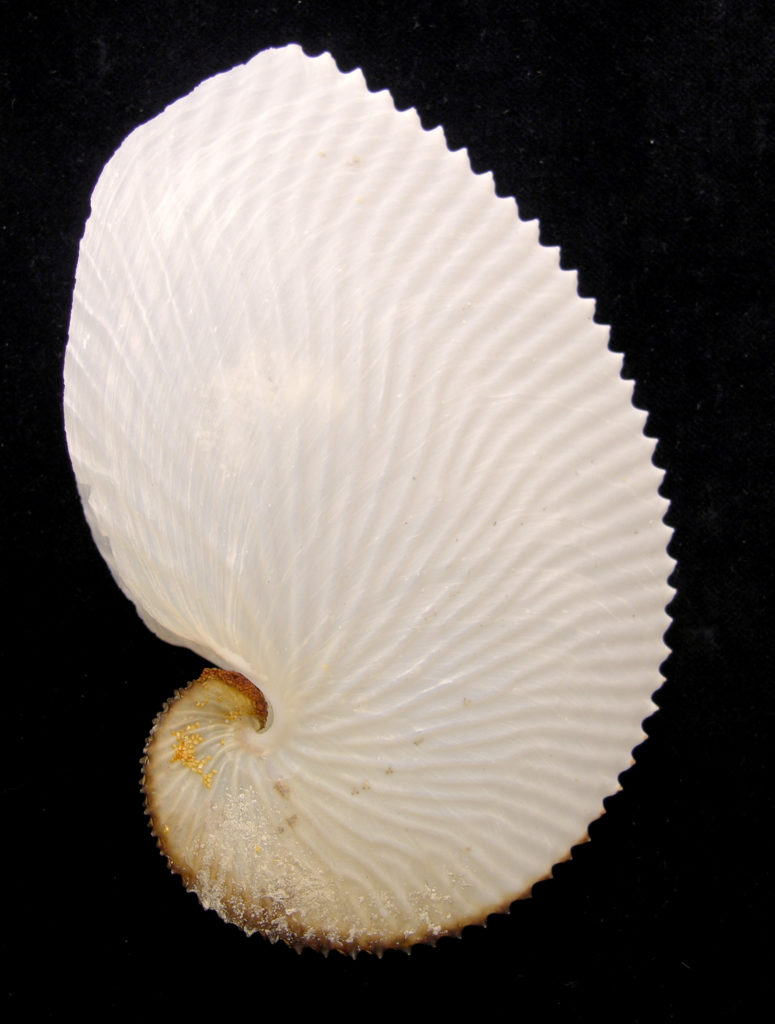
Female paper nautilus, photo by Bernd Hofmann at de.wikipedia

It’s not all in the name

Nautilus, photo by Manuae CC BY-SA 3.0

Although they are named paper nautiluses, these animals aren’t nautiluses at all (although they are distantly related). They are a group of unusual octopuses who spend their lives bobbing along near the surface of tropical and sub-tropical seas unlike typical octopus who live on the sea floor.

What the shell?

The females are the ones that make the beautiful egg case (pictured above) and measure around 38cm – eight times larger than the males (around 2cm) and 600 times heavier. Not much is yet known about the breeding habits of these adventurous octopuses, but when they mate, the male not only leaves his sperm behind in the female, but his entire hectocotylus.

Nooo, the hectocotylus is not a fancy word for penis as you might expect (it’s true penis is inside its body), but a specialised arm that sperm travels down into the females oviducts, still – poor lad! As you can imagine, when early observers in the 18th century found females with the hectocotylus attached they found it quite bizarre and so naturally, they theorised that it was a type of parasitic worm.

Shell yeah!

When females grow they continuously secrete calcite from the ends of two specialised arms to make a temporary shell. This paper-thin shell functions as an egg case to protect her developing young. When ready, she lays her eggs in the case and cosies up beside them, before continuing on their epic journey floating through the ocean – just like Jason!

The shell of the paper nautilus doesn’t just function as a protective egg case, they are also used as a buoyancy device. In order to keep itself buoyant, the paper nautilus routinely swims to the surface and quaffs large amounts of air into its shell. When it swims back down, it seals off the gas in the shell and dives to a depth where the compressed air counters its own body weight. The paper nautilus then becomes neutrally buoyant, making it much easier to swim around freely. But the paper nautilus doesn’t just aimlessly bob along the current passively waiting for food. Like all octopuses they are carnivores and need to hunt.

This quite gentle looking creature actually has a few hidden weapons up its tentacles, which it uses to catch unsuspecting sea slugs and crustaceans. After grasping the target in its tentacles, the octopus pulls the victim towards its mouth, bites down creating a hole using its hard beak and injects a toxin. The octopus then gauges out the fleshy innards through the hole in the crustaceans shell or scrapes at the soft meat of a sea slug using its radula, a kind of tongue covered with rows of small teeth.

I hope you agree that these creatures are a pretty magnificent animal and although most of their behaviour is yet to be discovered by science, it’s hard to imagine what will top a removable hectocotylus.

You can see a beautiful shell of the Nautilus, the paper nautiluses distant cousin, on display in the Booth Museum when we re-open. In the meantime, look out for an upcoming focus on the Paper Nautilus shell on our Close Look Collections page.

Grace Brindle, Collections Assistant


Animal, Vegetable or Mineral? Mystery Egg 2

This is a legacy story from an earlier version of our website. It may contain some formatting issues and broken links.

Time for blog post number 2 in the Booth’s Mystery Egg series for Easter.

Having worked at the Booth Museum for several years, I have seen a lot of really bizarre objects behind the scenes, some of which I have taken photos of and others which are just stuck in my mind’s eye. Normally, I would bring these objects out from behind the scenes to show visitors at the museum, but, under the current circumstances of Covid-19, we thought we would do three special additions of our usual Animal, Vegetable or Mineral? quiz online to show you some unusual animal eggs, made by some pretty incredible animals.

These are all objects we have behind the scenes at the Booth Museum! Here is Mystery Egg number 2 of 3, look out for the last one over the next few days.

Mystery Egg 2

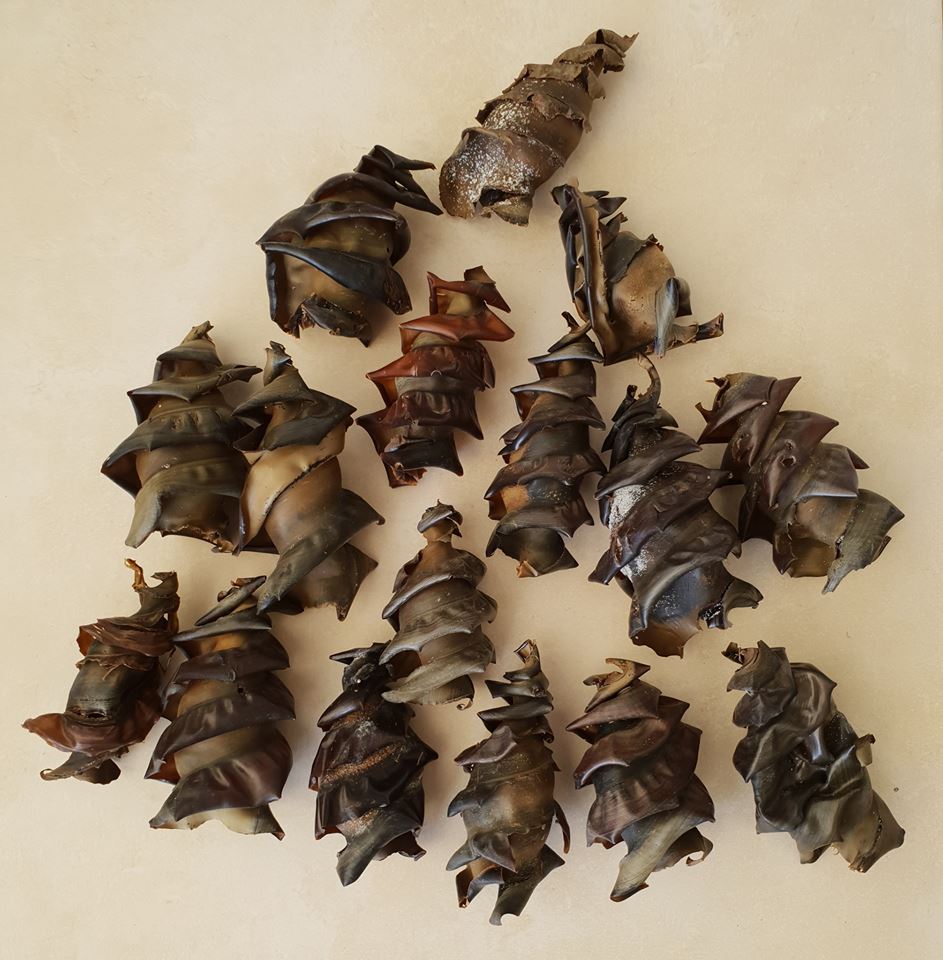
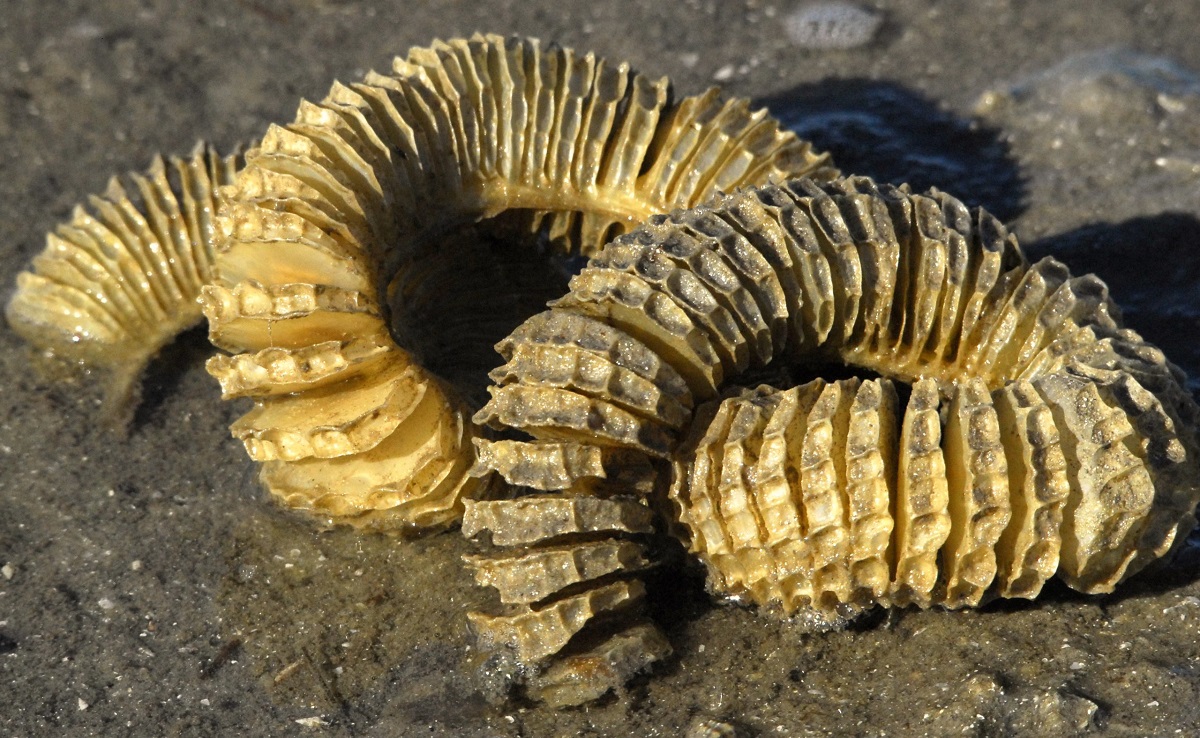
Mystery Egg 2, Photwik / CC BY-SA (https://creativecommons.org/licenses/by-sa/4.0)

Clue 1

These cork-screw shaped egg cases get washed up on the beaches of Australia, but if you haven’t been lucky enough to visit the sunny beaches down-under, you might have seen similar egg cases washed up on the exotic beaches of the UK (like the one pictured below). The animals that produced these egg cases or ‘mermaids purses’ in UK waters are related to the animal that made Mystery Egg case 2.

Mermaids purse, Evelyn Simak

Clue 2

The ocean-dwelling creatures that have made these eggs have a reputation for being formidable killers and top predators, some might even say they are mindless killing machines


…and who can blame people for thinking this, when faced with a set of razor-sharp teeth like these…

Clue 2 animal teeth, Richard Ling from NSW, Australia / CC BY-SA (https://creativecommons.org/licenses/by-sa/2.0)

And the answer is… Drum roll please!

The Port Jackson shark, Heterodontus portusjacksoni.

Ok, these teeth might have thrown you a little, but the Mystery Egg for today belongs to a species of shark. There are more than 440 species of shark in the world and our Mystery Egg belongs to the Port Jackson shark, Heterodontus portusjacksoni. 

Mark Norman, Museums Victoria / CC BY 4.0 (https://creativecommons.org/licenses/by/4.0)

These unlikely looking sharks live in Southern Australian waters and are found on the bottom of rocky, muddy or sandy environments or where sea-grass grows. One famous location in which they are found is Sydney Harbour, their common name Port Jackson, comes from the habour’s true geographical location. Port Jacksons can grow up to 2 metres in length and are known to migrate over 500 miles. They are incredible navigators and gather in huge numbers at the same spot every year in order to breed.

Not the typical eggs

The extraordinary spiral-shaped eggs are laid by the females two weeks after breeding. Each female lays two eggs and they are around the same size as the female’s head! Can you imagine how much energy it takes to make two eggs the size of your head? Well, it’s a lot! That’s why Port Jackson sharks are some of the best known mothers of the shark family. They carefully place an egg in their mouth and carry it around until they find the perfect rock crevice to wedge it into, to hide it away from predators. The spiral shape of their eggs makes them really difficult for predators like the crested hornshark to remove. These sneaky predators look almost exactly like the Port Jackson, which is why the eggs need to be hidden out of sight.

Not the typical teeth

I don’t know what you think, but when I think shark teeth, the Port Jackson’s aren’t typically what comes to mind. Their teeth are specially adapted to feed on their favourite meals, including sea urchins, molluscs, crustaceans and fishes.They have two distinct shapes, to enable them to feed on these animals, pointy at the front and flat at the back. The pointy front teeth are used for holding and breaking their prey and the back teeth are used to crush and grind hard shells. Their linnaen name Heterodontus comes from the Greek heteros meaning ‘different’ and dont meaning ‘tooth’.

Not the typical shark!

In order to breathe, most sharks need to move and keep their mouths open, this forces water over their gills to give them the oxygen they need. Port Jackson sharks are pretty unusual, in that they can eat and breathe at the same time. This means they can sit for long periods of time on the ocean floor without having to move, unlike many species of shark.

Sharks are one of my all time favourite animal groups, they are so varied in their behaviour, shape and form they are beautiful animals and are not the mindless killing machines that have been portrayed in the past. There are only a handful of unprovoked attacks on humans each year and around 6 related deaths, whereas humans kill around 100 million sharks each year. We are really lucky in the UK to have around 40 incredible sharks species that either live in,  or visit our waters including the gentle basking shark.

To learn more about how you can protect these wonderful animals visit the Marine Conservation Society Save our sharks.

You can see and touch the tooth from a Megalodon, an ancient giant shark, whose teeth were the size of a child’s hand, in the Booth Museum when we re-open.

Grace Brindle, Collections Assistant


Mid-Week Draw Online

This is a legacy story from an earlier version of our website. It may contain some formatting issues and broken links.

Frequent visitors to Brighton Museum will know that on a Wednesday afternoon Museum Lab is transformed into an artistic hub of creativity.

Our Museum Support Officer Beth organises the Mid-Week Draw. We invite people to join us for a few hours to sit in peace and draw objects from our collections. With a different selection of objects each week, often themed, the Mid-Week Draw has become popular with both regular artists, complete beginners or just visitors who drop in as they enjoy the museum.

With the current circumstances of Covid-19, we have decided to move the Draw online, so that our regular artists can continue their creativity and maybe even inspire others to join in and draw. Each week Beth will look though our digitalised collections and choose a few objects to hopefully motivate you pick up a pencil.
She’s started us off this week with her selection and her drawings, take a look

Draw Artists

We are very pleased to see that some of you have taken part in our online Mid-Week Draw, here are some of the fantastic works that have been sent in.

Ann

Ossie

Join In

If you are tempted to have a go, please share your drawings with us, we would love to see them. Email them to Beth at beth.burr@brighton-hove.gov.uk Tweet @BrightonMuseums or if you are uploading them to Facebook with pride, share the url in the comments section below.

Come back next Wednesday to see what new objects Beth has chosen.

Just in case you’re not inspired by any of these from our collection, here are some other drawing ideas to try at home instead:
  • Draw an object with a single line, not taking your pencil / pen off the page (Beth did the bison as an example)
  • Draw a fruit or vegetable sliced open
  • Combine animals to make your own mythical creature
  • Draw every meal you eat for a week
  • Enjoy it!

Discover More

The Mid-Week Draw

Beth Burr, Museum Support Officer

The story behind the picture: Red Dennis Fire Engine

This is a legacy story from an earlier version of our website. It may contain some formatting issues and broken links.

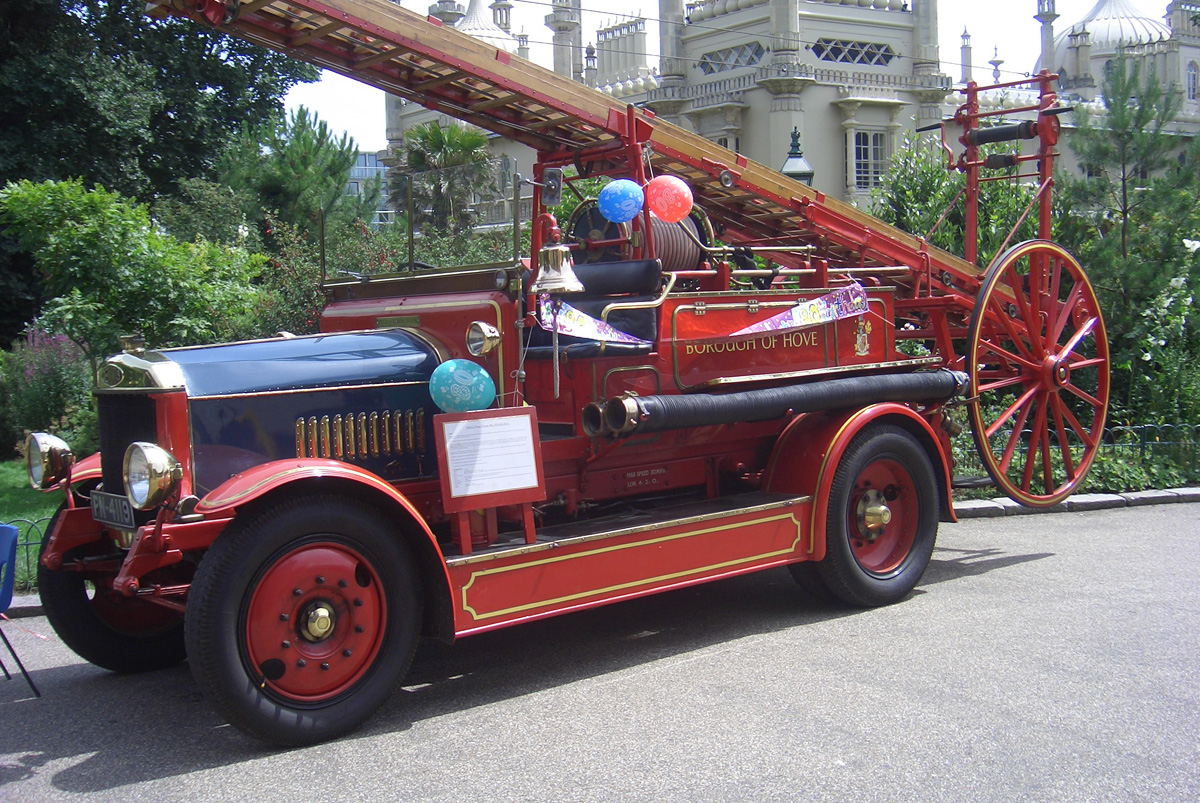
This picture shows a 1928 Red Dennis Fire Engine parked outside Brighton Museum & Art Gallery with the Royal Pavilion seen behind. Photographed in July 2009 the highly-polished and beautifully preserved engine is decked with a banner and balloons celebrating it’s 80th birthday.

A quick look at The Dennis Society web page gave me some technical information and usefully the registration PN4119 can be seen on this photograph for identification: Chassis number 7148. Body type, Low Load 60/70hpN. Layout, pump escape. Year registered, 1928

The engine was made by Dennis Brothers Limited, makers of commercial vehicles based in Guildford in Surrey, about 35 miles north of Brighton. The Dennis brothers, John and Raymond, began trading by making and selling bicycles (setting up the company in 1895) progressing to cars and commercial vehicles. During the First World War production moved to lorries and buses aiding the war effort and home and abroad. In 1922 after the war and with peace returned the company also started making lawnmowers gaining the seal of royal approval when Dennis lawnmowers were sold to King George V and King George VI.

This engine belonged to the Borough of Hove Fire Brigade, as you can see by the gold lettering on the vehicle and to the right, the Hove crest. In 1928 Hove was a separate town from Brighton and remained so until 1997 when the Boroughs of Hove and Brighton formed a unitary authority becoming Brighton & Hove (before the award of City status in 2001).

Hove was granted arms in 1899 gaining a crest showing three martlets with a further six on the crest’s ermine bordure. The martlet in heraldry is a stylised bird like a swift or house martin and is the emblem of Sussex.

The men working with this vehicle were based at the fire station in Hove Street built in 1926 at the cost of £11,000 then a huge sum of money and in use until its closure in 1976. Fortunately, the attractive building wasn’t demolished. Instead it was converted into flats now called Regency House. If you visit the building you can see the large arches under which this fire engine passed. In 1927 seven-day a-week fire station operation allowed for one man in the fire station on-watch, four to attend an emergency and one man on leave. Under the Fire Brigade Act of 1925, the men could retire with a pension after 25 years of service aged 55.

Twenty-seven years before this engine was purchased the men of the Hove Volunteer Fire Brigade starred in a dramatic film, Fire!

With a running time of 4 minutes 47 seconds Fire! Is a short silent film by Scottish-born, Hove based chemist and film enthusiast, James Williamson (1855-1933) showing the occupants of a burning house being rescued.

The 1901 fire engine was drawn by horses proving how far fire-fighting technology had moved on by 1928. You can find and watch the film online and follow the drama from the discovery of a house billowing with smoke, to the dash on foot to Hove Fire Station (then in George Street) to the harnessing of three magnificent white horses to fire vehicles seen in a high-speed chase down St Aubyn’s  – then a scene cut to the householder waking in bed, his house on fire, he clutching his head and falling down in despair to be rescued by a brave fireman who appears at the window, extinguishes the fire and carries the man down the ladder and out of the burning building. However, the drama is not over, for the final scene shows the man’s child leap from the flaming window and into a large rescue-blanket held by the firemen. Not one second of screen time is wasted in this fast-paced film, which early audiences must have gone home marvelling at.

My favourite moment comes 1.20 seconds into the film in a scene demonstrating the skilled horsemanship of the men and the highly-trained nature of the horses as a man rushes forward holding a running horse by the bridle, stops the huge powerful animal to a halt then steps it neatly backwards into the fire-engine harness ready to go in ten seconds flat. That’s quite an achievement and proves these men and animals were the real deal.

John Benett-Stanford (1870-1947) of Preston Manor would have known Williamson as he too was an early film-maker, although his interest lay in documentary film-making. John Benett-Stanford is credited as being the first person in history to make a war newsreel by filming British troops assembling before the battle at Omdurman in the Sudan which took place on 2nd September 1898. This rare moving footage no longer exists and remains only in a few still frames.

You can discover the journey from early moving images to pioneering film-making in two interactive galleries at Hove Museum, images of which can be seen online.

 Paula Wrightson, Venue Officer Preston Manor


Animal, Vegetable or Mineral? Mystery Egg 1

This is a legacy story from an earlier version of our website. It may contain some formatting issues and broken links.

It’s Easter week and unfortunately you can’t visit the Booth Museum when we would normally have plenty of fun activities for you. So we thought we would do three special additions of our usual Animal, Vegetable or Mineral? quiz online to show you some unusual animal eggs, made by some pretty incredible animals.

These are all objects we have behind the scenes at the Booth Museum! Here is Mystery Egg number 1 of 3, look out for the others over the next few days.

Mystery Egg 1

Mystery egg 1 Andrea Westmoreland from DeLand, United States / CC BY-SA (https://creativecommons.org/licenses/by-sa/2.0)

This unusual string of egg cases is made by a marine animal and can be found on the beaches of the US. Can you guess the animal that made it?

Clue 1

You might get an animal that makes a shell like this in your garden.

Clue 2

They make shells like in the photo below… do these look familiar?

Mystery egg clue. Photo by Pete / CC BY-SA (https://creativecommons.org/licenses/by-

And the answer is… Drum roll please!

The knobbed whelk, Busycon carica. 

These marine snails are quite large, larger than your average garden snail weighing in at around 1.1lbs (around 500g or half a bag of sugar) and measuring up to 30cm. Females are typically larger than males, scientists think this may be due to the fact that some of these snails can start off as males when they are young and then change into females as they get older. But their size is nothing on the largest marine snail in the world, the Australian trumpet snail, or giant whelk, Syrinx aruanus, which measures up to 70cm!

Knobbed whelks are carnivorous animals with clams, oysters and mussels among their preferred meals. To feed, they use their large muscular foot to hold their prey in place and use their shell edge to prize open their food’s shell. They can also secrete corrosive chemicals from their proboscis (tube mouth) which helps them to drill a hole in the shell of their prey to reach the soft juicy flesh inside – yum!

When they are ready to mate in spring, females lay a string of up to 40 egg cases which are anchored at one end to the sand. Each capsule contains around 100 fertilised baby snail eggs inside. When they hatch around 13 months later, the juviniles look like tiny replicas of the adults – so cute!

Living in the U.K. I won’t be jetting off to the U.S. anytime soon, but not to worry, egg cases of the common whelk, Buccinum undatum can be seen right here on beaches of the UK! You might have even seen one on during your daily exercise if you are lucky enough to live by the sea!

Sarah Smith / Egg cases – common whelk

Come and see some impressive shells made by other sea snails at the Booth Museum when we re-open. 

Grace Brindle, Collections Assistant

Artist, social reformer and women’s rights campaigner, Barbara Bodichon

This is a legacy story from an earlier version of our website. It may contain some formatting issues and broken links.

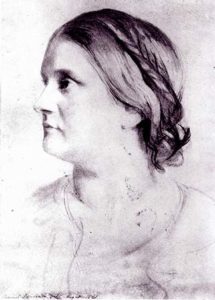
Today, 8 April, marks the birth date of Barbara Bodichon, nee Leigh Smith. An artist, social reformer, women’s rights campaigner and co-founder of Girton College, Cambridge, Barbara Bodichon challenged the status quo from day one and is an important figure in our 100 Pioneering Blogs of Sussex series.

Barbara Bodichon, from a sketch made in 1861. Portrait by Samuel Lawrence, 1880

Born in Whatlington near Battle, 8 April 1827, as the illegitimate daughter of a Derbyshire milliner and the politician Benjamin Leigh Smith, she was born in disgrace, yet her outsider status and exposure to unconventional thinking in her family (her parents never married despite having three more children) set the seeds for a remarkable life of challenging the norms and restrictions that women lived under.

Despite being a member of the landed gentry, Benjamin Leigh Smith held radical views and was a benefactor of the poor. He sent his children to be educated at local schools, brought them up himself when Bodichon’s mother died in 1834, and, controversially for the day when family fortunes and property were bequeathed to sons, settled the same amount of money on Bodichon as he did his sons on their twenty-first birthdays.

This enabled Bodichon to avoid the pitfalls of seeking marriage that usually fell to young Victorian women.  Instead she used her wealth and energy not only to explore her intellectual and artistic pursuits, studying painting at Bedford Square Ladies College in 1849, but to agitate for women’s rights.  From 1850 with her group of friends and fellow early feminists who formed the so-called ‘Ladies of Langham Place’ group, now considered one of the first organised women’s movements in the country, she explored, discussed and publicised issues of equality, particularly pertaining to the many ways women were discriminated against by the law.

One of the issues they deplored was the fact that, upon marriage, every single ounce of women’s property, including money, belongings, inheritances and even future earnings was automatically given up to the husband to spend, fritter away or use as he wished. In 1854 Bodichon spelled out these bitter realities in a book, the Brief Summary of the Laws of England Concerning Women. This meticulously researched list of all the different laws that put women at a disadvantage was the first time the public had been exposed to a clear understanding of the legal position of women. With the genie well and truly out of the bottle, the issue quickly became a national talking point and a committee was formed by the Law Amendment Society to investigate. The Ladies of Langham Place started their own Married Women’s Property Committee which became a nation-wide campaign group. In 1856 – in what’s now considered one of the first organised feminist actions in Britain – a petition demanding change was submitted to the House of Lords.  It was rejected that year but smoothed the way for a limited enactment in 1870 and the Married Women’s Property Act of 1882, which allowed married women to own and control property in their own right.

The workplace was another arena where Bodichon and her friends called for change. With women’s work largely consisting of ill paid drudge and women largely barred from university education and most careers, Bodichon published in 1857 a radical pamphlet, Women and Work in which she called for equality of education and work opportunities, challenging the prevailing opinion that employment wasn’t appropriate for respectable women and suggesting that married women’s financial dependence on their husbands was degrading.  In 1858, now married to French doctor, Eugene Bodichon, she co-founded with her friend, the feminist Bessie Rayner Parkes, the English Woman’s Journal, which discussed, developed, and publicised further the employment and equality issues she had developed in Women and Work.  Linked to this, in 1859 she co-founded, with women’s rights campaigner Jessie Boucherett and philanthropist Adelaide Ann Proctor, The Society for Promoting the Employment of Women with the aim of promoting women’s training and apprenticeships.

Bodichon had already made inroads in education by opening a progressive infants school in London where children learned together regardless of their social class in 1854. She worked to make higher education a possibility for women by developing with Emily Davies an experimental college for women at Hitchin. This developed into the 1869 established Girton College, the first women’s college at Cambridge University, although female students had to wait until 1948 to gain full membership of the University.

Although Bodichon was not the first woman to agitate for the vote, she co-drafted with Boucherett and feminist Helen Taylor a petition in favour of women’s suffrage in 1865. It was presented to the House of Commons by John Stuart Mill MP in 1866 but was defeated.  In 1869 after publishing  ‘Reasons for and against the Enfranchisement of Women’, Bodichon toured the country, appearing at meetings and giving speeches in favour of votes for women.  After retirement to her house at Scalands Gate (now called Scalands Folly) in Sussex in 1882, she built an extension to her house to serve as a reading room, library and night school for young working men who could not read or write.

As well as her incredible activities fighting for women’s rights, Bodichon, somehow, found the time for a career as an artist. Her work was exhibited at the Royal Society and was widely admired. Her London salon was a meeting ground of the greatest talents, political, literary and artistic, of the day, including the writer George Eliot who became one of her closest friends, early physician and fellow Hastings resident, Dr Helen Blackwell, the poet Elizabeth Barrett Browning, Hastings painter Marianne North and Dante Gabriel Rossetti Rossetti. Some of Bodichon’s paintings can be seen today at Hastings Museum.

Ventnor, Isle of Wight, Barbara Bodichon, 1856

Bodichon died in 1891 after a life of tireless service to bettering the lot of women and fighting for a more just society. Despite her remarkable and wide ranging achievements, she seems to have fallen out of the canon of great Victorian reformers and is not the household name she deserves to be. In 2007 feminist campaigner, Lesley Abdela came across Bodichon’s grave in the Brightling churchyard in a state of disrepair. The historian Dr Judith Rowbotham issued an appeal for funds to restore the grave and its surrounds and under the eye of Mrs Irene Baker, the Secretary of Brightling Parochial Church Council the grave was repaired and restored.

As an interesting side note, Bodichon was related by her paternal uncle to Florence Nightingale who never acknowledged her due to her illegitimacy.

Written by social hstorian, Louise Peskett

Exploring The Garden: Part 2, Birds and Mammals

This is a legacy story from an earlier version of our website. It may contain some formatting issues and broken links.

The second of our Nature at Home series of blogs looks at what you might find in your garden or local area, and gives a few ideas of how you might observe them, starting with some very familiar visitors.

Of all the visitors to your garden, birds and mammals are the most obvious as they are easily visible. However, with the exception of some bold characters, these larger animals tend to have a healthy fear of humans or other predators, so will usually move rapidly from one spot to the next.

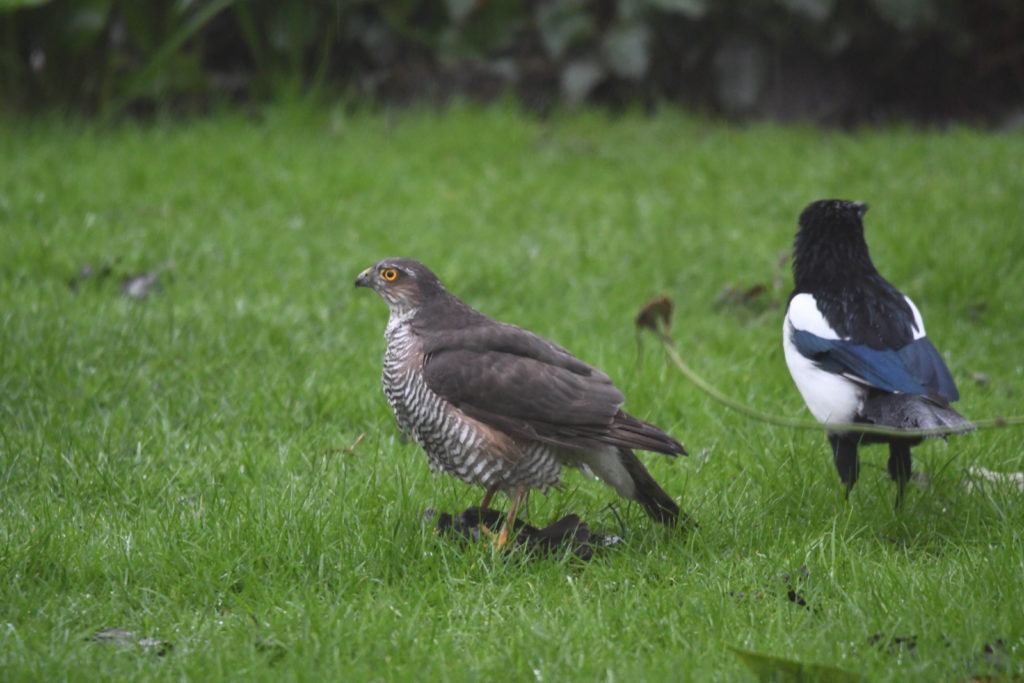
With patience you can observe these creatures going about their business and sometimes experience unexpected dramas.   

Sparrowhawk on starling (taken in authors garden, Feb 2020, using Nikon DSLR with 150 – 600mm telephoto lens, low light)

Though these animals can be very cautious, you’ll have an advantage to those watching animals at the coast or in the countryside. Your home is a ready-made hide with comfy seating, heating and kitchen and bathroom facilities. From behind glass, and with the lights out, most of the garden animals won’t notice you. You can observe the comings and goings of garden birds whilst enjoying your breakfast or a cup of tea. Even if you don’t have a garden, you can still enjoy wildlife from your window. My colleague lives on the first floor, and is without a garden, but looks forward to the return of swifts each spring which she watches screaming and flying at high speed between the rooftops outside her central Brighton window. 

Blackbird on neighbour’s roof, March 2016. Taken with Nikon DSLR and 55-300mm lens

This time of year is great for bird watching, especially in Sussex’s coastal location facing Europe. Migratory birds are returning to the UK to breed, and chiffchaffs are some of the earliest arrivals. They can be heard at the tops of trees making a very recognisable chiff-chaff-chiff-chaff call. Other birds such as goldfinches and starlings also tend to perch at the tops of trees or on TV aerials. These are good opportunities to use binoculars if you have them, though be careful where you aim them when pointing at houses. The RSPB have some good tips for choosing binoculars or monoculars.

Chiffchaff taken this March (taken with DSLR with 150 – 600mm telephoto lens)

Our resident birds like blue and great tits are also busily collecting material and checking out sites such as bird boxes for nesting. Blue tits don’t seem to mind their homes being fairly close to humans. If you can, put up a nest-box that can be viewed from indoors and see if anything chooses to nest there. You could even leave some hair from a hairbrush close by for them to use as nesting material. Setting up a birdfeeder within view of your favourite window seat is also a good way to guarantee views of the birds. Feeders are also likely to attract the most common mammal most of us will see, the grey squirrel.  

Grey squirrel on bird table, 2014. Taken with entry level DSLR

This is also a good place to focus your camera on, either hand-held or using a tripod. Should you be interested in taking up wildlife photography, there are a number of good blogs online with tips. Two examples are here, but many more can be found online,

The Digital Photography School 5 Top Value Lenses for Getting Started in Wildlife Photography

or if you prefer video Paul Miguel Photography Wildlife Photography for Beginners

Great Spotted Woodpecker on bird feeder. A range of seeds in different feeders can encourage a wider variety of birds. Taken with DSLR and 150 – 600mm telephoto lens

Keeping records of your observations in a notebook or digitally can be of interest to yourself, but if you want to give something back, you can get involved in citizen science. The British Trust for Ornithology’s (BTO) garden birdwatch project and other similar projects allow you to upload your observations and help scientists keep track of UK wild bird populations. In the Sussex Biosphere region, there is also the City Nature Challenge, which encourages you to record what you find in your local area.

Another aspect of having the time to observe these animals is starting to see and appreciate some features you may not have noticed before. There are beautiful iridescent feathers on pigeons, starlings and magpies, which make them a lot more colourful than they initially appear. Close observation of little brown birds can also make you realise that what appears to be a large flock of sparrows can often be a mix of dunnocks, juvenile greenfinch, goldfinch and chaffinch as well. And if you are lucky enough to have small predators visiting, the larger stoat can be identified from a small weasel by the black tip to its tail.    

Starling. The iridescence on their feathers is more spectacular than they initially appear. Taken with DSLR and 150 – 600mm telephoto lens)

By observing the movements of the birds in your garden you’ll soon learn where their nest sites are located, even if you never see their nests (please don’t go exploring for the nests – it is a criminal offence to disturb nesting sites as it causes the birds stress). As the season progresses, you’ll also be able to observe juveniles fledging. What could be more pleasing than seeing a family of wrens fledge from the depths of a hedge or half a dozen juvenile blue tits, you’ve watched being fed over the spring, burst from a nest box? 

Blue-tit emerging from nestbox. Taken with entry level DSLR and 55-300mm telephoto lens

With the exception of grey squirrels, mammals tend to be much harder to view as they are often very nervous and many are also nocturnal. Most of the common mammal visitors to your garden or neighbourhood can also be very divisive. Foxes, squirrels, rats and mice are the most likely to be seen, and each get varying levels of negative press. Even badgers, which you may be lucky enough to see, have recently suffered culls. The one urban mammal which tends to be liked by all is the hedgehog.    

Fox on rear porch, 2019. Taken with DSLR and 50mm lens, night – with flash

The larger mammals can be viewed easily from windows on first or second floors, especially with binoculars. Foxes will happily forage at dusk and during the night under the glow of streetlights. With streets generally empty of people, foxes should be much happier to come out and you may see them more in the early morning or late afternoon light. If you have a welcoming, safe garden, foxes may become comfortable enough to regularly visit, and may even bring their cubs to play in summer. If foxes do visit your garden, observe them with the lights off and sit back from the window, so you are shadowed from their view and avoid scaring them off. 

If you have feeding stations for birds, the bird seed is likely to attract rodents like mice and rats. Both will tend to be nocturnal, but if they get used to a regular, safe source of food they may become bold enough to come out during the day. Whilst initially quite fascinating to observe, if these animals are regularly visiting it might be worth making the feeding stations more difficult for non-flying animals to access as mice and rats can quickly reproduce, resulting in large populations. Squirrel-proof feeders and tall bird-tables are usually effective at deterring mice and rats.

Mice on bird table at night. Whilst they may be cute, if this happens it might be good to try and block their access, or stop putting food out for a while. Taken with entry level DSLR and 55-300mm lens at night with flash

Hedgehogs can be encouraged into a garden by providing access at the bottom of fences (only make holes in agreement with neighbours). A healthy garden with lots of invertebrates will be a haven for hedgehogs, as well as birds. It is best not to use slug-pellets in your garden as they will poison both hedgehogs and birds. Hedgehogs tend to be nocturnal so will only be apparent at night. It is difficult to photograph animals at night without more expensive equipment, but if you are curious about your nighttime visitors, wildlife cameras could be set up in your garden (The RSPB sell them)

To photograph these mammals, set up a tripod or stable surface for your camera. This avoids blurry images, as it is likely mammals will be active in low light. The animals will also be moving about so patience is key to get a photograph when they are still. You may be tempted to use a flash, but this will scare all but the boldest animals off. If you have external lights you could try leaving those on so that the animals get used to visiting the feeding stations under light. This will make photographing them much easier (though it will take time for the animals to feel safe enough to linger under the lights). With patience though, images like those below can be achieved – even for beginners using the auto settings on the camera.    

Camera and tripod. Recommended for low light conditions, or for monitoring a fixed spot

So next time you’re out see what you can find and if you’re in the Brighton region, why not record those finds in the City Nature Challenge.

Mute Swan photographed on Samsung smartphone, during daily exercise, March 2020

Fox (who felt safe in the garden) sitting outside the conservatory door. Taken on Samsung smartphone, Winter 2019

Squirrel in Toronto, Canada 2008, taken on Kodak bridge camera. Even a basic point and shoot camera can take passable images. Great if you have an old camera in the cupboard for young children to use

Image 11, 12, 13 – Gallery of images taken with basic phone or point and shoot cameras.

All photos (c) Lee Ismail

Lee Ismail, Curator of Natural Sciences and Kerrie Curzon, Collections Assistant

More information