Story Category: Legacy

Seeds and Christmas Greenery Sale in the Garden, Friday 17th

This is a legacy story from an earlier version of our website. It may contain some formatting issues and broken links.

The garden volunteers are having their annual seed and greenery sale for your festive wreath making, this Friday 17th.

Stuck for stocking fillers? Fancy having a go at making a wreath this year? Then why not come along to our annual seed and greenery sale under Brighton Museum portico on Friday 17th December between 10am – 1pm.

All our seeds have been lovingly collected & packaged by our wonderful garden volunteers. This is a great opportunity to purchase and grow some of our garden stars.

We’ll also have bundles of greenery (bay, dogwood, holly, butchers broom, yew and more), perfect for constructing a festive welcome for your door.

Our suggested donation is £2 for 3 packs of seeds and £5 for our wreath bundles, but whatever you can give to support our garden fund is very much appreciated (cash preferred).

Come and say hi and have a chat!


Absolutely Fabergé!

Antiques expert Geoffrey Munn examining the disassembled lilac Fabergé photograph frame

This is a legacy story from an earlier version of our website. It may contain some formatting issues and broken links.

Discover the Mystery of the newly revealed Fabergé items found by Antiques Roadshow expert Geoffrey Munn…

Recently, antiques expert Geoffrey Munn (man-on-telly and all-round good egg) came to visit curator Martin Pel and I, at Brighton Museum.

Antiques expert Geoffrey Munn examining the disassembled lilac Fabergé photograph frame

Antiques expert Geoffrey Munn examining the disassembled lilac Fabergé photograph frame

Previously, on an unrelated visit, he spotted the corner of just one of the pieces (the square lilac photograph frame) poking out of archival tissue paper in the stores. Such is his skill, he recognised it immediately as Fabergé, and quite rare too! It is thanks to Geoffrey that we are showing our five exquisite Fabergé items.

Geoffrey is as charming in real life as he is on the Antiques Roadshow. He is extremely knowledgeable, self-effacing, and very funny. Despite the joviality, we managed to pack in a full day and did some serious work too.

First on the agenda was to meet conservator Andy Thackray, who has been prepping the objects for display. The two photo frames were in a rarely seen state: i.e. open. We examined the photographs and debated who the two women could be.

Martin and Geoffrey examine the frames

Martin and Geoffrey examine the frames

Geoffrey and Martin think one of them could be Princess Alice, mother of the Late Prince Philip. (Apparently, Geoffrey once asked Prince Philip to take a look at the photo. He said he couldn’t be sure who it was, as it was a very long time ago!).

Our mystery lady in her frame

Our mystery lady in her frame

As Mr Munn examined the frame closely, he explained that it was enameled Guilloche on silver. Guilloche is a tricky technique, used to make the visible lines under the coloured enamel. The frame was made in Moscow, and he knew this because it had the Russian Imperial warrant (double-headed eagle) stamped on it. This is the endorsement of the Tzar himself and was only used above the Fabergé signature for objects made in Moscow.

The Imperial Warrant, above the Fabergé signature

The Imperial Warrant, above the Fabergé signature

The other thing that really stood out for me, was that Geoffrey managed to find and decipher the smallest inventory number I have ever seen. All Fabergé pieces were stamped with the appropriate marks and then given a unique number, which was unobtrusively scratched on. In theory, these numbers can be matched to the Fabergé sales registers. In practice, it’s not quite that straightforward. This particular number on the lilac frame looked like a tiny scuff mark. It was barely visible to the naked eye! Geoffrey has promised to follow that number up with his extensive contacts in the Fabergé world, so we hope he can reveal some details about the provenance of this stunning, but curious item soon. We will keep you updated of course.

Andy searching for the inventory number

Andy searching for the inventory number

Being able to see the photos without the glass was really helpful. The lilac frame contained a small round, silver-gelatin photograph, cut from a larger image. Embossed on the back were partial details of photographic studio in Paris. It turned out to be the mark of the Swedish-born, High Society photographer Otto Wegener. Sadly though, there were no other clues to the identity of the woman.

The reverse of the photo: “Otto… …Place de la Madeleine”

The reverse of the photo: “Otto… …Place de la Madeleine”

We will be running a campaign to find out who both women in our two photograph frames are. Keep your eye out for details of how you can get involved on our website and on the display.

Our 5 Fabergé items will be on display at Brighton Museum & Art Gallery, from 2 November 2021 until June 2022.

Fiona Story, Creative Programme Coordinator

Royal Pavilion Garden Greeters

This is a legacy story from an earlier version of our website. It may contain some formatting issues and broken links.

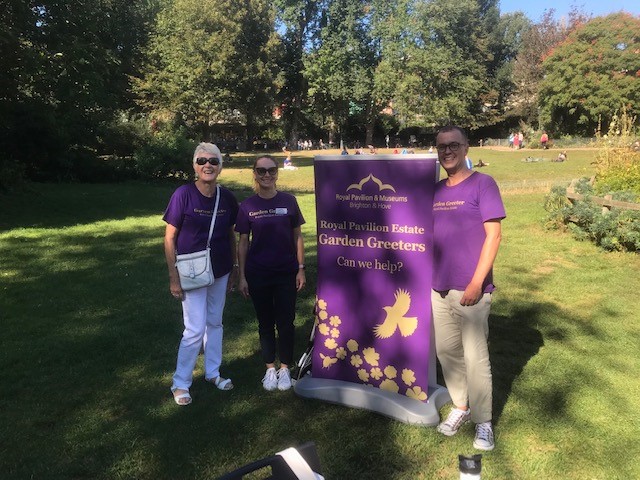
If you were strolling in Pavilion Gardens on any weekend this summer, you will have seen our purple and gold t-shirts and banner, asking “Can We Help?”

As Garden Greeters we’re on hand to welcome visitors, promote the Royal Pavilion and Museums, and to share tantalising historical tales.

Amongst us are artists, nurses, gardeners, tarot readers and much more, from many far flung places. We come prepared with leaflets and books. But even we couldn’t answer some of the questions put to us this year. Or persuade the odd visitor that their “fact” was indeed fiction.

For instance, we really did try to help the chap who kept on coming to ask “Why are there no flowers on the lawn?” We chatted for hours. In the end, he just wasn’t a fan of lawns.

Visitors always like to hear about George IV’s tunnel under the Gardens, and we’re ready to be told of the mythical tunnels too…to Mrs Fitzherberts house, or to escape a revolution to the beach. A new resident in Brighton had news for us, though. The night before he’d been shown a secret door. In the cellar of a pub in North Laine. What was behind the door? Prince Albert’s tunnel, so that he could get a pint whenever he wanted. Could we convince him that it wasn’t true? Absolutely not, because we hadn’t seen the door. Have you?

You never know who you’re going to Greet, or where they’re from, which is part of the fun. I remember trying to buy a bus ticket in Indonesia, but ending up taking a taxi. Me and the ticket guy just couldn’t get those tickets done! So after that, we always do our best to help. A lady from France had walked from North Street, and was very disappointed that the Lanes was only one lane. With a smile, we gave her a map, and suggested a few others. When we were asked where the Indian Embassy has moved to, or when the Turkish Baths became a museum, we let them down gently, and suggested a free audio tour.

There are always going to be lots of new folks to Greet, but there’s also lots of new things for us to discover. The mystery of the Weeping Wych Elm, Abba facing their Waterloo, a WW2 spy (apparently) hiding in a tree. So there’s plenty more Garden Greeting to be done.

We’ll be back next summer to do so!

Matt Wilson, Royal Pavilion Garden Greeter 

London’s Camden Town Group visits Brighton and Eastbourne

This is a legacy story from an earlier version of our website. It may contain some formatting issues and broken links.

Some of my favourite early 20th century English artists have been highlighted in two exhibitions in Sussex – the ongoing Down from London: Spencer Gore and Friends at Brighton Museum & Art Gallery, and John Nash: The Landscape of Love and Solace, which has just ended at Towner in Eastbourne.

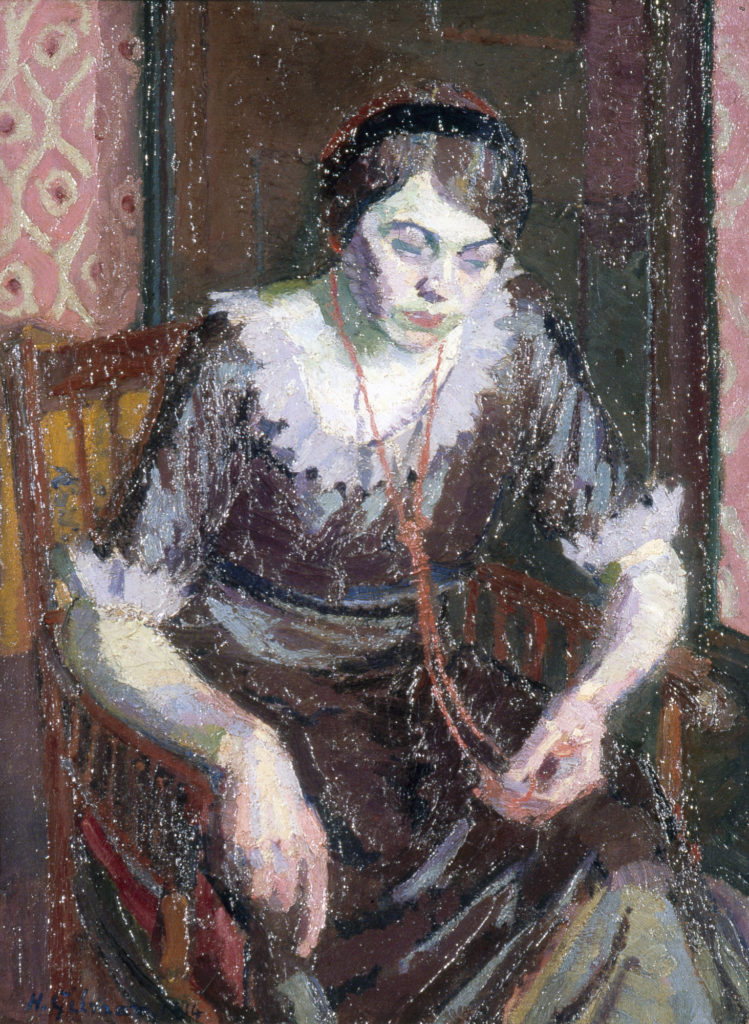
Both exhibitions have featured bright, colourful paintings by artists who formed part of the Camden Town Group in London. Paintings by Spencer Gore, Harold Gilman and Charles Ginner sparkle at Brighton Museum & Art Gallery, while at Towner they provided the context for some of John Nash’s beautiful early work.

Harold Gilman, The Coral Necklace, 1914, Royal Pavilion & Museums Trust

Harold Gilman, The Coral Necklace, 1914, Royal Pavilion & Museums Trust

The Camden Town Group has a historical link with Brighton dating back to 1913 when the artists held an exhibition at the Public Art Galleries, now known as Brighton Museum & Art Gallery. The Group was founded in London in 1911 by Spencer Gore and his friends Walter Sickert and Harold Gilman, and this was their last and only exhibition outside London. Almost all of the 16 members of the Camden Town Group – all men, women were not allowed to be members – lived and worked in north London, depicting its urban landscape and working lives, pubs and music-hall entertainment. They introduced modern, everyday life as a new theme in English painting as well as the innovative use of light and colour that had already appeared in Impressionist and Post-Impressionist paintings in France.

Charles Ginner, Leicester Square, 1912, Royal Pavilion & Museums Trust

Charles Ginner, Leicester Square, 1912, Royal Pavilion & Museums Trust

In the summer of 1913 Walter Taylor, an amateur artist and occasional patron of the Camden Town Group artists, invited his friend Spencer Gore to stay at his Brighton home in Brunswick Square. He introduced Gore to the Town Council’s Fine Art Committee who invited him to organise the Exhibition of the Work of English Post Impressionists, Cubists and others held at Brighton’s Public Art Galleries that winter. We are lucky to have in our Fine Art Collection Walter Taylor’s painting of his home, An Interior in Brunswick Square, and we know that Spencer Gore looked down from a balcony in that house on the scene captured in The West Pier, Brighton.

Walter Taylor Two figures in an Interior in Brunswick Square, c 1925, Royal Pavilion & Museums Trust

Walter Taylor Two figures in an Interior in Brunswick Square, c 1925, Royal Pavilion & Museums Trust

Spencer Gore The West Pier, Brighton, 1913, Royal Pavilion & Museums Trust

Spencer Gore The West Pier, Brighton, 1913, Royal Pavilion & Museums Trust

While not all of the paintings and drawings currently on display at Brighton Museum were in the 1913 exhibition, each of the artists represented took part.  And for the Brighton exhibition, the Camden Town Group invited and included paintings and drawings by a small number of women artists who worked alongside many of the Group’s members in London. Thus, our exhibition includes work by Sylvia Gosse, who worked with Sickert, Therese Lessore, who sketched on Brighton Beach, and Stanislawa Karlowska, who was a member of the New English Art Club in London and Robert Bevan’s wife.

Sylvia Gosse, La Rue Cousine, c 1930

Sylvia Gosse, La Rue Cousine, c 1930

The more avant-garde work in the third room of the 1913 exhibition by so-called Cubist or Vorticist artists was more challenging for the Brighton public. The Brighton Herald described it as “far and away the most challenging thing of the kind that Brighton has ever seen.”  “Don’t go to this exhibition after a bad night”, commented another reviewer. After the exhibition had closed in January 1914 and shortly before the Camden Town Group was absorbed into the London Group, Walter Sickert remarked that “At Brighton the Epstein-Lewis-Etchells room made me sick and I publicly disengaged my responsibility.” Even the 1913 exhibition catalogue had two separate introductions, one by James Bolivar Manson, Camden Town Group artist and secretary, subsequently Director of the Tate Gallery; and the other by Vorticist artist Percy Wyndham Lewis. Henry Roberts, Director of the Public Art Galleries, was careful to say in his preface that “The Fine Arts Committee have contented themselves with inviting the Camden Town Group to form the exhibition and are not responsible for the selection or arrangement, which has been undertaken by the Camden Town Group, acting through Mr Spencer F Gore.” This tiny catalogue is now on display in the exhibition at Brighton Museum.

Walter Sickert, The Laundry Shop, Dieppe, c1885

Walter Sickert, The Laundry Shop, Dieppe, c1885

The Royal Pavilion & Museums Trust’s fine collection of Camden Town Group paintings and drawings are all currently on display in Brighton Museum’s Fine art Gallery. The memorable 1913 exhibition is perhaps best recorded by the Town Council’s purchase of one of the exhibits, Robert Bevan’s The Cabyard, Night, the first and only painting by the artist to enter a public art collection during his lifetime.

Robert Bevan, The Cabyard, Night, 1913, Royal Pavilion & Museums Trust

Robert Bevan, The Cabyard, Night, 1913, Royal Pavilion & Museums Trust

Down from London is on display until next year, 2022. John Nash: The Landscape of Love and Solace at Towner closed at the end of September, but you can see many of the images and read about his relationship with the Camden Town Group artists in the new biography of John Nash written by Andy Friend and with the same title as the exhibition.

Discover More

Nicola Coleby, Partnerships & Development Manager, RPMT
Queen’s Road, 1931

This is a legacy story from an earlier version of our website. It may contain some formatting issues and broken links.

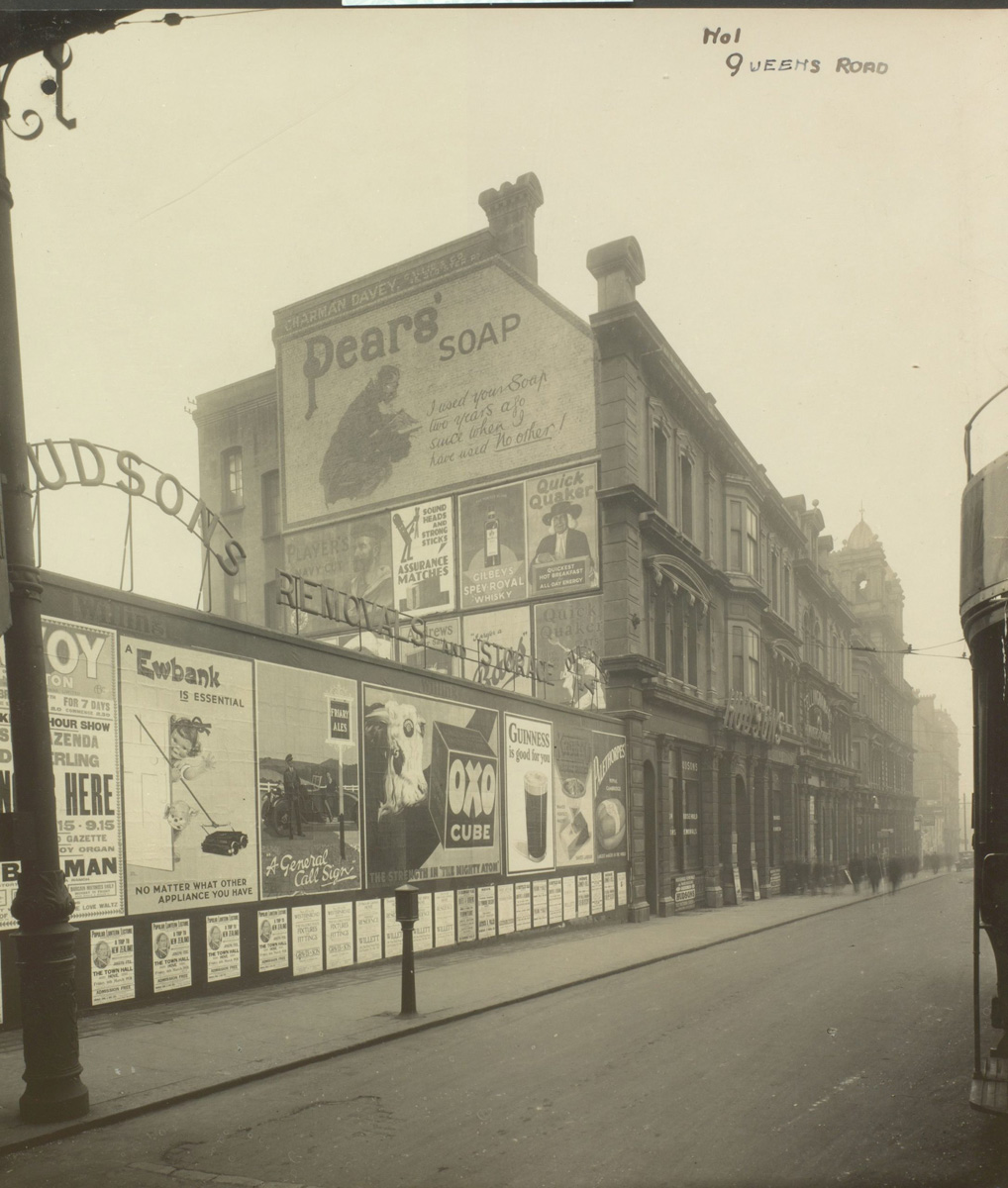
This photograph taken outside Brighton Railway Station shows Hudsons Depositories at 78-80 Queens Road. Part of the site became the Sergeant Yorke Casino in 1971 before it was redeveloped into a hotel in 2012.

Queens Road

Queens Road

Familiar Brands, Familiar Faces

A few of the products advertised here are still going strong today.

While virtually all tobacco advertising is banned in the UK, the sailor used in John Player’s cigarettes branding was once omnipresent. The company’s mascot is based on a photograph of Thomas Huntley Wood (1868-1951) for which he was offered two guineas and some tobacco to sit while serving on HMS Edinburgh in the early 1890s.

He served in the Royal Navy for 24 years before becoming a coastguard in Southwick. He is buried in Portslade Cemetery.

Dan Robertson, Curator of Local History and Archaeology

The Battle of Waterloo

This is a legacy story from an earlier version of our website. It may contain some formatting issues and broken links.

The Battle of Waterloo took place on June 18 in 1815 in what is now part of Belgium. Napoleon Bonaparte was finally defeated by a British-led coalition led by the Duke of Wellington and the Prussian Army. The battle marked the end of the Napoleonic Wars. 

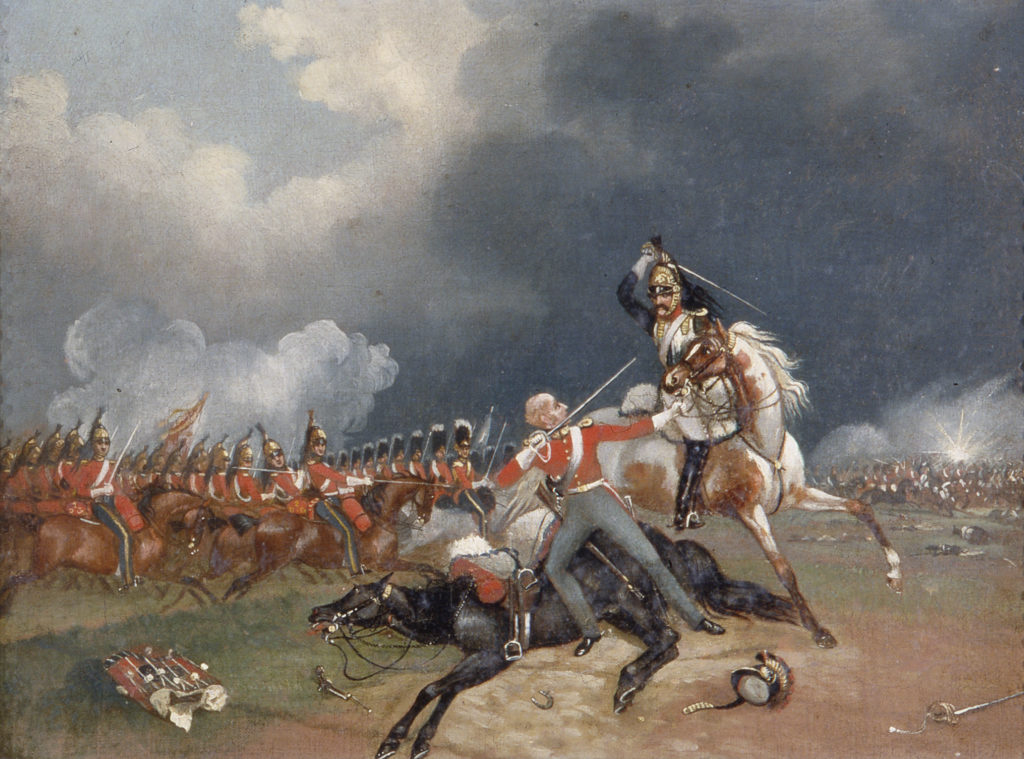
A Lifeguardsman Attacking a Cuirassier at Waterloo" showing a soldier on a white horse sword fighting with another soldier on the ground whose horse is lying beside him. In the background are charging soldiers on horseback. 19th Century.

A Lifeguardsman Attacking a Cuirassier at Waterloo” showing a soldier on a white horse sword fighting with another soldier on the ground whose horse is lying beside him. In the background are charging soldiers on horseback. 19th Century.

Yet this far away battle remains part of the history of Brighton & Hove over 200 years later in the names of its streets including Wellington Road and Waterloo Place. Kerrison Mews off of Waterloo Street in Hove is named after battle survivor Sir Edward Kerrison who lived in the area.

The Duke of Wellington Wearing the Order of the Golden Fleece" by Henry Perronet Briggs

The Duke of Wellington Wearing the Order of the Golden Fleece” by Henry Perronet Briggs

Pub names such as The Duke of Wellington in Upper Gloucester Road show how the battle captured the public’s imagination. Other veterans of the war are buried in graveyards across the city. Keep an eye out for the references on streets signs and names of buildings and you will see them everywhere.

In our Willett Collection of Popular Pottery we have souvenirs like this chamber pot with a lurking Napoleon, a figure of threat to the British public who also faced poverty thanks to the huge cost the wars were inflicting on the taxpayers.

The Prince Regent, who created the Royal Pavilion and later became George IV was fascinated by all things military but was not allowed to fight as he was heir to the throne. He did follow the battles through maps and dispatches and was happy to spend hours sharing the news from the front with his friends dressed in a military uniform. He also pretended he’d fought in the war disguised as a German general to wind up the Duke of Wellington.

King George IV, standing in Garter Robes, by Sir Thomas Lawrence, c1821

King George IV, standing in Garter Robes, by Sir Thomas Lawrence, c1821

After the defeat of Napoleon at Waterloo in 1815, Great Britain had become the most powerful nation in Europe. George IV’s coronation in 1821 was meant to eclipse Napoleon’s own lavish coronation in 1804. George was determined that his coronation should outshine that of the deposed emperor and the final sum worth £9 million in today’s money was the most expensive coronation ever in Britain.

With such historical links in the city to this battle, it only seems fitting that when the Eurovision Song Contest was held at Brighton Dome for the first and only time in 1974 the winning song by ABBA was … Waterloo. 

Caroline Sutton, Press & Media Officer

Doughty’s Dogs on the West Pier

This is a legacy story from an earlier version of our website. It may contain some formatting issues and broken links.

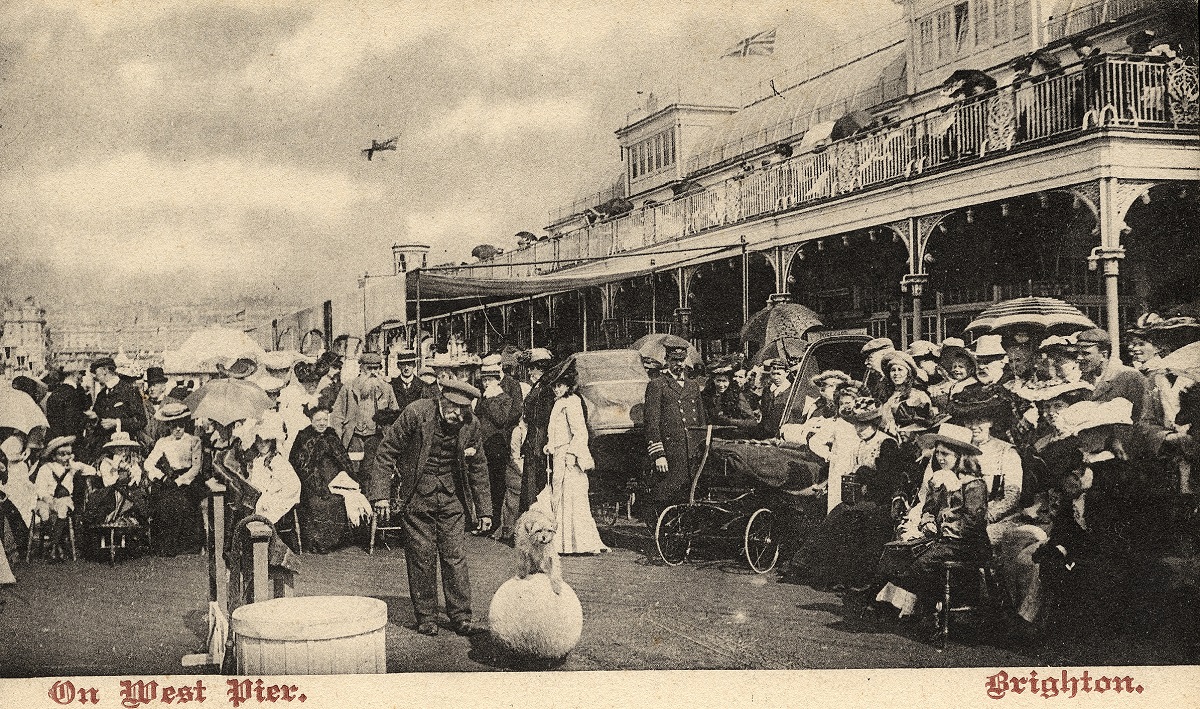
This postcard shows James Doughty and his dogs performing on the West Pier in Brighton in 1908.

James Doughty and his performing dogs on the West Pier, c1904

James Doughty and his performing dogs on the West Pier, c1904

After a long career as a travelling clown and showman, James Doughty came to settle in Brighton. He would carry on performing until he was in his 90s, although his dogs were doing much of the work at this point.

Doughty's Dogs

Doughty’s Dogs

This remarkable postcard shows a jumping dog in mid-flight through two hoops. It’s one of those magical images where the photographer has hit the shutter at the perfect moment to capture the excitement of the scene.

James Doughty of Brighton was a fascinating Brighton character and was performing as the oldest clown in Britain at the age of 94. He was such a legend of Brighton, he featured on postcards for tourists to send home. 

He ran away from school at the age of 13 to become a travelling performer and at 65 joined the circus in Brighton.

In 1911, at the age of 93, he married a woman of 25, Alice Zilpah. Apparently, his previous wife had been 25 years younger than him. He is said to have succeeded the famous clown Joseph Grimaldi at Drury Lane in 1851, taking over many of his wigs, props and songs. He died in March 1913 after entertaining many visitors to the now derelict West Pier for years. 

Doughty's Dogs

Doughty’s Dogs

Today we tend to use the phrase ‘jumping through hoops’ to describe carrying out complicated and annoying tasks to achieve a goal. But this photo is reminder that literally jumping through hoops can be a fast and enjoyable spectacle — especially when performed by a trained dog with an expectant audience.

By Kevin Bacon, Digital Manager

A ‘beautiful and splendid cabinet of the arts’ in Brighton, 200 years ago

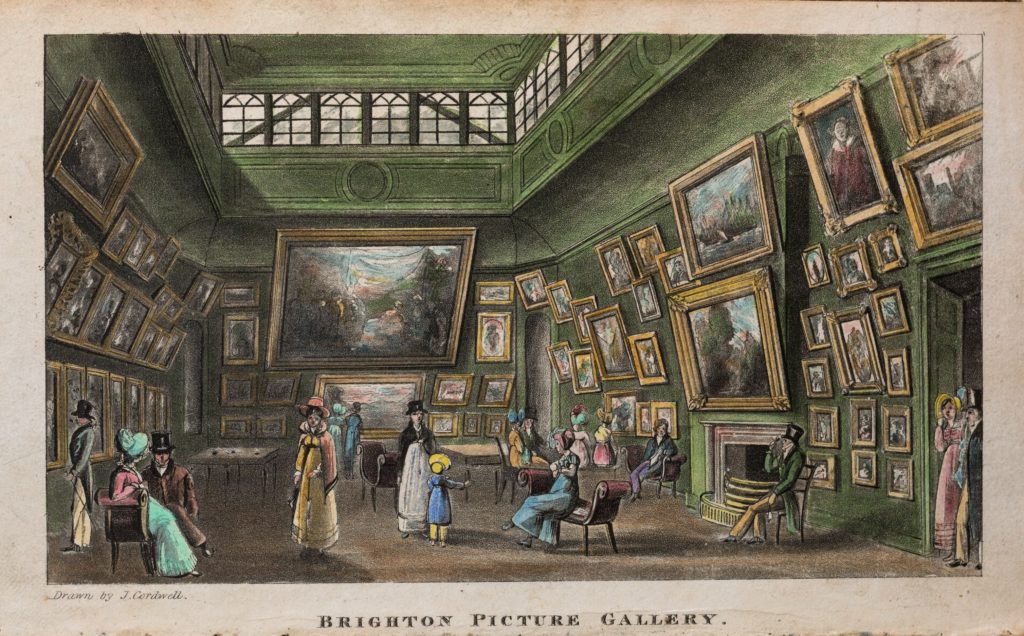
Brighton Picture Gallery aquatint c. 1820

This is a legacy story from an earlier version of our website. It may contain some formatting issues and broken links.

Now that museums and galleries are reopening, we look at an early Brighton picture gallery in the Circus Street area. 

The interior of the Brighton Picture Gallery, 1823

The interior of the Brighton Picture Gallery, 1823

What cultural entertainment was available in Brighton 200 years ago? Apart from events at assembly rooms, horse racing, theatres and libraries, Brighton also had a picture gallery in the early 1820s, long before art exhibitions were held in the Royal Pavilion (from 1850) and Brighton Museum was built (1873).

This image from 1823 shows the interior of the much-praised picture gallery. It stood at what is now roughly the area between Circus Street and Grand Parade, a plot of land that was developed between 1806 and 1808. This development included a riding school and equestrian circus, known as the Royal Circus, opened by Messrs Kendall and Co in August 1808. An engraving from 1809 shows an impressive ninebay, threestorey structure, adorned with a large Pegasus sculpture. Wings to the north and south housed a coffee house (the beginning of Brighton café culture?), billiard rooms and a confectionery.

The [Old] Steyne and [Grand] Parade area in 1808.

The [Old] Steyne and [Grand] Parade area in 1808.

The Royal Circus and Amphitheatre in 1809

The Royal Circus and Amphitheatre in 1809

In 1819 Mr Bodicote opened a picture gallery in the building, which quickly became a meeting place for Brighton society. Having paid a oneshilling admission, or one guinea for annual membership, visitors could also read newspapers, magazines and reviews in the gallery. The engraving showing the interior appeared in several publications, including Richard Sickelmore’s book The History of Brighton (1823). He describes the gallery as a ‘beautiful and splendid cabinet of the arts…, it is decidedly unrivalled, provincially, and may be fairly classed with those of the first consequence in London.’

Fashionable visitors in Brighton Picture Gallery, 1823 [detail]

Fashionable visitors in Brighton Picture Gallery, 1823 [detail]

Fashionable visitors in Brighton Picture Gallery, 1823 [detail]

Fashionable visitors in Brighton Picture Gallery, 1823 [detail]

Indeed, the gallery looks impressive: fashionably dressed visitors can be seen flocking in, and the paintings are arranged in a style reminiscent of London’s Royal Academy summer exhibitions – hung closely and all the way to the top of each wall of the top-lit room. Pictures on levels above the eye line are slightly tilted, for better visibility. In the early years after its opening, Brighton Museum displayed paintings in the same way.

The list of artists shown was surprisingly international, comprising Dutch, Flemish, Italian, German, Spanish and French masters, among them Parmigiano, Veronese, Caravaggio, Poussin, Ruysdael, Mengs, Hogarth, Gainsborough and others, as well as ‘the finest collection of De Loutherbourg’s work extant’. There are no records confirming that the great painters John Constable or JMW Turner visited the gallery, but it seems highly likely that during their extended stays in Brighton in the 1820s they would have dropped in.

Sadly, the gallery, dependent on sales of pictures, was not a commercial success, and closed in 1823, with much of the art being auctioned at Christie’s. By 1827 the building housed a ‘Bazaar’, its walls still lined with the paintings that did not get sold at the Christie’s auction. J Whittemore notes in one of his Brighton guidebooks that ‘although we lament the alterations [the building] has undergone, we are gratified to perceive that in its present state, it affords an hour’s amusement to the numerous fashionable visitors.’ A tiny engraving shows a building that seems to have been refaced, with the wings gone. Sadly, no trace of it remains today, but the area around Circus Street has recently undergone extensive development, and Brighton University’s School of Art borders the area, which is a rather nice coincidence.

Alexandra Loske

‘There are two sides to every question, and two teams to every Football match’ – a 1930s’ guide to appreciating football from Brighton & Hove Albion

This is a legacy story from an earlier version of our website. It may contain some formatting issues and broken links.

Following the UEFA Euro 2020, we thought we’d take a look at our football related collections for guidance on how to cope with the highs and lows that might present themselves as the tournament progresses.

Booklet titled 'Official Handbook', 'Brighton & Hove Albion F.C. Season 1930-31.' Page 44. Brighton & Hove Albion F.C 1909 - 10.

Booklet titled ‘Official Handbook’, ‘Brighton & Hove Albion F.C. Season 1930-31.’ Page 44. Brighton & Hove Albion F.C 1909 – 10.

Writing in Brighton & Hove Albion FC’s Supporters’ Club handbook for the 1930-1931 season, the unknown writer called ‘Impartial’ offers a few ‘Points still worth Remembering’ to spectators of the great game. Here are a couple of our favourites:

‘A football player is also a human being. Like the rest of us he is liable to his “off” day.’

‘Encouragement and support when things are going wrong are the finest tonics. Give it them.’

‘Linesmen are there to assist the Referee, if required. They don’t care two straws which side wins.’

How many of these points do you think remain relevant in today’s game? Whatever you think, I’m sure many people were cheering on Brighton & Hove Albion player Ben White who was called up to the England squad for the Euro 2020 tournament, as well as four other Seagulls who represented their national teams.  

One thing is for sure, their playing and travelling kits were nothing like these Albion players who were photographed by the Brighton & Hove Herald newspaper on 11 December 1937. They are at Hove railway station, the nearest station to the Goldstone Ground, the club’s home at the time. The other photos show matches at the ground in the Thirties. 

Brighton and Hove Albion football team standing on the platform at Hove Station. 11 December, 1937.

Brighton and Hove Albion football team standing on the platform at Hove Station. 11 December, 1937.

We can also be sure most spectators nowadays will not be choosing to wear a flat cap like this postcard, which shows a smartly dressed crowd supporting BHAFC against Port Vale during a cup tie the twenties. 

Postcard featuring a crowd at the Goldstone Ground, Hove. Sign indicates that the game is a cup tie between Brighton & Hove Albion FC and Port Vale FC. c1920.

Postcard featuring a crowd at the Goldstone Ground, Hove. Sign indicates that the game is a cup tie between Brighton & Hove Albion FC and Port Vale FC. c1920.

Dan Robertson, Curator of Local History

Harriet Elphinstone-Dick

This is a legacy story from an earlier version of our website. It may contain some formatting issues and broken links.

On the 9 September 1875, in rough open water Harriet Elphinstone-Dick swam seven miles from Shoreham Harbour to Brighton’s West Pier.

She completed the distance in a record making 2 hours and 45 minutes. It was regarded as one of the greatest swimming feats of the time.

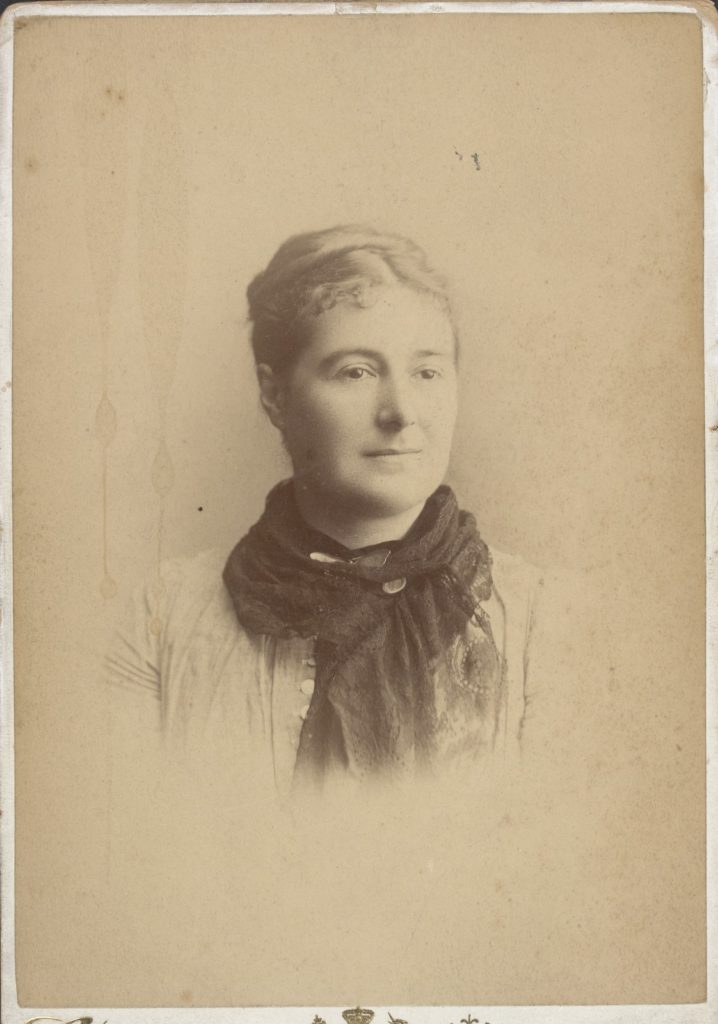
carte-de-visite image of Harriet Elphinstone-Dick from Australian archives. Credit: Charlemont & Co, c.1889-c.1898.

carte-de-visite image of Harriet Elphinstone-Dick from Australian archives. Credit: Charlemont & Co, c.1889-c.1898.

Born in Brighton in 1852 as Harriet Elizabeth Rowell, she rejected Victorian societal norms by remaining unmarried and teaching swimming. She used the name ‘Elphinstone-Dick’ in order to compete on equal terms in swimming competitions. 

West Pier, Brighton, 1880s

West Pier, Brighton, 1880s

Sea bathing grew popular during the 18th century. Lewes born physician Dr Richard Russell in 1750 published a paper advocating both the consumption and bathing in sea water for numerous complaints. Brighton being the nearest coastal town to Lewes drew visitors to ‘take the waters,’ contributing to the growth and popularity of the place. 

Charles Brill inherited what was to be established as Brill’s Baths in 1840 from his uncle Mr Lamprell. The original amenities built in 1823 on the south-east corner of East Street, brought in fresh sea water from Hove (actually) where it was warmed. It was expanded in 1861 with a Ladies only baths built on the west-side of Pool Valley, followed by a grand scale centrepiece circular domed Gentlemen’s baths that was 20 metres in diameter built between 1865-1869. It was designed by Sir George Gilbert Scott known for grand scale architecture such as the Albert Memorial. 

It was at Brill’s Baths Ladies swimming facilities that Harriet established herself as a swimming instructor. With swimming friend Helen Saigman, they set out to prove their ability and reputations as accredited teachers by attempting a long-distance swim. Due to changing wind and weather, the original Rottingdean to Brighton course was changed, starting west from Shoreham Harbour traveling east to the West Pier. 

The Brighton Gazette reported on 9 September 1875, that the first mile was completed in about 13 minutes. Within another half an hour more than half the distance had been undertaken. Unfortunately, Helen was to suffer severe cramp during the feat, forcing her to leave the water. The newspaper observed that, ‘Miss Dick, still being fresh and undaunted continued on her journey. These young ladies have accomplished the greatest swimming feat of the present day with the exception of Captain Webb’s Channel trip.’ 

With her lover Alice Moon (1855-1894), Harriet sailed to Melbourne, Australia in December 1875. There she taught three hundred women and girls to swim at St. Kilda Baths. She returned to England in 1878 to study physiology, anatomy, and medical gymnastics at the London Institute for the treatment of Deformities. On returning back to Melbourne in 1879, Harriet and Alice opened the first gym for women.

Demolition of Brill's Baths, Brighton. 1929.

Demolition of Brill’s Baths, Brighton. 1929.

Harriet died suddenly at home in South Brighton, Australia from heart failure in 1902. Her 1875 swimming feat is remembered in the Brighton Museum & Art Gallery exhibition, Queer the Pier, with an interactive automation machine. In 1929 Brill’s Baths made way for the art deco Savoy cinema, which evolved into what many local people may remember as the ABC cinema. 

Lisa Hinkins