Shedding Light on Preston Manor and Other Updates
Tessa Corton – Graduate Conservator, continues a series of blog posts from the Graduate Conservators at Brighton & Hove Museums.
In the last update, Dom wrote about “Problematic Pests and Reviving Rooms”, and it has been a year since “Preparing Preston and Fungi on Film.” It is time for an update on light fading.
Light Monitoring at Preston Manor Update
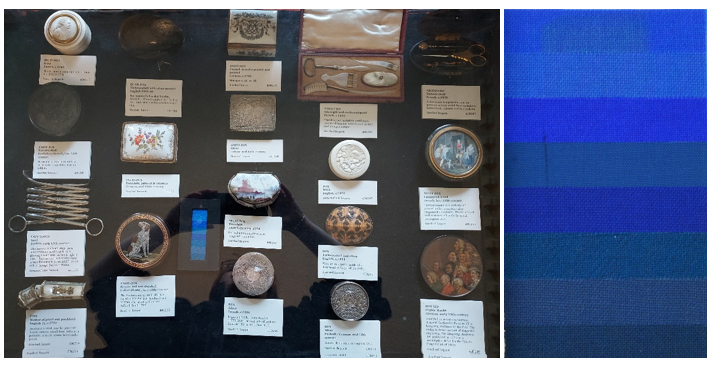
Back in April 2025, I installed eleven Blue Wool dosimeters in Preston Manor in preparation for its long-awaited reopening. These simple strips of card mounted fabric are key to a research project I am leading. It explores the impact of the lighting of the new visitor experience on the collection.
As I explained in a previous blog, both visible and UV light cause irreversible changes in object appearance, most commonly seen as fading. To manage the rate of change, we as conservators need to understand the degree of change after a year before making any recommendations. This is where the blue wool dosimeters come in.
I collected the dosimeters in early April this year. I photographed each one next to the control (an identical dosimeter kept unexposed), before returning them to the Manor. The method of analysis I had decided on can use clear photographs or the actual dosimeter. Therefore I chose to return the dosimeters as soon as possible, to obtain as much data as possible before April 2027.
The more days the dosimeter is in place, the more representative the results are. The longer the project runs, the more nuanced the results become.
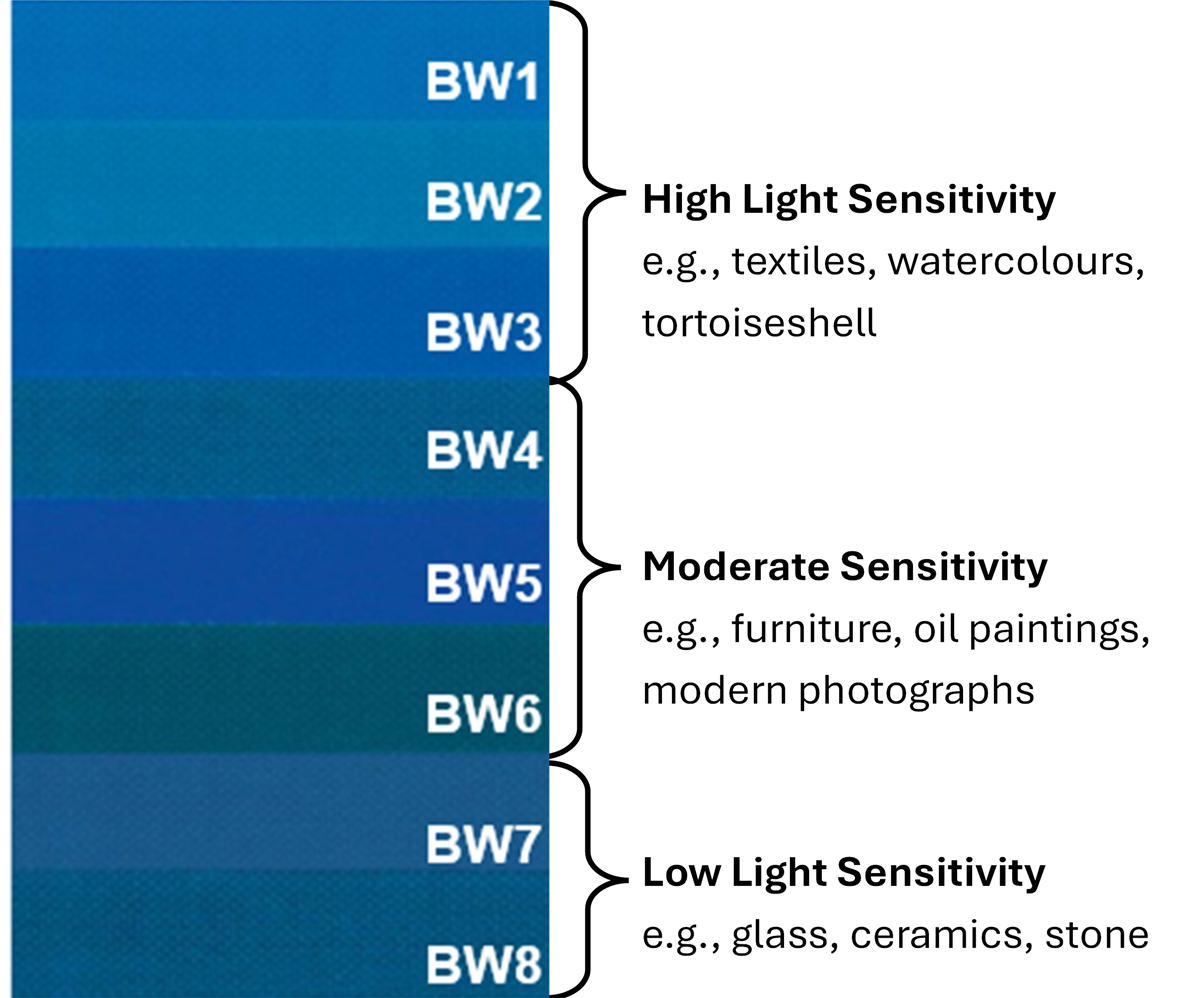
As a quick reminder, blue wool dosimeters are made of eight shades of blue wool. These are designed to fade after a predetermined dose of light, measured in Megalux (Mlx).
Shade 1, BW1, is the lightest and most light sensitive. It represents materials such as delicate textiles, tortoiseshell, and watercolours. In comparison, shade 8, BW8, is the darkest and most light fast, corresponding with stone and glass. By observing just noticeable fades in the shades, an estimated cumulative light exposure can be calculated.
Analysing the dosimeters relies on identifying a “just noticeable difference” (JND) in the blue wool shades. This is defined as the minimum amount of change visible to a healthy human eye. I studied the photographs I had taken of the dosimeters and ticked off which shades I could detect a difference in.
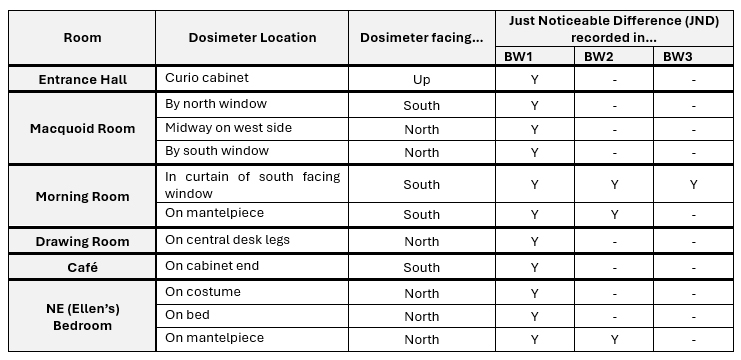
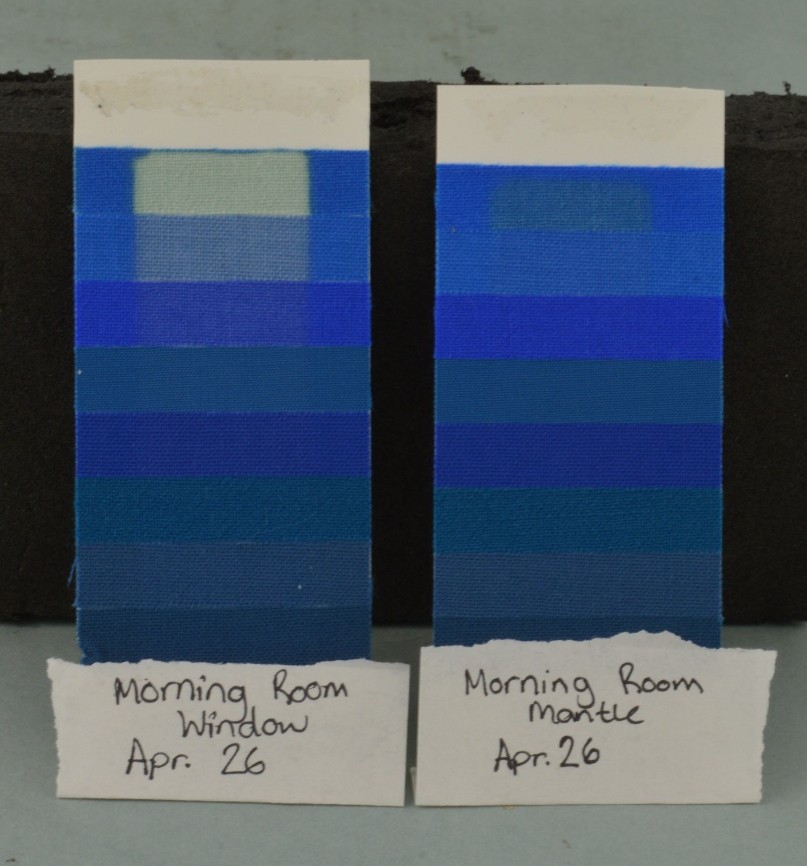
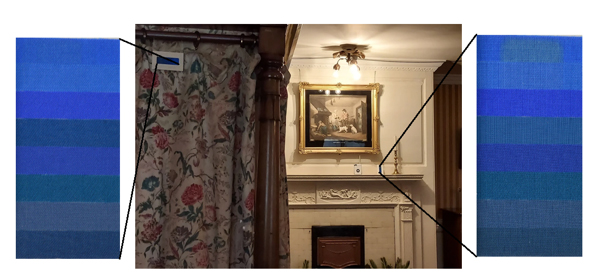
The results are much like I predicted. The dosimeters which face south show the most fading. This is because they receive direct sunlight and for longer than their north facing counterparts. Likewise, the dosimeters closer to the window faded more, as can be seen from the two in the Morning Room.
The one placed in the window shows a clear change in the third shade, which is more than predicted, whilst the one placed on the mantelpiece shows a JND in BW 2.
There were a few unexpected surprises too. In Ellen’s bedroom, the impact of the light fitting is clear when compared to the bed. The mantelpiece shows a fade in BW2 not apparent in the bed dosimeter.
As each shade fades after a known dose, I was able to calculate a known range of Mlx exposure and estimate a dose from the midpoint of the range. I then compared this to the National Trust recommendations to establish that Preston Manor is currently following these guidelines.
There are a couple of concerns however, regarding some of the more light sensitive objects. The costumes in Ellen’s bedrooms and the contents of the two curio cabinets in the Entrance Hall. After much maths, and by adapting a formula shared in a conference I attended earlier this year, I was able to use my previous estimates of exposure to calculate a time until a fade would be noticeable in the objects. From this, I was able to make recommendations to take to the Collections and Programming teams to slow the rate of change.
The dosimeters have been returned to Preston Manor and will be reanalysed this time next year. It is hoped that further fades will have been noticed, to create a more nuanced picture of the situation.
Hove Attic Update
My longest standing project is still progressing steadily. Here are some stats as of time of writing
- 381 objects decant and checked for mould
- Of the 381, 146 objects were cleaned of mould
- Of the 381, 209 objects have returned to temporary stores at Hove Museum
- Of the 381, 172 objects are awaiting return to Hove Museum
- An additional 483 objects have been packaged and are awaiting transport for checks and cleaning
These numbers refer to individual object numbers, but the actual number of items is higher as they can apply to a group of items.
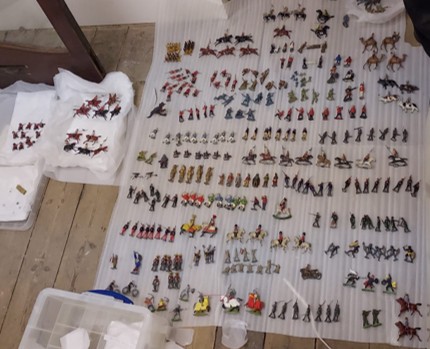
“What does a Prussian look like?”
This is a small collection from a box of toy soldiers. These were 67 object numbers, counted within the figure 483, but 305 individual items, showing how deceptive just counting object numbers can be.
With the help of three volunteers over the past eighteen months, the project is on the brink of the final phase. The second of the stores, the Craft Store, has been completed and is ready to be placed in temporary storage. Just over a quarter of this store was mould affected. In the first, which was a mixture of Craft and Film, this percentage was just under half.
The final store presents the final hurdle. It contains more objects than the other two combined. It has the largest and most awkward objects to transport, and historically has the best environment for mould growth.
The main store is expected to be ready for transport in July and will be swapped with the returning Craft Collection. I am currently waiting for the redecoration of the Film Gallery at Hove Museum to be completed before the final decant can take place. After that, it’ll just be a matter of checking and cleaning until the project is completed.
In the meantime, I am conducting a condition assessment, cleaning, and disposal view of the fashion furs and feathers collection. I am becoming more involved in balancing filming and conservation, and exploring opportunities in Heritage Science training.
The next update will be from Dom in the autumn. He will discuss completing the remediation of mould in the Costume Store and getting involved in the redevelopment of the Booth Museum displays.