‘A Garden Pavilion’- A Place in Time and a Short Origin Story of the Royal Pavilion Gardens

Inspiration comes from the unlikeliest of places, or so it’s said. For me, this was most certainly the case with the topic of my blog, which was inspired by an Elm Tree, specifically the Braced Elm Tree or the ‘Padlock Tree’.
I came across a print of the Braced Elm Tree (photographed) which was entitled “Old Elm Tree Pavilion Grounds, Brighton”. Little did I know, that this particular Elm Tree is an ancient English Elm Tree (Ulmas Minor Atinia) and was planted in 1776. It has stood in the Pavilions West Lawn for over 240 years and is protected as a key specimen by the National Elm Collection in Brighton and Hove. This Elm tree pre-dates any of the Royal Pavilion’s history and takes us back to the original foundation of the Royal Pavilion Gardens. It was planted in Promenade Grove, Brighton’s first official garden (which I will be writing more about), and consisted of Elm Trees, shrubs and plants.
Its nickname as the “Brace Tree” comes from the iron brace which was tied around the tree to reinforce its structure. Long story short, the Royal Pavilion Gardens are quite literally a living museum with a relic in itself still with us in the form of the Braced Elm. While millions of Elm Trees have been unfortunately lost due to the repercussions of Dutch Elm Disease, it’s remarkable to say that we still have the Braced Elm with us today, along with 15 other varieties of Elm.
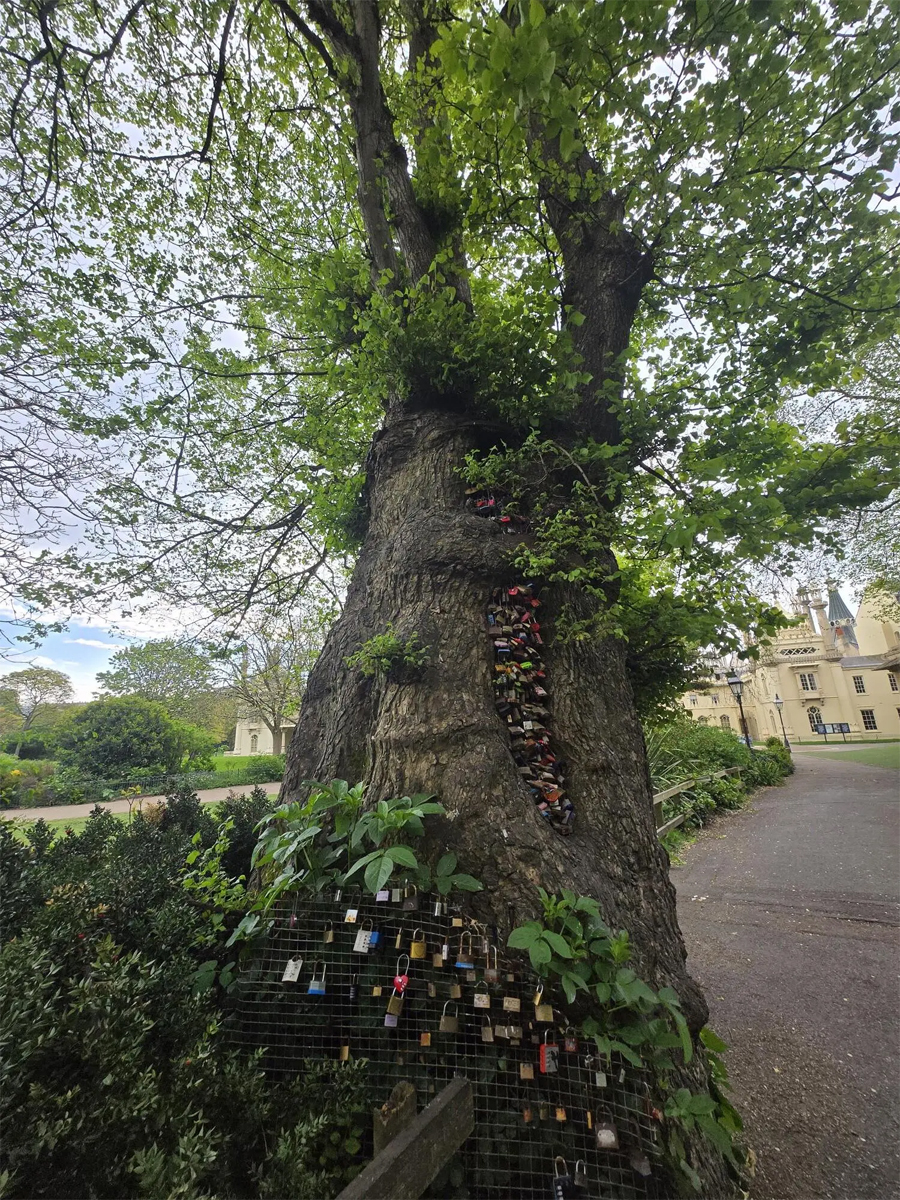
As an Archivist, cataloguing a collection means that I am moving through time at a rapid pace. I must focus on what is visibly in front of me in the form of a correspondence, a watercolour, a print, an architectural plan etc. These are brilliant sources and insight into an institutions changing phases throughout history. But this Elm is something living, breathing, and growing and physical evidence of a place in time. It stood still and quite literally took me right back in time to the very beginning, no matter the changes that occurred, the life that it has seen, it remains as a constant.
As I continue to catalogue prints, watercolours and artistic impressions of the Royal Pavilion, it felt almost like a jigsaw puzzle coming together to tell a wider story of the origins of the Royal Pavilion Gardens.
Join me as I share with you historical sources from the Royal Pavilion archives. And the stories that they have told me about the gardens.
Now, take my hand and take a step into the gardens with me as I let the historical sources speak for themselves.

Brighton in the 1780’s and 1790’s was flourishing as a fashionable sea side resort. It had considerable advantage with attractions, assembly rooms, inns, circulating libraries, shops, race courses and theatres. The sea itself was a central attraction, with people seeking to enjoy the benefits of sea water.
On the 13 July 1793, the first official garden in Brighton opened for the public. This was called the Promenade Grove. It would have occupied the central part of the Western Front of the Royal Pavilion and Garden.
Promenade Grove was right at the hub of this movement. It functioned as a pleasure garden for nobility. It offered public breakfast clubs, teas, musical concerts, night parties etc. It was a curated park which called for a paid admission to enter and it was simply made of Elms, shrubs and flowers. It was said that the lawns were mowed so well that they gave the illusion of carpet, almost like an outdoor palace.
It was often said that in the Grove, music was played, trees were lit with lanterns at sunset and people played musical instruments.
In the late 18th century there were significant transformations in landscape gardening. One example was the growing prominence of reputable gardeners such as Lancelot’ Capability’ Brown (1716-1783) (Capability was a nick name given to him as he was famous for being capable of transformation). He was a reputable gardener, who believed in transforming countryside’s from being open areas of land to landscapes serving as social centre pieces and fashionable spaces.
Brown was inspired to replace rigid, formal land into picturesque Arcadian landscape paintings of Masters like Claude Lorrain. He wanted the British garden to be scenic living landscape paintings. Brown visualised the earth and lawns to be a canvas almost mirroring water. In fact, some of the earlier prints of the Royal Pavilion contain a blue like tint on the lawns, which makes me think of the Royal Pavilion Gardens almost mirroring the sea.
Although Brown had passed away in 1783, his ideas and philosophies did not disappear. Rather they were reinterpreted and evolved into different ideas of designing a picturesque English garden.
Humphrey Repton (1752-1818), a reputable landscape gardener whose surviving works include Groveland’s Park Enfield, Russell Square and Bloomsbury Square, was one of the proposed designers to present ideas to the then Prince Regent. Repton famously published extensive watercolours in the form of large bound red books with 3D pop ups reimagining the entire Royal Pavilion Estate. It consisted of a lived-in experience of the gardens with gravel walks, terraces and flower beds integrated with exotic plants to reflect an ‘Indian inspired’ fantasy.
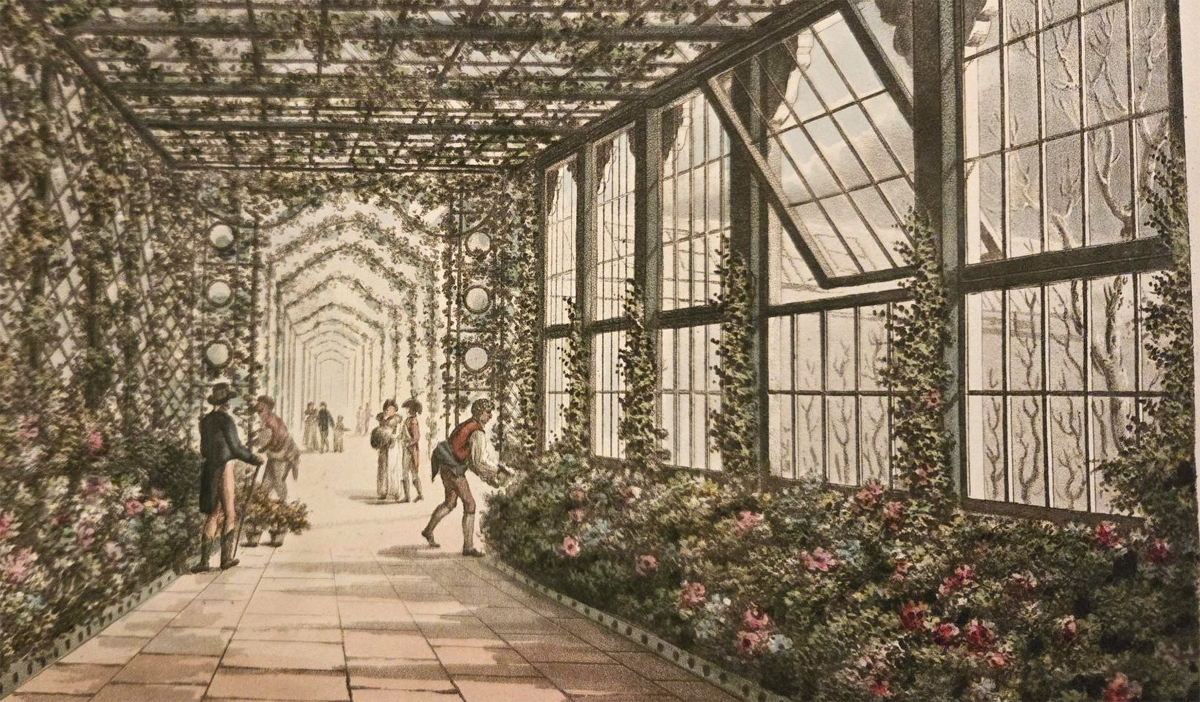
Repton and John Nash, who went on to win the commission for the project, were initially partners. Therefore there are elements which are extremely similar. One of the key differences, and what I would have loved to see, was an interconnecting conservatory.
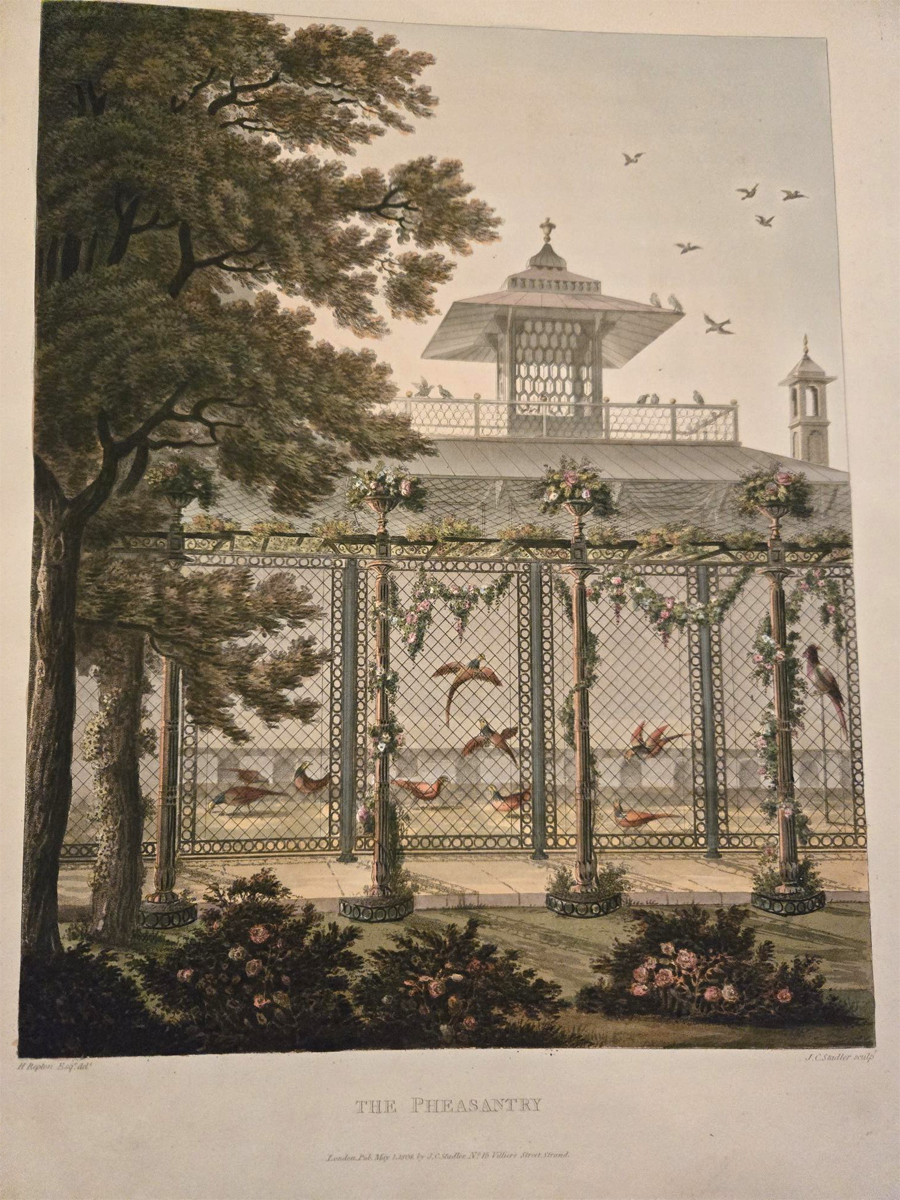
Photographed is another proposed vision of Humphrey Repton’s vision for the Royal Pavilion Garden. This was for a “Pheasantry” which would have been an ‘Indian’ inspired aviary and was designed to house rare birds.
Repton’s plans were not bought into fruition due to King George IV deciding to appoint John Nash (1752-1835) architect and Surveyor General of the Office of Works, and William Townsend Aiton (1766-1849) Superintendent of Royal Gardens at Kew.
But the plans laid a pivotal foundation as they transformed landscape designs from plans to visual reimaginations. It is clear that his ideas contributed to the final layout of the Royal Pavilion Garden.
And the fact that Nash and Repton were partners, and Nash by trade was an architect, it was clear that he drew upon Repton’s expertise in gardening.
It would be very difficult to understand the origins of the Royal Pavilion Garden, without acknowledging the lost palace that was Carlton House and its Gardens.
Carlton House was the first mansion and the first official residence of King George IV. This was of course following St James Palace where he was raised. It formed an essential foundation for King George IV to experiment with his architectural and horticultural desired vision. This taste would trickle into different areas of the Royal Pavilion and Garden. In simple terms, it was almost like a laboratory for ideas.
At its core, Carlton House was a French Neoclassical style building inspired by King Louis XVI as a statement of bringing the French Neoclassical style of architecture to England. It was rebuilt and designed by Henry Holland in 1793. Holland went on to be appointed as architect for the Royal Pavilion and designed the first Marine Pavilion between 1787-1788. An interesting fact is that the pillars to the entryway were actually salvaged and form the entryway to the National Gallery, Trafalgar Square.
The original layout of Carlton House gardens were designed by William Kent for Princess Augusta, but went through phases of developments.
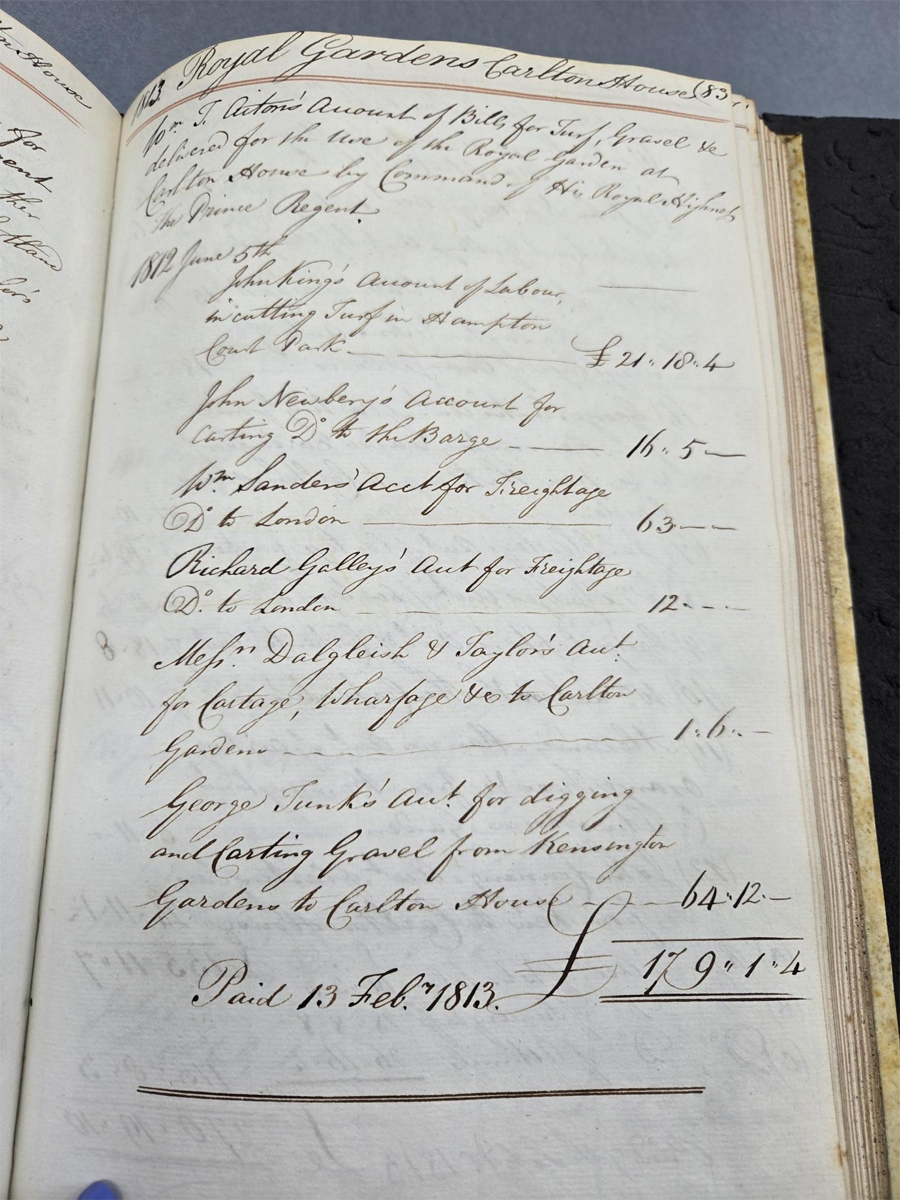
This is an extract from Lord Chamberlains accounts, which TNA (The National Archives) kindly allowed me to have a look through. In this extract it documents various labour and transportation costs related to the maintenance of the Carlton House Estate covering 1812 to 1813.
It conveys costs related to labour and transport, including payments to John King for labour at Hampton Court, freightage payments to a Mr Sanders of £63. Richard Gulley £12 for freightage to London, and an entry for George Tunks related to “digging, carting gravel from Kensington Gardens to Carlton House Gardens” costing £64.12 shillings.
Carlton House was a pioneer for gardens transitioning from being separate entities to becoming an extension of a building.
Below is a print of the conservatory in Carlton House which was designed in the Gothick style of architecture. This print is from 1811 from Ackermann’s Repository of Arts, as designed by Thomas Hopper in 1807.
It was known as the ‘jewel of the gardens’, it coined this name first of all due to its architectural wonder. It was a Neo classical, Gothick masterpiece, in itself made from cast iron and translucent glass and was heated.
Hopper designed huge folding glass doors or ‘sash doors’ which could almost disappear if they were folded back entirely. Thus creating quite literally an ‘open air’ Pavilion, which would bring the outside in as opposed to looking out into the gardens.
Horace Walpole described the music room and the conservatory as having a ‘fairytale’ effect. It created an enchanting scene where one could gaze out into a ‘green recess’ into the winding walk of the garden.

Not to take away from the story, but what is important to understand with regards to the Royal Pavilion and Garden, was that the early 19th century would mark a period of significant transformation, which would impact the Brighton we see today. So it’s important to take a pause and have a look at this historical source, to really take in Brighton before these changes occurred, but also mid transition.
Recently I located a treasure within the Royal Pavilion archives amongst uncatalogued material. This was a map entitled a Map of Brighton 1802 and was created by William Constable (worthy of his own story for sure). Drawn in pen and water colour, dated 1802, it captures Brighton right before the developments made to the Royal Pavilion Estate by John Nash.
In the centre right you can see the outline of the former Marine Pavilion designed and built by Henry Holland. At the time, merely a symmetrical building facing the Stein. The map itself is of huge significance, firstly as it was actually a business card! Not only this, Constable would have been only 19 years old!
William Constable (1783-1861) was a self acquired and self taught draughtsman, daguerreotypist, cartographer, surveyor, engineer and explorer, inventor, and based on research, an all round perfectionist. Constable was passionate about exploration and at the time was saving up to travel to America with his brother. He worked alongside his brother at a Drapers shop at Number 3 North Street, Brighton. He drew this map as a route for customers to locate his store.
Constable was credited with transforming photography from a scientific experiment to a commercialised process. He did this by purchasing a Daguerreotype license, which he paid £1000 for at the time. A Daguerreotype was the process which produced a photographic picture on a silver-plated copper sheet. Constable opened his studio just two years after a Daguerreotype was announced to the public.
If I got into how remarkable William Constable was, I would be here for a while. But the significance of this as an existing record is huge for the Royal Pavilion Garden. I like to think of it as a freeze frame of the point when Brighton was transforming rapidly away from being a quaint fishing village, into becoming a central hub of activate.
By 1806 the estate comprised of 8 acres of land. The Prince had just purchased the Promenade Grove, Quakers Croft, the remaining farmland, the Dairy Field and properties on Church Street. The Prince also arranged for the public thoroughfare which ran along the Pavilions western front to be closed and replaced as New Road.
The Royal Pavilion Gardens were a stark transition from the lavish, yet intimate fairy-tale garden of Carlton House, which Horace Walpole wrote about. Many of the fundamental planting schemes were originally adopted in Carlton House. But also the technology and developments rolled out in the interiors of the Royal Pavilion to ‘bring the outside in’.
Briefly going back to the Gothick conservatory built by Thomas Hopper. It was not only a beautiful scenic room, but it adopted hugely advanced heating technology. This was in the form of hot air flutes, pits filled with tan bark (which generated heat as it rotted) to grow.
At this specific time it was considered a trend to grow fruit. It was for this reason that the conservatory was built to nurture the growth of fruits. That exact technology was adopted in the Pavilions west corridor, the glass heavy design scheme and heating systems were made so that King George IV could stroll through, with a feeling of an indoor garden with potted fruit trees.
Between 1805 to 1823 William Aiton designed the planting schemes for the Royal Pavilion Garden. He focused on the integration of new internationally imported plants. Mass plant types were integrated in the garden for visual affect as a reflection of the interiors of the developing Royal Pavilion.
Henry Phillips was a Sussex born gardener living in Brighton and was commissioned by Thomas Road Kemp to lay the enclosures of the garden in the Regency Style in 1823. Phillips codified the layout of the Royal Pavilion Garden in 1823 through publishing Sylvia Florifera an official account of the Garden.
“the shrubbery is a style of pleasure garden which seems to owe its creation to the idea that our sublime poet“
Phillips approach to the composition of plants was inspired by colour. He had a mindset like that of a painter. He was very focused on the colour schemes of the plant beds and the decorative element of planting, then anything else.
“trees whose leaves are of greyish or bluish tint when seen over or between shrubs of yellow or bright green seem thrown into the distance…the picture is formed by a succession of blossoming and by judiciously contrasting the greens”
A few examples of Phillips theory in practice were that he would have plain and variegated evergreens combined. Then light and elegant acacia, which he explains as having a ‘more beautiful affect’ floating over the firm dark holly or bay trees.
Phillips objected to plants being ‘arranged’ in any set order as he felt this stripped away the artistic element. Rather he preferred groups of four to six to give an artistic effect. He depicts how he massed “flaming yellow crocuses” together to create an intense burst of colour instead of scattered plants. He then depicts using a shrubbery foreground, or border as a stage for other plants. For example he used large groups of Chinese Asters (Callistephus Chinensis) which would come in vibrant blues and purples to create a layer of rich pigment.
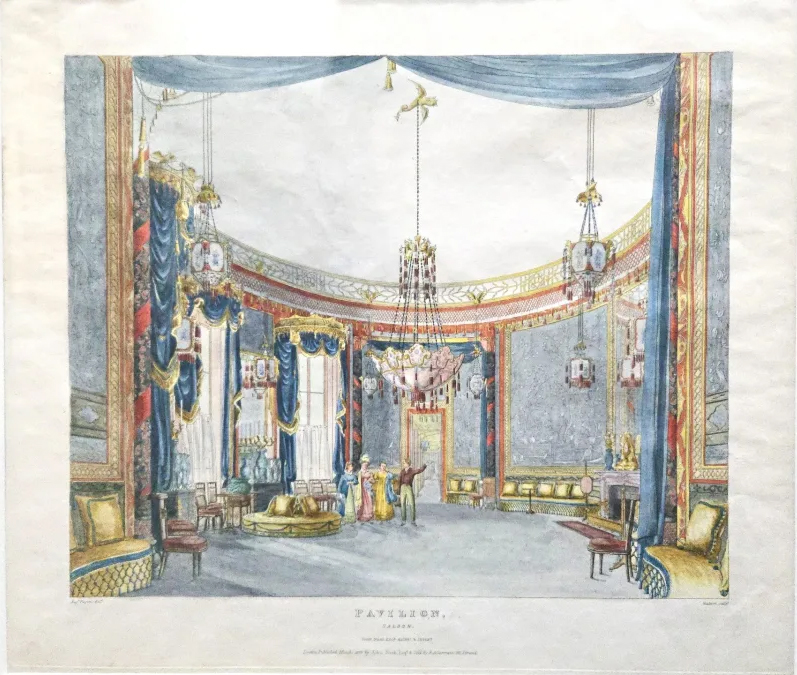
In contrast, he describes that his preferred colour palette was blue or purple. In another extract he describes the below, which depicts how he would often contrast, blue or purples of the Chinese Asters with sandy colours. I recently visited Dr Alexandra Loske’s exhibition on the colour blue at the Brighton Museum & Art Gallery. I was thinking about the impact of colours which were being experimented with in the interiors of the Royal Pavilion on the external gardens. It was said that William Aiton and Henry Phillips championed blues and in particular loved Delphiniums due to their vibrant blue colour providing a pop of colour which King George IV loved.
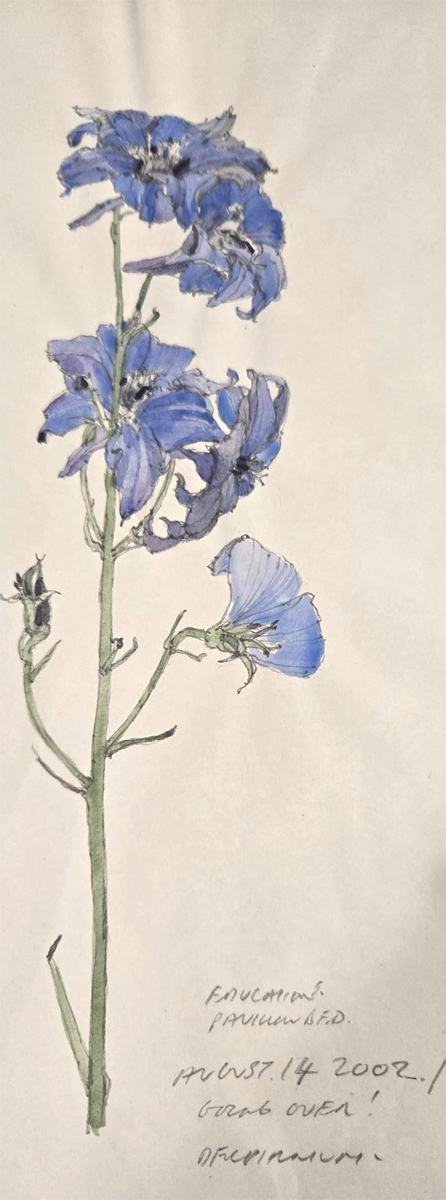
This a watercolour painted by Mike Jones, former Head of Conservation for the Royal Pavilion & Garden, botanical artist and publisher of Set for a King for Brighton & Hove Museums. This was illustrated from the historical Regency restoration beds in the Royal Pavilion Garden, and is a Delphinium or Larkspur.
Looking at this illustration of a Delphinium and its Regency roots. I will talk more about its cultural roots, and my final section gives an indication of the kinds of colours and design ideas, which were bought to fruition in the Regency garden. It is almost like the international plants were adopted as decorative elements to fulfil the artistic wishes of Aiton and Phillips.
I was fortunate to have a visit from the Royal Pavilion’s dedicated garden team. What was quite interesting to learn is that 19th century records, layouts of the gardens, plant lists obtained from historic bills of royal supplier John Wilmott and published works as demonstrated in the extracts I have referenced from Henry Phillips, continue to remain hugely relevant today.

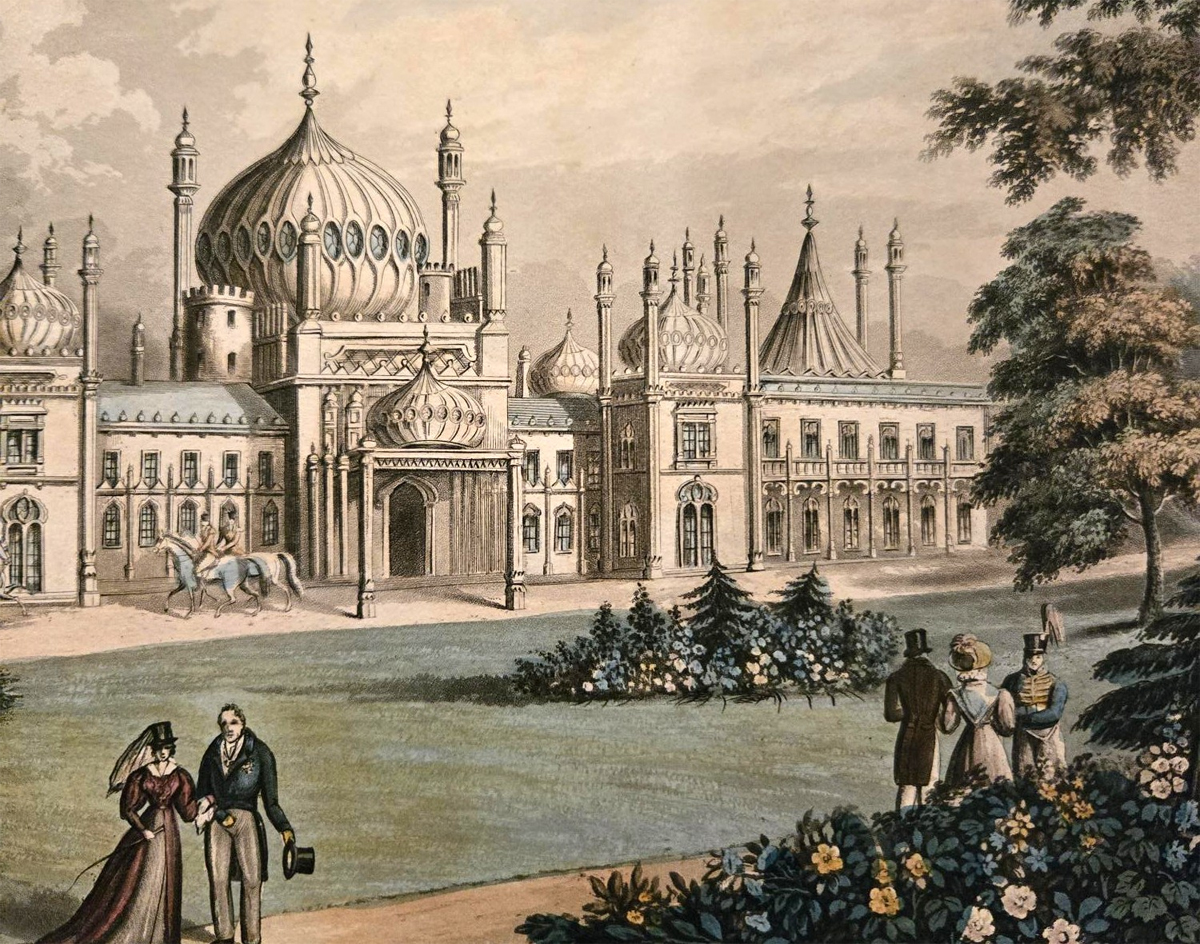
Above is a print of the Eastern front of the Royal Pavilion in 1820. Plants visible in this 1820 print reflect the picturesque Regency style implemented by John Nash and William Aiton. Plants included are Hollyhocks, Foxgloves, Herbaceous Perennials and Seasonal Bulbs.


Travelling forward in time, I wanted to look at how plants were incorporated into architectural structures built across the Royal Pavilion Estate. This is mainly because I think its such an interesting look into the meticulous work locals in Brighton did to create these temporary monuments, which were essentially moments in time.
For anyone unfamiliar, these prints showcase temporary structures which were designed and built to welcome or celebrate the Royal family. They were destroyed following the event.
The temporary archways were erected as celebrations to commemorate King William IV and Queen Adelaide’s arrival to Brighton. The second was to celebrate Queen Victoria’s first visit to Brighton. The print entitled “Triumphal Arch” was designed by John Fabian.
Fabian lived in Brighton and was often commissioned to build these temporary archways. The design itself was inspired by Roman single arch gateways. They were designed to also house spectators, but in many ways Fabians designs took this above and beyond traditional Roman archways, with the key distinctive feature being the integration of plants.
The archway erected for King William IV’s first visit to Brighton was a 50 foot floral and wooden structure erected in Marlborough Place. It celebrated the King on the 30 August 1830. It was not only an archway, it had tiers of seating for thousands of spectators. It was made out of timber scaffolding and fully dressed in evergreens. For the archway erected for Queen Victoria’s arrival on the 4 October 1837 her name was spelt with dahlias and laurels. In fact, moss, dahlias and laurels were supplied by local nurseries and gardeners in Brighton.
What strikes me from this, is not only the sheer scale, but the efforts of Brighton’s local community to creating these beautiful monuments. And how central plants were to creating these magnificent structures.
During King George IV reign, the Pavilion Garden was completely closed off from public access. But King William IV was the first royal to set aside dates and times that the public could enter the Royal Pavilion Garden for the first time. This marks the Royal Pavilion Garden change in Brighton’s wider society.

Music in the Gardens
During the Victorian era of the Royal Pavilion Garden, Queen Victoria wanted more privacy in the Estate. Unlike King William IV who aside set days where the public would be welcome to roam in the Royal Pavilion Garden. So until the sale of the Royal Pavilion Estate to the Brighton Town Commissioners, it is likely that the gardens were not open to the public.
Having said this, the concept of a stylistic garden was flourishing with gardeners across England seeking to recreate elements of the picturesque garden. But, as well as this, gardens weren’t just visual entities, they were becoming a movement in England. They were inspiring deep feelings, sensory immersion and historical storytelling.
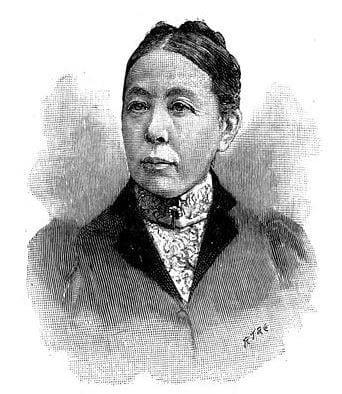
Helen Marion Burnside (1841-1923) was a lyricist, poet, author and card designer. I have photographed a book which I found in the Royal Pavilion archives. It contains music composed by Joseph L Roekel, written by Helen Marion Burnside of a song entitled “The Scent of Limes.” Lyrics tell the story of a long standing infatuation with fragrant gardens.
Helen Marion Burnside actually lost her hearing at the age of 13 due to scarlet fever, and her greatest desire was to become a Musician. Although, she had lost her hearing, Helen went on to write over 6000 verses with her music widely acclaimed. This book, a price of 4 shillings, and on the top left and top right you can see the names “Madan Bowyer Betchworth” and “M Estelle Mills.” Victorians would often sign their sheet music and bring it with them when they would attend a gala or an event. The very fact that this was in the Royal Pavilion archives suggests Helens music could most certainly have been played in the Royal Pavilion!
The imprint reads “Robert Cocks and Co” and displays the Royal Arms meaning that its likely Queen Victoria herself endorsed the printing of Helens music. I would really love to hear someone play Ms Burnsides music in the Royal Pavilion one day.

The title of the song itself “The Scent of Limes” is a reference to 16th century trends of experiencing gardens. In the 16th century during the Tudor and Elizabethan era, gardens were completely defined by their scent. Paths were frequently surfaced with low growing carpeting herbs rather than gravel walkways so visitors would directly walk on plants like “creeping thyme, Roman chamomile, mint, musk roses etc which released bursts of fragrances”.
Limes were originally planted in the Royal Pavilion during the redesign of the Garden between 1815-1822 by John Nash and William Aiton. The two central reasons were first to create a sensory garden where plants would meet the noses of visitors promenading through the gardens. The second to also create a distinction from the public in Brighton and the palace walls.
I wrote about Elm Trees at the start of this blog post. Away from my Braced Elm, which we know was planted in 1776, trees were also planted as part of this idea of closing off areas of the gardens to create a distinction from the public to the private Royal Pavilion Estate. I even read a quote comparing the rows of trees to Sleeping Beauty’s castle!
Henry Phillips applauded the planting of lime trees. He said that the lime tree is perfect as its heavy honey sweet blossoms in summer produced a fragrance so powerful it would fill the entire Royal Pavilion Estate. Lime blossoms were said to have been used in the Victorian era as a secret language of love. It was said a lime was a sign of conjugal love. What is quite lovely, is that when the Royal Pavilion Garden was finally opened to the public, following the sale of the Royal Pavilion Estate from Queen Victoria to the Brighton Town Commissioners, the public would have gotten to experience the exact same aromatic garden that Ms Burnside drew inspiration from!
I have been able to share historical sources and research I have conducted into the origin of the Royal Pavilion and Gardens. I would also like to share a huge area of interest of mine, which has inspired me to reinterpret the Royal Pavilion Garden and bring it to a new light.
My interest is in Decolonising. Colonising was the process of European countries essentially establishing military and economic control over newly found territories. But in this process they created an extractive system or a ‘system of taking.’ Natural resources such as cotton, tobacco, spices and tea and plants for example, were transported back to Europe. But in this process, British archives still contain items from those periods of colonial occupation. So through decolonising we are able to flip the narrative and uncover the actual cultural origin and significance of items that still remain with us.
It is clear and obvious in the Royal Pavilion architecture that it is deeply inspired by ‘Indo-Saracenic’ architecture. With an internal decorative scheme inspired by China. So it is very important for us as an institution to learn and understand the true cultural origin of the collections, but also the plants within the Royal Pavilion Garden.
As a British archivist from a South Asian background, I have been applying my own cultural expertise to my profession as an archivist. I help organisations through sharing my own cultural knowledge on objects, which I know the true origins of. In turn it helps enrich archival descriptions to better reflect the true cultural origins. I have been able to incorporate this skill within my role at the Royal Pavilion, by expanding on the research accumulated by Mike Jone,s former Head of Conservation for the Royal Pavilion and publisher of Set for a King.
Within the Royal Pavilion archives, we have research papers which Mike Jones. They are compiled with in depth illustrations and research, breaking down the summer and winter trails of plants and their names. Upon conducting research of each plant, I noticed a majority of the plants in the gardens trace back to different nations across the world. They link to different cultures which I found fascinating. I will be doing a second blog post on this, but I have chosen to share a few chosen examples with you.
If we look at this Delphinium, which I mentioned was planted within the Regency flower beds to add a pop of colour, the name itself can be traced back to Ancient Greece “delphinion.” It meant dolphin and was given that name because it resembled a dolphins snout. It originated in the Northern Hemisphere and can be traced to the Himalayas across regions of South West China and Eastern Himalayas.
The plants were sourced by plant collectors utilising trade routes via the British East India Company to transport these plants back to Europe. In Chinese cultures it was known as a sign of good luck, fortune and protection. The flower holds a highly specific connection to the Chinese Zodiac, tying it to the Year of the Dragon! We are now in our Dragon era in the Royal Pavilion and Garden, but it just gives you an insight into the true cultural origin.

Another example is the “spider” like Nigella Damascena, otherwise known as “Love in a Mist”. It is native to the coastal regions of Southern Europe, North Africa and South West Asia. Its botanical name “Nigellus” was coined from its very dark seeds. Its roots go so far back, that there are also links with Ancient Egypt. A vessel of treasured Nigella seed oil was buried with Pharoah Tutankhamun to provide health and vitality in the afterlife.
One of the ways in which I am supporting the National Lottery Heritage Fund project to restore the Royal Pavilion Garden is by joining Lynn Gayford for a project on decolonising the gardens. We will work with a local primary school and share some stories from my own culture and my relationship with plants. I can relate to the idea of Nigella seed oil, as in South Asian cultures oils are a key herbal remedy and treatment. They are still used and often passed down through generations. One of the examples I gave to the primary school group was mustard oil. I grew up with my grandma teaching me to apply mustard oil on my skin and hair, and for this reason I would associate plants and seeds with oil. Also, for anyone interested it was said that Cleopatra would use Nigella seed oil commonly to her skin.
It has been a pleasure to share stories from the Royal Pavilion archives related to the archival material we have of the Royal Pavilion Garden. I think it’s clear that the Garden is a treasure as it is quite literally a living museum. The beautiful Braced Elm as a living breathing example, with a collection to be admired. When I first stepped into the Royal Pavilion Garden, last summer I would not have thought the gardens contained plants from around the world as seeing the Pavilion your eyes naturally gaze towards the architecture.
I think it taught me to think about collections and story writing differently. I had physically only worked with material objects, so I was introduced to a whole new world. One of the first areas of the Royal Pavilion archives that made me feel fully comfortable were Mike Jones illustrations, which I saw on my first day in the archives. When I started searching into the origins of plants and read Mike Jones Set for a King, it was such a warm welcome to the Pavilion and really kick started my view of how I would arrange our collections. Especially when it came to the internal and external restoration of the Royal Pavilion.
Hopefully this has been a journey that you have enjoyed. I certainly hope that in your next walk around the Royal Pavilion Garden, you will appreciate the historical significance of the living collections, and appreciate the dedicated hard work of our gardening team.