Is this part of a larger project?
A Garden Fit For a King is a key part of an ambitious larger project initiated by Brighton & Hove City Council. The Royal Pavilion Estate comprises a historic Royal Palace, Regency garden, museum and art gallery, and three performing arts spaces. The aim of this project is to reinvigorate and reconnect the Estate through conservation and restoration works, while also improving the visitor experience.
It will address a broad range of issues: improved interpretation and sharing of stories, learning programmes and spaces, community engagement, improved infrastructure, improved accessibility, a broader range of volunteering opportunities, historical research projects, improved tree management, and reducing instances of anti-social behaviour.
A Garden Fit For a King is Phase 2 of the wider Royal Pavilion Estate project. Phase 1 Heritage Centre Stage was completed in 2023.
What is the main aim of this phase of the wider project?
The project seeks to remove the Garden from the ‘Heritage At Risk Register’, preserve its heritage and biodiversity, and engage both locals and tourists in appreciating and celebrating its significance and beauty.
Why is the Garden important?
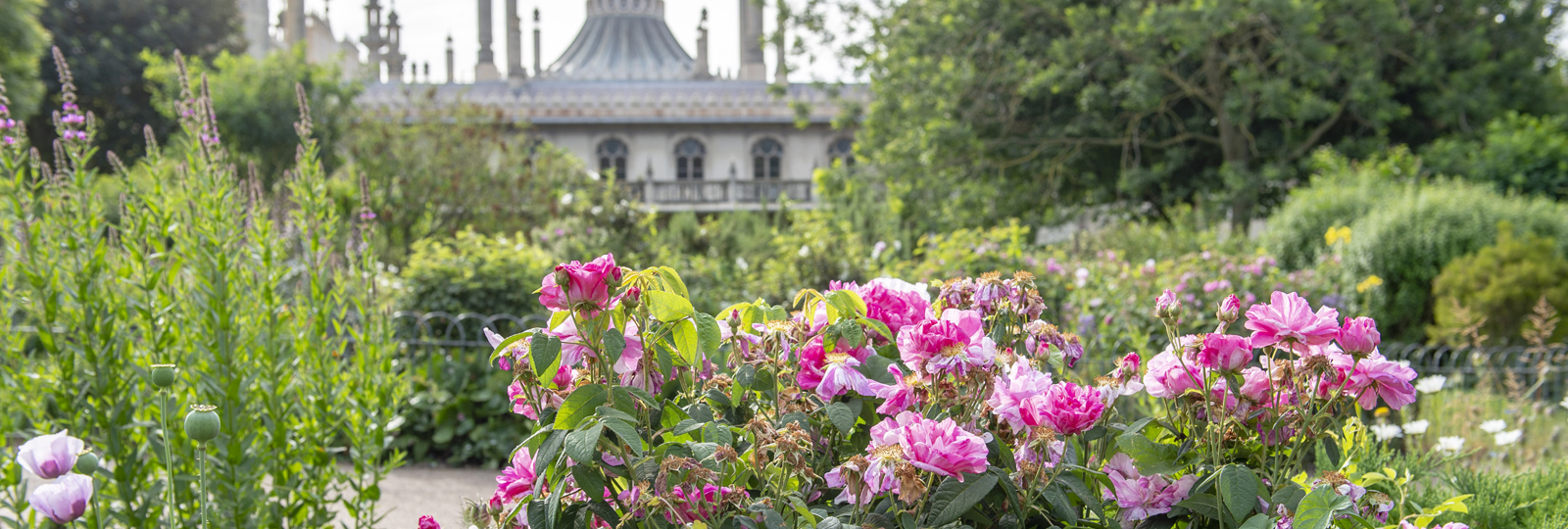
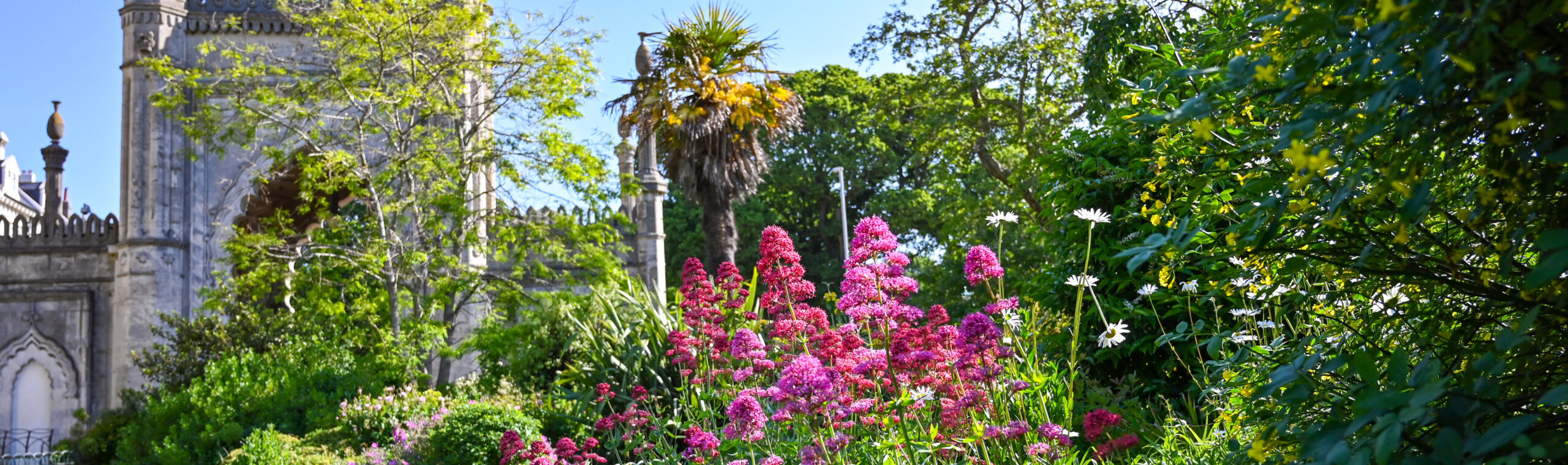
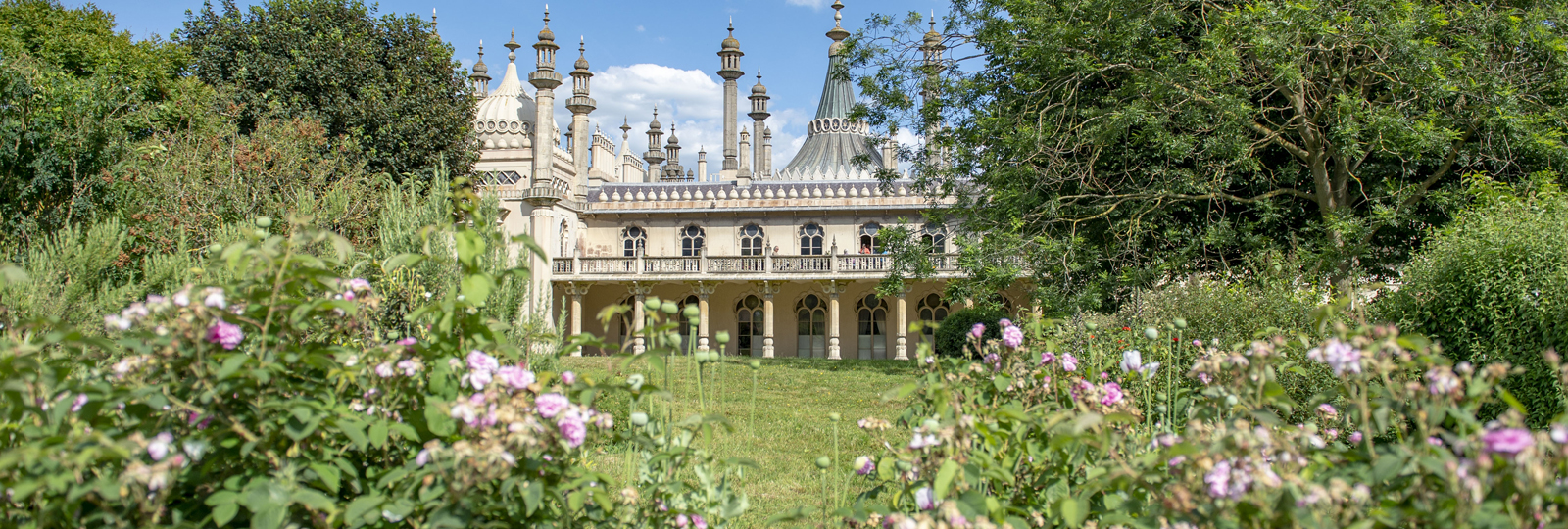
The Grade II listed Royal Pavilion Garden is very rare and nationally significant. This is mainly because of its survival as an example of the Regency Picturesque garden style, together with a surviving pleasure pavilion.
The Garden offers an unparalleled opportunity for a heritage visitor experience within an urban public green space setting, crossing Regency, Victorian and 20th century stories.
The Garden has been in public ownership since 1850 when the town campaigned to buy the Estate from the Crown.
Who looks after the Garden?
The Garden is looked after and maintained by Brighton & Hove Museums which is an independent charity with limited resources. The Garden is maintained by a small, but dedicated, team of Gardeners and volunteers.
What is the project cost and where is the funding coming from?
The total project cost is c.£6.4M with The National Lottery Heritage Fund generously supporting us by awarding a grant of £4,369,755 together with contributions from Brighton & Hove City Council. Brighton & Hove Museums is currently fundraising to secure the remaining shortfall of the project. To date, we have received generous awards from the Finnis Scott Foundation, King Charles III Charitable Fund, Garfield Weston Foundation and the Wolfson Foundation.
How many visitors come to the Garden?
The Garden is open to all, and we estimate that 1.5 million people visit it each year.
If every person who visited the Garden donated £1 towards the project, then this would exceed our fundraising target. We could achieve even more, such as delivering more talks and engagement activities, enhancing our planting schemes or further improving the new information we plan to share!
Why does this need to happen now?
The Grade II listed Garden is currently on the ‘Heritage at Risk Register’ with its condition continuing to deteriorate. We do not have an option to leave it as it is. The Royal Pavilion Estate is a key part of the City’s visitor economy and investment in this important space will enhance visits.
What improvements are you making to the Garden?
- Reinstating the historic boundary based on the original 19th century railing designs.
- Reviewing the design and position of internal fencing used to protect flower beds and lawns.
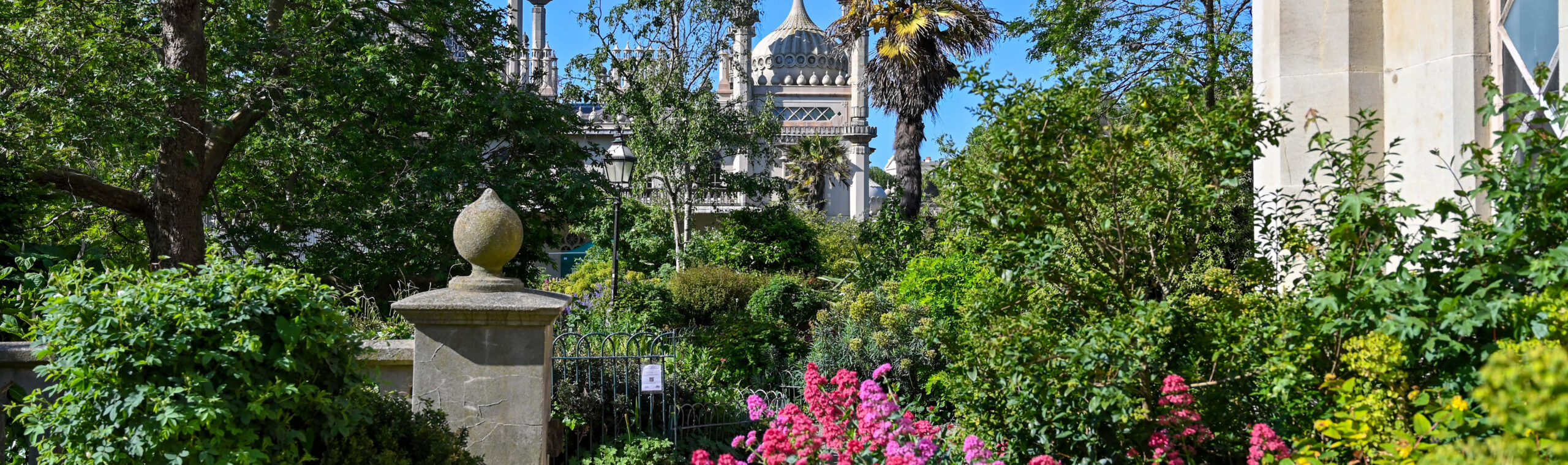
- Conserving and enhancing the Garden entrances to improve the visitor welcome, including the listed North and India Gates.
- Undertaking repairs to the listed 1921 balustrade.
- Carrying out repairs to the listed William IV lighting columns.
- Reinstating historic flower beds.
- Restoring the historic path networks, which will include improving drainage and widening for accessibility.
- Protecting the historic Elm Avenue, including improving drainage and irrigation.
- Making visual and practical improvements to the Garden team’s storage areas.
- Creating a new Garden Pavilion area for community and school activity.
- Working to protect and enhance the biodiversity and wildlife in the Garden.
What are you doing to enhance the visitor experience?
- Physical improvements will be made to the Garden to improve access.
- Developing a Community Forum with key Community Partners.
- Delivering a programme of activity to create more volunteering opportunities, develop skills and provide training, develop engagement activities for schools, and will involve specific target groups.
- Introducing accessible and inclusive interpretation.
- Creating a new outdoor learning space – The Garden Pavilion.
- Installing public toilet facilities with a Changing Places toilet and providing an information kiosk.
Which priority audiences have been identified for the project?
- People with disabilities
- People with poor mental health
- Families and adults on low incomes
- Young people
Has the project got planning approval?
A planning application was submitted in October 2023. Planning permission was received in August 2024. The full application and comments by both the public and statutory consultees can be found on the BHCC planning applications webpage with the reference number BH2023/02835.
What happens next?
We have appointed a Project Team who are in the process of reviewing the final plans. The funding covers some additional staff roles to help with the delivery of the plans.
The project will last for around 3 years.
How will you ensure that the heritage investment is protected?
The proposal that we are working to is that there will always be 24-hour access for the public to the Gardens. BHCC are committed to working with partners, including the Police, to reduce crime and antisocial behaviour in central Brighton, including the Garden. We are currently working with BHCC and other stakeholders to review how this will work to ensure the protection of the investment in heritage, as well as providing safety to visitors using this space.
Why are you reinstating the historic boundary if you are not closing the Garden completely?
Our plans involve reinstating a consistent design of metal fencing around the perimeter. The design for this is based on the fence that was here during the 1800s. (some of this original fencing can still be seen by the Old Steine, and some of the original flint wall boundary can still be seen on Church Street).
The royal estate would always have had a defined boundary and so we wish to reinstate this to provide a visual sense of arrival at a special place. It is important that there is a uniform approach to the design so that visitors understand the whole estate. We hope that this sense of arrival, along with improved interpretation and engagement in the garden itself, will support with understanding this unique and special place and subsequently improve behaviours in this space.
Further to this, we know that damage to the Garden occurs from people accessing it via unauthorised routes e.g. over the walls and low fence by the Steine and coming in through shrubberies.
Will this work push antisocial behaviour to other parts of the city and simply move the problem on?
B&HM’s role is to care for the spaces that they are responsible for. These are fragile historic areas which need specialist care. Our plans are not only looking to protect the Garden itself from criminality and antisocial behaviour, but also the historic buildings and collections, such as Brighton Museum & Art Gallery and the internationally significant Grade 1 listed Royal Pavilion building.
BHCC are committed to working with partners, including the Police, to reduce crime and antisocial behaviour in central Brighton more generally, as well as the Garden itself.
Why are you proposing to remove some trees?
We have permission to remove some trees that have been introduced to the Garden in more recent times. The removal of these trees will open the original Nash views that were intended to ‘frame’ key viewing points of the historic buildings within the Garden. Therefore, this will help to reunite and reinstate the wider Royal Pavilion estate and improve how people understand its unique heritage.
We will also be removing some poor-quality trees, for example those that are blocking out sunlight, which will help us to introduce more floriferous plants like those intended in the original Regency design.
We will be replacing any removed trees with new plants and trees sited in better places in the Garden.
We will not be removing any of the historic elms.
What is happening to the Max Miller statue?
There are no plans as part of this project to move the Max Miller statue.
Is it true that there will be new statues in the garden?
There are suggestions for new statues in Brighton, but they do not form part of this project.
Will the project affect the Pavilion Gardens café?
No.
What is happening with the toilets?
As part of the project plan, the toilets will be redeveloped to incorporate a Changing Places toilet as well as some family friendly toilet facilities. There will also be an information kiosk which will help to promote the Garden history and B&HM. The development will take place during the capital works for the project.
Will you be holding events in the garden that people will have to pay for?
As a charity BH&M needs to utilise commercial income opportunities to fund, and to be able to keep looking after, these unique and special places for the people of Brighton and its visitors. (For example, the recent maintenance works to the North Gatehouse cost £136k). Therefore, we plan to explore event options to help fund our work and to contribute to the ongoing maintenance of the Garden itself.
Part of the role of the Community Forum will be to explore what type of events would be in keeping with and suitable for the Garden.
We are committed to protecting and enhancing the biodiversity and wildlife in the Garden and any event will need to consider this as a priority.
There are no plans to close during our buildings opening times, except on the odd occasion of specific filming requests, as happens now.
We are committed to overall entry to the Garden being free for everyone.
How will you create a Community Forum?
We will be inviting representatives working with our priority audiences to share their skills and expertise to help us deliver the activity plan.
Who did you consult with on your plans?
We consulted widely with over 40 relevant groups and many individuals. We also undertook surveys in the garden of users, as well as on-line surveys. We promoted an open day where B&HM staff and the project team met and talked with visitors and residents about the plans. We could not speak to everyone but are confident that a very wide range of views were collected.