When Eighteenth Century wallpaper meets Twenty-First Century technology
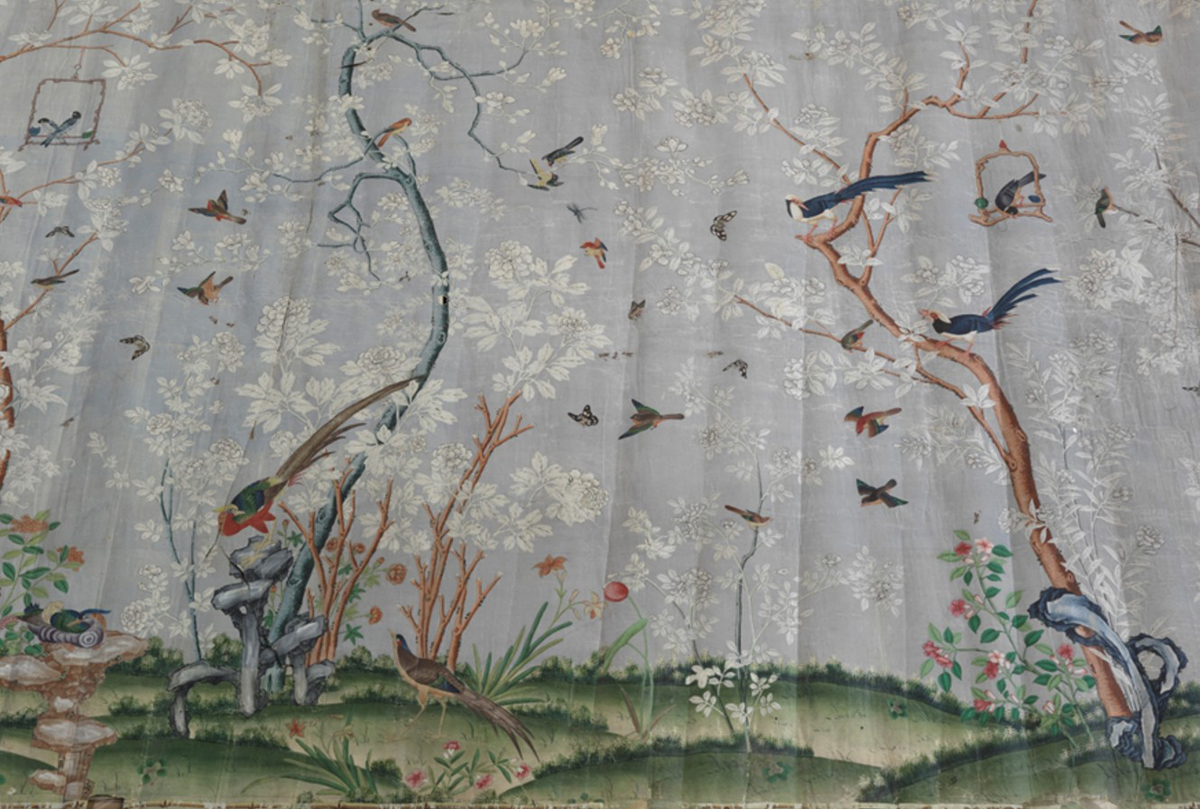
Amy Junker Heslip, Brighton & Hove Museums (B&HM) paper conservator and University of Sussex PhD student has joined forces with the Heritage Science and Conservation Research Team at The National Archives (TNA). The focus of this collaboration is ground-breaking research into a collection of remarkable Chinese export wallpapers from the Royal Pavilion, Brighton (Fig. 1).
Thanks to the newly refurbished heritage science laboratories at TNA, Amy has been able to conduct detailed, non-invasive analysis on multiple rolls and fragments of wallpapers, opening new avenues for understanding their material history.
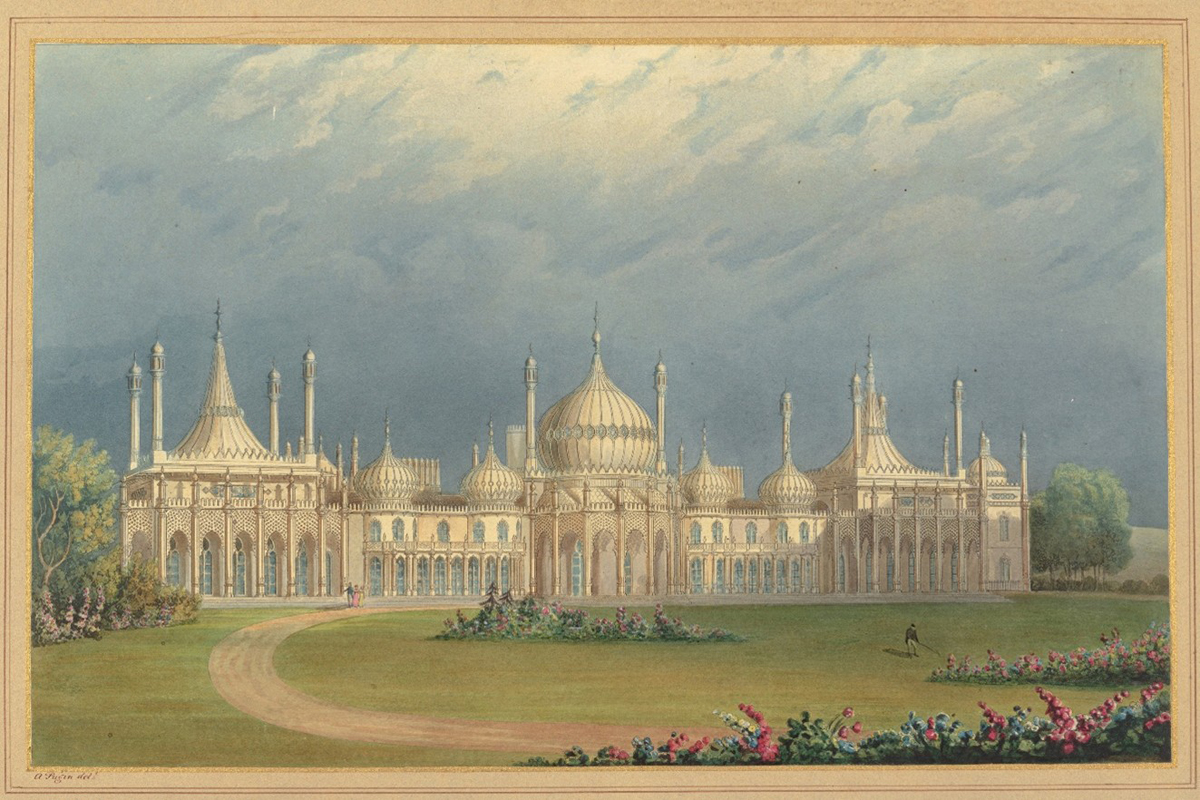
The Royal Pavilion, Brighton: A Unique Archive
The Royal Pavilion holds an extraordinary collection of Chinese export wallpapers. (Fig. 2) Two of its rooms still display wallpapers that were originally installed around 1816. They are made up of more than fifty lengths of hand-painted paper. Beyond these two rooms, the archive boasts over forty additional lengths, both full and partial, along with numerous fragments. This makes the Pavilion’s holding one of the richest archival resources in the UK for studying these rare decorative artworks.
Origins and Designs of Chinese Export Wallpapers
The wallpapers were created and hand painted in non-repeating patterns in workshops in China and were made exclusively for the export market and brought to England through the East India company throughout the mid eighteenth to the early nineteenth century.
Designs were typically executed in sets, often made up of 24 or 40 sheets per set. These sets were very generally of panoramic scenes, depicting figures within landscapes, or alternatively a ‘birds-and-flowers’ design.
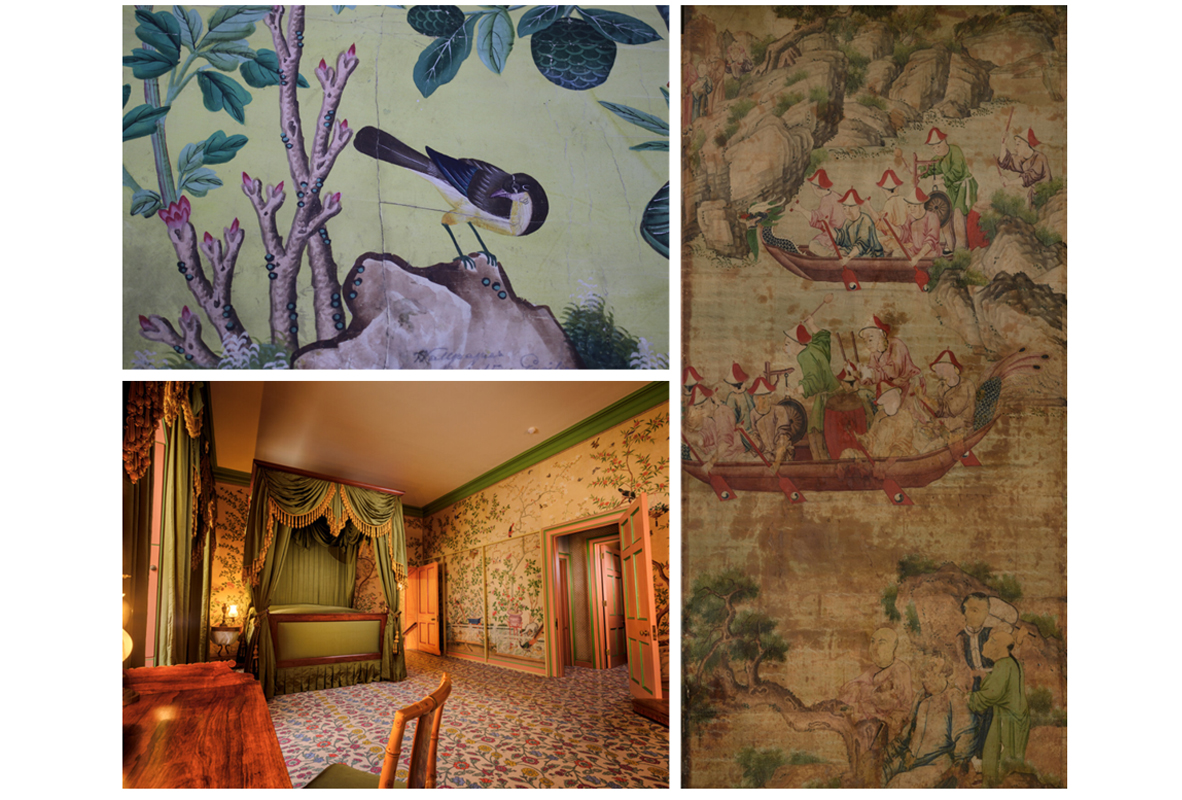
The birds-and-flowers designs were created in a variety of colour ways. At the Royal Pavilion, the archives contain examples of the birds and flowers designs in a grey/lilac, green and yellow. (Fig. 3, top left)
Visitors to the Pavilion today can see examples of a yellow ground with birds and flowers design in Queen Victoria’s bedroom (Fig. 3, bottom left), while what is referred to as the Adelaide corridor showcases a panoramic scene (Fig. 3, right). Many wallpaper rolls preserved in storage remain very vibrant, as several were installed only briefly in the Royal Pavilion before being removed, leaving their colours unusually fresh for their age.
Scientific Research at The National Archives
Amy’s research at TNA will identify the pigments used to create these wallpapers. Establishing precise pigment composition not only informs their conservation needs but also provides insights into trade routes, workshop practices and the geographic origins of the materials used in their production.
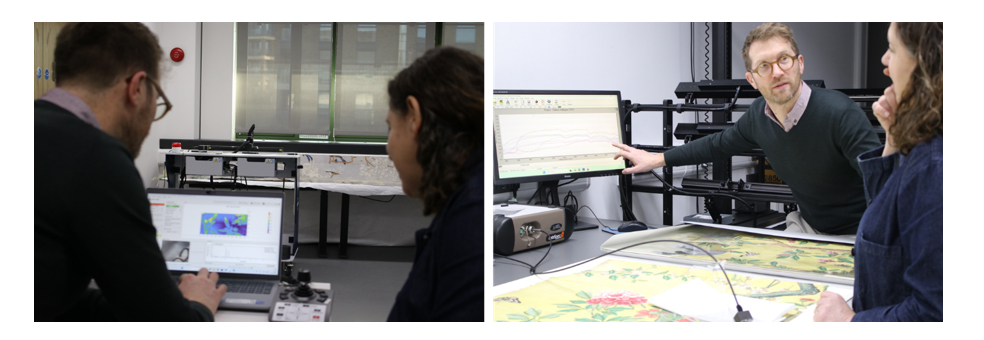
Amy and Marc Vermeulen, Head of Heritage Science and Conservation Science at TNA, use non-invasive analysis for this analysis, using three key techniques available within TNA: X-ray fluorescence (XRF), fibre-optic reflectance spectroscopy (FORS), and multispectral imaging (MSI). (Fig. 4, left and right)
- X-ray Fluorescence (XRF) (Fig 4, left)
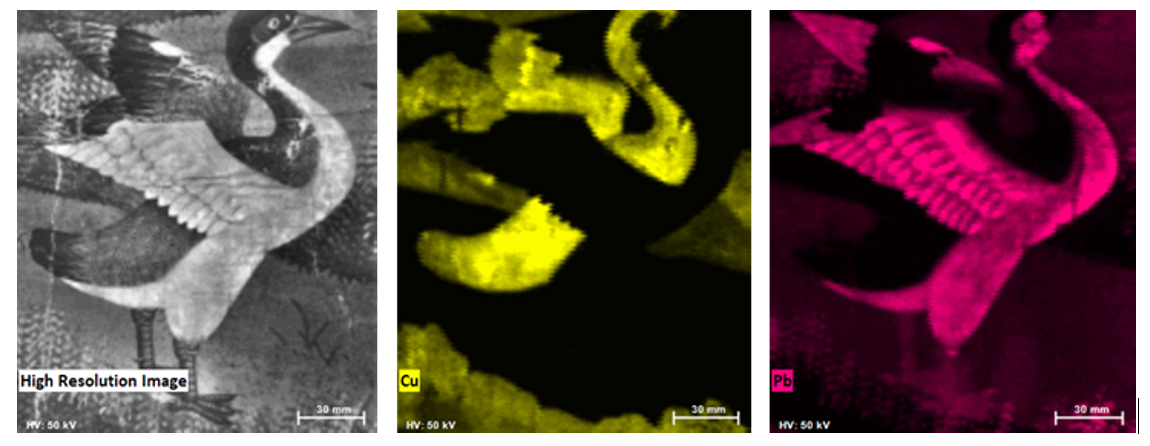
XRF works like a very gentle X-ray: when a surface is exposed to an incident X-ray beam, the elements within it release tiny bursts of energy that allow researchers to identify pigments, inks, and other components without taking samples, based on elements-specific energy signals. TNAs newly acquired state-of-the-art XRF instrument allows for elemental mapping, producing spatial visualisation of element distribution and revealing how materials are distributed across designs (Fig. 5). This makes it possible to distinguish original pigments from later additions, retouching, or degradation products. - Fibre-Optic Reflectance Spectroscopy (FORS) (Fig 4. Right)
FORS, by contrast, works by shining light onto a surface and analysing the wavelengths reflected back. Some pigments or dyes have specific features allowing to distinguish them from one another. This technique can help identifying organic colourants, mineral pigments, and surface treatments. - Multispectral imaging (MSI)
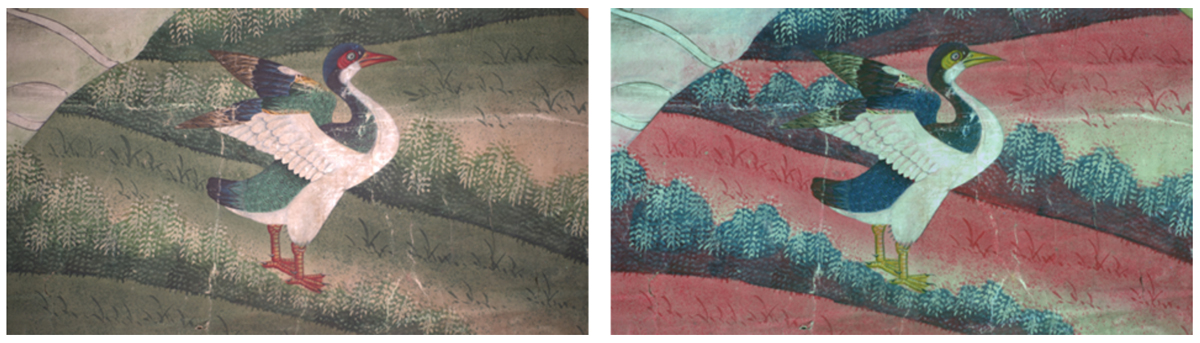
MSI involves photographing an object under different types of light to reveal details not visible in normal conditions. It can help identify pigments, surface changes, and hidden features. In our case, infrared reflected (IRR) and infrared reflected false colours (IRRFC) were of particular interest, as they allowed us to explore exploratory drawings and differentiate between similar-looking pigments under visible light but having different behaviours in IRRFC. The technique is particularly well suited to visualize the distribution of indigo, a blue colourant, for which blue or green areas in the visible image (Fig. 6, left) will turn red in the IRRFC image (Fig. 6, right).
Refurbishment of TNA’s Science Labs: Supported by RICHeS Funding
The analytical work was made possible by the recent refurbishment of TNA’s heritage science laboratories, funded through AHRC’s Research Infrastructure for Conservation and Heritage Science (RICHeS) programme. RICHeS is a UK‑wide initiative designed to unlock access to heritage‑science facilities, strengthen national capability, and ensure that equipment, expertise, and research data are accessible to the wider community. This investment enabled TNA to upgrade their laboratories, created purpose-built spaces, and acquire upgraded analytical equipment, including the new XRF instrument.
By aligning with RICHeS’ goals of improving capacity, fostering collaboration, and supporting world class scientific excellence, the improved infrastructure enhances TNA’s ability to host external researchers, contribute to distributed national facilities, and participate more fully in collaborative heritage science networks such as the material study of these Chinese export wallpapers.
Next steps
With the data collection phase now complete, work will now shift toward comparing and interpreting the results. The study has generated thousands of data points, numerous XRF maps and multispectral images, all of which will take time to analyse and understand fully. Early observations already hint at a diverse range of materials whose origins and distribution highlight the truly international foundations of these wallpapers as global products.
These findings will continue to be explored over the coming months, and the full results will be published later this year, contributing valuable insights to both conservation practice and the wider understanding of eighteenth and nineteenth century artistic techniques.
Amy Junker Heslip is undertaking a collaborative CHASE funded PhD with the University of Sussex and Brighton and Hove Museums Amy is a conservator at Brighton & Hove Museums.
Dr Marc Vermeulen is Head of Heritage Science and Conservation Research at TNA. Heritage Science and Conservation Research