The Royal Pavilion – The Electric Powerhouse of the Late Victorian Era
The late nineteenth century was a hub of innovation with breakthroughs in engineering which shaped the world we see today with Brighton and the Royal Pavilion certainly at centre stage.
Contextually, the Victorian era was a time of significant change with the Industrial Revolution, the railway boom, The Great Exhibition in 1851, and prosperity with Britain being coined as the “Workshop of the World” in the early Victorian era with Britain recorded as trading over 40% of the worlds traded manufactured goods, but also a time of huge changes in social dynamics and the establishment of the Telegraph. Leaps in technology and communication were central to this societal shift, with some even regarding technology as a catalyst. Brighton was at the heart of key developments which took place in this era.
Over the course of cataloguing the Royal Pavilions collections, and conducting research the Royal Pavilions Estate plans of the 1880s confirm that key developments and inventions were almost simultaneously reflected and embedded in the Royal Pavilion as they were being discovered and being bought into fruition- and the Pavilion along with its many phases moved with these developments which was thanks to a remarkable engineer, by the name of Magnus Volk. Before reviewing Volks connection to the Royal Pavilion- its important to understand just how fascinating he was as an individual.

Magnus Volk (1851-1937)
Magnus Volk was a self taught British German electrical engineer and inventor. His inventions include the establishment of the electrical railway line along Brighton’s sea front, the worlds oldest railway in 1883 which is still running today, he also established the Brighton and Rottingdean Seashore Electric Railway in 1896 and invented one of the worlds first electric cars in 1887.
Born in 1851, Magnus Volk came from a family of mechanical pioneers with strong British German heritage. Volks fathers name was also Magnus Volk and his mother Sarah Maynard. Volks father was a clockmaker originally from Langenbach, Germany- and moved to Brighton to open a clock making work shop. Unfortunately, Volks father passed away when Magnus was only 18 years old.
Volk was born in Western Road, Brighton and was educated locally in Brighton. Volk initially trained as an apprentice to a scientific instrument maker. Having lost his father at 18, Volk took over the families clock making workshop. Volks foundation in clock making instilled his knowledge and understanding of the intricacies of mechanical engineering and it was definitely clear that he was fascinated and absorbed by it, as only 2 years later Volk started to experiment with a telegraph and electric shocking coils essentially experimenting with telephone equipment before it had even been invented!
Magnus Volk and the Royal Pavilion Brighton
Brighton in the 1860s and 1870s was flourishing – with the city becoming an exclusive royal retreat into a vivacious metropolis along with the arrival of the railway Brighton became a “go to” destination with some even coining it as a “London-by-the-sea”. The Royal Pavilion, attracted thousands and thousands of visitors with its identity shifting away from its status as a royal residency following the sale of the Royal Pavilion to the Brighton Town Commissioners.
Magnus Volk, who was living in Dyke Road, had continued to experiment with engineering, and had accumulated a reputation as being a local inventor. In 1880, he successfully installed electric lighting in his home using a Sieman’s generator and a gas engine, this finding made him the first person in Brighton and the south coast of England to do so. This finding, along with his reputation as a local inventor led to him obtaining a contract to install electricity throughout the Royal Pavilion in 1883 and later becoming Electrical Engineer to the Brighton Town Corporation and was the beginning of Volks relationship with the Royal Pavilion.
Almost simultaneously, in 1879 Volk installed a telephone line connecting his house to his friends house on Preston Road and demonstrated a two way telephone call, this was only three years after Alexander Graham Bell had patented the telephone. Bell and Volk were both members of the Institute of Electrical Engineers- it was often regarded that Volk would study journals and published materials including latest technical papers on Bells telephone and Edisons lightbulbs.
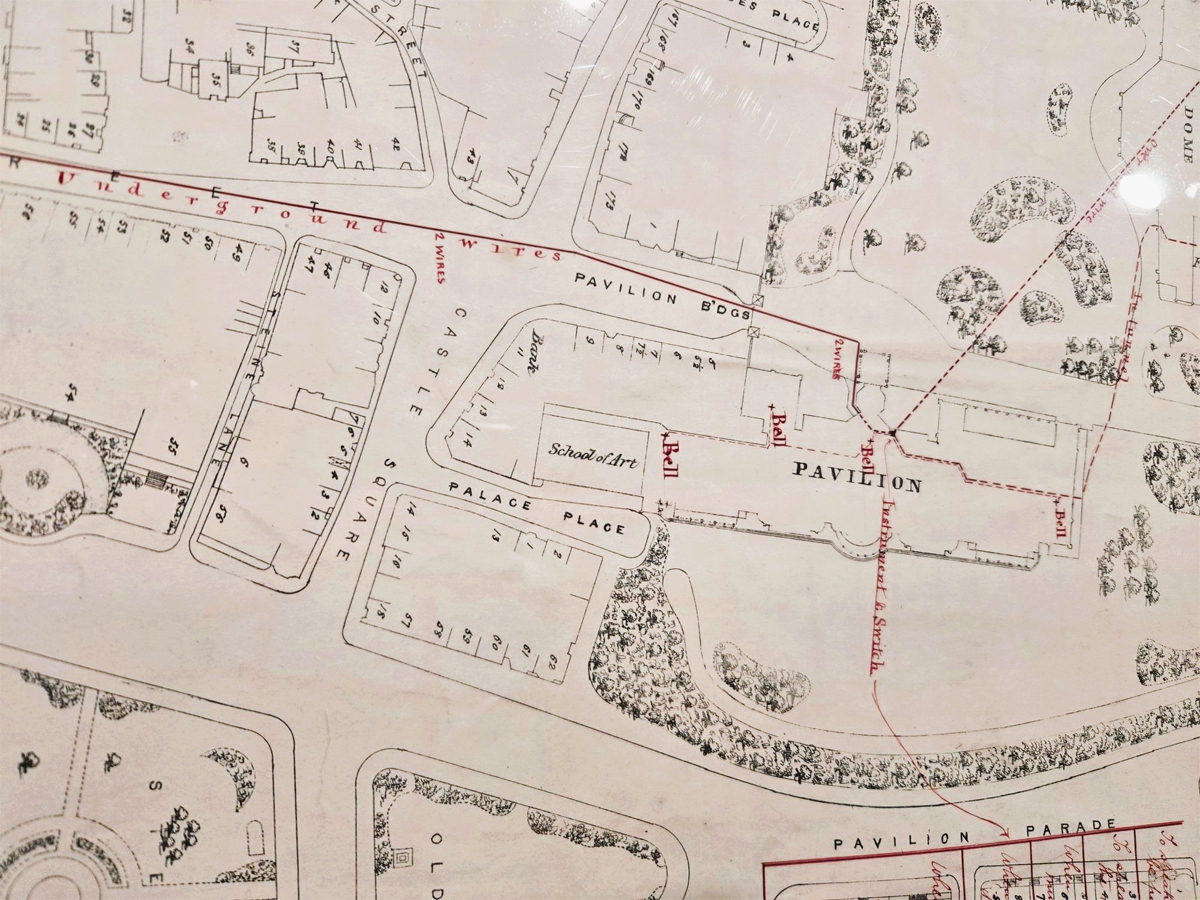
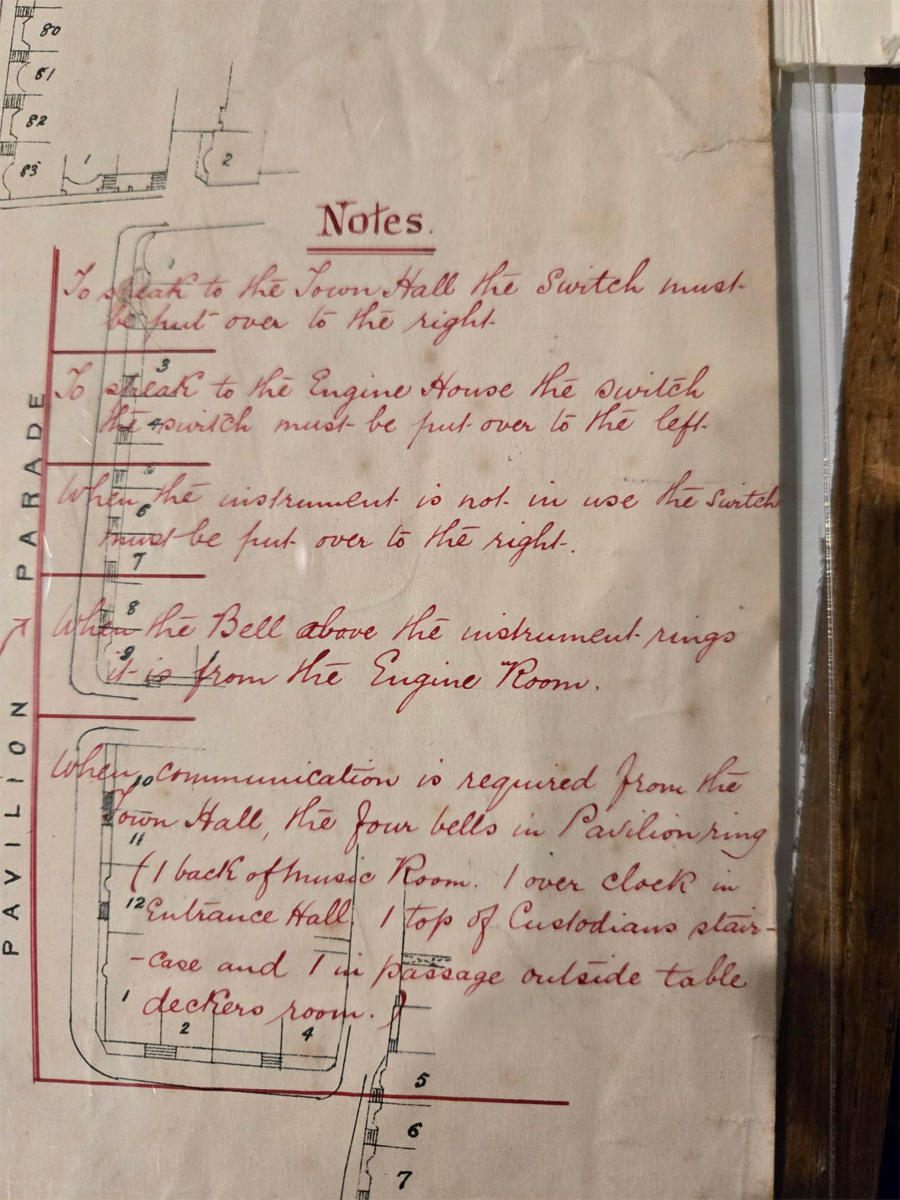
Photographed is a Royal Pavilion Estate Plan, which can be dated to 1883. In our timeline, this was the same year Volk had been appointed to install electricity throughout the Royal Pavilion. The plan is a handwritten instruction manual for operating a switchboard or an early communication system in the Royal Pavilion, Brighton.
I have attempted to type up some on the text written which reads:
- To speak to the Town Hall the switch must be put over to the right.
- To speak to the Engine House the switch…must be put over to the left.
- When the instrument is not in use the switch must be put over to the right.
- When the Bell above the instrument rings it is from the Engine Room.
- When communication is required from the Town Hall, the four bells in Pavilion ring:
- (1 back of music Room)
- (1 over clock in Entrance Hall)
- (1 top of Custodians stair-case)
- (and 1 in passage outside table deckers room)
Electric Lighting in the Royal Pavilion
As a former royal residence, one can certainly imagine that the Royal Pavilion was a high priority on the list of organisations who had the latest developments in technology and communication. This actually stems from King George IV who had been a huge advocate for being ahead in terms of new developments. He went so far as attending a demonstration of gas being used in his home at Carlton House. Gas had only been in public use from 1807, and was installed in the Royal Pavilion in 1818- therefore its ingrained into the institutions history to be ahead of its time.
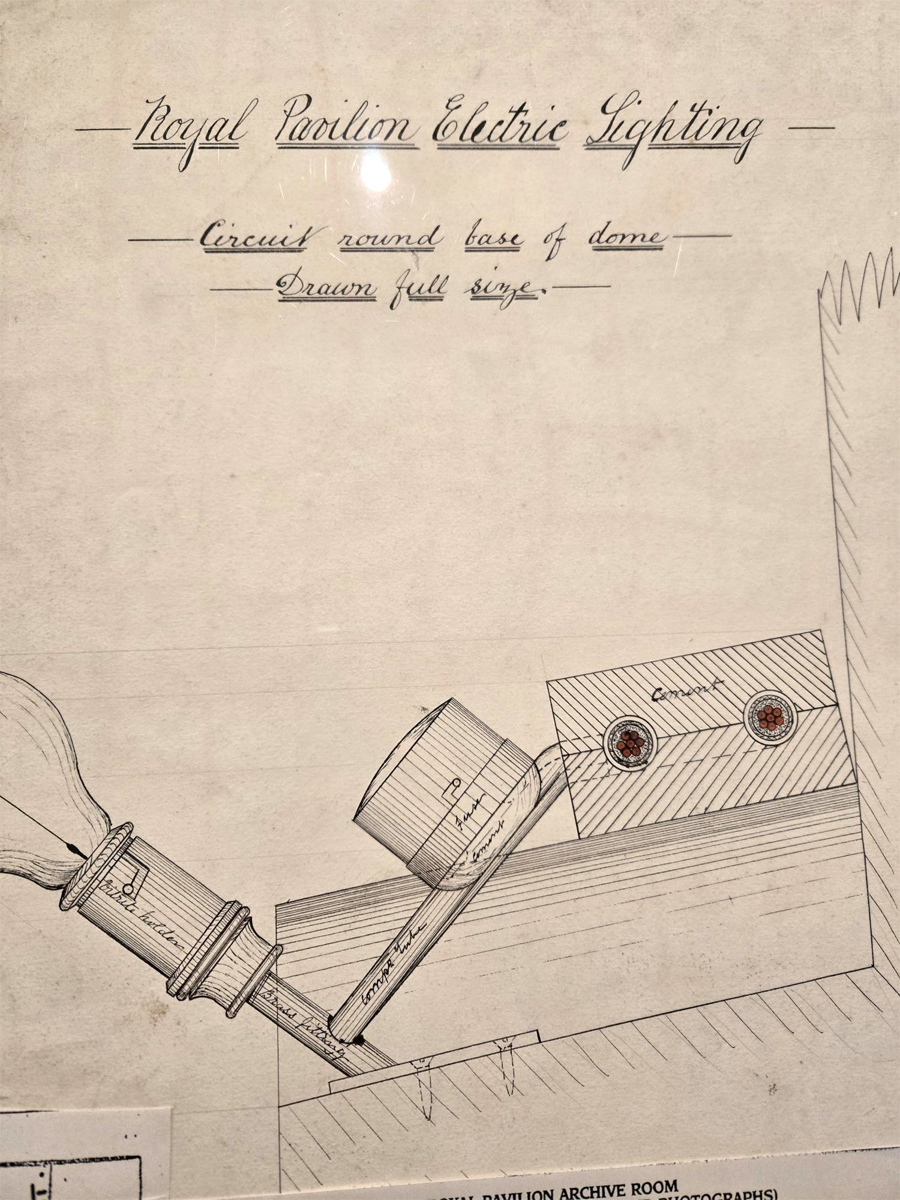
Photographed is essentially a blueprint to an ambitious project in electric lighting in the 19th century. The drawing is entitled “Royal Pavilion Lighting- Circuit round base of dome” and depicts how Volk was adapting existing building techniques for this technology. The bulb demonstrates an incandescent carbon filament light labelled “brass fitting” and “switch holder”. The noted “Compo Tube” refers to tubing traditionally used for gas pipes demonstrating how Volk was re using materials to house electrical wires, which was before PVC had even been introduced. Overall, the dome was one of the largest spaces in England to be lit by electricity at this time, and the dome alone had over 200 carbon filament lamps installed. Contextually, this plan is extremely special as it demonstrates how fundamental Volks work was, he not only installed electricity but he was re using and repurposing existing materials to create a solid foundation for electricity to function throughout the Pavilion.
Volk and the Future of the Royal Pavilion
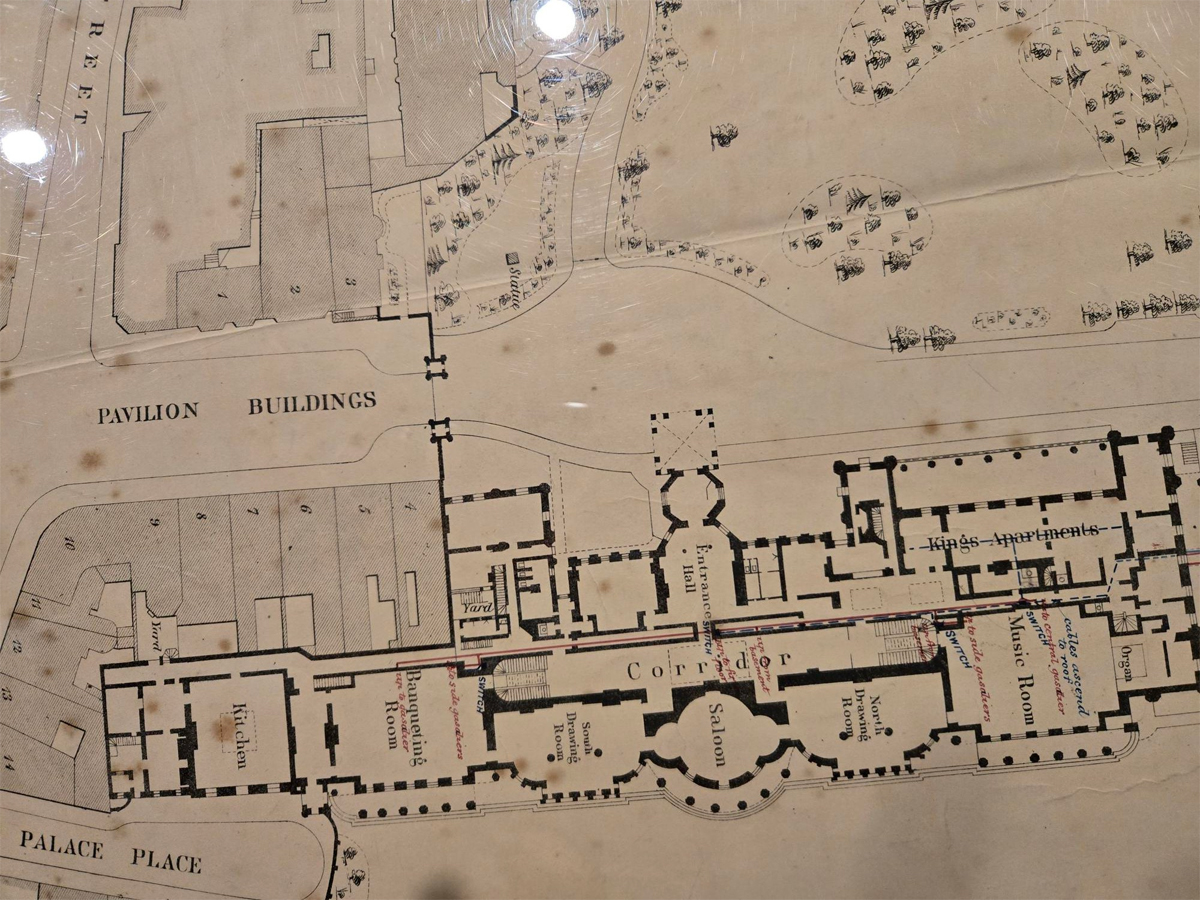
Photographed is another Royal Pavilion Estate plan, and can be dated to 1883. This is a working document depicting Volks electrical overlay over a plan of the Royal Pavilion. The red ink lines demonstrate the exact points where the control points were- in other words where the switches were located. In red ink is written “Entrance Hall Switch”, “Music Room Switches”, “Kings Apartments” etc. The plan often lists the exact number of incandescent lamps attached to each section which was 473 in total.
As a working plan, this would have been a live guidance for those in Volks company to install electricity in each room and demonstrates a fully functioning ‘electrified’ building which is extremely telling of just how rapid the updates were in the scope of the time it took Volk to land the contract and just how much he was able to achieve in a short period of time.
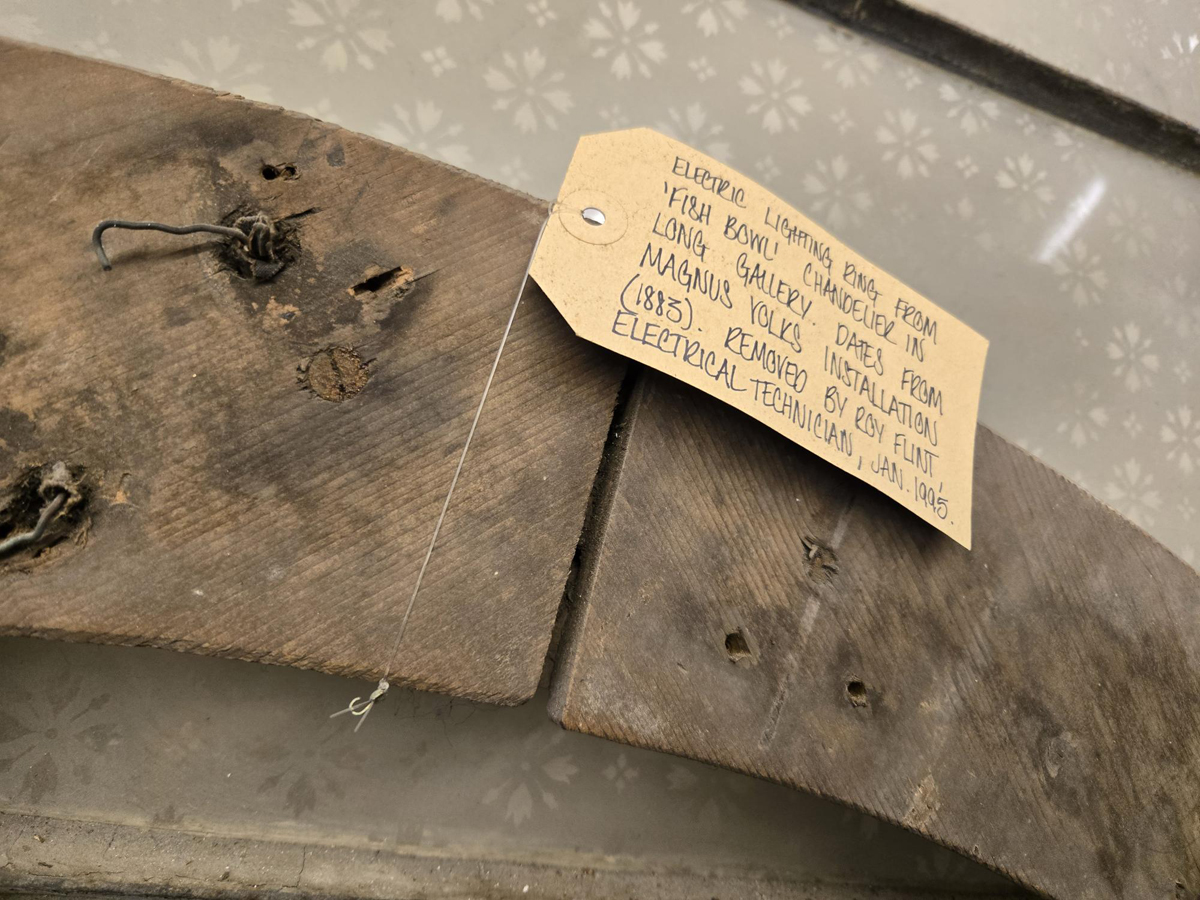
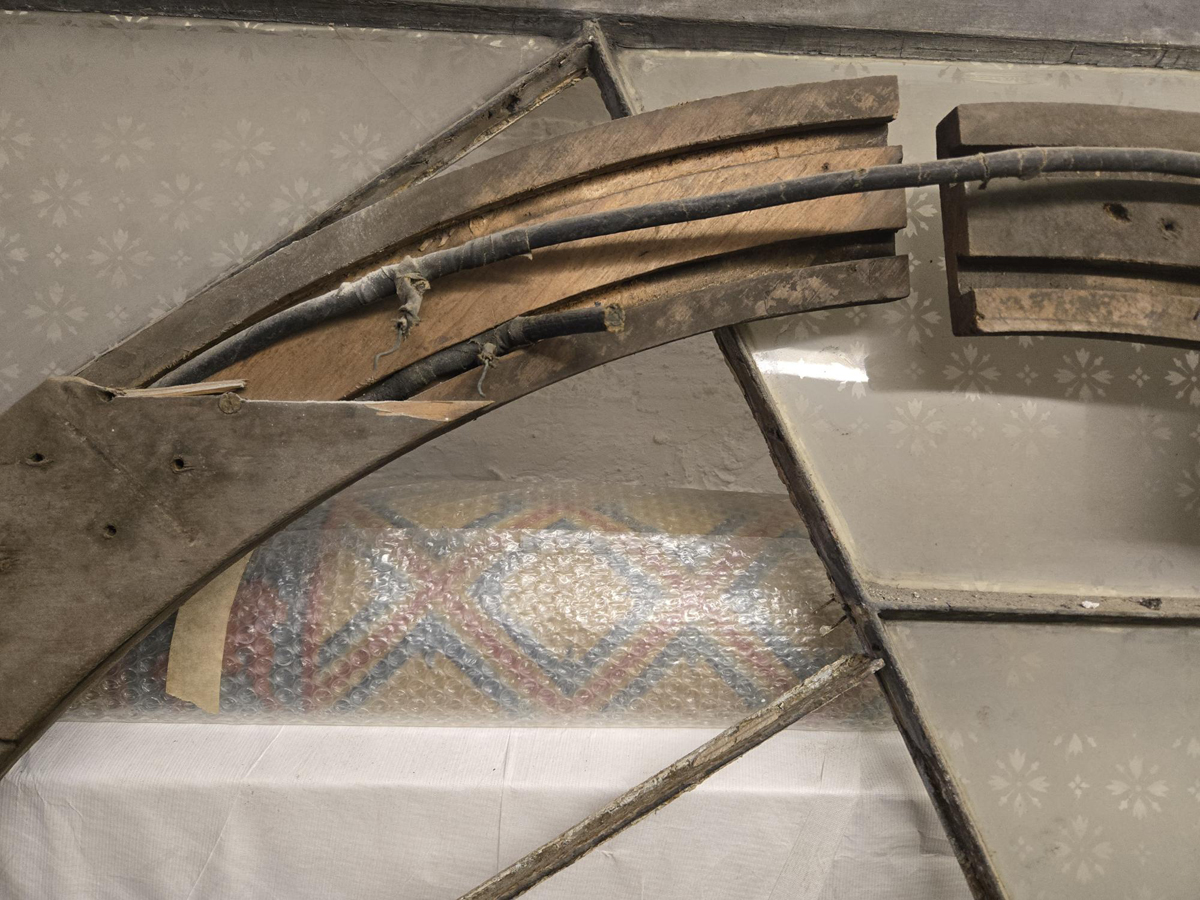
Recently, I was fortunate to be shown down into the Royal Pavilions basement, where we have a removed electric lighting rig from a ‘fish bowl’ chandelier in the Long Gallery, which dates from Magnus Volks electrical installation in 1883.
Until next time
Thank you for taking the time to read this blog post. I hope it encapsulates just how integral the Royal Pavilion is to our understanding of the history of Brighton, but also England. And how it existed for so many as centre stage for inventions and innovations to shape their individual legacy. Whilst cataloguing and surfacing this material, I am able to raise the visibility of collections and increase their accessibility for the future. It also opens up the pathway for others to conduct further research and develop future projects.
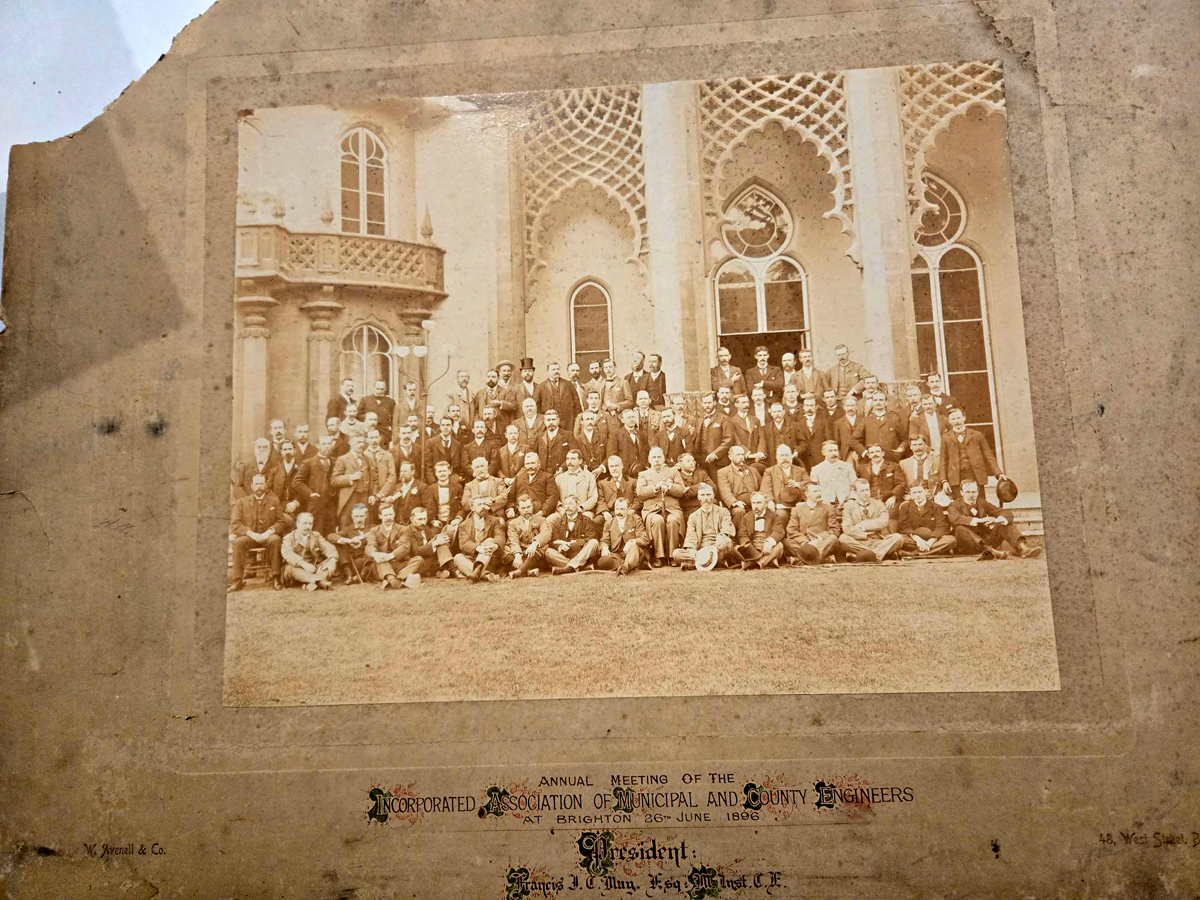
Below is a photograph I found of an annual meeting of the Incorporated Association of Municipal and County Engineers at the Royal Pavilion, on the 26th June 1896 – with Franis J C May (1809-1906) prominent Victorian Engineer and architect as the President.
Within our Royal Pavilion Estate plans, we have several plans created by May. He would have been a huge collaborator who Magnus Volk had commonly worked with. I share this as I can’t help but start to form a picture of what that era of the Pavilion would have looked like, and just how the Pavilion was right at the helm of innovation.
Also, for those familiar with Volk, you will know that this was the same year that Magnus Volk launched his ambitious Brighton to Rottingdean Seashore Electric Railway. The Aquarium station of the railway currently has items from our collections on loan, including Volks pocket watch.
Its’ a pleasure to surface stories of individuals whose contributions may have been overlooked. It allows us to appreciate their contributions and the way in which it enriches our knowledge of how we see and remember certain developments throughout history.
I will leave you with an enlightening conversation I had during one of my archive pop ups, there seemed to be a very high potential that the very red writing included on the plans could have been written by Volk himself. Although this is for someone else to investigate in the future, I will take enjoyment in sharing his story.