Storytelling in the Royal Pavilion Archives
Over the last few months, I have been working as an Archivist for the Royal Pavilion. This is an externally funded position, by The National Archives, to catalogue the Royal Pavilion’s collections. Cataloguing entails capturing and recording the details of a record and transferring these details onto an electronic records management system. Having experience working with similar projects, this is a very exciting opportunity to catalogue the Pavilion collections. It will also re-surface interesting stories of the Pavilion and its many changing phases throughout history.
We do have information available about the collections, but the core aim is to collate all of the existing information. We can then develop this and create a functional database. This will be made accessible for the public and widen awareness of what we have in our collections and also how to access it.
The Royal Pavilion attracts hundreds of thousands of visitors a year. It inevitably captures the eye of historians, tourists, researchers, artists, musicians, architects and many more internationally. Through increasing the visibility of our collections, I would like to leave the Royal Pavilion with a solid foundation, which will inspire future research projects to delve deeper into certain areas of our collections.
I also hope to utilise my skills in collections care and digitisation to identify areas of the collections which would benefit from being preserved in a digital format. Given that the archives date back to the early 18th Century, understandably there are records which are in declining condition. Therefore digitisation is an excellent tool to ensure that they are preserved. However, we can not achieve this until a cohesive catalogue of all of our collections has been accumulated and we can identify the key areas which would benefit from these tools.
I look forward to liaising with my internal colleagues in Curation, Conservation and Collections Management. As well as my peers across external sites, such as The Keep, to make well rounded decisions to identify appropriate locations for the collections to be kept.
Storytelling
I entitled this blog post Storytelling in the Royal Pavilion as I personally have an interest in sharing stories and the context surrounding specific objects that I have interacted with in the archives.
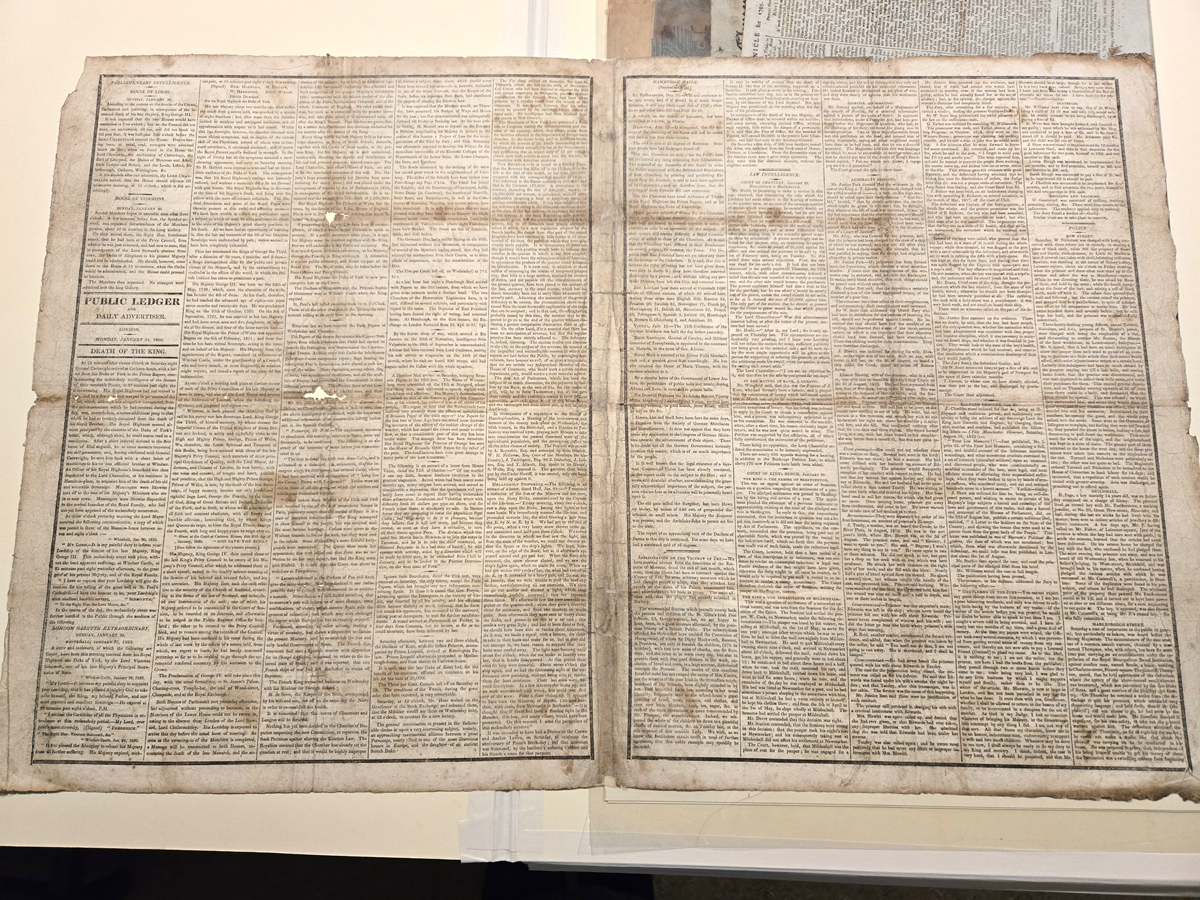
This image is a photograph of pages taken from The Public Ledger and Daily Adviser announcing the death of King George III. It was published on the 31 January 1820, two days after the official date of death, which was the 29 January 1820.
An extract in the article reads, “thus has terminated the Reign of George III after a duration of 59 years, 3 months and nine days.” King George III had the third longest reign as British monarch 1760-1820, with Queen Victoria second (with 63 years and 216 days), and Queen Elizabeth II the longest (70 years, 214 days).
King George III founded and granted the charter for the Royal Academy of Arts in 1768. It was in response to a petition from artists seeking to establish a national arts institution, school and exhibition space. Additionally, King George III amassed a library of 65,000 books and made this available to scholars. The collection was donated to the British Museum and formed the nucleus of the British Library. It is also interesting to note that King George III sponsored Captain James Cook’s voyages of discovery to the Pacific.
Additionally, King George III studied science and was interested in astronomy. He funded a huge proportion of William and Caroline Herschel’s projects. For those who may be unfamiliar, William and Caroline were a brother and sister duo who made transformative contributions to astronomy in the 18th century. This supported William Herschel’s discovery of the planet Uranus in March 1781.
Lost stories
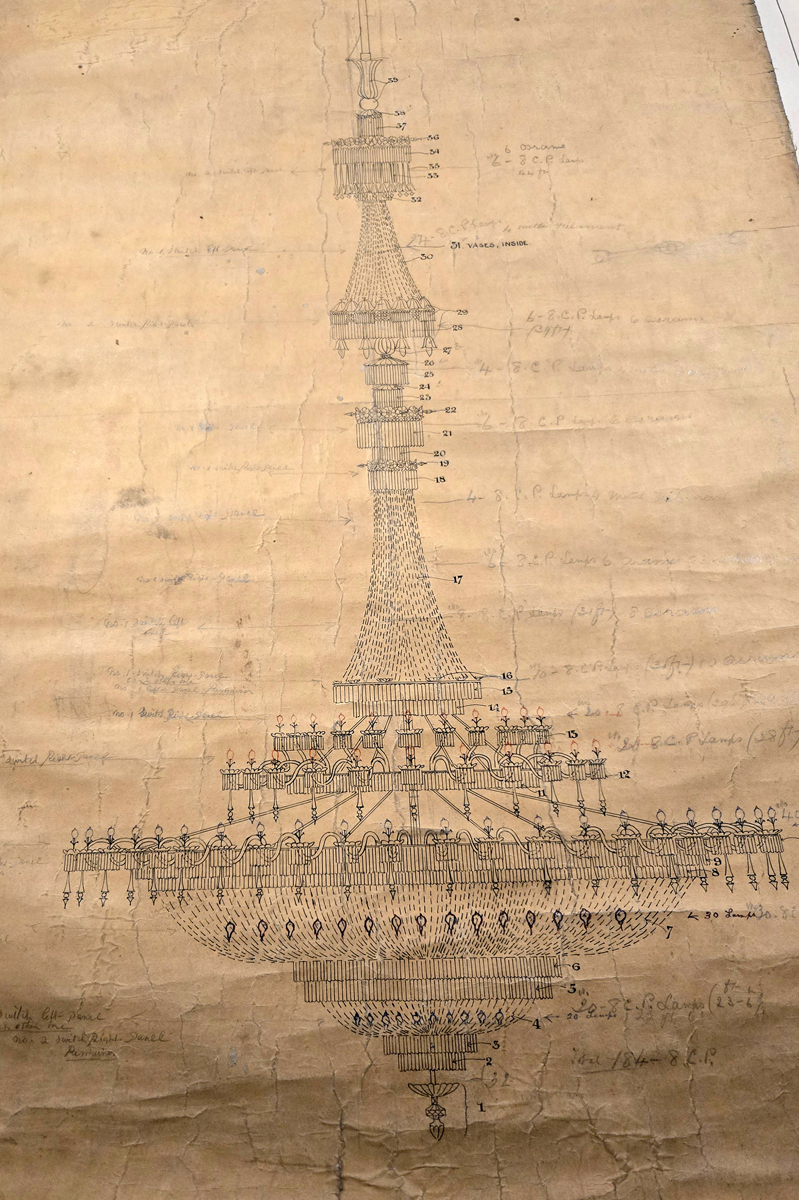
Photographed here is a plan for what became known as a gas powered chandelier. It was installed in Brighton Dome. The Brighton Dome complex was built between 1803 – 1808 as the former Prince Regents stables and riding house. It was commissioned by Architect William Porden.
On the 19 July 1850, the Brighton Town Commission secured the purchase of the Royal Pavilion Estate from Queen Victoria. They then sought to refurbish and restore the estate for the benefit of the town. In 1867, during this transition, Philip Causton Lockwood (1821-1908) was appointed to renovate the Royal Pavilions Estate, including the Brighton Dome.
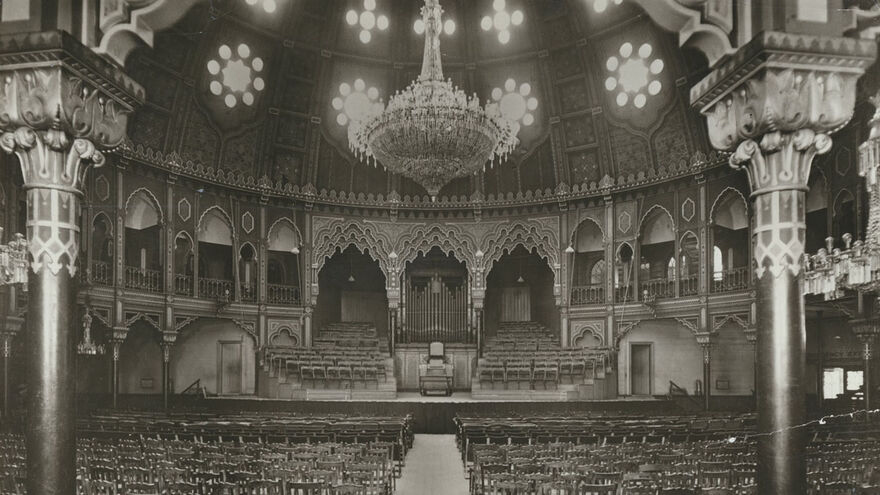
Lockwood sought to remodel the Brighton Dome and create a circular concert hall and assembly room. A huge mark of this transition was the installation of the magnificent gas chandelier. This was fitted by Messrs. Green and Son. It was recorded as having been 31.6 foot high, and 14 feet in diameter, with 520 jets and weighed one and three quarter tonnes.
The Brighton Dome in its new identity was opened in 1867 with a grand concert of vocal and instrumental music. An organ was placed in 1868.
Sources confirm that the British German pioneering engineer Magnus Volk, was responsible for retrofitting the chandelier with electric lighting in the 1880’s. Electricity at that time was a luxury, so it is very telling for the time.
Unfortunately, we will not be able to view the chandelier again in its entirety, as it was removed in the 1930’s due to an art deco refurbishment. This is a very telling story of how certain features existed over the many changing phases of the Royal Pavilion, and are no longer available for us to admire.
I located this sketch (above) along with one other in the Royal Pavilion archives. Henry Roberts explains in The History of the Royal Pavilion that it wasn’t until 1818 that gas was used as an illuminant. In 1821 gas was installed in the principal rooms of the Royal Pavilion, such as the Music Room and Banqueting Room.
At the time, attendants had used specialised lighting wands which consisted of a curved end with a smouldering wick and a metal hook (gas was piped into the building via external sources). Servants or attendants would then use the hook to reach and turn the stop clocks or gas keys. Quite interesting to note, is that gas keys were artistically designed as decorative features such as decorative leaves, curls or flowers, so as to not take away from the design.
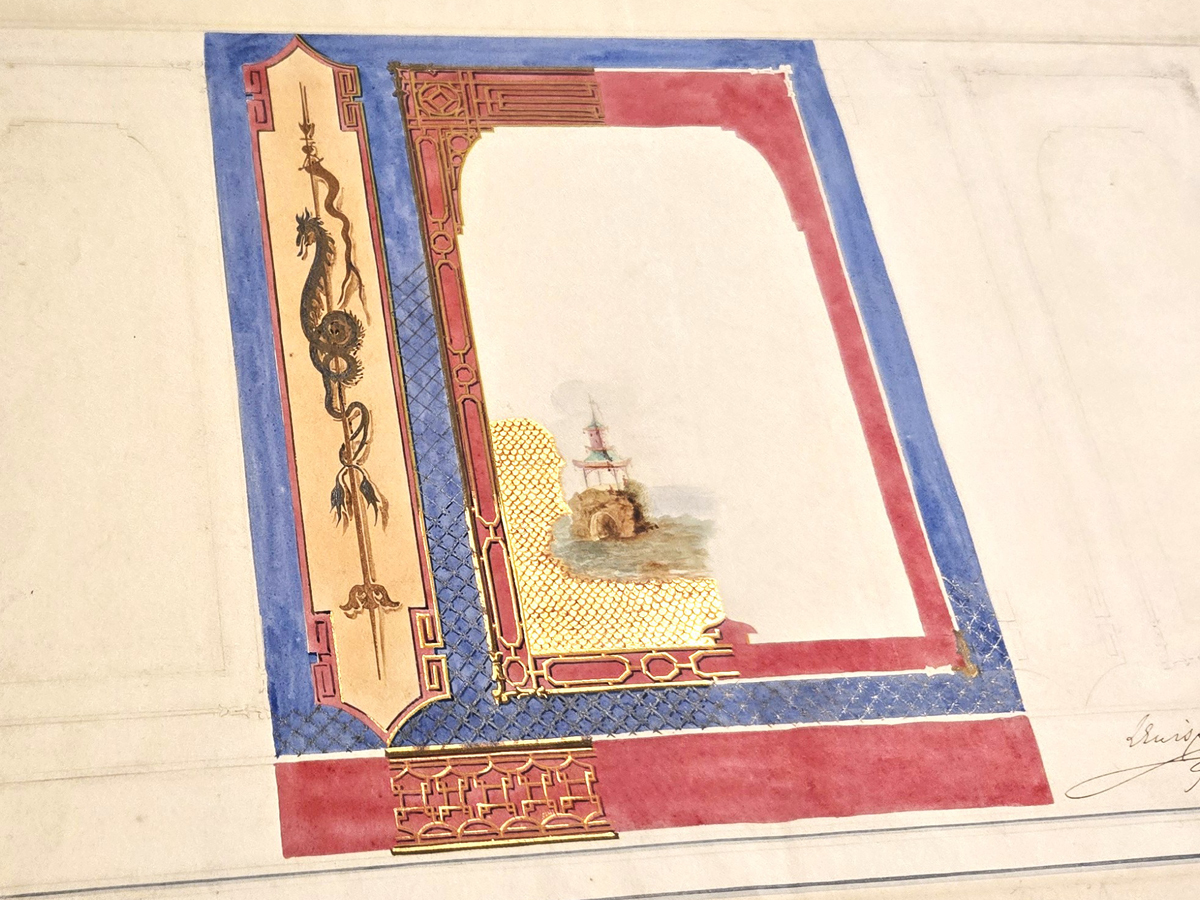
Below is a drawing by Christopher Wren Vick and can be dated to 1850. Christopher Wren Vick (1831-1841) was a carver, gilder and an ornamental painter. This particular drawing focuses on decorations in the Banqueting Room to replace the original decorations which were removed on the sale of the Royal Pavilion.
The Royal Pavilion was stripped of internal paintings and furnishings during the sale from Queen Victoria to the Brighton Town Commissioners. A huge focus of the initial internal restoration was to return the furnishings and paintings to their original form.
Christopher Wren Vick was a key individual entrusted with this first phase of restoration. According to financial records, considerable sums for redecoration during both King William IV and Queen Victoria’s occupation of the Royal Pavilion, were paid to him.
Towards the centre of the drawing, the gold decorative section is actual gold leaf. I believe that this is extremely telling of the intricate detail which went into architectural plans and designs of the interiors of the Royal Pavilion. A common theme throughout all of the Royal Pavilion plans is the continuous use of watercolours. One can almost hold a drawing up to a specific area of the Pavilion and it would be a reflection of the designs drawn up.
Christopher Wren Vick’s craftsmanship included specialised graining and gilding. Vick used his expertise to redecorate the interiors to reflect the original Regency era splendour.
Into the Gardens…
As well as cataloguing the Royal Pavilion collections, I will also be supporting the Royal Pavilion Garden team with the ongoing restoration project. Throughout the process of cataloguing the Pavilion collections, I have come across extremely interesting archival material and records related to the Garden over time. These include records relevant to the Garden restoration project. I hope to liaise with the project team to support them in fulfilling their objectives to raise the profile of the Garden, and re-surface some interesting stories about it.
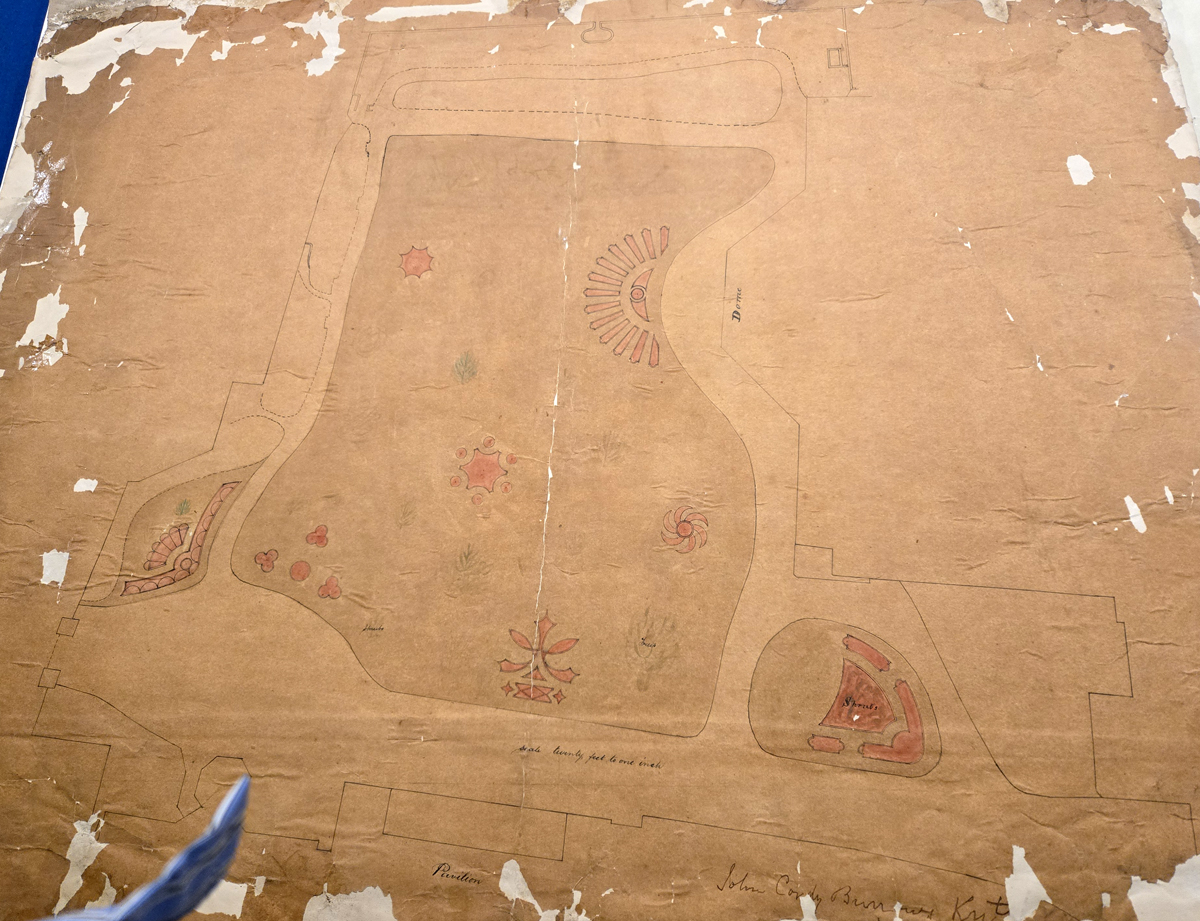
Below is a plan for ornamental flower beds, dated 7 October 1874. At this time, the Royal Pavilion Garden was publicly accessible as part of the Victorian era of managing the estate. As displayed in this drawing it featured vibrant flower beds.
I wanted to draw attention to the name sketched at the bottom of the drawing. Sir John Cordy Burrows. Burrows (5 August 1813 – 25 March 1876) was a prominent British surgeon and politician who served as Mayor of Brighton on three occasions (1857, 1858, 1871) and had the nickname “King Cordy” due to his accomplishments.
Sir John Cordy Burrows made huge contributions to the towns development. He helped to secure the sale of the Royal Pavilion to the Brighton Town Commission, and the founding of the Aquarium and Library. He advocated for better public health and sanitation improvements throughout Brighton. I admire the way in which Sir John Cordy carried through his medical expertise into the areas he advocated in. He understood the need for investment in creating safe public spaces. Additionally, he co-founded the Royal Literary and Scientific Institution and was fundamental in establishing the Brighton Museum, Library and Gallery. In 1873 Sir John Cordy Burrows was knighted (and rightly so).
I could be writing for quite a while about Sir John Cordy Burrows, but I will leave you with a link between Sir John Cordy Burrows and the Old Steine Gardens. Burrows personally funded the landscaping and planting of the Southern enclosure of the Old Steine Gardens and privately commissioned the Victoria Fountain.
Below is a link to Sir John Cordy Burrows collection, which is housed in the Royal College of Surgeons.
The Proof is in the Wallpaper
I recently came across pieces of wallpaper in the Royal Pavilion archives.
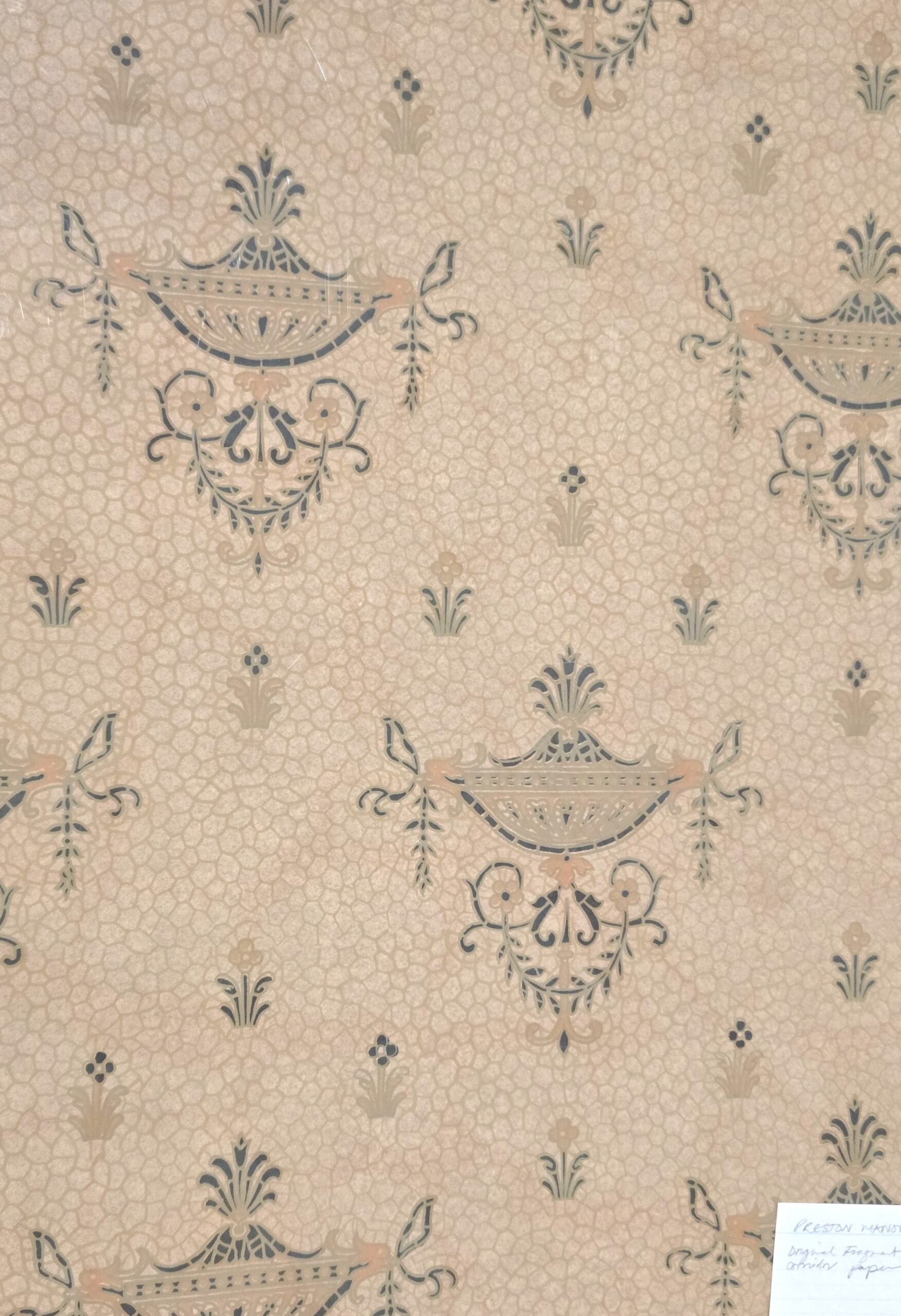
Both of the photographed pieces are fragments of wallpaper which were located in Preston Manor. The first, is an original fragment of wallpaper located upstairs in the main corridor. Interestingly, it has remained in quite a stable condition, which is a testament to its manufacturer.
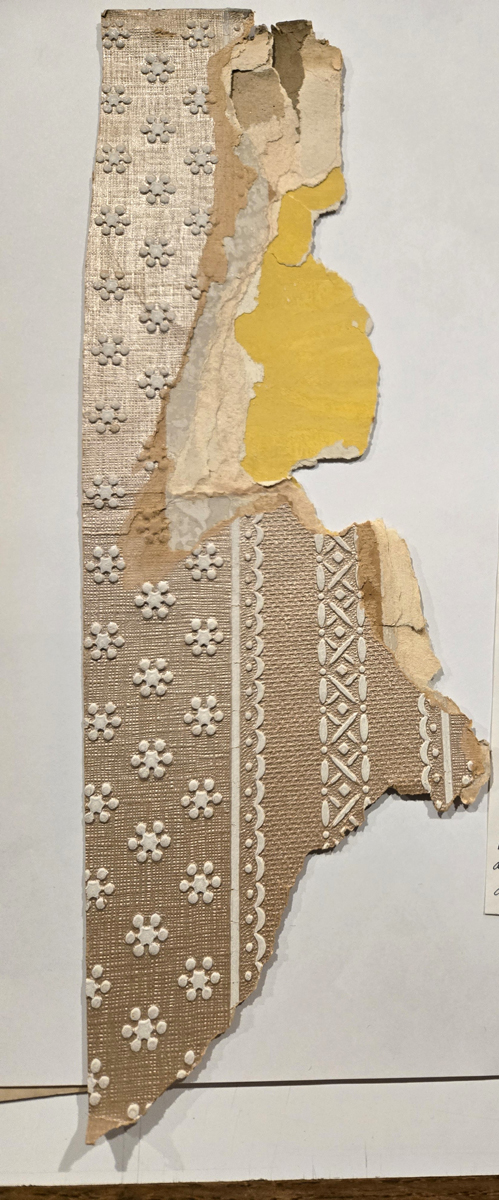
Below is another fragment of wallpaper, which was located in Lady Stanford’s bedroom. Notes collated with the wallpaper explain that it consists of six layers of paper. You can see the wallpaper in this condition, due to this piece being studied to investigate ‘Regency Stripe’ for the restoration of the room. This was to make sure the stripe wasn’t confused for a sign of deterioration.
Having said this, there are other fragments in the same set, which have dark brown stains washed over the brown and white (slightly visible in certain areas of the photographed sample), but I am unsure of the cause.
I labelled this section The Proof is in the Wallpaper as I do believe that wallpaper is very telling of the changing phases a structure goes through overtime. Certain notes mention that one of the six layers could be traced back to 1738. This was during the rebuilding of the manor in 16th century Palladian and Georgian architectural styles. It is evidence that the wallpaper exists as proof of this transition, but also stood the test of time.
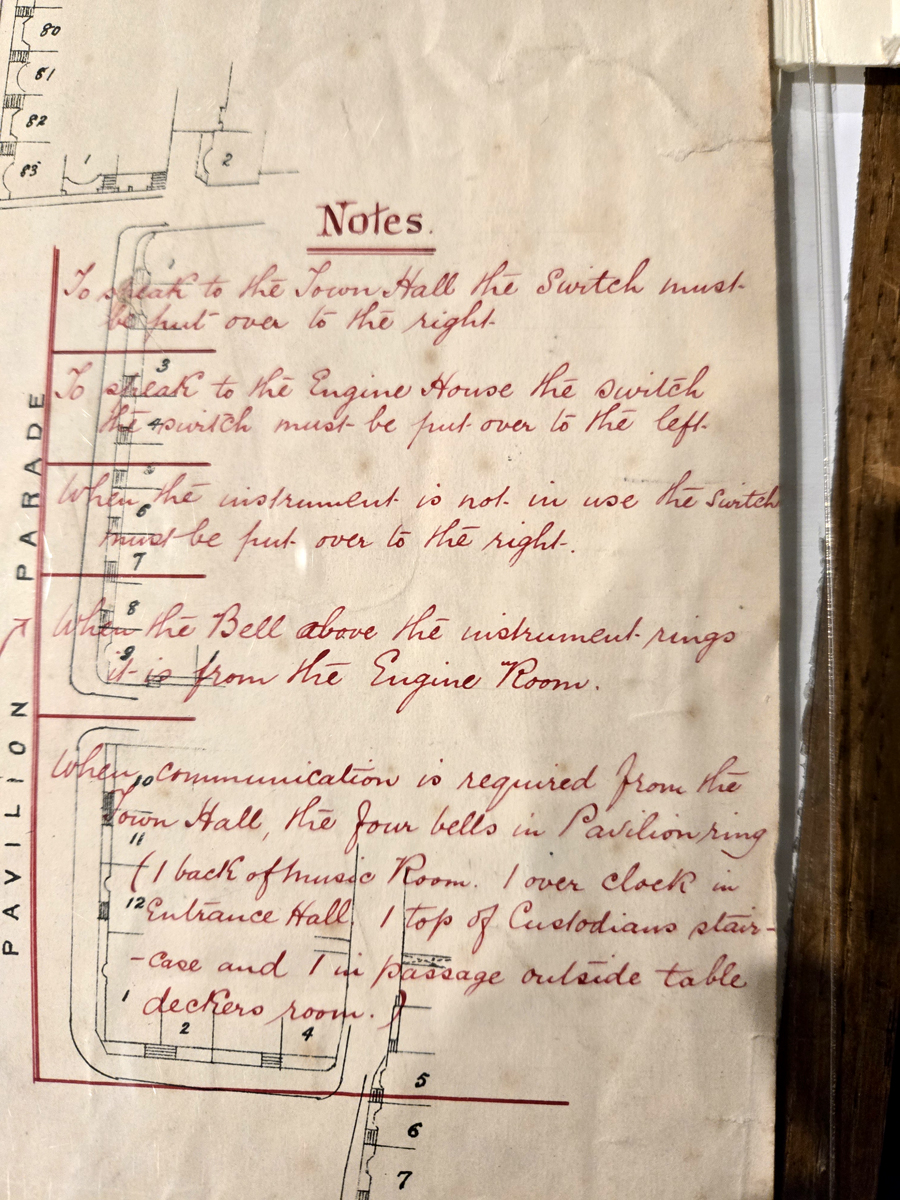
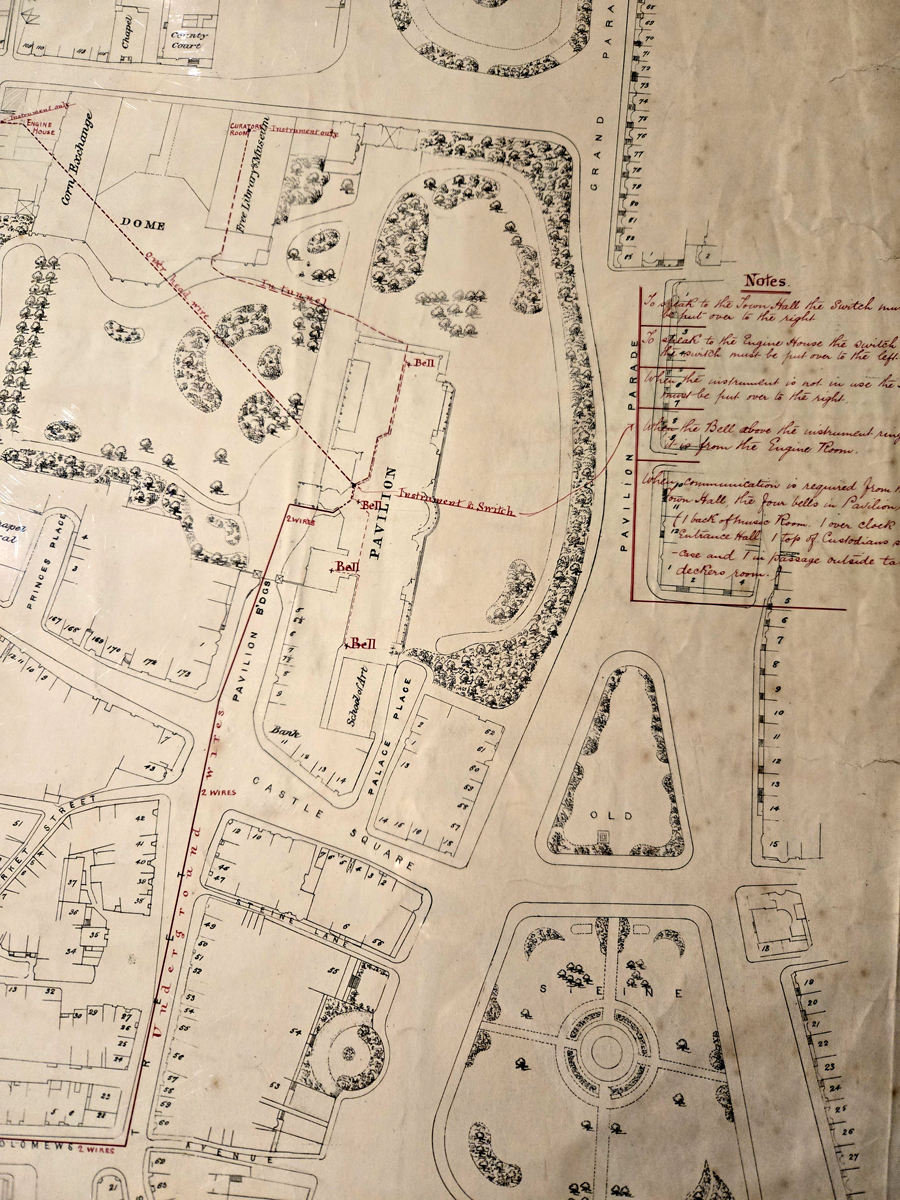
Below is a plan for the installation of a telephone wire from the Royal Pavilion to the Town Hall, dated 1886. In 1881, electricity was first displayed in the Royal Pavilion by Magnus Volk. In 1879, Magnus Volk installed a telephone line from his home in Preston Road, to his friends home in Springfield Road, which was said to have been occupied by William Jago. This was a two way telephone line, and was said to have been the first official telephone line in Brighton.
Contextually, this is hugely significant as it marks one year after the telephone had been patented by Alexander Graham Bell. This demonstrates how Brighton was a leading force in the developments of technology in the nineteenth century.
In 1881, Volk conducted a public display of a telephone call by installing a specific one way telephone system in the Brighton Dome Concert Hall. He connected the speakers podium to eight listening devices on his exhibition stand in the Royal Pavilion. It allowed visitors to listen in to the proceedings at the Dome.
This demonstration showcased a new phase in technology. It was a huge turning point in the future development of the Royal Pavilion. The architectural plans narrate this transitional period in the Pavilion. The 1880’s signalled a new era of modifications throughout. We see the developments of electrical lighting, telephone lines, fire alarm systems and illuminations among others.
To summarise
I hope that this has be an informative insight into the Royal Pavilion collections. It is only a brief look into the interesting stories I have found whilst interacting with the collections. As I continue, many more are being re-surfaced everyday. There is huge potential for cataloguing and sharing stories to inspire future research projects and discoveries.
As an Archivist, my main aim is to be able to create efficient systems of records management. Then leave an institution with a solid foundation for them to continue to develop into the future.
Digitisation, for example, would not be possible without first identifying what content we have and it’s condition. It may be fragile and may not be suitable for public handling. This process also correlates with other partner systems, which allows us to attach these digitised images to the cataloguing records. These provide even more of an insight into areas of the collections. Areas which may otherwise never have become visible for public access. Considering that the Royal Pavilion collections date back to 1787, there is potential for future projects to develop upon my foundation.
I certainly hope to do more engagement activates, as I do thoroughly enjoy sharing stories and knowledge exchange. I have been fortunate to do some public engagement with Archive pop ups in the Royal Pavilion and I hope to do many more in the new year.
I always find it interesting to surface the stories of individuals who may not be recognised in an institutions history, or who were perhaps unknown. The purpose of cataloguing is to start recording the items we have and who created them. Also to provide a voice for the plans and ideas which may never have come to fruition. Or in the case of the chandelier, magnificent creations which we will never be able to admire again.