Joseph Henry Good: A Closer Look
Bridging Classical Styles with Urban Needs
In this post, I wanted to share some interesting pieces of information and insight that I have gathered whilst cataloguing one specific collection. That is the collection of Mr Joseph Henry Good (1775-1857).
Good was a prominent British architect and surveyor, and original fellow of the Royal Institute of British Architects. He was a pupil of the renowned architect Sir John Soane (1753-1837) from 1795 to 1800, and he served as Clerk of Works for the Tower of London, The Royal Mint and Kensington Palace. His surviving designs include the Armourers and Brasier Hall, and the North Gate, located on the Royal Pavilion Estate. He mentored Robert Wallace, Henry Ashton and Alfred Bartholomew.
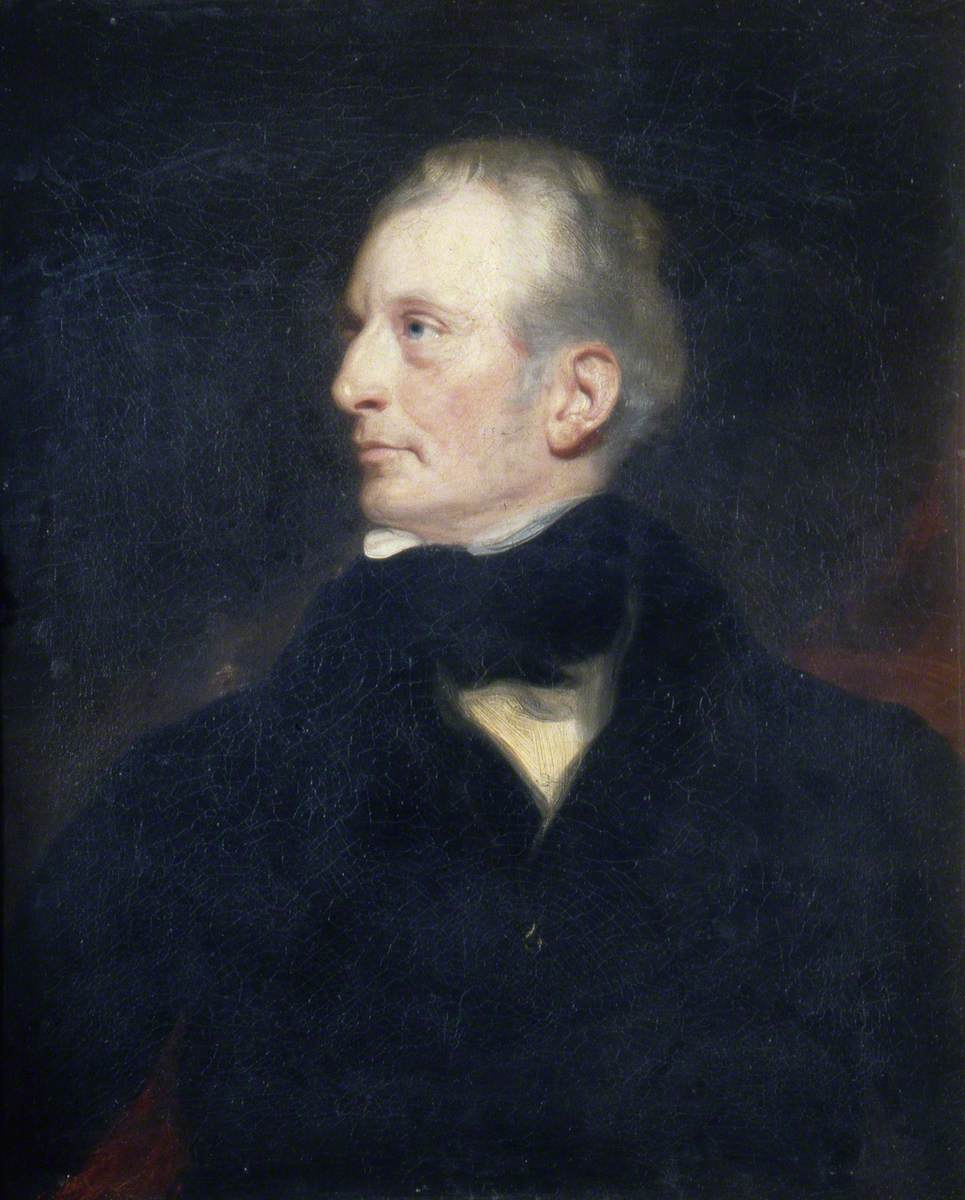
Good was born in 1775, and was the son of Reverend Joseph Good, a clergyman, from Somerset.
Whilst cataloguing Joseph Henry Goods architectural plans, I found myself marvelling at the sheer detail of them. My research shows just how much he did to revive and preserve the Royal Pavilion at such a crucial turning point in its history.
Good’s experience was rooted in Neoclassical architecture, with elements of Gothic architecture apparent through his mentorship under Sir John Soane (1753-1837). He was able to adapt effortlessly to Indo-Saracenic architecture demonstrating his versatility as an architect. Coupled with this, Good was employed at a pivotal transitional period in the Royal Pavilions history, which was 1827 to 1837.
Contextually, William Nixon, who was Clerk of Works and essentially assistant to John Nash, had passed away in 1826. We have a few plans signed by a William Nixon, which were found in John Nash’s former office. However, Nixon had passed away in 1827 therefore it’s highly unlikely that these were his drawn up by him. But he did have a son who succeeded him, so there is a possibility that these could be assigned to him.
Simultaneously, in 1830 King George IV had passed away, with King William IV remaining at the Royal Pavilion. Given that John Nash was no longer connected to the Royal Pavilion, Good’s employment signalled the “passing of the baton” into the next phase of architectural developments. Although, historical sources record Good’s term of employment at the Royal Pavilion as 1827 to 1837, Henry Roberts (1870-1951) the first Director of the Royal Pavilion, writes in his narrative The Royal Pavilion Brighton that there is evidence of there being an overlap between Nash and Good (which I will come back to).
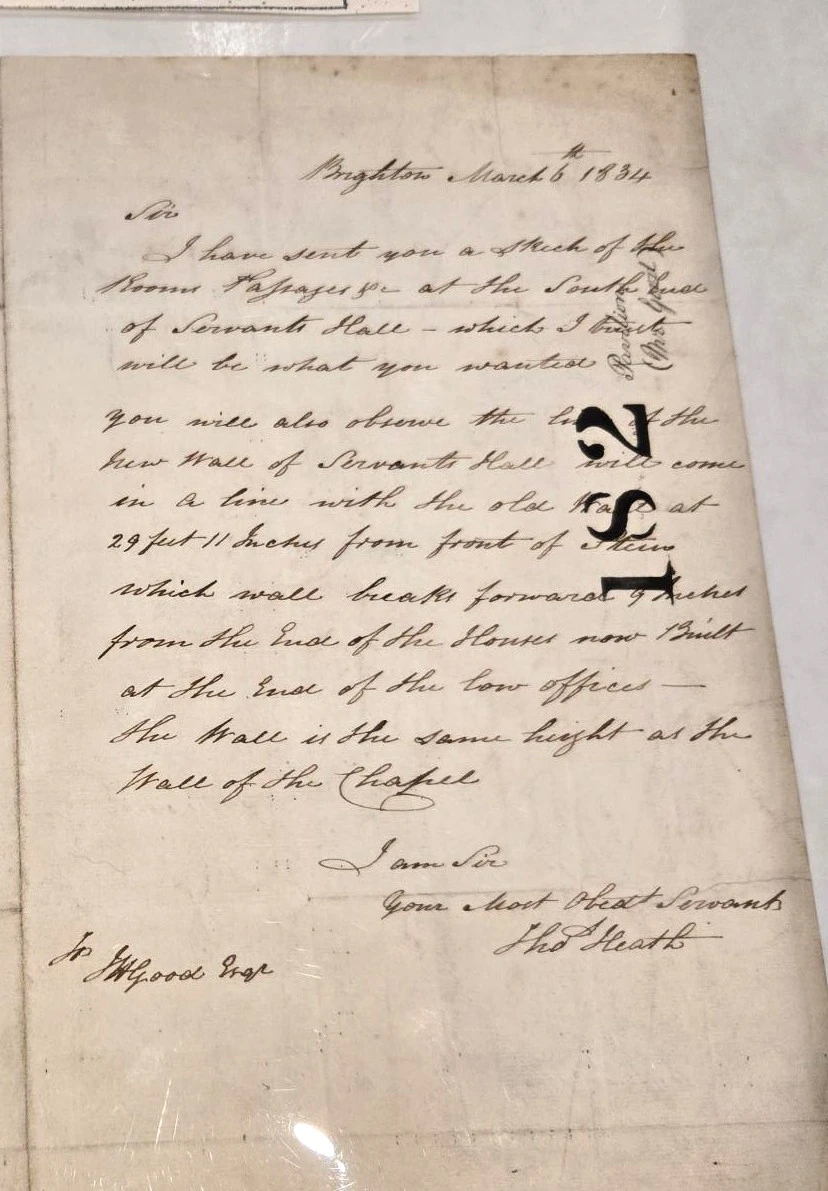
I have also found several examples where Good addressed significant infrastructural issues across the entirety of the Royal Pavilion Estate, including the Brighton Dome. His work was fundamental in preserving key areas of the Pavilion for years to come. Joseph Henry Good worked very closely with King William IV and Queen Adelaide to continue developing the Royal Pavilion, and address these concerns.
I wanted to write this piece as a testament to Mr Good, but to also provide a snapshot into his fundamental role at the Royal Pavilion. What better way to do this then through his original plans.
The Royal Pavilion archives contain over 200 plans. These range from plans for dormitories, to stables, to servant’s halls, to proposed building plans and more. They span from 1827 to 1837. Good’s proposed plans are extremely special due to their sheer scope, detail and meticulous reimagination of the estate in general along with secondary buildings.
Photographed is a correspondence written by Thomas Heath to Joseph Henry Good on the 6 March 1834 – in this correspondence Heath writes
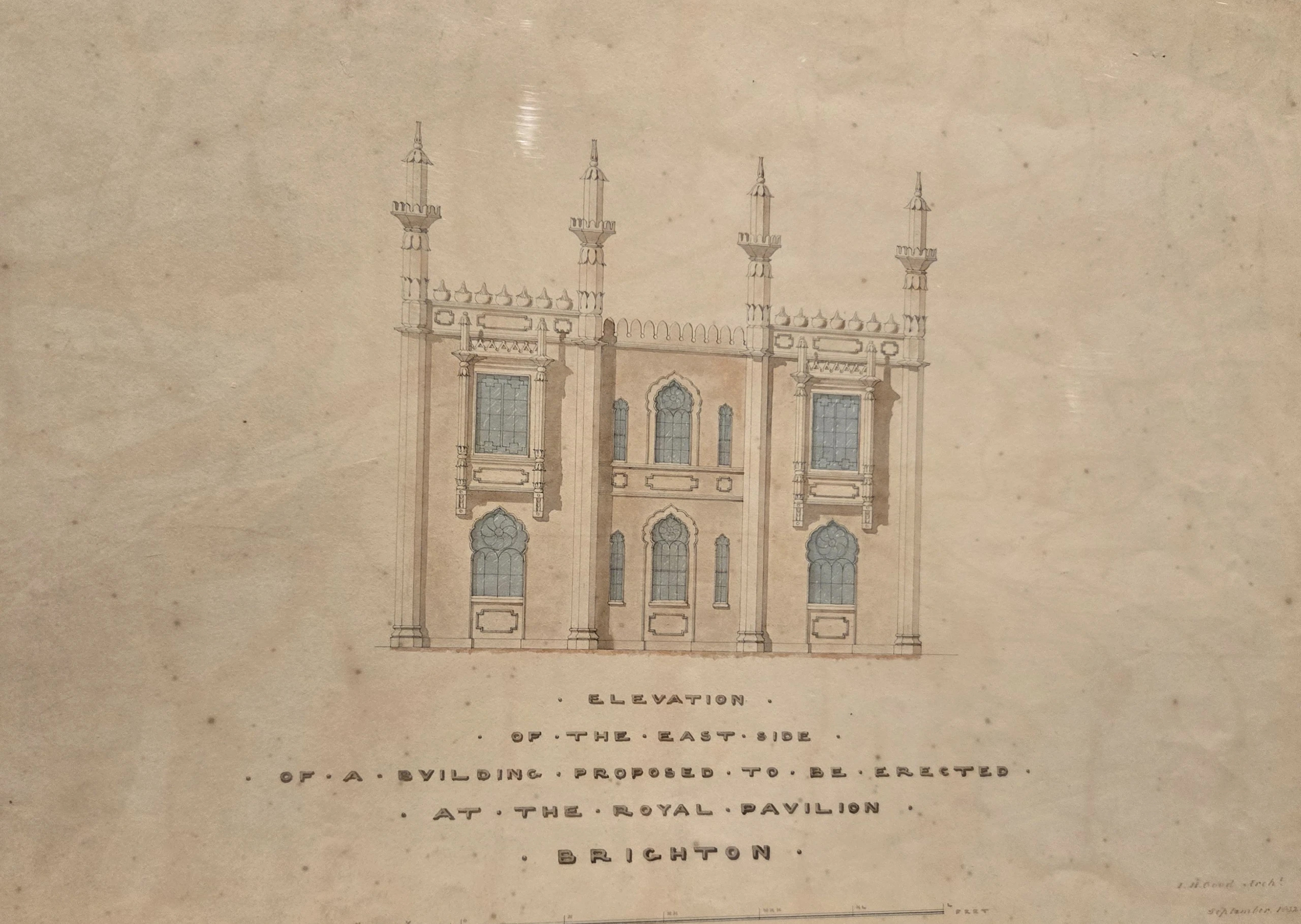
We have several plans related to the servant’s hall and dormitories to be built in the South Lodge. Mr Good wanted to transform the lodge into functional residences and areas, where servants, maids, footmen and other staff could work and live, as a dedicated space of sorts.
I also want to highlight the mention of the chapel, in reference to the Pavilion Chapel. This was actually demolished in 1851 with the organ moved to the Royal Pavilion Music Room, following the sale of the Royal Pavilion to the Brighton Town Commissioners.
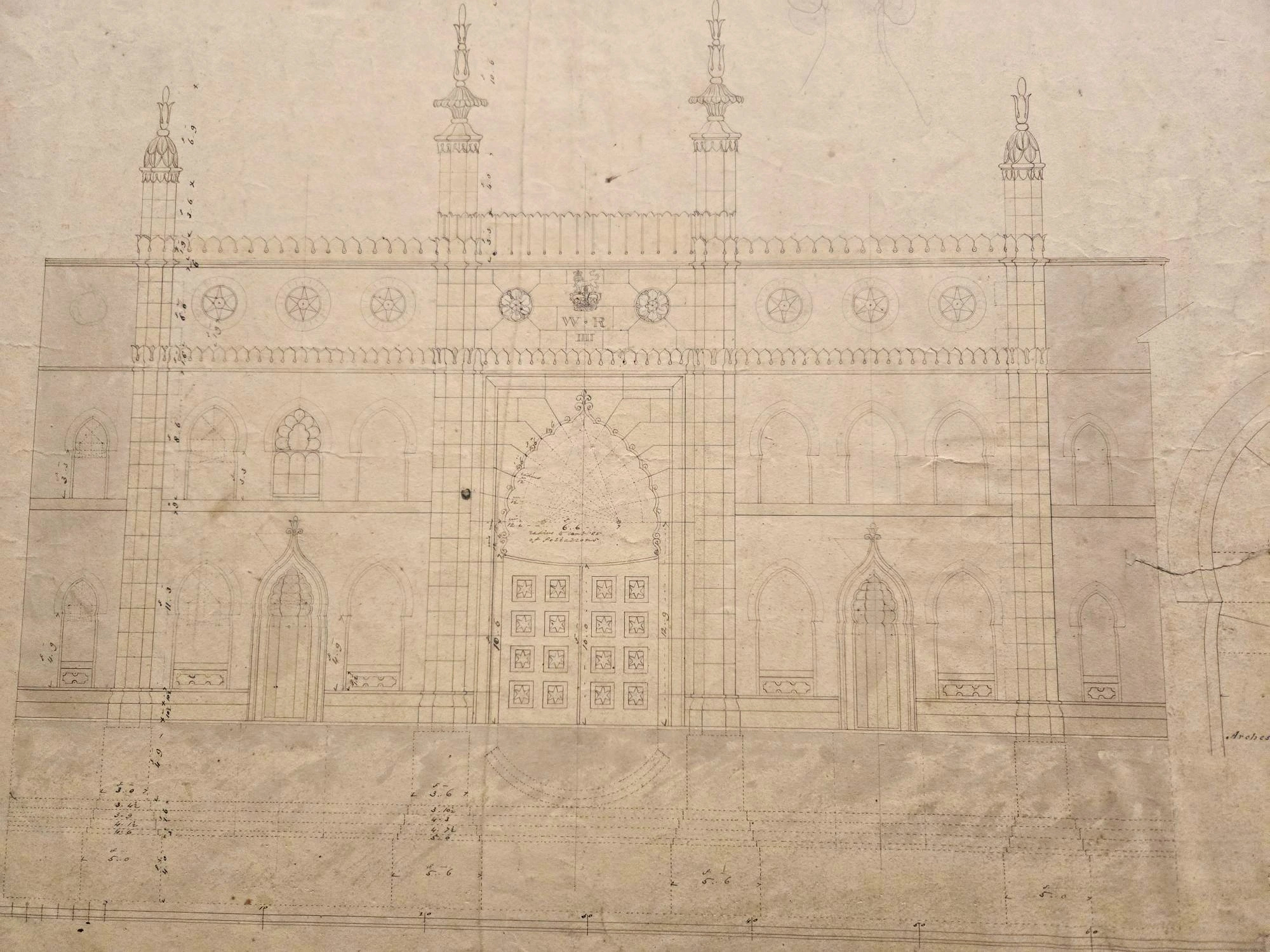
Plans of the South Gateway to the Royal Pavilion demonstrate an area of the Royal Pavilion, which is no longer in existence. But it can be evidenced through architectural plans, drawings and paintings. The South Gateway was designed by Good for King William IV in 1831 and essentially was one of Good’s initial ventures to mark the transition from one monarch to another.
In many ways, it showcased Good’s talents of incorporating Indo-Saracenic architectural elements of the Royal Pavilion to build upon the legacy of John Nash.
The Brighton Herald depicted its cost to be £3,437 and described it as:
I do find this quote quite interesting as the plans portray developments or proposed alterations to be made to increase the functionality of the South Gateway. I had assumed developments were being made to the areas occupied by servants, workers and footman (which the plans do reflect), however with the mention of “His Majesty’s guests,” one can only imagine how this would have reflected in the internal decorative scheme.
In the case of North Gate House, the Royal Pavilion archives have original fragments of wallpaper, which were stripped from the interiors of North Gate. Thematically they reflect more of a home as opposed to the elaborate furnishings of the Royal Pavilion.
I found Alexandra’s blog post Ch-ch-ch-changes: the South Gate of the Royal Pavilion through the ages interesting in demonstrating how the transitional changes of the plans, showcase the transitions the South Gateway had gone through before ultimately being removed.
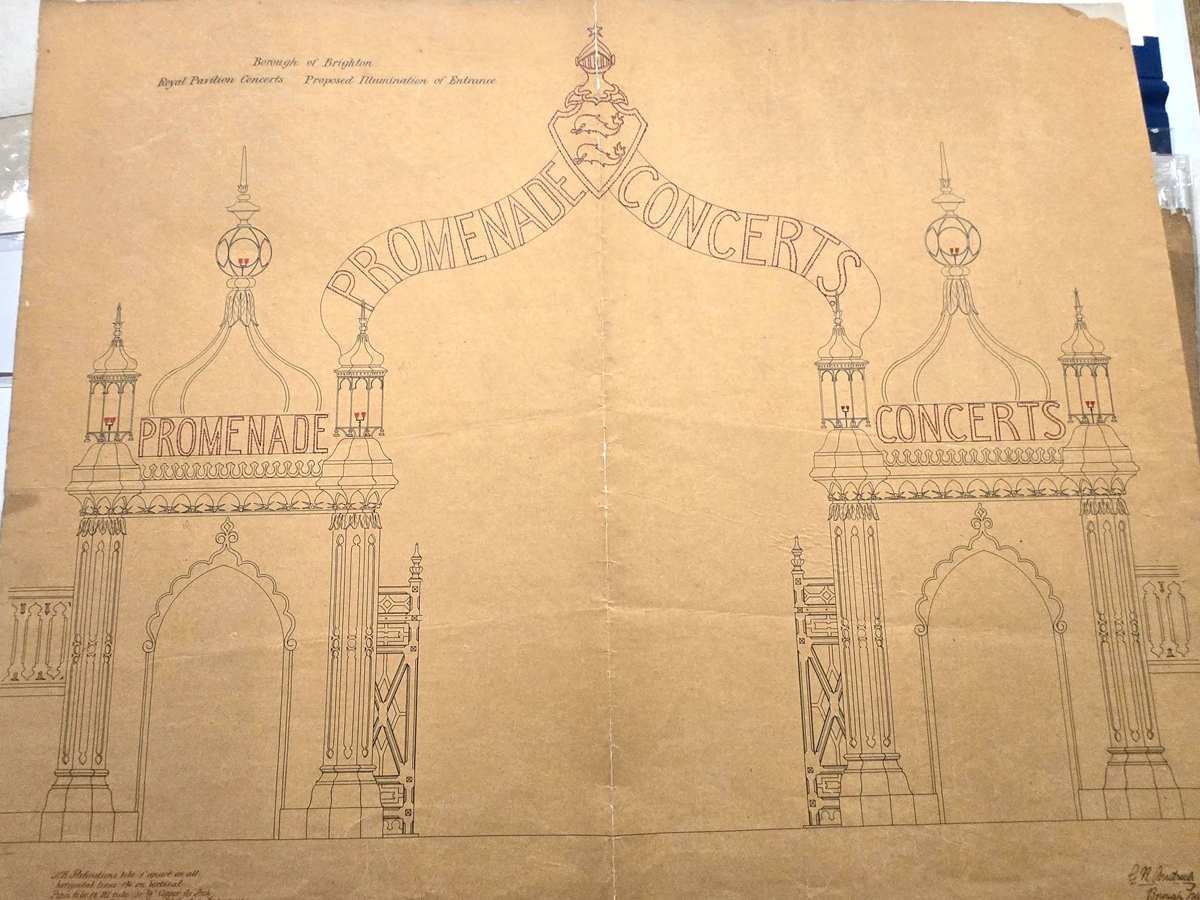
I have included two photographs – one of a proposed plan for the South Gateway in 1830, the second is a proposed alteration to the South Gateway in 1880. In 1850, the Royal Pavilion was sold to the Brighton Town Commissioners. The South Lodge, which boasted of over 2 storeys, was demolished to leave what we see in the drawing, a smaller scale structure. This drawing was entitled “Proposed Illumination of South Gateway”. The inscription reads “Promenade Concerts” which certainly leaves our imagination with thoughts of the Royal Pavilion Gardens being a welcoming environment for musical concerts to be held.
Contextually, this was the last plan that I catalogued recalling the South Gateway, and it is very telling of the discussions which would have occurred at that time.
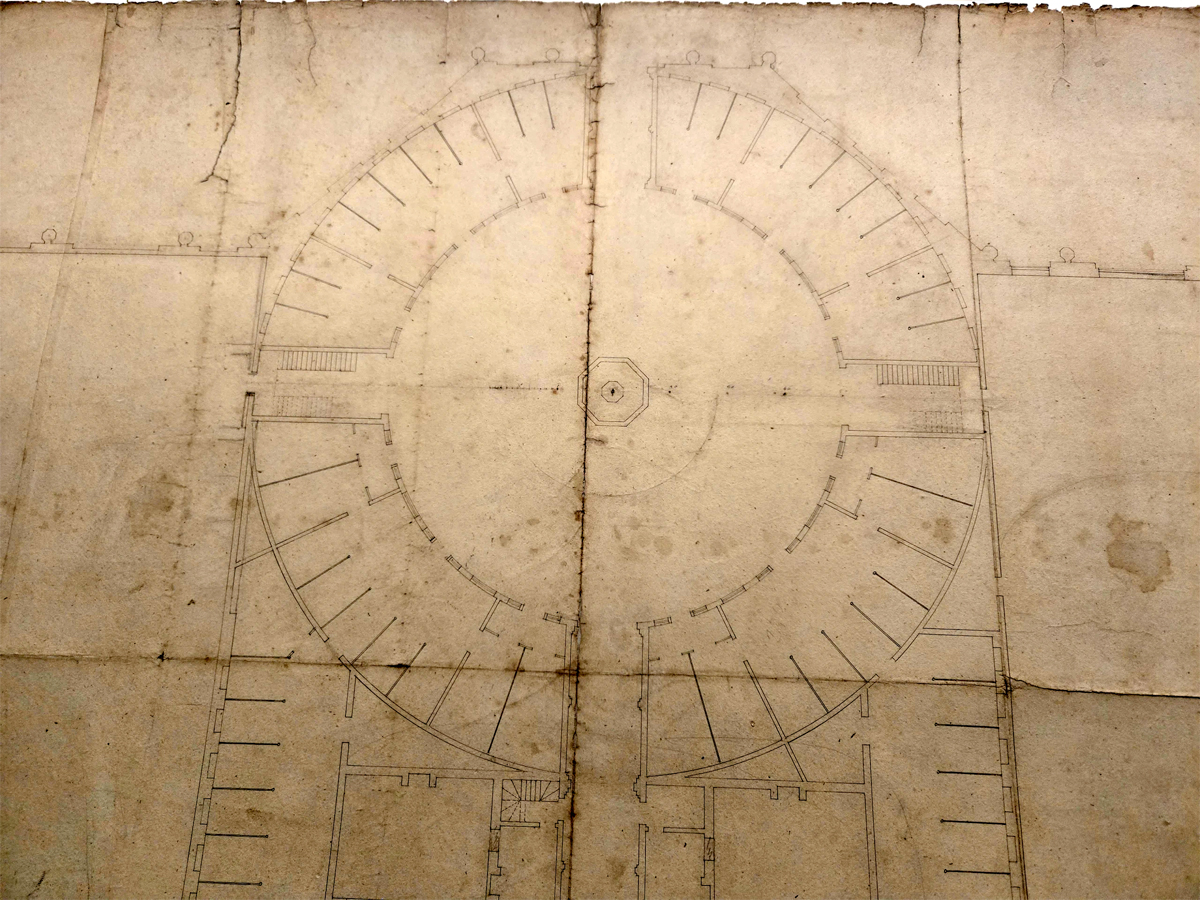
Joseph Henry Good performed essential maintenance to the Royal Pavilion stables. Architectural plans showcase various alterations and modifications along with additions. In the 1830s, William IV commissioned Good to develop the stables, at this point it contained 29 standings for horses, 6 coach houses, kitchens, farriery, with bedrooms and lofts.
In a letter written by Good to Sir William Knighton (who had raised the issue four years earlier) on the 27 of May 1827 (extract below) illustrates how the use of mastic as an adhesive was proving detrimental. He had to cover the mastic with copper. In another extract he describes that a coppersmith was employed to apply copper coverings to the turrets over the Grand Dining Room (referring to the Banqueting Room) and the Music Room. He goes on to explain that “the plasterer” is chipping away at repairing mastic when necessary. The timing is quite interesting, as this was following the late King George IV’s very last visit to the Royal Pavilion.
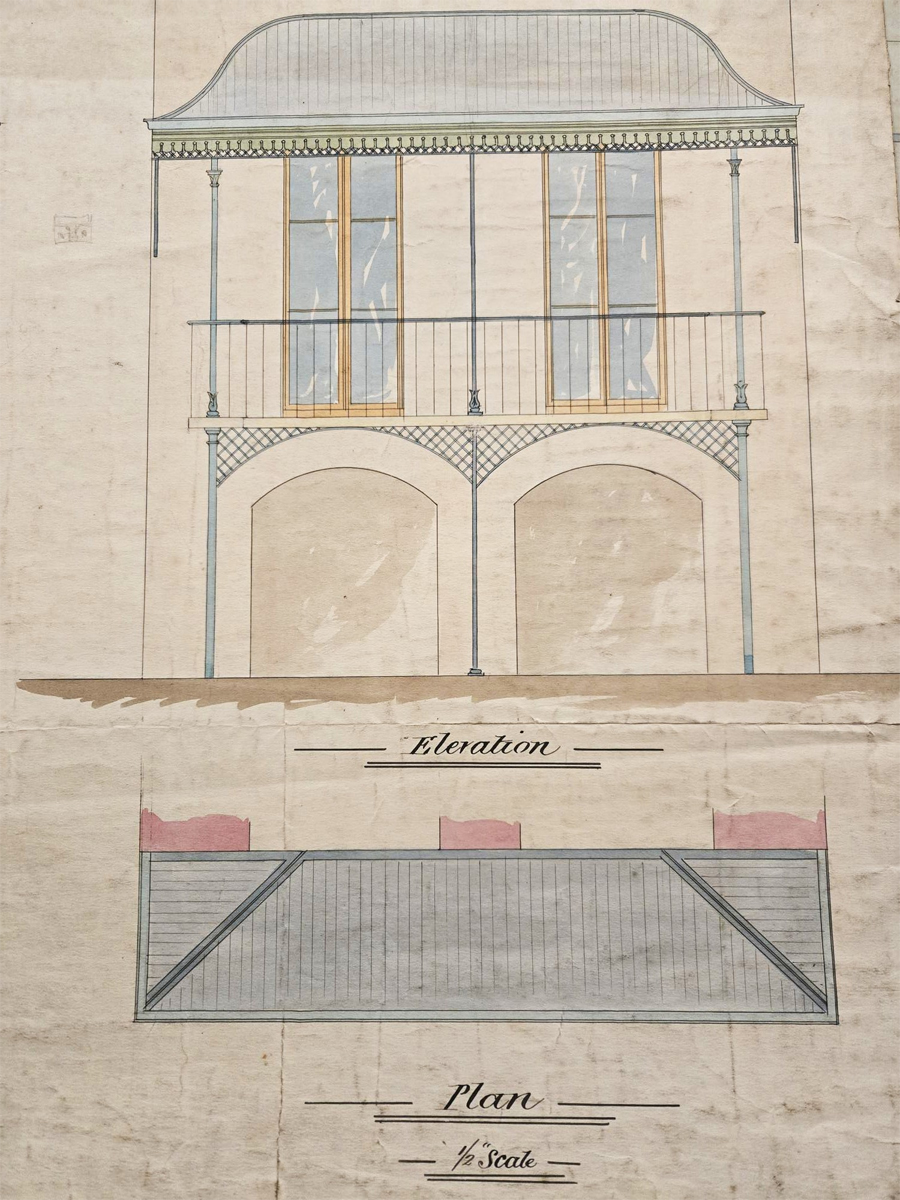
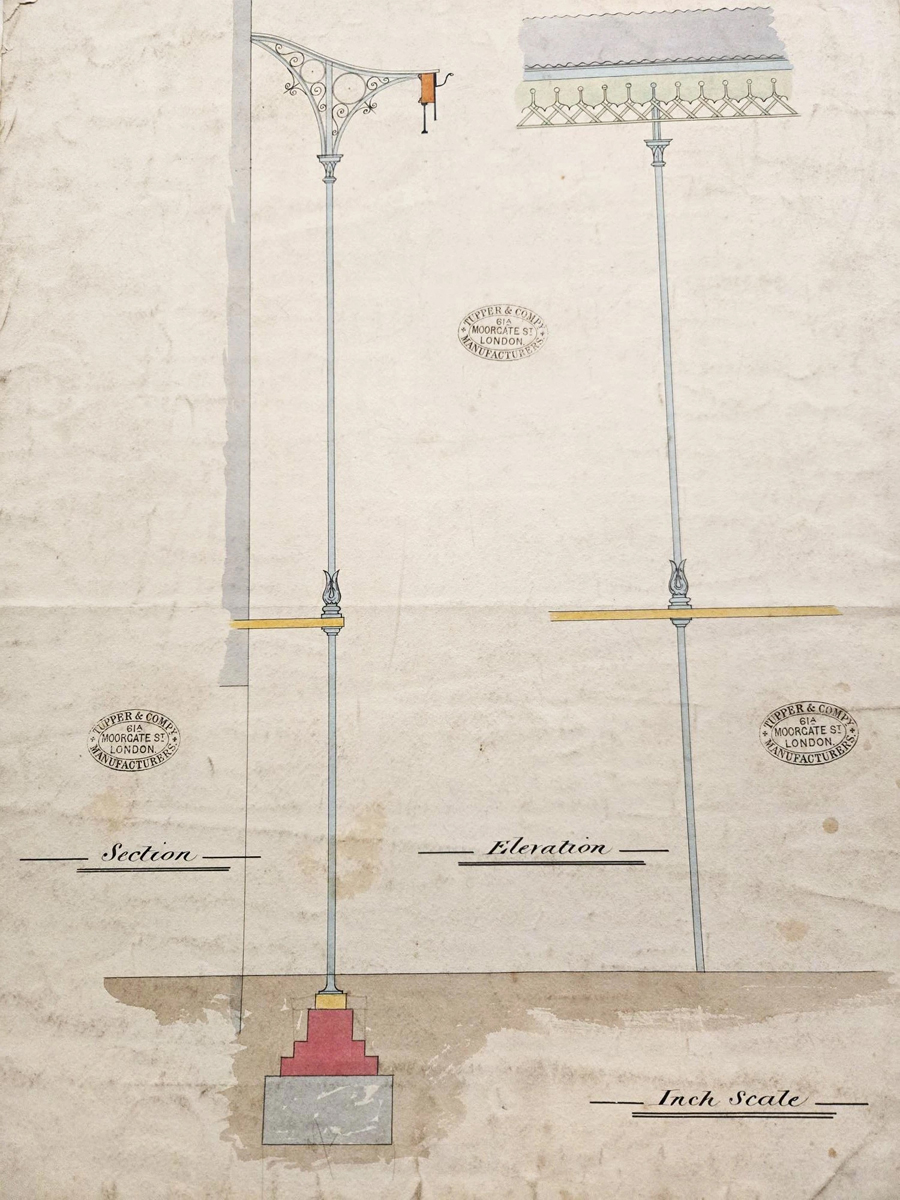
Over the course of cataloguing the Good architectural plans, I became quite curious as to how Good was regarded by future architects. There weren’t many informative pieces available. I read that his architectural style was described at times as almost “fantastical in approach” with his plans ranging from a central pool with a stage for an orchestra, an orangery, an aviary and hot houses.
Although, the plans I have physically interacted with do not document any designs for an orangery or a central pool, they do document plans for a verandah. It would have been overlooking the Royal Pavilion Gardens to create a merging of the Pavilion leading into the gardens. Although, there are only two plans of this proposed verandah, I find myself imagining what this might have looked like had his plans been bought to fruition.
Good embraced the Royal Pavilion Garden and certainly wanted to develop guests’ experiences whilst visiting.
In reflection, cataloguing Joseph Henry Good’s architectural plans was a reminder that when there is little to no contextual information available, there lies a learning experience. What initially struck me was that Good was not a well-known individual, and we have very few examples of his existing works. His designs and his work were simply not visible for us to see and appreciate. Therefore his huge contributions have slipped under the radar or are simply not known.
However, these plans themselves exist as a voice to his inner mind, his thoughts and visions for the Royal Pavilion and tell us his story.

It has been recorded that Mr Goods involvement with the Royal Pavilion commenced in 1827. This is according to Henry Roberts (1870-1951), the first Director of the Royal Pavilion Estate in his narrative Royal Pavilion, Brighton.
However, Mr Good was very likely involved with the supervision of the underground passage installed in 1822. It travels from the Royal Pavilion into the former Prince Regents stables. Roberts puts forward an interesting piece of information, which explains that although the tunnel was initiated by John Nash, his tie to the Royal Pavilion had been severed “by Michaelmas in 1822.” Therefore there may have been an overlap between Good and John Nash.
For anyone interested in accessing Joseph Henry Good’s architectural plans, they have now been made accessible via The Keeps database.
The next time someone passes North Gate, I certainly hope that Mr Joseph Henry Good comes to mind!