Fire and Water: Dreaming of Dragons – in Sussex and around the world
This year we introduced a family-friendly Dragon theme to the visitor route of the Royal Pavilion. To complement this, Alexandra Loske curated an exhibition in the Prince Regent Gallery. Fire and Water: Dreaming of Dragons, draws on Brighton & Hove’s extensive collections. It reveals how dragons have captured people’s imagination in European and Asian cultures, and what makes the Pavilion’s dragons special.
Alexandra recently presented the story of Brighton’s very own dragon species at the Sussex Retold: Sounds, Sites, Stories conference (19 June 2026) at the University of Sussex, which brought together artists, story-tellers, scholars, land-workers and policy-makers to share work and ideas about the diversity of Sussex heritage and how it can inform the future.

The interiors of the Royal Pavilion [Fig. 1] were designed to transport visitors to the King of England to an imagined Chinese world. This was an international fashion in the 18th century, called Chinoiserie. Here, on the edge of England, inside the Pavilion, in the early 19th century, this fascination with Asia, and Chinese culture in particular, found its most extreme and glorious expression.
Fire and Water: Dreaming of Dragons, shows the significance of dragons in the building and in the wider context of mythology [Fig.2]. My assumption had been that the concept of dragons was a dualistic one. A simple opposition of East and West, good and bad, benign and dangerous, airborne and waterborne. It is true that Asian dragons are predominantly associated with the sky, and govern the weather, while European dragons often emerge from lakes, caves, or murky waterholes – as indeed the Sussex ‘Knucker’ dragon does. But the story is not as simple as it seems.
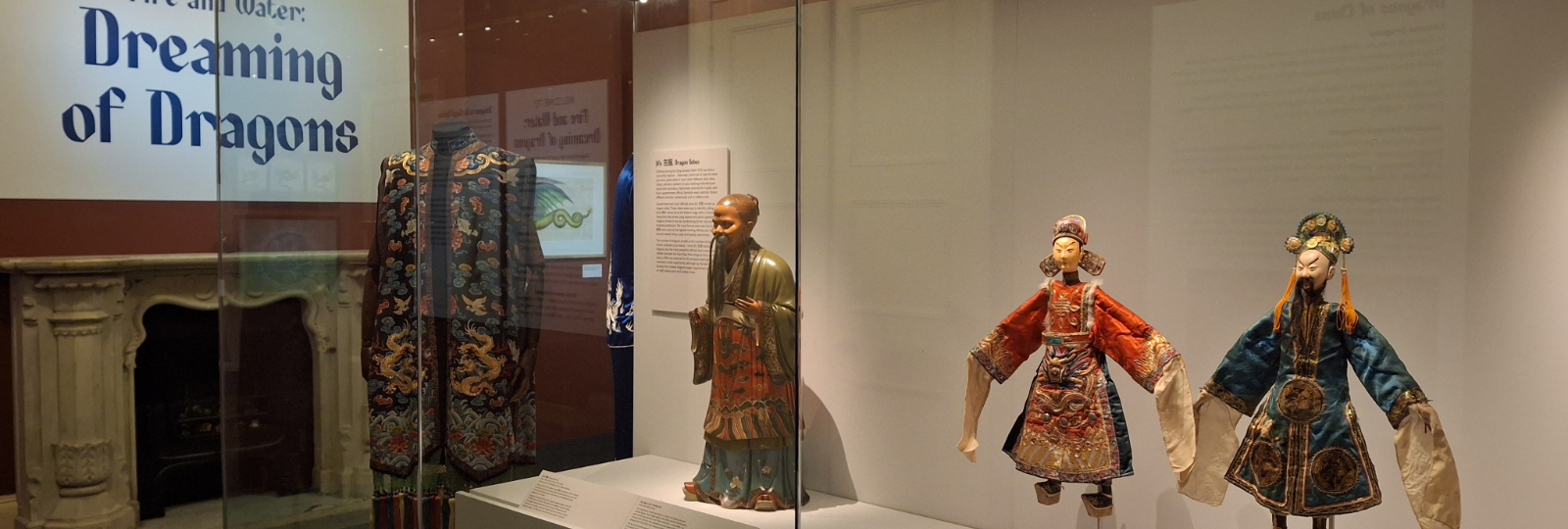

What I learned when preparing the exhibition was that the dragon is a unifying symbol globally. It has common features in many cultures, as well as highly individual ones that have been shape-shifting and blurring through time. In the context of Sussex, we may want to consider the Royal Pavilion flock of dragons a species specific to this county, a flight of the imagination of some early-19th-century British designers, a privileged future King, as well as artists and designers in China. The latter’s aim was to supply Europeans with dragons they thought might appeal to them. With a few exceptions, all the Pavilion dragons were made by Europeans that had never been to China.
Dragons are one of the dominant motifs in the Royal Pavilion, present in almost every room, in many shapes and forms, always decorative. There are both two-dimensional and three-dimensional dragons in the Pavilion [Fig. 3].
Some are simplified motifs of a larger design pattern; others hang precariously from ceilings, or perch on overdoors. Many are half-hidden and are only noticed if one looks carefully. For this exhibition, I tried to highlight the complex relationship between Chinese symbolism, Chinese export art, and the irreverent, decorative Western Chinoiserie style, which often incorporated the former. The Prince Regent (later King George IV), his decorators and guests were probably not familiar with the complex symbolic meanings of dragons in Chinese culture. But it is possible that they knew that the creature was a powerful symbol that was associated with the Emperor.
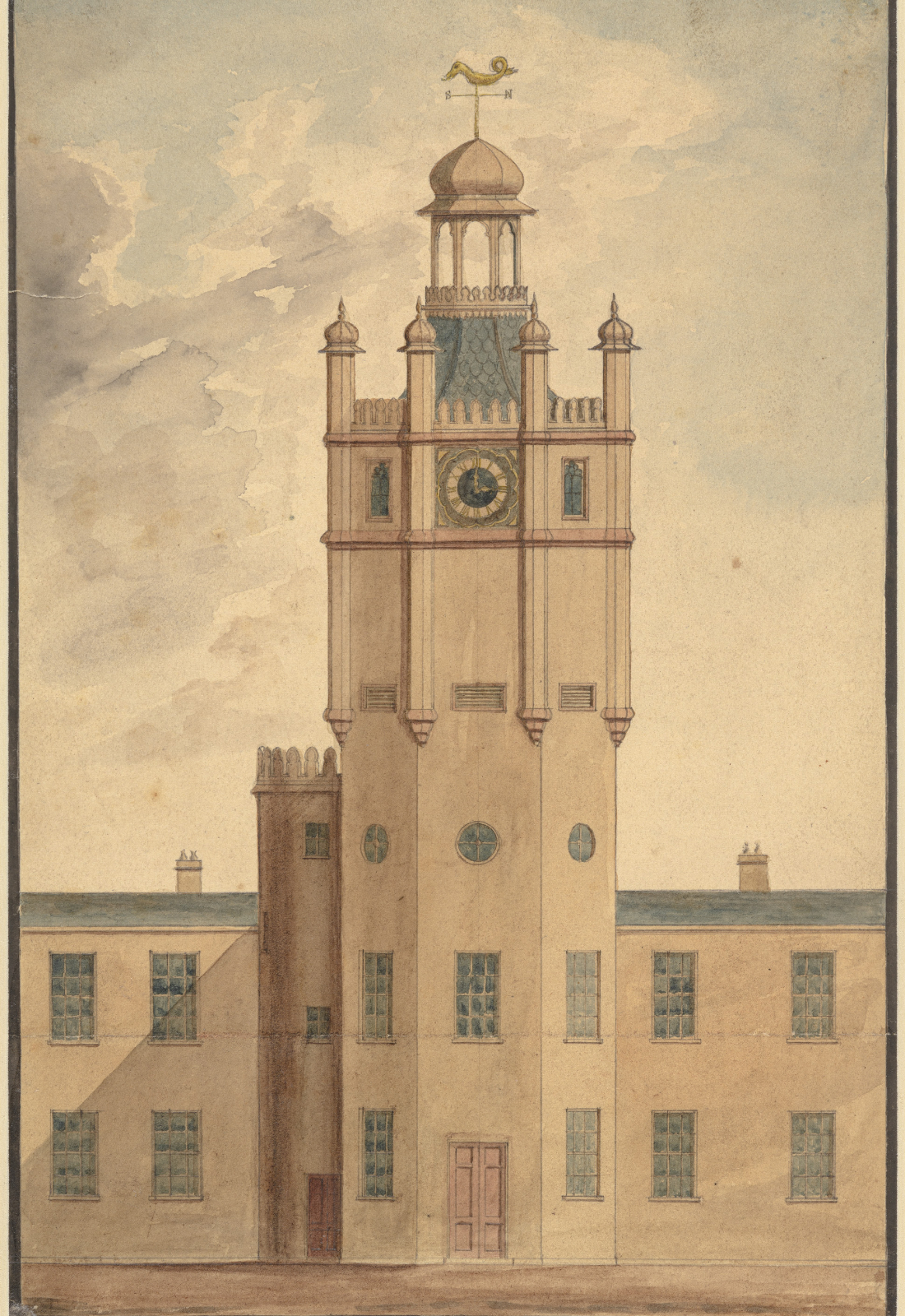
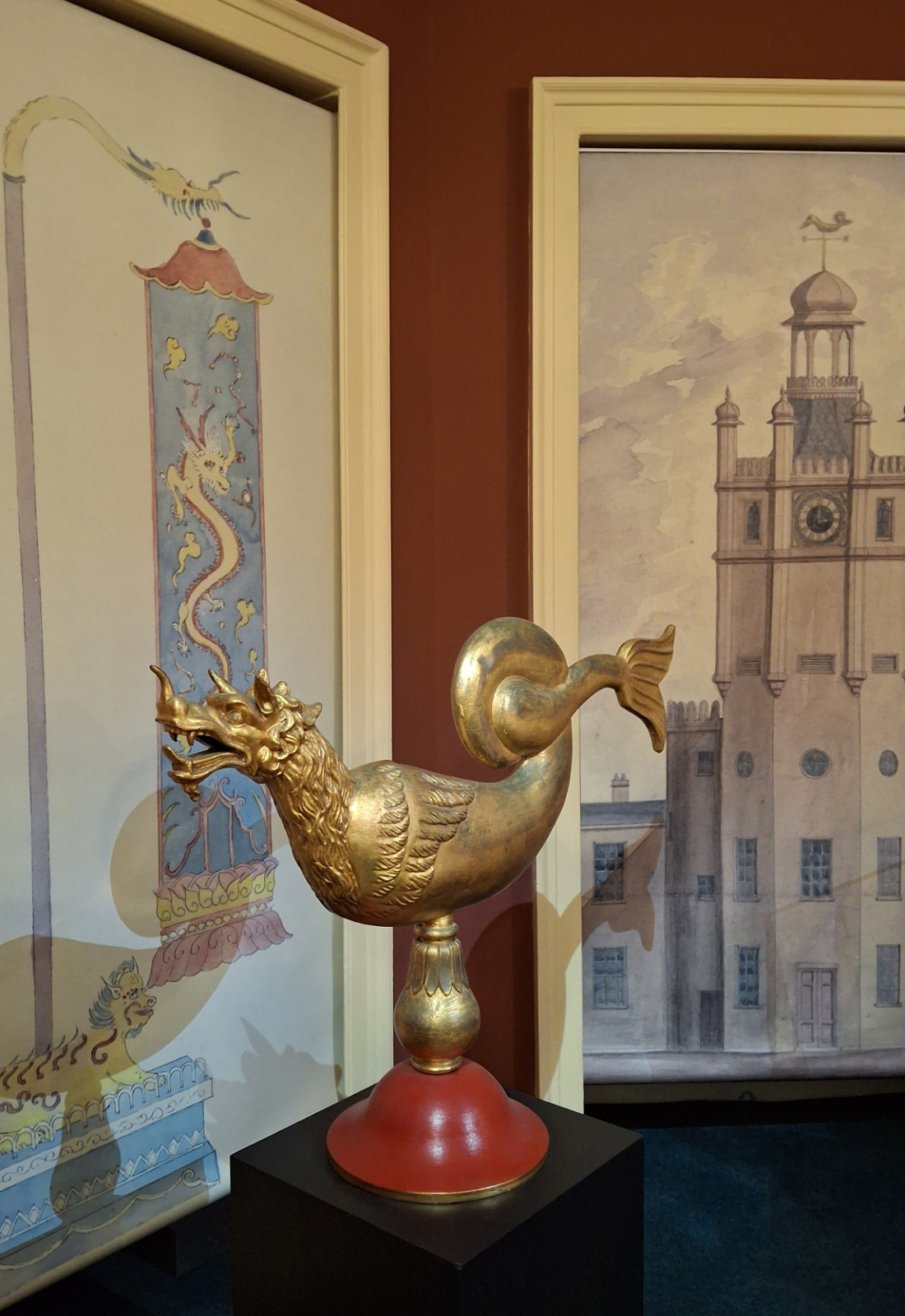
The first dragon a visitor to the Royal Pavilion would have seen in the 1820s was on the outside of the building. It was in the shape of a gilt-copper weathervane – possibly designed by the architect John Nash – on top of a clock tower at the south end [Fig. 4]. This was demolished in the late 19th century, but the dragon survives and is included in the exhibition [Fig. 5]. It was the Pavilion’s only true democratic dragon: being in an elevated position on the outside, it would have been seen by anyone living in or visiting Brighton.
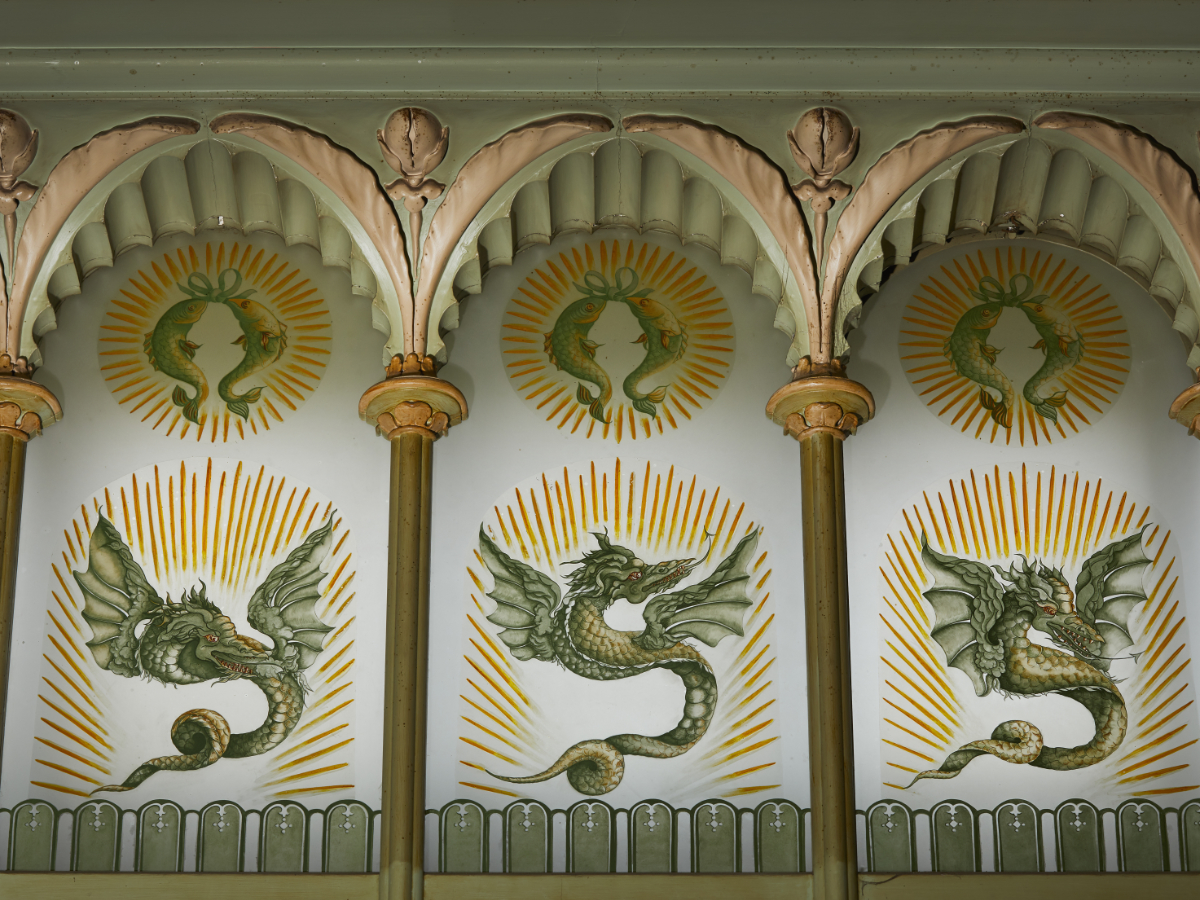
Inside, you were greeted in the Entrance Hall by an assembly of fish-like dragons painted on the clerestory windows [Fig. 6]. It was possibly inspired by the Chinese Yu-Lung, a type of water dragon with the head and fins of a giant fish. In the next room, the Long Gallery, a large skylight is painted with an image of Lei Shen, the God of Thunder, surrounded by drums and attendant dragons.
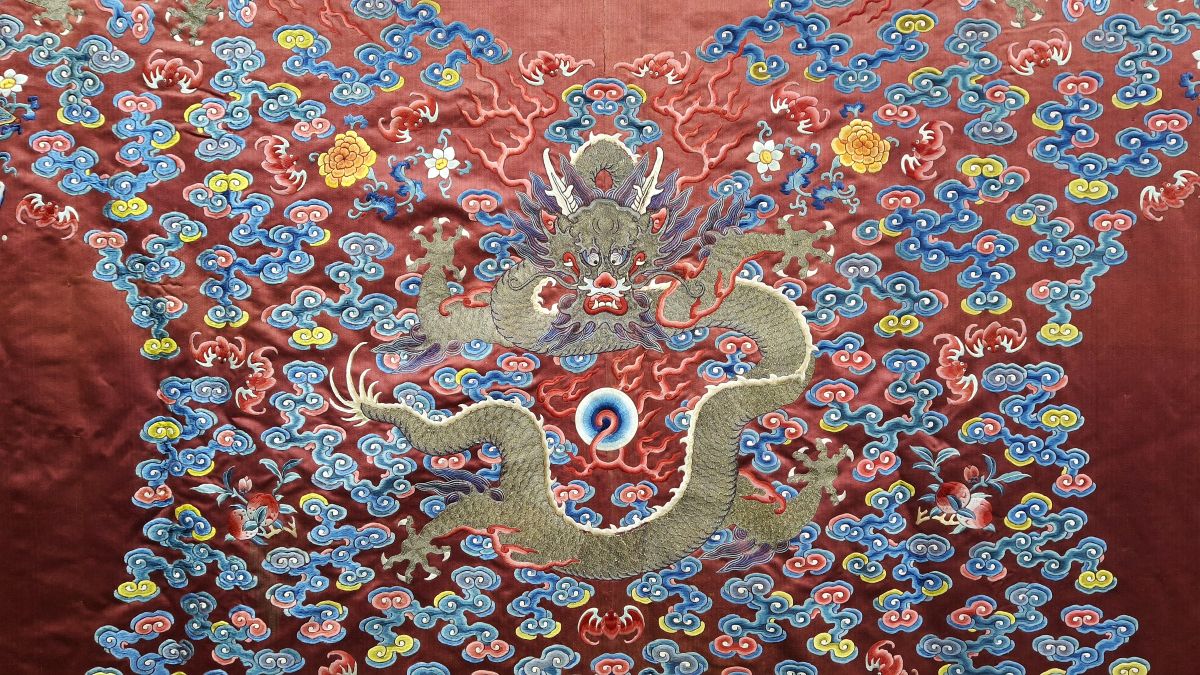
The most magnificent one and perhaps the best-known dragon object in Sussex is in the Banqueting Room, at the very centre of the ceiling [Fig. 7]. This dragon seems to be holding the extremely large and heavy chandelier in its claws. It is flying under a painted plantain tree and an open sky. Designed by the artist Robert Jones in c1817, it was carved from wood, then silvered and eventually glazed in different colours. The dragon is impressive but looks European rather than Chinese. It shows that Jones was more familiar with European mythology (likely Welsh dragons) than Chinese culture. There are more shimmering carved dragons in the Music Room. There, we find them over doors and mantelpieces, perched at the top of windows and curtains, or clinging to another magnificent chandelier. In several rooms we see the so-called ‘dragon paper’ on the walls, in deep red, green and a vibrant chrome yellow. Also designed by Robert Jones, the pattern was inspired by Chinese court robes. One of which, a ceremonial vest, called a xiape 霞帔, is included in the exhibition.
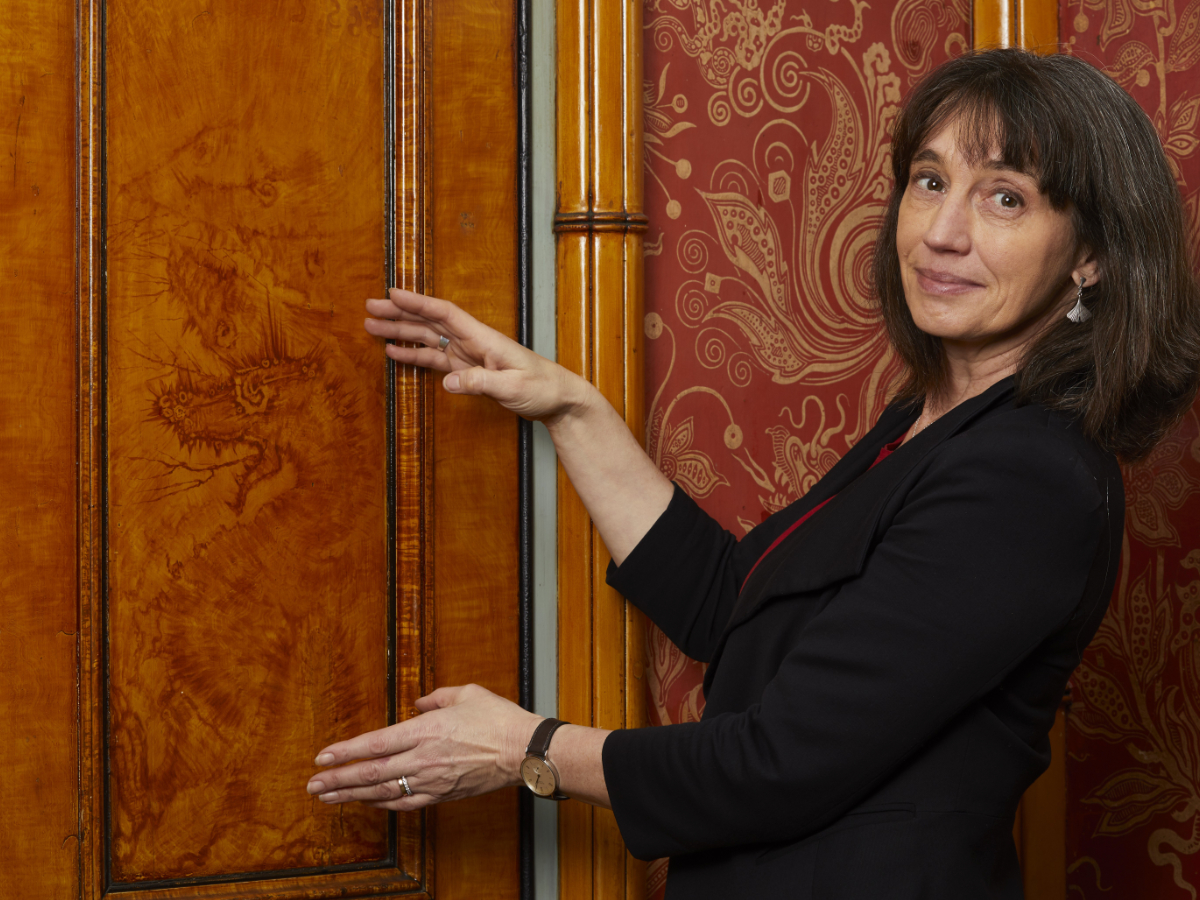
Among the more subtle dragons are those in the Red Drawing Room (not usually open to the public). They reveal themselves to visitors only when looking carefully. Small dragons and other creatures emerge from some surfaces. They are painted into the woodgrain effect of all doors and wood-panelled areas in that room, such as window casements, shutters, and skirting boards [Fig. 8]. One can imagine guests of George IV in the 1820s retiring to this room after a long evening of wining and dining, probably somewhat inebriated, and after a while seeing dragons ‘coming out of the woodwork’.


The Royal Pavilion interiors were designed to impress, overwhelm, entice, and bedazzle. Then and now it is hard to take in and remember all the detail on a visit. The gallery of dragons is at the end of the Pavilion’s visitor route. Together with my curator colleagues Portia Tremlett and Lucy Faithful, I was able to source a great selection of ceramics, design drawings [Fig. 9], textiles and other objects from the collections. But it was a challenge to tell the stories of the dragons the visitors had just seen on their walk through the building. I decided to spend a couple of hours with the photographer Tessa Hallmann to capture all the dragons whose stories I wanted to tell in the exhibition. The walls of the gallery are lined with these photographs, accompanied by short and accessible captions about them.
And why ‘Dreaming of Dragons’ as a title? In Chinese culture and history, Emperors were considered sons of dragons, forming a link between heaven and earth. A new Emperor was thought to see or dream of dragons when he ascends to the throne. This is a powerful concept. But I also thought that throughout history and across almost all cultures, humans have been imagining, believing in, and dreaming up dragons – good ones and bad ones. Here in Sussex, we have both the fearsome ‘Knuckers’ who emerge from ponds or wells and devour livestock, and the entirely benign, bewildering, and sometimes hilarious Chinoiserie dragons in the Royal Pavilion.
Fire and Water: Dreaming of Dragons will continue in the Prince Regent Gallery into 2027.
Discover more dragons
How to look at a Dragon Robe
